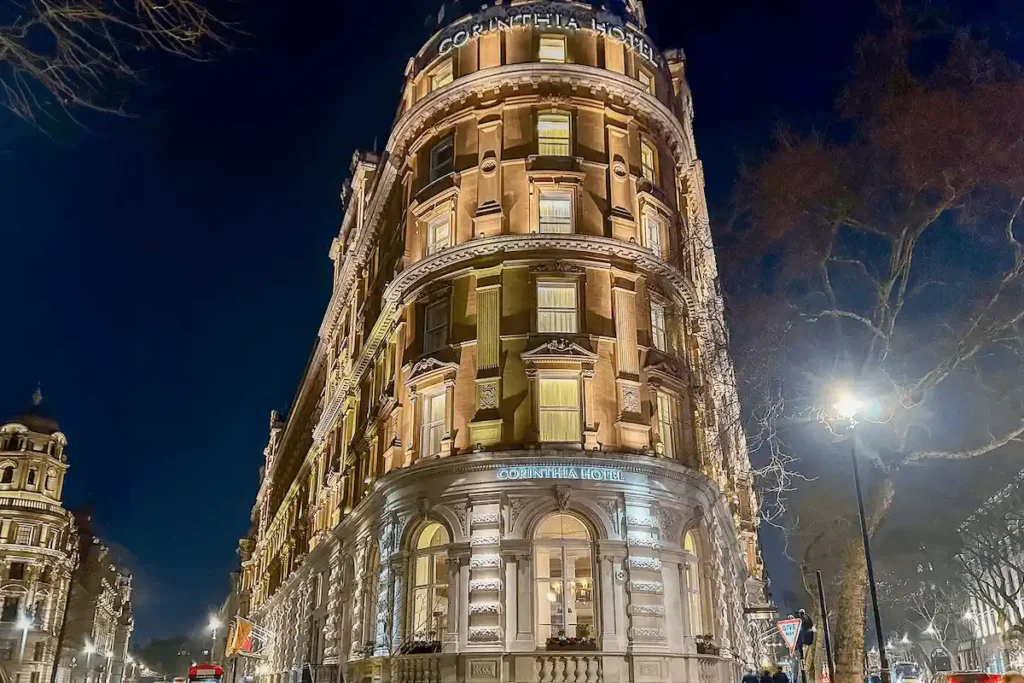
The Corinthia London occupies the 1885 Hôtel Métropole footprint—the Victorian era’s largest grand hotel—requisitioned in 1936 to serve as Ministry of Defence headquarters through the Falklands conflict. Following £300 million reconstruction, the French Renaissance façade now frames 294 suites where government intelligence officers once planned Operation Overlord.
The building’s Tudor wine cellar, moved 43 feet in concrete during wartime reconstruction, anchors a four-floor subterranean spa beneath rooms where MI9 founded Britain’s escape and evasion intelligence operations. This is verified empire architecture converted into residential command space. View the complete portfolio of best historic hotels in London.
Corinthia London ★★★★★
The Corinthia London presents 1885 imperial hospitality architecture transformed through documented military intelligence occupancy. The Ministry of Defence requisitioned the original Hôtel Métropole in 1936, converting Victorian reception halls into operational headquarters that directed the Falklands campaign. Room 424 served as MI9’s founding office—the military intelligence unit responsible for escape and evasion operations across occupied Europe. The building’s “UFO Desk” officially logged aerial phenomena sightings for the British government. These rooms housed the strategic command structure of an empire.
Corinthia London is a Victorian architectural marvel repurposed for modern luxury.
The 2011 resurrection retained the French Renaissance exterior while installing 465 m² penthouses with 180-degree Thames views where ministry officials once occupied utilitarian offices. The Royal Penthouse commands the seventh floor—the building’s original roofline expanded to accommodate panoramic river sight lines. Seven individually themed penthouses replace former government filing rooms.
The Crystal Moon Lounge centers on a 1,001-crystal Baccarat chandelier featuring a single red signature crystal. This is documented imperial real estate repurposed for private residential occupation.
The building’s foundation preserves Henry VIII’s brick-vaulted wine cellar from the original Palace of Whitehall. During 1940s Ministry expansion, engineers encased the entire 1,000-tonne Tudor structure in concrete and relocated it 43 feet to preserve the heritage asset.
This 16th-century royal storage vault now anchors ESPA Life at Corinthia—3,300 m² across four subterranean floors featuring a silver-steel swimming pool and amphitheatre sauna built directly above Tudor brickwork. The Thermal Floor occupies space where Whitehall Palace wine reserves once aged beneath government offices.
Kerridge’s Bar & Grill operates in the restored 1885 oval dining room, where meat-aging fridges line walls that once hosted Victorian society dinners. The Northall maintains classical British cooking beneath the building’s original towering windows—the same architectural openings that illuminated Ministry desks during the Cold War.
Salvatore Calabrese’s Velvet bar occupies the 1920s-inspired cocktail space, while the Music Room ballroom has been restored to 1885 specifications for film premieres and fashion events. Beth Cullen-Kerridge’s golden “empty suit” bronze integrates into restaurant design where empire administrators once held strategic sessions.
The Garden Lounge terrace features an outdoor fire and bespoke cigar humidor where military intelligence officers once occupied concrete balconies. Each amenity maps directly onto the building’s verified Victorian-to-Ministry architectural evolution.
The accommodation experience layers 1885 hospitality infrastructure, decades of government occupation, and Tudor royal foundations into unified residential command space. This is empire authority architecture available for private inhabitation.
Check Availability & Rates →The Corinthia London converts 1885 Victorian empire hospitality and 75 years of Ministry intelligence headquarters into residential occupation. Guests inhabit rooms where MI9 planned wartime operations, above Henry VIII’s relocated wine cellar, within French Renaissance façades that once directed an empire’s strategic command structure.
FAQ: Corinthia London
What is the historical significance of Corinthia London?
Originally opened in 1885 as the Hôtel Métropole, one of Victorian London’s largest grand hotels, it was requisitioned by the government in 1936 to serve as Ministry of Defence headquarters through the Falklands conflict. Room 424 housed the founding office of MI9 military intelligence, and the building played a critical role in planning Operation Overlord during WWII.
What is Henry VIII’s wine cellar and where is it located?
A Tudor brick-vaulted wine cellar from the original Palace of Whitehall sits beneath Corinthia London. During 1940s Ministry of Defence construction, the entire 1,000-tonne structure was encased in concrete and moved 43 feet to preserve it. The cellar now anchors the hotel’s four-floor ESPA spa.
What makes the Royal Penthouse unique?
At 465 m² (5,000 sq ft), the Royal Penthouse offers 180-degree panoramic views of the Thames and London Eye. It occupies the seventh-floor roofline of the former Ministry of Defence building, converted from utilitarian government offices into one of seven individually themed luxury penthouses.
What dining experiences are housed in Corinthia London?
Kerridge’s Bar & Grill occupies the restored 1885 oval dining room, while the signature restaurant Mezzogiorno (formerly The Northall) features a grand, high-ceilinged hall. The Garden offers an al fresco dining retreat, the Crystal Moon Lounge serves afternoon tea beneath a Baccarat chandelier, and Velvet operates as a 1920s-inspired cocktail bar.
Victorian Empire Converted to Residential Command
The Corinthia London transforms 136 years of verified architectural authority—from 1885 Victorian hospitality empire through 75 years of Ministry intelligence operations—into modern residential occupation. The building’s documented evolution from grand hotel to government headquarters to luxury accommodation preserves Tudor foundations, French Renaissance façades, and wartime operational rooms within unified prestige infrastructure.
Explore similar heritage command properties at Rosewood London and The Lanesborough London.
For more curated itineraries and luxury-focused travel insights, visit Your Luxury Guide. For official travel information and destination updates, visit Britain tourism-info.
Your Luxury Guide — Where Exceptional Travel Begins.