Corinthia Budapest operates from the Grand Hotel Royal, commissioned in 1896 to mark Hungary’s millennium with a technological dominance no European property could match. Architect Rezső Ray delivered French Renaissance grandeur on the Grand Boulevard, creating the structure that would later inspire The Grand Budapest Hotel. The Lumière brothers chose this building for Hungary’s first motion picture screening, establishing a cinematic legacy that persists through its six-story atriums and 15-meter Royal Spa.
For travelers prioritizing verified historical command in Central Europe, explore our curated collection of the best historic hotels in Budapest.
Corinthia Budapest ★★★★★
The Corinthia Budapest operates from a structure designed to announce Hungary’s arrival as a European power. Rezső Ray’s 1896 commission produced the Grand Hotel Royal—not merely a luxury hotel, but the most technologically advanced hospitality structure on the continent. Electric lighting throughout all 438 rooms. Hydraulic elevators serving six floors. Central heating systems engineered to standards that wouldn’t become industry-standard for another decade.
The building opened as a direct challenge to Vienna and Paris, positioned on Erzsébet körút where the Grand Boulevard intersects with UNESCO-listed Andrássy Avenue.
Corinthia Budapest is one of Europe’s most legendary “Grand Hotels,” a meticulously restored 19th-century masterpiece that served as the inspiration for Wes Anderson’s The Grand Budapest Hotel and remains the pinnacle of Hungarian luxury.
The Lumière brothers recognized this immediately. When they sought a venue for Hungary’s first motion picture screening in 1896, they selected the Grand Hotel Royal specifically for its scale and modernity. That screening established the building’s permanent association with European cinema—a legacy the property maintains through its documented role as the visual and thematic blueprint for Wes Anderson’s The Grand Budapest Hotel.
The pink-hued facade, the soaring atriums, the marble staircases that connect six floors of public spaces—these aren’t aesthetic choices, they’re architectural evidence of the property’s historical dominance.
The $100 million restoration completed in 2003 preserved this authority while integrating contemporary luxury infrastructure. The six-story atrium remains the structural centerpiece, but now channels light through spaces equipped with fiber-optic connectivity and climate systems that maintain museum-grade environmental control.
The 438 rooms include 31 luxury suites and several “Royal Residences” designed for extended occupancy by guests who require private butler service, dedicated workspace, and the security infrastructure that comes with bulletproof glass installations.
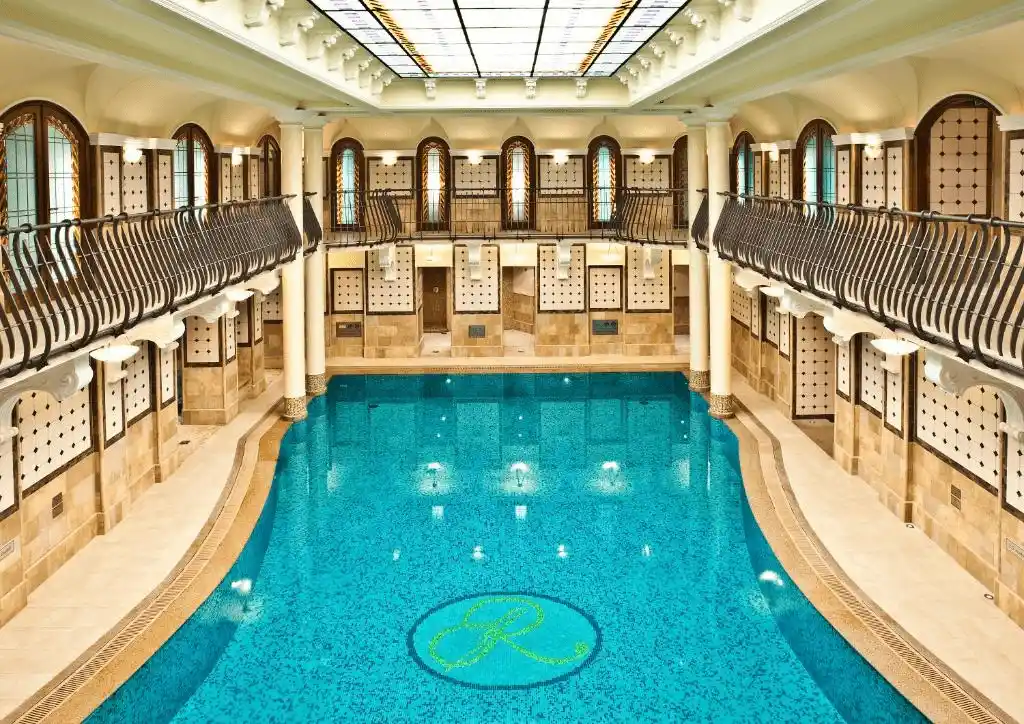
The Royal Spa represents the property’s most significant historical asset. This is not a modern wellness center retrofitted into a heritage building—it’s an authentic 1886 Art Deco bathhouse that predates the hotel itself. The 15-meter swimming pool operates beneath soaring ceilings and intricate stained-glass windows that have survived two world wars. Multiple saunas, steam baths, and treatment rooms now utilize ESPA products, but the spatial experience remains unchanged from when Hungarian aristocracy used these same facilities to conduct private negotiations away from public scrutiny.
The Presidential Suite occupies one of Central Europe’s largest luxury accommodations. Original antiques document the building’s unbroken lineage of elite occupancy. The dedicated butler service operates with the same discretion that served European nobility during the property’s first century. Front-row opera tickets, private Danube yacht arrangements, securing closed museum viewings—these are standard requests handled by the property’s “Les Clefs d’Or” concierge team.
The Grand Ballroom continues to function as Budapest’s most prestigious event venue. Gold-leaf detailing and original frescoes frame state banquets and diplomatic receptions that require the authority only a documented 1896 landmark can provide.
The Brasserie & Atrium and Rickshaw restaurants operate within spaces that have hosted a century of power negotiations, now serving contemporary European and Far Eastern cuisine to guests who understand that location, architectural heritage, and documented historical significance create value no new construction can replicate.
Check Availability & Rates →The Grand Hotel Royal opened as proof that Budapest commanded resources and architectural vision equal to any European capital—the Corinthia Budapest preserves that authority through 438 rooms where guests don’t visit history, they occupy the physical spaces where European power concentrated for 128 years.
FAQ: Corinthia Budapest
What makes Corinthia Budapest historically significant?
Corinthia Budapest operates from the 1896 Grand Hotel Royal, commissioned for Hungary’s millennium as Europe’s most technologically advanced hotel. The Lumière brothers held Hungary’s first motion picture screening here in 1896, and the property served as the documented architectural inspiration for The Grand Budapest Hotel. The building represents French Renaissance design at its peak, featuring a six-story atrium, original marble staircases, and the Royal Spa—an authentic 1886 Art Deco bathhouse with a 15-meter pool beneath stained-glass ceilings.
What distinguishes the Royal Spa at Corinthia Budapest?
The Royal Spa is an authentic 1886 Art Deco bathhouse that predates the hotel, featuring a 15-meter swimming pool beneath soaring ceilings with intricate stained-glass windows. The facility includes multiple saunas, steam baths, and treatment rooms using ESPA products, maintaining the same spatial configuration Hungarian aristocracy used for private meetings. This is historical infrastructure preserved and upgraded, not a modern wellness center built in heritage aesthetics.
Where is Corinthia Budapest located in the city?
The property occupies a landmark position on Erzsébet körút, part of Budapest’s Grand Boulevard, within walking distance of the Hungarian State Opera and UNESCO-listed Andrássy Avenue. This location placed the hotel at the center of late 19th-century European power networks and maintains that strategic advantage for modern travelers requiring proximity to Budapest’s diplomatic, cultural, and financial districts.
What room categories are available at Corinthia Budapest?
The hotel offers 438 rooms including 31 luxury suites and several “Royal Residences” designed for extended high-end stays. The Presidential Suite ranks among Central Europe’s largest luxury accommodations, featuring dedicated butler service, original antiques, and bulletproof glass. All rooms reflect the $100 million restoration that preserved architectural heritage while integrating contemporary luxury infrastructure including fiber-optic connectivity and museum-grade environmental controls.
Historical Authority Secured Through 128 Years of Documented Dominance
The Corinthia Budapest operates from a structure purpose-built to establish Hungary’s position among European powers—an objective it achieved through verifiable technological superiority in 1896 and maintains through continuous elite occupancy across three centuries.
Guests seeking comparable historical command in Budapest’s luxury hotel sector should evaluate the Four Seasons Gresham Palace Budapest and Anantara New York Palace Budapest, properties that similarly translate architectural heritage into modern competitive advantage through documented provenance and preserved spatial authority.
For more curated itineraries and luxury-focused travel insights, visit Your Luxury Guide. For official travel information and destination updates, visit Hungary tourism-info.
Your Luxury Guide — Where Exceptional Travel Begins.