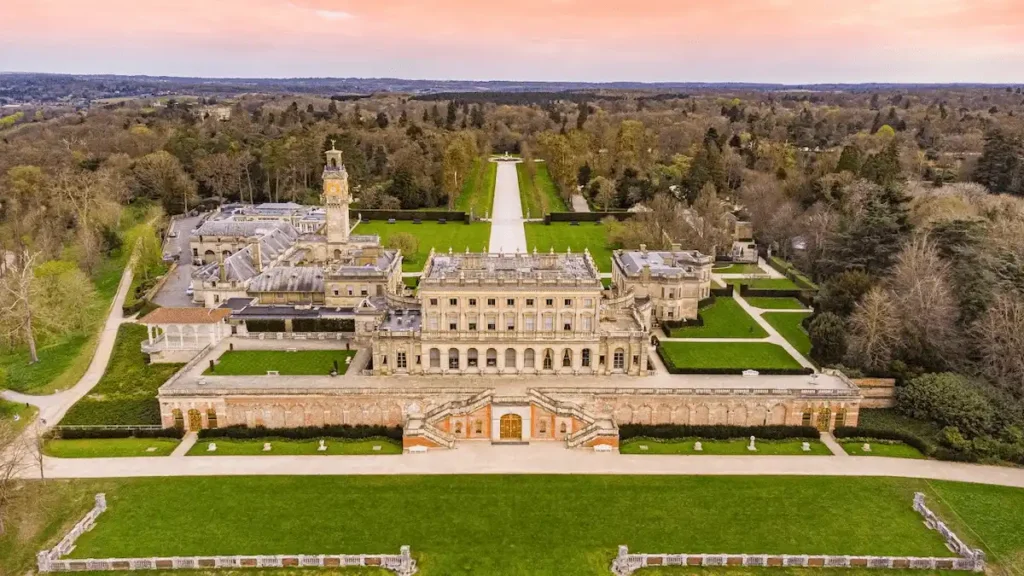
Cliveden House stands 200 feet above the Thames, commanding 376 acres that have hosted three centuries of British authority—from dukes to prime ministers to the Astor political dynasty. The estate’s physical scale mirrors its historical influence: formal gardens designed by royal landscapers, State Rooms where Churchill debated policy, and bedchambers where the course of nations shifted during weekend gatherings. This is not decorative history.
Every corridor, every terrace, every suite reflects the deliberate architecture of power.
Cliveden House ★★★★★
The estate’s dominance begins with geography. Positioned on a chalk cliff overlooking a strategic Thames bend, Cliveden was engineered for territorial command—a seat where England’s elite could survey their domain while negotiating the nation’s direction in absolute privacy. The current mansion, commissioned in 1851 by the Duke of Sutherland (Britain’s wealthiest landowner), replaced two previous houses destroyed by fire, each rebuilt larger and more imposing than its predecessor. This is inherited authority made tangible.
When William Waldorf Astor acquired Cliveden in 1893, he transformed it into the era’s ultimate power residence. His daughter-in-law, Nancy Astor—Britain’s first female MP—elevated the estate to a political command center. The “Cliveden Set” gathered here: cabinet ministers, newspaper magnates, diplomats conducting Britain’s interwar strategy across dining tables and in paneled libraries designed for consequential conversation.
Today’s 38 suites and rooms occupy the spaces where that authority operated. The Spring Cottage suite—formerly Nancy Astor’s private retreat—features the original 1850s plasterwork and direct terrace access to the Italianate parterre gardens below. The Sutherland Suite spans 850 square feet with 14-foot ceilings and Thames views framed by floor-to-ceiling windows the Duke specified for maximum light and territorial surveillance. These are not themed accommodations. You inhabit the actual chambers where British power resided.
The Great Hall serves as the estate’s architectural spine: 60 feet long, two stories high, with a carved stone fireplace large enough to stand inside. Rococo plasterwork covers the ceiling—allegories of the seasons commissioned when decoration signaled dynastic permanence. The adjoining State Dining Room seats twenty beneath crystal chandeliers, its proportions calculated for the formal dinners where Astor guests shaped policy between courses.
The estate’s 376 acres extend Cliveden’s authority beyond the mansion. The Water Garden—designed by architect William Winde in 1666—follows geometric precision that mirrors Versailles’ territorial logic. The Amphitheatre, carved into the hillside in 1893, provided Astor with a 500-seat outdoor venue for entertaining on a sovereign scale. Every path, every sightline was engineered to demonstrate control over landscape and society.
The Cliveden Spa occupies the estate’s former indoor tennis pavilion—a vaulted 1893 space converted into treatment rooms and a thermal pool where light filters through original arched windows. This is legacy infrastructure repurposed for modern sovereignty over time itself: massages scheduled between formal afternoon tea in the mansion and evening cocktails in the French Dining Room.
Check Availability & Rates →The 400-foot terrace serves as a limestone platform for three centuries of political orchestration, from the Duke of Buckingham to the Cliveden Set. To walk these parterre gardens is to trace the exact grounds where the British elite brokered international treaties and consolidated social dominance overlooking the Thames.
FAQ: Cliveden House
What makes Cliveden House historically significant?
Cliveden House served as the political nerve center for Britain’s interwar elite—the “Cliveden Set” led by Nancy Astor gathered here to shape national policy. The 1851 mansion replaced two earlier houses on the same commanding Thames cliff, cementing three centuries of aristocratic and political authority on this single strategic site.
Which rooms offer the most authentic historic experience?
The Sutherland Suite occupies the Duke of Sutherland’s original private apartments with 14-foot ceilings and Thames-facing windows. Spring Cottage preserves Nancy Astor’s personal retreat with 1850s architectural details intact. Both deliver unfiltered access to spaces where British power actually operated.
What distinguishes Cliveden’s grounds from other estates?
The 376-acre landscape was engineered for territorial display—geometric Water Gardens designed in 1666, a 500-seat Amphitheatre carved into the hillside, and formal parterres visible from State Room windows. Every sightline reinforces the estate’s command over the Thames Valley below.
Is Cliveden House suitable for contemporary luxury standards?
The estate pairs historic authority with modern utility—spa treatments in the converted 1893 tennis pavilion, Michelin-standard dining in original State Rooms, and suites equipped with climate control that preserves 19th-century plasterwork. You gain both legacy access and current-day sovereign comfort.
The Legacy Continues
Cliveden House translates three centuries of territorial command into a stay where history amplifies luxury rather than decorating it. The estate’s physical scale, documented political influence, and architectural precision establish a tier of accommodation reserved for those who understand the value of inhabiting genuine authority. From the Great Hall’s allegorical ceilings to the Thames terrace where Churchill walked, every detail confirms: this is where British power chose to reside.
For travelers seeking estates with comparable historic weight, Thornbury Castle and Ellenborough Park maintain similar standards of documented lineage and architectural sovereignty.
For more curated itineraries and luxury-focused travel insights, visit Your Luxury Guide. For official travel information and destination updates, visit Britain tourism-info.
Your Luxury Guide — Where Exceptional Travel Begins.