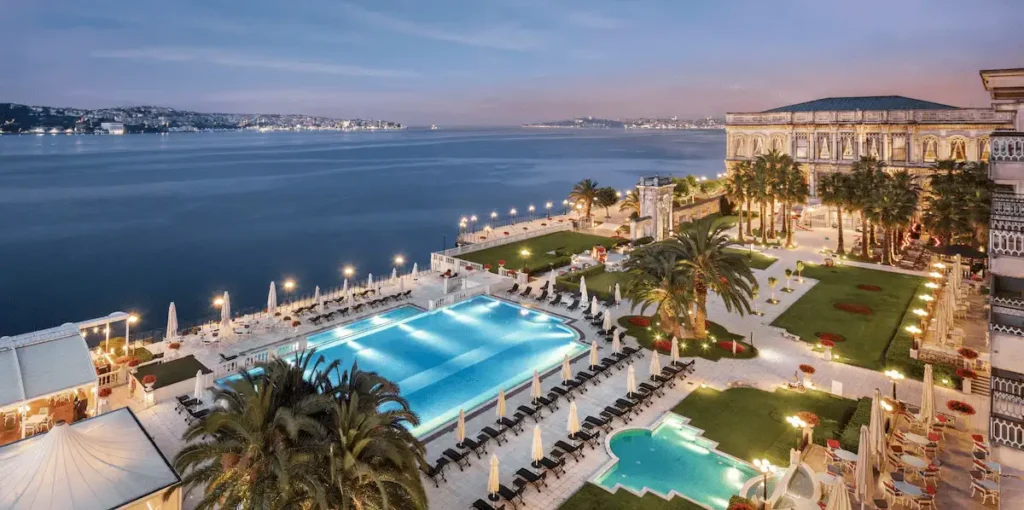
Çırağan Palace Kempinski Istanbul stands as the only Ottoman imperial palace on the Bosphorus where modern guests occupy the same quarters once reserved for sultans. Commissioned by Sultan Abdülaziz and completed in 1871 by the Balyan family—the Ottoman Empire’s dynastic court architects—this Neo-Moorish masterpiece was constructed using 2.5 million Ottoman gold coins.
Unlike Topkapı or Dolmabahçe, which function solely as museums, Çırağan remains a living seat of authority where the infrastructure of imperial command has been converted into the ultimate expression of contemporary luxury. Discover more elite properties in our guide to the best historic hotels on Bosphorus.
Çırağan Palace Kempinski Istanbul ★★★★★
The Çırağan Palace does not merely reference Ottoman power—it is Ottoman power. This is the sole imperial palace on the Bosphorus strait where guests do not tour behind velvet ropes but instead inhabit the architectural apparatus of 19th-century imperial command. Sultan Abdülaziz commissioned the palace in 1863 as a direct assertion of Ottoman supremacy during the empire’s final golden age, and he entrusted its construction to Nigoğayos Balyan and his son Sarkis—the Armenian architects who designed every major Ottoman palace of the era.
Çırağan Palace Kempinski Istanbul remains the only Ottoman imperial palace and hotel on the Bosphorus, offering a regal experience where guests can swim at the edge of the strait in a world-renowned heated infinity pool.
The name itself, Çırağan, derives from the Persian word for “light source,” a reference to the thousands of torches that once illuminated the facade during imperial celebrations visible across the Bosphorus. Construction consumed 2.5 million Ottoman gold coins—a sum that positioned the palace among the most expensive buildings ever erected in the empire.
The exterior presents severe Neoclassical discipline: white Proconnesian marble, rhythmic colonnades, geometric precision. But the interior abandons European restraint entirely. Balyan deployed a rare Neo-Moorish vocabulary—arabesques, calligraphic friezes, star-patterned vaults—that transformed the palace into a manifesto of Eastern luxury at a moment when Europe was dictating global aesthetic standards.
The palace served as the primary residence of Sultan Abdülaziz until his deposition in 1876, then briefly housed his successor Sultan Murad V during his constitutional reign. After Murad’s own removal, the palace became his gilded prison for 28 years until his death in 1904—a fact that adds a layer of tragic grandeur to its legacy. In 1910, a catastrophic fire reduced the structure to a shell. It remained a ruin on the Bosphorus waterfront until 1989, when Kempinski undertook one of the most ambitious palace restorations in modern Turkish history.
The 2023 redesign, led by Ottoman art historian and interior architect Serdar Gülgün, eliminated all generic five-star tropes. Gülgün reimagined the lobby as a 16th-century Ottoman reception hall, installing an octagonal central seating unit surrounded by hand-painted Iznik-style ceramics that reference Topkapı’s imperial tile work. The corridors throughout the hotel wing were reinterpreted as imperial tents—a nod to the campaign pavilions Ottoman sultans used during military expeditions. Striped wallpapers in jewel tones, custom brass lanterns, and geometric runners simulate the spatial experience of entering a vizier’s mobile command center.
The rooms themselves are exercises in spatial dominance. The Palace Suites occupy the original royal chambers, with 14-foot ceilings, hand-carved moldings, and floor-to-ceiling windows framing the Bosphorus. Every suite includes European antiques, silk carpets, and marble bathrooms with gold-plated Dornbracht fixtures. The Sultan Suite, covering 4,600 square feet across two levels, is among the world’s most expensive hotel accommodations. It features a private marble hammam, a grand piano, a billiard room, and 24/7 dedicated butler service. Guests arrive via private elevator and can request helicopter transfers directly to the palace’s exclusive helipad.
The infinity pool—heated year-round—runs parallel to the Bosphorus and creates the visual illusion of water merging with the strait. It is bordered by the palace’s original 19th-century gardens, where ancient plane trees and manicured parterres establish a buffer between the hotel and the city. The Gazebo, a neoclassical pavilion redesigned as an Ottoman garden room, serves high-society Afternoon Tea in four symmetrical seating areas that mirror imperial garden architecture. Le Fumoir, set within the gardens, operates as an ultra-exclusive bar offering rare single malts, aged cognacs, and a curated cigar collection stored in a walk-in humidor.
Çırağan Palace Kempinski has also developed proprietary scent branding with Atelier Rebul, Istanbul’s oldest perfumery. The signature fragrance—featuring notes of oud, amber, and Bosphorus mist—appears in all bath amenities and diffuses subtly through public spaces, creating olfactory continuity that reinforces the palace’s distinct identity.
Arrival options reflect the property’s tri-modal dominance: guests may arrive by limousine through the grand driveway, by private yacht via the Bosphorus dock, or by helicopter landing directly on the palace grounds. This logistical flexibility is not a marketing gimmick—it is the infrastructural expression of how Ottoman elites historically commanded space, land, sea, and air simultaneously.
Check Availability & Rates →Çırağan Palace does not interpret Ottoman imperial architecture—it preserves the exact spatial hierarchies, material luxuries, and ceremonial grandeur that defined the apex of 19th-century Eastern power, now converted into the only Bosphorus palace where the act of residence is available to those who recognize its significance.
FAQ: Çırağan Palace Kempinski Istanbul
What makes Çırağan Palace Kempinski unique among Istanbul hotels?
Çırağan Palace Kempinski is the only Ottoman imperial palace on the Bosphorus where guests can stay overnight in the original royal quarters. Built by Sultan Abdülaziz in 1871 using 2.5 million Ottoman gold coins, it remains a functioning palace rather than a museum, offering direct access to 19th-century imperial architecture and grounds.
Who designed Çırağan Palace?
The palace was designed and constructed by Nigoğayos Balyan and his son Sarkis Balyan, the Ottoman Empire’s official court architects who also designed Dolmabahçe Palace. The Balyan family shaped Ottoman imperial architecture throughout the 19th century, and Çırağan represents their mastery of Neo-Moorish interiors within Neoclassical stone structures.
What is included in the Sultan Suite at Çırağan Palace?
The Sultan Suite spans 4,600 square feet across two levels and includes a private marble hammam, gold-plated Dornbracht bathroom fixtures, a grand piano, a billiard room, dedicated 24/7 butler service, and a private elevator. Guests may also arrange helicopter arrivals via the palace’s exclusive helipad.
Can guests arrive by yacht at Çırağan Palace Kempinski?
Yes. Çırağan Palace maintains a private Bosphorus dock for yacht arrivals, alongside a helipad for helicopter transfers and a grand driveway for limousine access. This tri-modal arrival infrastructure reflects the historical command of land, sea, and air that defined Ottoman imperial mobility.
The Authority of Imperial Residence
Çırağan Palace Kempinski delivers what no other Istanbul property can: the legal right to inhabit an actual seat of Ottoman imperial power. This is not a hotel styled after a palace—it is the palace itself, preserved, restored, and operationalized for those who understand the difference between luxury accommodation and the occupation of historical command.
Travelers seeking parallel grandeur, explore the Four Seasons Hotel Istanbul at the Bosphorus.
For more curated itineraries and luxury-focused travel insights, visit Your Luxury Guide. For official travel information and destination updates, visit Turkey tourism-info.
Your Luxury Guide — Where Exceptional Travel Begins.