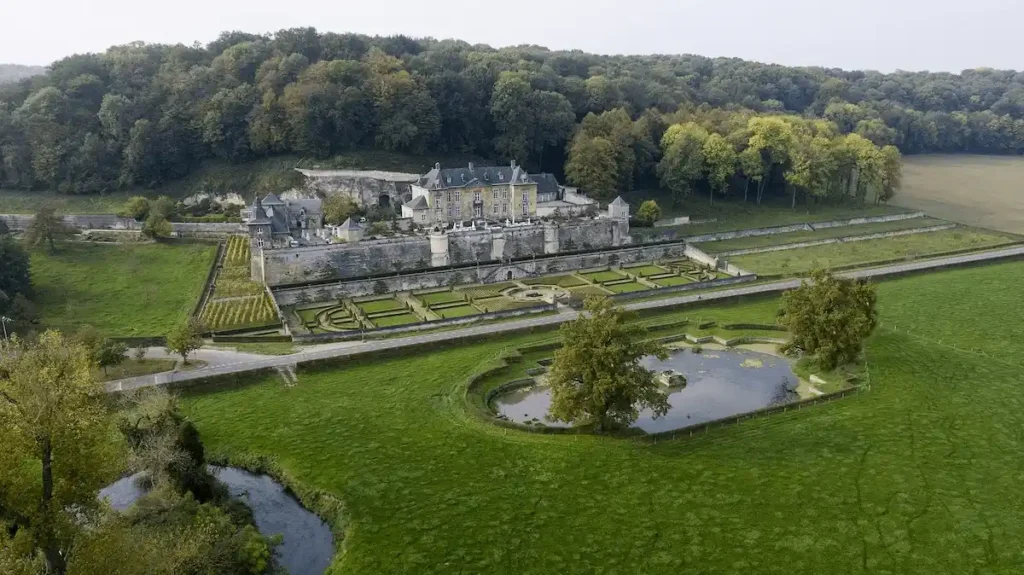
This is not a country manor adapted for tourism. Château Neercanne is the Netherlands’ only true castle hotel—a 1698 fortress built on the strategic high ground of Mount Saint Peter, where Maastricht Stone vaults stored the spoils of territorial dominance and baroque halls enforced social hierarchy.
Today’s guest inherits that command: the same defensive position that once controlled the Meuse Valley now frames a Michelin-starred estate where historic cellars hold vintages from the château’s own vineyards.
This is power geography made tangible—explore the Netherlands’ most commanding castle hotels.
Château Neercanne ★★★★★
The fortress rises from Maastricht’s southern border—a deliberate choice of elevation that placed its original owners above the merchant routes and military movements below. Built in 1698 by the Huijssen van Kattendijke family, Château Neercanne was never a decorative estate. Its Maastricht Stone construction—the same marlstone that fortified the city’s defensive works—formed walls thick enough to withstand siege and climate, while its terraced vineyards signaled agricultural mastery over the steep slopes of Mount Saint Peter.
Château Neercanne converts this 17th-century marlstone fortification into a high-density overlook of ancestral and territorial command.
The château’s architectural authority is rooted in its baroque symmetry: the central corps de logis flanked by service wings that once housed stables, wine cellars, and servants’ quarters. The grand staircase—original oak with wrought-iron balustrades—ascends through three stories of frescoed reception rooms where 18th-century estate owners entertained Maastricht’s political and commercial elite. These were not social gatherings; they were exercises in territorial influence, held in halls designed to remind guests of the family’s command over both land and legacy.
Below the château, the marlstone caves extend deep into Mount Saint Peter—hand-carved vaults that stored wine at constant temperatures long before modern refrigeration. An engineering achievements that allowed the estate to maintain wine quality across centuries, establishing Neercanne as a viticultural authority in a region where few châteaux attempted serious production. Today’s guest tours the same cellars where barrels aged under the protection of meter-thick stone, the cool darkness preserving vintages that fueled the château’s social capital.
The dining experience operates within this historic infrastructure. The Michelin-starred restaurant occupies the original baroque dining hall, where 18th-century banquets once demonstrated the estate’s agricultural and culinary dominance. Chef’s menu draws directly from the château’s terraced gardens and vineyards—produce that travels meters, not kilometers, from soil to plate. This is not farm-to-table theater; it is the continuation of a 300-year supply chain where the estate controlled every input of its own prestige.
The suites occupy the upper floors of the main residence, each room preserving original architectural details—ceiling frescoes, oak-paneled walls, baroque fireplaces—while modern interventions remain invisible. Floor plans follow the traditional enfilade layout, where interconnected rooms once allowed hosts to control the flow of guests through hierarchical space. Today’s visitor experiences that same spatial command: private suites that open onto terraced views of the Jeker Valley, where the château’s elevated position remains its defining strategic advantage.
The grounds extend across 13 hectares of formal gardens and vineyard terraces, each level carved into the hillside to maximize sun exposure and drainage. The original garden design—attributed to French landscape architect Daniel Marot—follows baroque principles of geometric control: clipped hedges, gravel paths, and fountain courts that impose order on natural topography. Walking these grounds is not a pastoral escape; it is an encounter with 300 years of engineered landscape dominance.
Service here operates with the formality the architecture demands. Staff move through the château with the precision of a private household, anticipating needs without intrusion—a level of discretion that mirrors the original estate’s operational hierarchy. This is not hospitality as performance; it is the continuation of protocols developed when the château functioned as a working territorial seat.
Check Availability & Rates →To enter Château Neercanne is to occupy the highest ground—where baroque stone meets Michelin precision, and every terrace reinforces three centuries of command over the Jeker Valley’s most strategic elevation.
FAQ: Château Neercanne
What makes Château Neercanne historically significant?
Built in 1698 as a fortified estate on Mount Saint Peter’s strategic high ground, Château Neercanne is the Netherlands’ only true castle hotel—constructed with military-grade Maastricht Stone and featuring hand-carved marlstone wine cellars that demonstrate three centuries of viticultural engineering.
Does the château still produce wine?
Yes. The estate maintains active vineyard terraces on Mount Saint Peter’s slopes, continuing the château’s original viticultural function. The marlstone caves below the château age wines at constant temperatures, preserving the 300-year-old storage infrastructure.
What dining options reflect the château’s historic status?
The Michelin-starred restaurant operates within the original baroque dining hall, where 18th-century banquets once demonstrated estate dominance. Chef’s menu sources directly from the château’s terraced gardens and vineyards.
How does the location enhance the stay?
The château’s position on Mount Saint Peter’s summit provided strategic control over Maastricht’s southern approaches—a defensive advantage that today translates to commanding valley views and immediate access to the historic marlstone cave network.
Where Territorial Command Defines Every Stay
Château Neercanne stands alone in the Netherlands’ luxury hospitality landscape—not as a converted manor, but as the only fortress hotel where military architecture and viticultural engineering merged to create 300 years of unbroken territorial authority. From the Maastricht Stone vaults to the Michelin-starred baroque hall, every element reinforces the same principle: elevation is dominance, and dominance is legacy.
Continue with the next stage of fortress excellence, Landgoed Duin & Kruidberg.
For more curated itineraries and luxury-focused travel insights, visit Your Luxury Guide. For official travel information and destination updates, visit Netherlands tourism-info.
Your Luxury Guide — Where Exceptional Travel Begins.