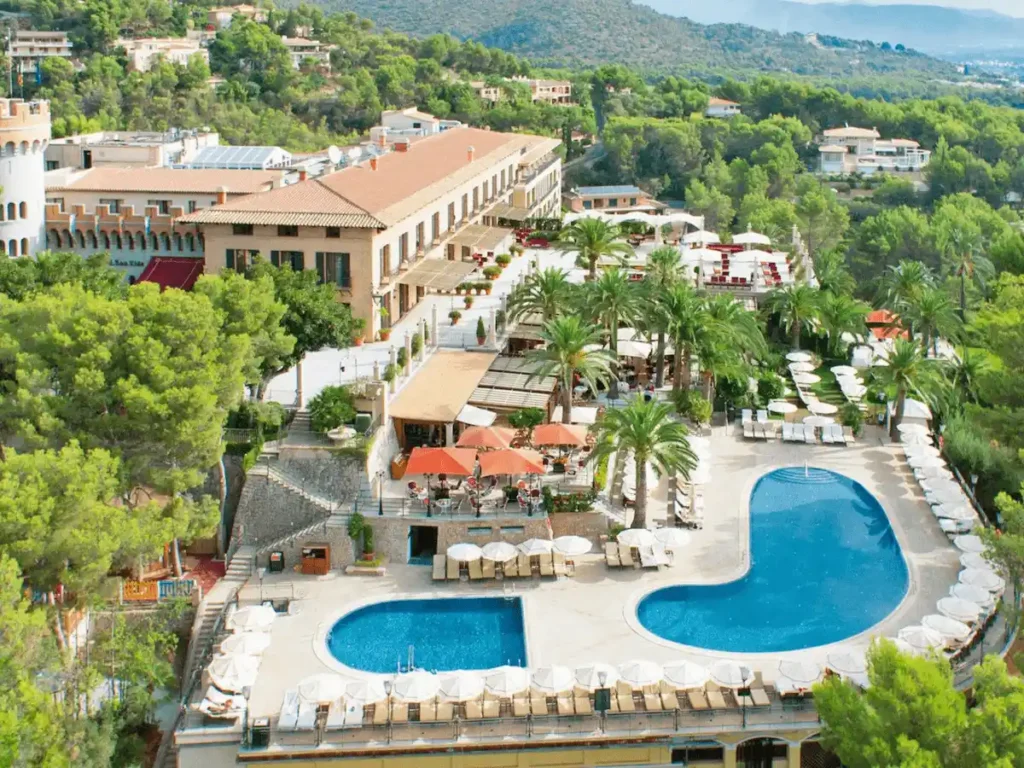
Castillo Hotel Son Vida occupies the highest defensive position in Palma—a 13th-century baronial fortress that has commanded the Son Vida plateau since Aragonese conquest. Originally constructed as a territorial watchtower during the Reconquista, this Gothic stronghold evolved into a noble estate before its conversion into Mallorca’s first and most exclusive castle hotel.
From its fortified walls, guests survey the Bay of Palma as medieval lords once monitored maritime approaches, inhabiting a legacy of strategic dominance that no modern resort can replicate. For broader context on Spain’s castle hotel network, explore the best castle stays across Spain.
Castillo Hotel Son Vida, a Luxury Collection Hotel, Mallorca ★★★★★
Built in 1260 as a defensive outpost during the Christian reconquest of Mallorca, the castle’s Gothic stone walls established immediate territorial authority over Palma’s northern approaches. The original watchtower, still intact, served as the architectural anchor for subsequent expansions by Mallorcan nobility who recognized the site’s inherent command over trade routes and coastal defenses.
By the 17th century, the estate had transformed into a baronial summer residence, its fortifications augmented with Renaissance galleries and terraced gardens that reinforced the family’s social dominance.
The Castillo Hotel Son Vida’s 350-acre expanse functioned as a self-sustaining feudal domain—olive groves, vineyards, and agricultural lands that rendered the castle economically independent from Palma’s urban economy. This territorial scale remains today, now manifested as three championship golf courses that preserve the estate’s spatial exclusivity while serving as the leisure infrastructure for the international elite.
The castle itself has been meticulously restored to emphasize its Gothic foundations: vaulted stone ceilings in the original keep, wrought-iron chandeliers suspended from medieval beams, and limestone corridors that channel centuries of aristocratic footfall.
The 164 rooms and suites occupy both the historic castle structure and contemporary wings designed to architecturally defer to the original fortress. Baronial Suites within the castle feature exposed stone walls up to four feet thick—the same defensive masonry that once absorbed siege artillery.
Modern amenities are embedded within this medieval framework: heated marble floors beneath Gothic arches, climate control concealed behind tapestries, floor-to-ceiling windows that replace former arrow slits to maximize panoramic command over Palma Bay. The Presidential Suite occupies the castle’s former lord’s chambers, its private terrace positioned precisely where nobles once received military intelligence and issued territorial decrees.
Dining at Castillo Hotel Son Vida reinforces the estate’s institutional authority. Es Castell Restaurant operates within the original banquet hall, where vaulted ceilings and heraldic stonework frame contemporary Mediterranean gastronomy.
The wine cellar occupies the castle’s 13th-century dungeons—climate-stable stone chambers now housing 15,000 bottles, many from estates that supplied the original fortress centuries ago. The spa, built into the castle’s lower fortifications, utilizes the same thermal properties that kept the medieval armory dry, creating humidity-controlled treatment rooms where modern wellness protocols operate within defensively engineered stone.
Golf infrastructure extends the estate’s historical logic: Son Vida Golf, designed by the Folco Nardi studio, follows the contours of the original feudal agricultural terraces, transforming medieval land management into championship play. The course’s elevated greens mirror the castle’s strategic positioning, offering the same long-range visibility that made Son Vida militarily invaluable. Access to two additional courses—Son Muntaner and Son Quint—provides guests with 54 holes across terrain that once constituted the castle’s economic hinterland.
Service standards at Castillo Hotel Son Vida reflect the property’s institutional origins. The staff operates under protocols inherited from grand-estate hospitality: discretion, anticipatory service, and spatial knowledge that ensures guests navigate the castle’s historical architecture with the confidence of resident nobility. Private butlers, dedicated concierge teams, and golf caddies trained in estate history function as modern equivalents to the household staff that once maintained baronial estates across Europe.
Check Availability & Rates →To occupy Castillo Hotel Son Vida is to inhabit the apex of Mallorcan territorial command—where Gothic fortifications, 350 private acres, and eight centuries of baronial authority converge into a residential experience unmatched by any mainland Spanish estate. This is not hospitality; it is sovereign residency.
FAQ: Castillo Hotel Son Vida
What makes Castillo Hotel Son Vida historically significant?
Built in 1260 as a Gothic watchtower during the Aragonese conquest, Castillo Hotel Son Vida served as Mallorca’s primary northern defensive position before evolving into a baronial estate. Its 350-acre footprint and intact medieval fortifications represent the island’s most substantial example of feudal territorial control converted into luxury accommodation.
How does the property maintain its historical integrity while offering modern luxury?
The castle’s original Gothic structure—including four-foot-thick defensive walls, vaulted stone ceilings, and the 13th-century watchtower—remains architecturally dominant. Contemporary amenities are engineered within this medieval framework: climate control behind period tapestries, spa facilities in lower fortifications, and suites that preserve exposed stonework while integrating heated marble and advanced acoustics.
What distinguishes the castle’s location and views?
Castillo Hotel Son Vida occupies Palma’s highest natural defensive position, the same elevation that made it strategically vital during the Reconquista. Guests command 360-degree visibility over the Bay of Palma, the Serra de Tramuntana mountains, and three golf courses that follow the estate’s original feudal terraces—views historically reserved for military surveillance and baronial authority.
What level of privacy does the 350-acre estate provide?
The property functions as a self-contained domain with controlled vehicular access, gated entry protocols, and spatial separation provided by three championship golf courses. This territorial scale replicates the isolation originally designed for defensive purposes, ensuring guest privacy standards unattainable in urban luxury hotels.
The Sovereign Residency: Castillo Hotel Son Vida as Territorial Command
Castillo Hotel Son Vida delivers what no mainland property can replicate: 13th-century Gothic fortifications anchoring 350 acres of Mallorcan plateau, with architectural and spatial authority inherited from eight centuries of baronial control. For travelers seeking parallel levels of historic estate dominance, consider Parador de Alarcón’s cliff-fortress positioning or Parador de Granada’s Alhambra proximity—though neither matches Son Vida’s combination of defensive architecture, championship golf infrastructure, and island sovereignty.
For more curated itineraries and luxury-focused travel insights, visit Your Luxury Guide. For official travel information and destination updates, visit Spain tourism-info.
Your Luxury Guide — Where Exceptional Travel Begins.