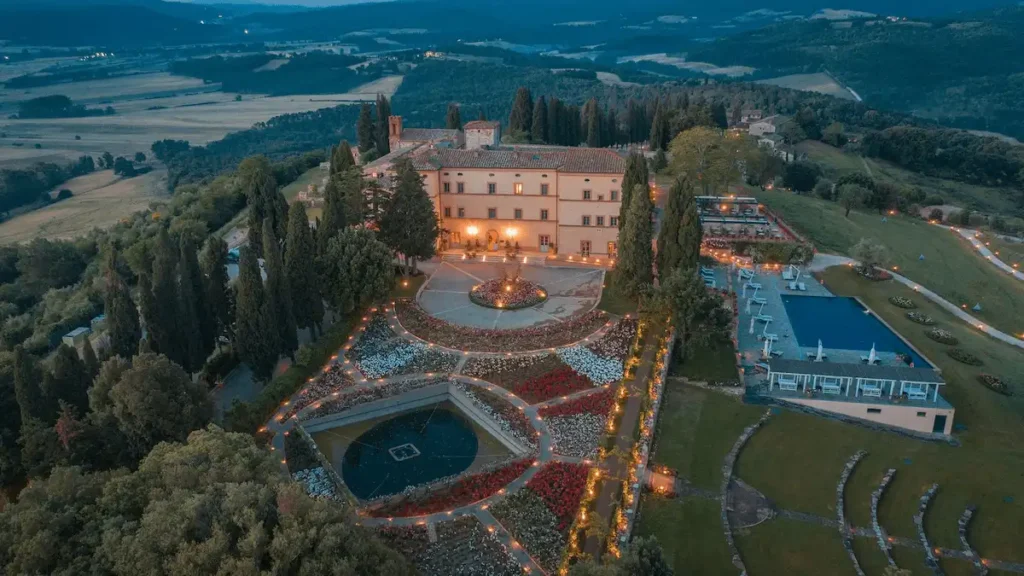
Castello di Casole Belmond transforms a verified 10th-century feudal stronghold into a 4,200-acre territorial estate where Sienese nobility once governed the agrarian wealth of Tuscany. The castello’s documented origins as a defensive fortification established its strategic elevation. Guests inhabit a lineage of territorial command where physical elevation and agricultural productivity defined social hierarchy. This is accommodation as feudal inheritance—every stone wall carries the weight of Tuscany’s landed power structure.
Castello di Casole Belmond Hotel★★★★★
The castello’s 10th-century foundation established it as a rocca—a fortified administrative seat controlling agricultural taxation and defense across the Elsa Valley. The Bargagli family’s 700-year occupation (documented from 1100) transformed the military outpost into a noble residence, adding Renaissance loggias and frescoed halls while maintaining the defensive curtain walls.
The property’s 4,200 acres functioned as a self-sufficient feudal economy: olive presses, granaries, and wine cellars that supplied both the castello and Siena’s urban markets.
Castello di Casole honors its origins as a 10th-century Etruscan settlement, curating a sophisticated retreat where ancient agricultural traditions meet modern Italian elegance.
Belmond’s 2012 restoration preserved the castello’s spatial hierarchy. The 39 suites occupy the original palazzo and 10 newly built borgo residences that mirror Tuscan vernacular architecture. Stone floors harvested from the estate’s quarries maintain thermal mass. Vaulted ceilings in the Granary Suites reach 5 meters—former grain storage spaces now contain freestanding copper bathtubs and limestone showers.
The Estate Villas feature private infinity pools positioned to command views across vine rows planted in the alberello system, a training method predating mechanized agriculture.
The castello’s physical infrastructure reinforces its heritage of self-sufficiency. A 3,000-square-meter Essere Spa operates within the restored fattoria complex—agricultural buildings where livestock and harvest yields were once managed. Treatment rooms feature original terracotta floors and timber ceiling beams sourced from estate chestnut forests. The spa’s thermal circuit includes a bio-sauna built into a 14th-century stone cellar, maintaining the subterranean coolness that once preserved wine and oil.
Oliveto Restaurant occupies the former limonaia, where citrus trees sheltered during winter. It sources 70% of ingredients from the estate’s certified organic farms: Cinta Senese pork, Chianina beef, DOP olive oil pressed from 60,000 estate trees. The menu structure mirrors feudal dining—multi-course sequences where each dish represents a different sector of the land’s productivity.
The wine cellar stocks 400 labels, including estate-produced IGT Toscana from Sangiovese vines planted on the property’s southern slopes.
The castello’s elevation at 420 meters provided medieval defensive advantage and now delivers unobstructed sight lines across three valleys. Stone terraces where sentries once monitored trade routes now function as private outdoor lounges. The infinity pool’s 25-meter length aligns with the original fortress walls, its edge visually merging with the valley floor 200 meters below.
This is territorial inheritance made tangible—guests occupy the same commanding position that defined Tuscan feudal power for eight centuries.
Check Availability & Rates →Castello di Casole Belmond Hotel stands as Tuscany’s clearest surviving expression of feudal territorial architecture—a fortified estate where defensive stone and agricultural wealth created an autonomous sphere of aristocratic command over one of Italy’s most productive landscapes.
FAQ: Castello di Casole Belmond
What is the historical significance of Castello di Casole?
Castello di Casole originates as a 10th-century feudal stronghold documented in Sienese archives. The Bargagli family’s 700-year stewardship established it as a self-sufficient agricultural estate controlling 4,200 acres of olive groves, vineyards, and timber forests—a complete territorial economy that supplied both military defense and regional markets.
How does Belmond preserve the castello’s original architecture?
Belmond’s restoration maintained the defensive curtain walls, Renaissance loggias, and vaulted agricultural spaces. Stone quarried from the estate replaces modern materials. Original terracotta floors and chestnut ceiling beams remain in situ. New construction mirrors Tuscan vernacular forms, ensuring the borgo villas integrate with the historic palazzo’s spatial hierarchy.
What makes the estate’s agricultural operations unique?
The 4,200-acre estate operates as a certified organic farm producing DOP olive oil from 60,000 trees and IGT Toscana wine from Sangiovese vineyards. This agricultural continuity extends medieval practice—the same terraced slopes that fed feudal Siena now supply Oliveto Restaurant, maintaining an 800-year chain of land productivity.
Why is the castello’s location strategically important?
The 420-meter elevation provided medieval military advantage, allowing visual control over three valleys and the Via Francigena pilgrimage route. This defensive high ground now delivers unobstructed panoramas across the Elsa Valley—the same territorial command that made the site valuable to Sienese nobility for eight centuries.
Territorial Authority Preserved in Stone
Castello di Casole Belmond Hotel occupies the intersection of military architecture and agricultural dominance—a 10th-century fortress where defensive elevation and productive land created an autonomous feudal sphere. Guests inherit the spatial command of Sienese nobility across 4,200 acres of Tuscany’s most historically defended landscape.
Discover similar territorial estates at COMO Castello Del Nero and Castello Banfi Il Borgo.
For more curated itineraries and luxury-focused travel insights, visit Your Luxury Guide. For official travel information and destination updates, visit Italy tourism-info.
Your Luxury Guide — Where Exceptional Travel Begins.