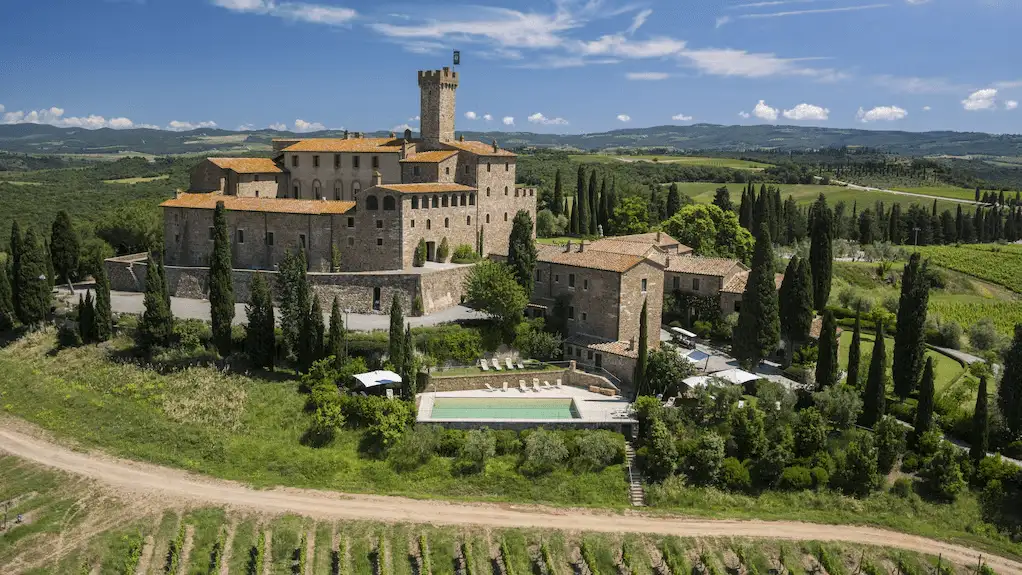
Castello Banfi il Borgo stands as a fortified 13th-century settlement commanding 7,100 acres of Brunello vineyards in southern Tuscany. The property centers on Poggio alle Mura, a medieval defensive borgo that served as a territorial watchtower over the Val d’Orcia. Today, the estate operates as both a UNESCO-recognized wine producer and a five-star residence where guests occupy suites within the original tower walls and converted grain stores of a settlement that has regulated Montalcino’s viticultural output for eight centuries.
Castello Banfi – il Borgo – Relais et Chateaux ★★★★★
Castello Banfi il Borgo does not reinterpret medieval architecture—it preserves it. The property’s 14 suites and villas occupy the original defensive structures of a borgo established in 1260 as a fortified grain center for the Republic of Siena.
The castello’s 33-meter tower, Poggio alle Mura, remains the visual and strategic anchor of the estate, positioned to survey the entire southern Tuscan corridor from the Tyrrhenian coast to Monte Amiata.
Castello Banfi – Il Borgo reinterprets its 13th-century heritage as a defensive outpost into a refined hilltop estate that commands the premier viticultural landscape of Montalcino.
The defensive masonry—two-meter-thick travertine walls and vaulted stone ceilings—now frames suites furnished with Tuscan antiques and private terraces overlooking contiguous vineyard blocks. Each room maintains the original spatial proportions of the medieval garrison quarters, where narrow windows and elevated thresholds enforced total privacy from external intrusion. Modern climate systems and spa-grade bathrooms are embedded within these historic envelopes without altering the fortified structure.
The estate’s Balsamico Restaurant operates within the castello’s former wine cellars, where 15th-century terracotta floors and exposed archways create the spatial grammar of a Renaissance banqueting hall. The menu sources exclusively from the estate’s own agricultural production—Brunello di Montalcino DOCG, estate-grown olive oil, and vegetables cultivated on borgo land that has been under continuous production since the 1300s. Dining here is not a culinary experience; it is the consumption of territorial authority, where every ingredient represents centuries of controlled cultivation.
Castello Banfi il Borgo’s enoteca houses over 400 labels, including vertical tastings of the estate’s Brunello reserves dating to 1978. The castello’s glass museum—Museo del Vetro—displays Roman glasswork excavated from the estate’s archaeological sites, providing material evidence of the land’s strategic importance since imperial occupation.
The wellness center occupies a converted granary, where barrel-vaulted stone rooms now contain thermal pools and massage suites lined with the same travertine that fortified the borgo’s defensive perimeter.
This is not a hotel conversion. It is the occupation of a medieval supply fortress that has never surrendered its territorial command. Guests do not visit Montalcino—they occupy the original seat of its viticultural authority.
Check Availability & Rates →To stay at Castello Banfi il Borgo is to inhabit the watchtower from which eight centuries of Tuscan wine dominance was surveyed, controlled, and exported—an unbroken lineage of territorial command now reserved for those who understand that true luxury is measured in acres held, not amenities listed.
FAQ: Castello Banfi il Borgo
What is the historical significance of Castello Banfi il Borgo?
Castello Banfi il Borgo was established in 1260 as a fortified grain storage and defensive outpost for the Republic of Siena. The borgo’s 33-meter tower, Poggio alle Mura, served as a strategic watchtower over southern Tuscany and the Val d’Orcia corridor. The estate has remained under continuous agricultural production for over 800 years and now operates as a UNESCO-recognized Brunello di Montalcino wine producer alongside its five-star accommodations.
What makes Castello Banfi il Borgo different from other Tuscan castle hotels?
Castello Banfi il Borgo is a working 7,100-acre wine estate where the accommodations occupy the original 13th-century defensive structures. Unlike converted manor houses, this property maintains its function as a territorial wine producer. Guests stay within the actual medieval grain stores and garrison quarters, with rooms featuring two-meter-thick travertine walls and vaulted stone ceilings that have never been structurally altered. The estate’s enoteca offers vertical tastings from its own Brunello reserves dating to 1978.
What amenities are available at Castello Banfi il Borgo?
The property offers 14 suites and villas within medieval structures, a spa in a converted granary with thermal pools, Balsamico Restaurant serving estate-sourced cuisine in 15th-century wine cellars, an enoteca with 400+ wine labels, and the Museo del Vetro displaying Roman archaeological finds excavated on-site. All accommodations feature original medieval masonry, Tuscan antiques, private terraces overlooking vineyard blocks, and modern climate systems embedded within historic walls.
How large is the Castello Banfi wine estate?
The estate encompasses 7,100 acres in the Montalcino region, with 850 acres dedicated to Brunello di Montalcino DOCG vineyard production. The property includes olive groves, agricultural fields, and protected forest land. Castello Banfi produces over 300,000 cases of wine annually and operates as one of the largest quality-focused Brunello producers in Tuscany, maintaining continuous cultivation of the same land since the medieval period.
The Authority of Territory Held
Castello Banfi il Borgo does not offer a Tuscan experience—it grants occupation of the fortified seat from which Tuscany’s wine empire was administered for eight centuries. This is governance through stone, land, and uninterrupted lineage. Guests seeking similar territorial command should examine Castello di Casole Belmond and Castello di Velona, properties where medieval authority remains the foundation of modern luxury.
For more curated itineraries and luxury-focused travel insights, visit Your Luxury Guide. For official travel information and destination updates, visit Italy tourism-info.
Your Luxury Guide — Where Exceptional Travel Begins.