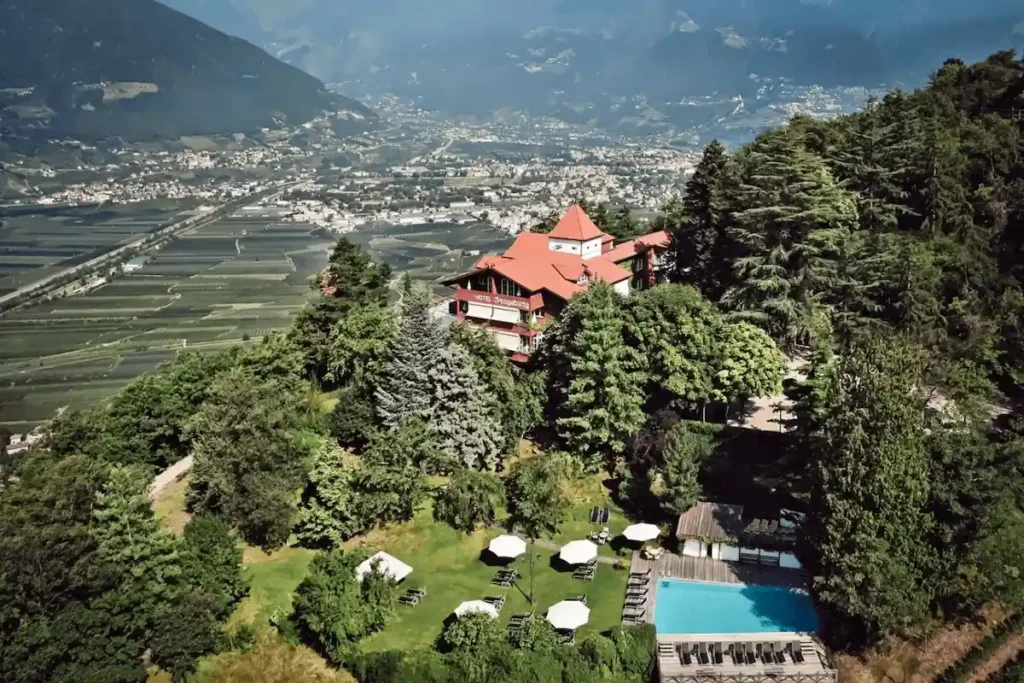
Castel Fragsburg occupies the strategic high ground above Merano—a 17th-century fortress estate that once controlled the valley approaches between the Italian plains and the Austrian Alpine passes. Built as a defensive seat by South Tyrolean nobility, this stone command post has maintained its territorial authority for four centuries.
The castle’s elevation and masonry anchored aristocratic families who understood that power flows from position: the ability to observe, control, and command the valley below. Today, the 5-star property preserves that sovereign perspective, offering guests immediate occupancy of a legacy where the Alpine elite enforced their domain through architectural dominance and geographic supremacy.
Castel Fragsburg ★★★★★
Castel Fragsburg stands at 1,200 meters—a deliberate elevation chosen by 17th-century South Tyrolean nobility to enforce territorial oversight of the Merano basin. The fortress estate’s thick stone walls and corner towers reflect a design philosophy where defense and prestige merged: only families with documented authority could command such strategic positions along the Alpine trade corridors.
The original defensive architecture remains visible throughout—barrel-vaulted ceilings, narrow window embrasures, massive oak doors that once sealed the noble family’s private chambers from both weather and intrusion.
Castel Fragsburg is offering an intimate, elevated sanctuary that balances rugged Alpine cliffs with the refined elegance of a private botanical estate.
The castle’s transformation into a 5-star hotel preserves this hierarchical architecture. Sixteen suites occupy the historic footprint, each room reflecting the spatial logic of aristocratic living where scale denoted status. The Tower Suite replicates the lord’s private observatory—original stone walls now framing floor-to-ceiling windows that convert the defensive vantage into modern panoramic luxury. Period furnishings aren’t decorative; they’re functional artifacts that demonstrate how South Tyrolean families balanced military readiness with refined domestic comfort.
The property’s 1,200-square-meter spa operates within the castle’s lower defensive levels—stone chambers that once stored provisions and weaponry now house thermal pools and treatment rooms. The architecture creates natural thermal regulation; the original thick walls maintain constant temperature, while modern engineering integrates heated stone floors and mountain water features. The wellness facilities map directly onto the fortress’s secure interior, where privacy was once enforced by military design and is now maintained through exclusive guest access.
Dining occurs in the castle’s great hall—a vaulted stone chamber where the noble family historically received guests and conducted estate business. The Michelin-starred restaurant preserves the room’s commanding proportions while executing modern South Tyrolean cuisine that reflects the valley’s position at the crossroads of Italian and Austrian influence. Meals aren’t served; they’re ceremonies that mirror the historical importance of aristocratic hospitality, where food quality signaled the host’s status and territorial resources.
The castle grounds extend across terraced gardens that descend the mountain slope—original defensive earthworks transformed into cultivated landscapes where guests inhabit the same elevated perspective that once allowed the nobility to survey their valley domain. Walking the property traces the fortress perimeter, where every angle and sightline was calculated for strategic advantage.
This isn’t a hotel built near historic sites; this is the seat of historic power itself, where modern guests occupy the exact position from which South Tyrolean aristocrats commanded their Alpine territory for four centuries.
Check Availability & Rates →Castel Fragsburg translates defensive sovereignty into modern territorial luxury—seventeen rooms where guests don’t visit Alpine history but command it from the same stone fortress that South Tyrolean nobility built to enforce their dominion over the Merano valley approaches.
FAQ: Castel Fragsburg
What makes Castel Fragsburg historically significant?
Castel Fragsburg served as a 17th-century defensive fortress for South Tyrolean nobility controlling the Merano valley approaches. Its 1,200-meter elevation provided strategic oversight of Alpine trade routes between Italy and Austria. The original stone architecture—including defensive walls, corner towers, and vaulted chambers—remains intact, demonstrating how aristocratic families merged military security with refined domestic living.
How does the castle’s architecture enhance the guest experience?
The fortress design creates natural advantages: thick stone walls provide thermal regulation and acoustic privacy, elevated positioning delivers unobstructed Dolomite views, and the original defensive layout ensures exclusive guest spaces. Tower suites occupy the castle’s highest points, offering the same commanding perspectives that South Tyrolean lords used to monitor their territory. The spa utilizes lower defensive chambers where stone walls maintain constant temperature for thermal facilities.
What distinguishes Castel Fragsburg from other Alpine luxury hotels?
Castel Fragsburg operates within an authentic fortress estate built for territorial command, not a villa or converted residence. The property’s documented 17th-century defensive architecture and strategic elevation represent verified aristocratic power—guests occupy the actual seat of South Tyrolean authority. The Michelin-starred dining in the original great hall and exclusive access to fortress grounds provide experiences impossible at non-castle properties.
Why choose Castel Fragsburg for a South Tyrol stay?
The castle delivers immediate occupancy of South Tyrolean aristocratic legacy—sixteen suites within an operational fortress where noble families enforced valley dominance for four centuries. The property’s elevation, original defensive architecture, and territorial grounds offer experiences that standard luxury hotels cannot replicate. Guests inhabit the precise position from which Alpine aristocracy commanded their domain, preserved through verified historic architecture and modern 5-star execution.
The Alpine Fortress Standard
Castel Fragsburg establishes the territorial authority that defines legitimate Alpine castle hospitality—where South Tyrolean defensive architecture becomes the foundation for modern sovereign luxury. Guests seeking similar documented aristocratic command should examine Castello di Velona in Tuscany’s Val d’Orcia or Jumeirah Capri Palace, where Mediterranean coastal dominance mirrors Alpine territorial prestige.
For more curated itineraries and luxury-focused travel insights, visit Your Luxury Guide. For official travel information and destination updates, visit Italy tourism-info.
Your Luxury Guide — Where Exceptional Travel Begins.