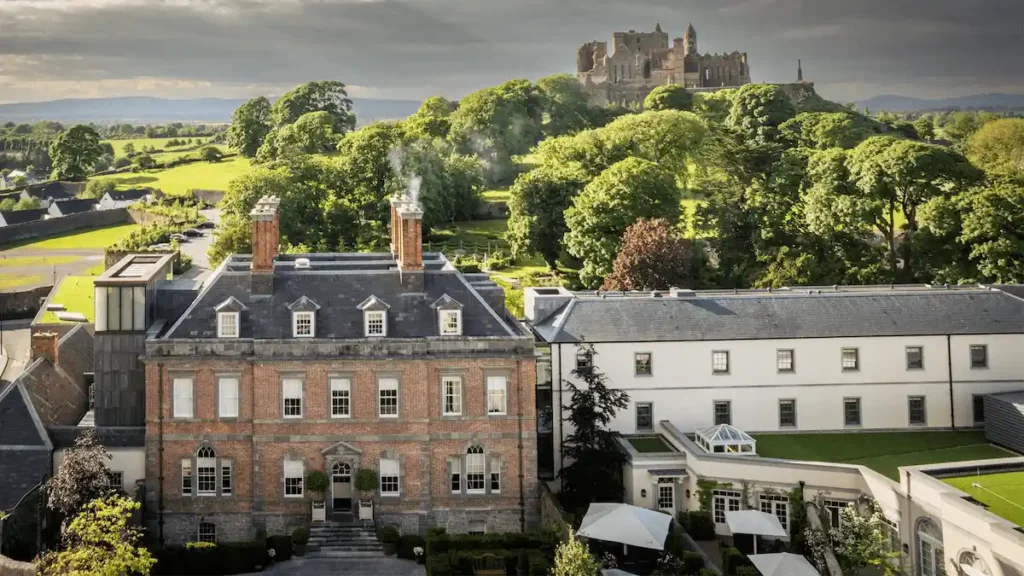
Cashel Palace Hotel stands as the only residence in Ireland directly connected to the Rock of Cashel by private ecclesiastical pathway. Built in 1730 by Sir Edward Lovett Pearce—architect of the Irish Houses of Parliament—as the official seat for Archbishops of Cashel, this Palladian manor commanded two centuries of religious authority before becoming the birthplace of the Guinness brewing legacy.
The 2022 restoration integrated 42 suites across the original red-brick manor and new Garden Wing, preserving the Bishop’s Walk—a gated path where Archbishops moved between palace and cathedral for 200 years.
Guests inhabit rooms where ecclesiastical power shaped Ireland’s spiritual landscape, where Queen Elizabeth II resided during her 2011 state visit, and where Richard Guinness cultivated the hops that launched his son Arthur’s brewing empire.
Cashel Palace Hotel ★★★★★
The Rock of Cashel rises 300 feet above Tipperary’s Golden Vale. For 1,000 years, it served as the coronation site for the Kings of Munster. In 1730, Sir Edward Lovett Pearce—fresh from designing the Irish Houses of Parliament—received the commission to build a residence worthy of the Archbishops who administered spiritual authority from this ancient seat.
The result: a red-brick Palladian manor positioned at the Rock’s base, connected by a private gated pathway known as the Bishop’s Walk. For two centuries, Archbishops used this stone corridor to move between their residence and the cathedral where they presided over Ireland’s ecclesiastical decisions.
Cashel Palace Hotel is a 1730 Palladian masterpiece and former archiepiscopal residence located at the foot of the Rock of Cashel, famously known as the birthplace of the original Guinness beer recipe.
The palace’s gardens operated as more than ornamental grounds. Richard Guinness served here as land agent, cultivating hops in the walled orchard while managing the Archbishop’s estate. His brewing experiments in these gardens produced the ale recipe he passed to his son Arthur—the foundation of the Guinness empire. Ancient mulberry trees planted in 1702 to mark Queen Anne’s coronation still anchor the three-acre grounds, mapping 320 years of continuous cultivation.
When Lord Brocket converted the palace into a hotel in 1962, he preserved the building’s ecclesiastical architecture while introducing it to international society. Jackie Kennedy stayed in the Main House suites. Elizabeth Taylor occupied rooms where Archbishops once reviewed diocesan reports.
During Queen Elizabeth II‘s landmark 2011 state visit to Ireland—the first British monarch to visit in a century—she resided here, adding royal precedent to the building’s religious legacy.
The 2022 restoration expanded capacity to 42 rooms while maintaining the palace’s original spatial hierarchy. Nine suites occupy the Main House, where 18th-century plasterwork and period fireplaces mark the Archbishop’s private quarters. The new Garden Wing extends into the historic orchard, connecting modern luxury to the grounds where Guinness hops first grew. Every suite maintains views of either the Rock of Cashel or the walled gardens—the same sightlines Archbishops used to monitor their domain.
The Bishop’s Buttery operates in the original vaulted cellars, where palace staff once stored provisions for ecclesiastical functions. Menus source exclusively from Tipperary’s Golden Vale—the limestone-rich pasturelands that made this region Ireland’s dairy and cattle center.
The Guinness Bar occupies the former brewing cellars, displaying original copper vessels and hops cultivation equipment. Guests drink where Richard Guinness perfected the ale formula that would become Ireland’s most recognized export.
The Spa introduces contemporary wellness into palace grounds, featuring an outdoor heated pool positioned for direct Rock of Cashel views. Treatments use seaweed harvested from Ireland’s Atlantic coast—the same marine plants that sustained monastic communities on the Rock for centuries.
The equestrian concierge provides access to Coolmore Stud, the Magnier family’s thoroughbred breeding operation that produces more Champion sires than any facility globally. Guests transition from Archbishop’s residence to Ireland’s most exclusive stables—both seats of documented dominance in their respective domains.
The Bishop’s Walk remains the property’s defining asset. This private stone pathway—built solely for ecclesiastical use—connects palace grounds directly to the Rock’s cathedral entrance. No other accommodation in Ireland offers documented architectural linkage to a 1,000-year-old royal site. Guests walk the same corridor where Archbishops processed between residence and altar, inhabiting a physical connection to Ireland’s religious and political center.
Check Availability & Rates →Where Archbishops commanded diocesan authority and Guinness hops first grew, guests now occupy the only residence architecturally united with the Rock of Cashel—a Palladian manor that has housed ecclesiastical power, brewing innovation, and royal visits across three centuries of documented Irish dominance.
FAQ: Cashel Palace Hotel
What makes Cashel Palace Hotel historically significant?
Built in 1730 by Sir Edward Lovett Pearce as the official residence for Archbishops of Cashel, the palace served as Ireland’s ecclesiastical command center for two centuries. It’s also the birthplace of the Guinness brewing recipe, where Richard Guinness cultivated the hops that launched his son Arthur’s beer empire. The property features the Bishop’s Walk—a private gated pathway connecting directly to the Rock of Cashel, used exclusively by Archbishops to access the cathedral.
Can guests access the Rock of Cashel from the hotel?
Yes. Cashel Palace Hotel is the only accommodation with direct architectural connection to the Rock of Cashel via the historic Bishop’s Walk—a private stone pathway built in 1730 for exclusive ecclesiastical use. This gated corridor provides guests the same access route Archbishops used for 200 years when moving between their residence and the cathedral.
What connection does the hotel have to Guinness beer?
Richard Guinness served as land agent at Cashel Palace in the 18th century, managing the Archbishop’s estate and cultivating hops in the palace gardens. His brewing experiments here produced the ale recipe he passed to his son Arthur Guinness, who founded the Guinness brewery in 1759. The hotel’s Guinness Bar displays original copper brewing vessels and celebrates this documented brewing origin.
What notable guests have stayed at Cashel Palace Hotel?
Queen Elizabeth II resided here during her historic 2011 state visit to Ireland—the first British monarch to visit in a century. The palace has also hosted Jackie Kennedy and Elizabeth Taylor. During its conversion to a hotel in 1962 by Lord Brocket, it became a destination for international high society while maintaining its ecclesiastical architecture.
Ireland’s Episcopal Legacy in Modern Form
Cashel Palace Hotel translates 290 years of documented authority into contemporary accommodation—where the Archbishop’s private residence, Guinness brewing origins, and royal visits converge in Ireland’s only hotel architecturally unified with a millennial royal site.
Guests seeking similar intersections of religious power and verified heritage legacy should consider The K Club and Carton House Hotel, where Ireland’s aristocratic estates maintain their documented dominance through modern luxury.
For more curated itineraries and luxury-focused travel insights, visit Your Luxury Guide. For official travel information and destination updates, visit Ireland tourism-info.
Your Luxury Guide — Where Exceptional Travel Begins.