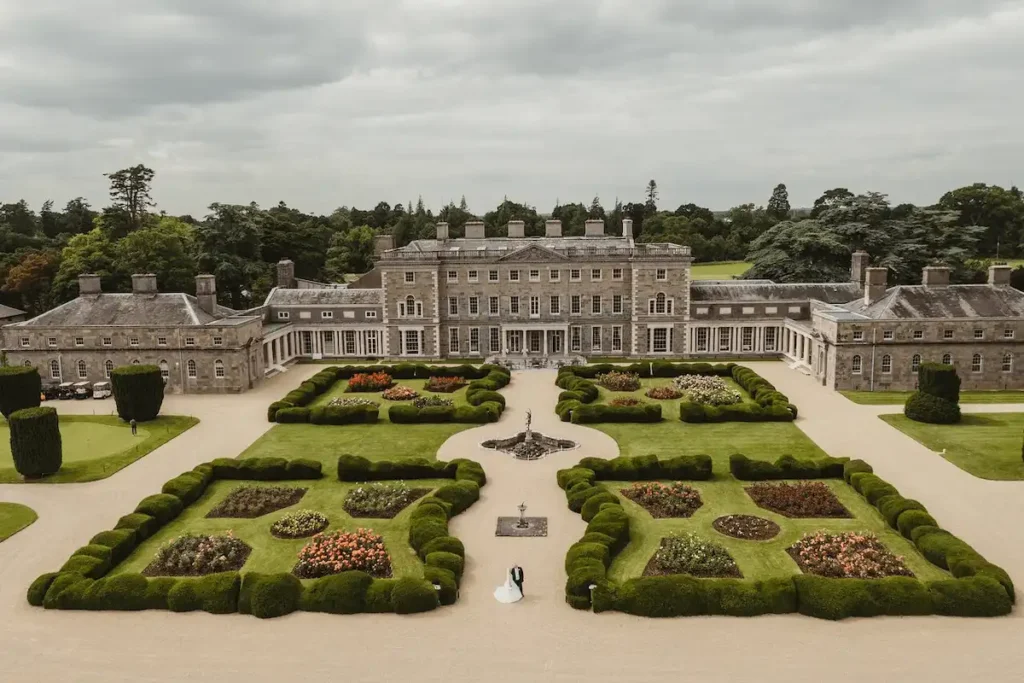
Carton House Hotel stands on 1,100 acres of sovereign land that the FitzGerald family—Ireland’s “Virtual Kings”—controlled for seven centuries. From 1170 to 1922, this estate functioned as the command center for the Dukes of Leinster, who ruled Ireland as Lord Deputies under the Crown. The 1739 Palladian mansion, designed by Richard Castles, was built as an architectural statement of absolute power: the Gold Salon’s Francini Baroque ceilings were commissioned specifically to demonstrate to visiting royals that the FitzGeralds lived better than kings.
Today, the property operates as a Fairmont-managed five-star hotel where guests inhabit the physical infrastructure of Ireland’s most powerful dynasty.
For travelers seeking the weight of verified lineage, explore our curated collection of best historic hotels in Ireland.
Carton House A Fairmont Managed Hotel ★★★★★
The 5.5-mile stone boundary wall surrounding Carton House was constructed for one purpose: to physically separate the Dukes of Leinster from the common world. This isn’t metaphorical exclusivity—it’s engineered territorial dominance dating to the 1170 Norman Invasion. The estate’s 1,100-acre footprint represents Ireland’s oldest continuous sovereign demesne, a land block that remained under unbroken FitzGerald control until the 7th Duke forfeited the entire birthright in 1922 to settle a £67,500 gambling debt.
Carton House Hotel isn’t a renovated manor—it’s the architectural seat of a family who served as Ireland’s Lord Deputies, exercising Crown authority over the entire island for 700 years.
The 1739 Palladian mansion was commissioned by the 19th Earl of Kildare as a monument to the family’s return to absolute power after decades of political exile. Richard Castles designed the structure as a fortress of status: the Gold Salon’s hand-carved Francini ceilings weren’t decorative—they were a calculated display of wealth intended to eclipse European royalty.
When Queen Victoria visited in 1849 and 1897, she stayed in the Chinese Boudoir, a chamber featuring 1759 hand-painted wallpaper that remains untouched. The room exists today exactly as it was prepared for a reigning monarch, preserved as evidence of the estate’s role as a diplomatic staging ground for Crown relations.
The spatial immersion begins in the Morrison Room, housed within the estate’s 1815 barrel-vaulted dining hall. This was the architectural centerpiece of the FitzGeralds’ social command—the room where Ireland’s political elite gathered under the family’s authority.
The Fairmont Mill Spa operates inside the original 18th-century limestone mill, converting the estate’s industrial infrastructure into a wellness facility that maintains the property’s utilitarian grandeur. The dual championship golf courses—The Montgomerie and The O’Meara—utilize the rolling 18th-century parkland topography that was originally landscaped to demonstrate the family’s territorial scale.
Lord Edward FitzGerald, the 1798 revolutionary leader, grew up in these halls. His status as a national martyr saved Carton House from IRA destruction in 1923, when similar estates were burned as symbols of British rule. The property’s survival is a historical anomaly—most Anglo-Irish “Big Houses” were systematically destroyed during the War of Independence. Carton House endured because Lord Edward’s legacy transcended political faction; his childhood home became untouchable.
The Shell Cottage, an 18th-century folly built by Lady Emily Lennox using exotic shells, later served as the private residence of Marianne Faithfull. The estate’s Water-Powered Organ, installed in 1857, still operates in the Gold Salon—a rare mechanical instrument engineered to run on the stream flowing beneath the mansion.
Grace Kelly and Prince Rainier used Carton House as their private sanctuary, a retreat where they could escape global media scrutiny. The estate now serves as the official training base for the Irish National Rugby Team, providing high-security infrastructure for the nation’s most visible athletes.
This isn’t a hotel that added history—it’s a command center that accepted guests. You’re inhabiting the rooms where Ireland’s ruling class exercised territorial authority for seven centuries, staying in a structure built to prove that one family lived better than kings.
Check Availability & Rates →The Gold Salon’s Francini ceilings were engineered as proof of supremacy—a calculated demonstration that the FitzGeralds possessed the wealth, taste, and continental connections to outclass European royalty on their own architectural terms.
FAQ: Carton House Hotel
What makes Carton House Hotel historically significant?
Carton House Hotel occupies the 1,100-acre ancestral seat of the Dukes of Leinster, who controlled the estate from 1170 to 1922 as Ireland’s Lord Deputies. The 1739 Palladian mansion, designed by Richard Castles, features the Gold Salon with Francini Baroque ceilings commissioned to demonstrate the FitzGeralds’ superiority over European royalty. The property represents Ireland’s oldest continuous sovereign demesne and survived the 1923 IRA purge due to Lord Edward FitzGerald’s status as a revolutionary martyr.
What original architectural features remain at Carton House?
The estate preserves Queen Victoria’s Chinese Boudoir with 1759 hand-painted wallpaper exactly as it appeared during her 1849 and 1897 visits. The Morrison Room operates within the 1815 barrel-vaulted dining hall, the Gold Salon houses an 1857 water-powered organ engineered to run on the estate’s underground stream, and the Fairmont Mill Spa occupies the original 18th-century limestone mill. The 5.5-mile boundary wall built to separate the Dukes from the common world still encloses the entire property.
Who were the most notable guests at Carton House?
Queen Victoria stayed twice in the Chinese Boudoir (1849, 1897). Grace Kelly and Prince Rainier used the estate as their private European sanctuary. The property served as the childhood home of Lord Edward FitzGerald, the 1798 revolutionary leader whose legacy saved the house from destruction. Marianne Faithfull later resided in the Shell Cottage, the 18th-century folly built by Lady Emily Lennox.
What amenities utilize Carton House’s historic infrastructure?
The Morrison Room fine dining operates in the 1815 barrel-vaulted hall where the FitzGeralds hosted Ireland’s political elite. The Fairmont Mill Spa functions inside the estate’s original 18th-century limestone mill. The Montgomerie and O’Meara championship golf courses utilize the rolling parkland topography landscaped in the 18th century. The property serves as the official high-security training base for the Irish National Rugby Team.
The Authority of Verified Lineage
Carton House delivers what institutional longevity provides: the authority of unbroken lineage. The FitzGeralds ruled Ireland for 700 years from this exact ground, and the physical evidence of that sovereignty—the 5.5-mile wall, the Gold Salon ceilings, the Queen’s preserved boudoir—remains intact. You’re not visiting a museum; you’re inhabiting the operational headquarters of Ireland’s most powerful family.
For travelers seeking comparable estates where Irish aristocratic lineage translates into contemporary luxury, The K Club and Cashel Palace Hotel offer equally documented seats of territorial command.
For more curated itineraries and luxury-focused travel insights, visit Your Luxury Guide. For official travel information and destination updates, visit Ireland tourism-info.
Your Luxury Guide — Where Exceptional Travel Begins.