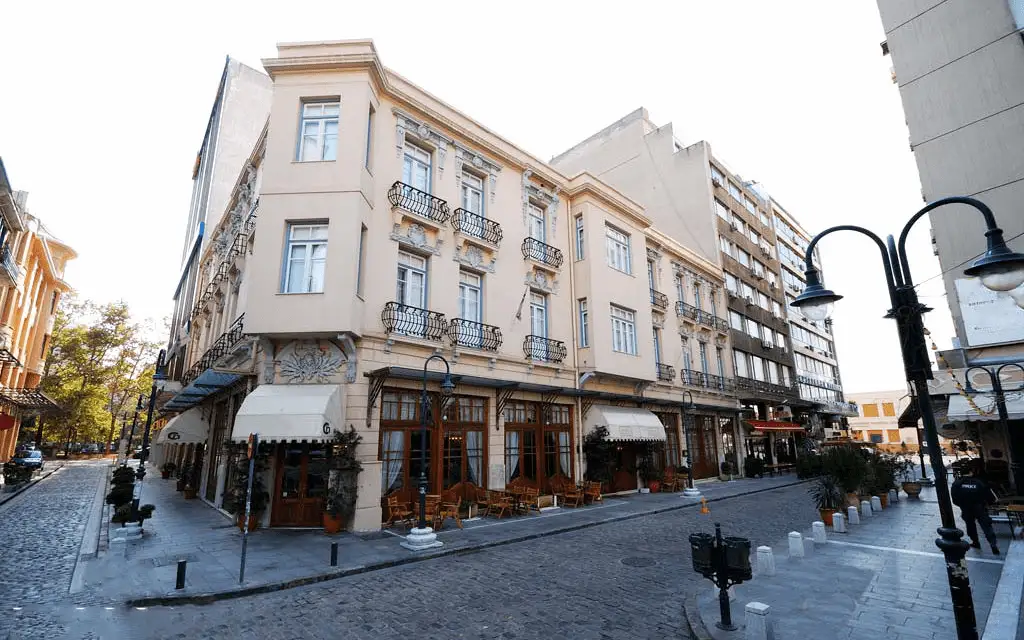
The Capsis Bristol Boutique Hotel stands within Thessaloniki’s preserved 1860 neoclassical structure—a building commissioned during the late Ottoman administrative reform, when European architectural authority was reshaping the city’s commercial districts. This five-star property translates 150 years of architectural dominance into a modern residence where guests inhabit rooms designed for 19th-century merchant elite.
Discover the sellection of best historic hotels in Thessaloniki that command the city’s legacy quarters.
Capsis Bristol Boutique Hotel ★★★★★
The Capsis Bristol occupies a structure built in 1860, when Thessaloniki functioned as the Ottoman Empire’s critical Aegean trade hub—a city where European neoclassical architecture signaled commercial power and administrative prestige. This building was constructed during a period of rapid urban expansion, serving the merchant class that controlled trade routes between Constantinople, Vienna, and the Mediterranean ports.
Capsis Bristol Boutique Hotel is housed within the historic 1860 Ottoman Post Office and holds the exclusive distinction of being Thessaloniki’s only member of the prestigious Historic Hotels of Europe association.
The neoclassical facade, with its symmetrical columns and ornamental pediments, represented European architectural authority transplanted onto Ottoman commercial soil.
The original building served as a private residence and administrative office, its ground-floor arcades designed for merchant transactions while upper floors housed family quarters. The structure survived the catastrophic 1917 fire that destroyed much of Thessaloniki’s commercial center, standing as one of the few preserved neoclassical buildings from the city’s pre-fire era. This survival established the property’s architectural rarity—a verified remnant of Thessaloniki’s transformation from Ottoman trade port to modern Greek metropolis.
Today’s 20 suites occupy the building’s historic footprint, where 4-meter ceilings and original hardwood floors define spaces once reserved for merchant families. The Superior Suites preserve the building’s neoclassical proportions—tall windows overlooking Oplopiou Street, crown molding that frames sleeping quarters, and restored marble fireplaces that once heated 19th-century salons. Junior Suites maintain the building’s secondary chambers, where servants’ quarters have been transformed into compact luxury spaces with period-appropriate furnishings.
The ground floor’s breakfast hall occupies the original commercial arcade, where merchants once conducted transactions beneath vaulted ceilings. Stone columns support spaces now serving as dining areas, their capitals carved in Corinthian style reflecting the neoclassical vocabulary of European authority.
The restoration preserved the arcade’s spatial logic—high ceilings create acoustic separation, while natural light enters through the building’s street-facing windows, illuminating spaces exactly as they functioned 150 years ago.
The property’s central location positions guests within Thessaloniki’s preserved historic quarter, where neoclassical, Byzantine, and Ottoman structures occupy adjacent blocks. The building sits two blocks from Aristotelous Square, the city’s 1920s French-designed civic center, and four blocks from the Roman Rotunda—a spatial relationship that maps Thessaloniki’s 2,300-year architectural evolution. This positioning establishes the hotel as a central node within the city’s documented heritage network.
Check Availability & Rates →The Capsis Bristol translates 1860s merchant authority into contemporary luxury, where neoclassical proportions and original architectural elements define a residence commanding Thessaloniki’s preserved commercial heritage. Guests inhabit spaces designed for the merchant class that once controlled Aegean trade routes.
FAQ: Capsis Bristol Boutique Hotel
What is the historical significance of Capsis Bristol Boutique Hotel?
The Capsis Bristol occupies an 1860 neoclassical building constructed during Thessaloniki’s transformation into the Ottoman Empire’s major Aegean trade hub. The structure served as a merchant residence and administrative office, surviving the devastating 1917 fire that destroyed much of the city’s commercial center, making it one of Thessaloniki’s rarest preserved pre-fire neoclassical landmarks.
What original architectural features are preserved at Capsis Bristol?
The property retains its 1870 neoclassical facade with symmetrical columns and ornamental pediments, 4-meter ceilings, original hardwood floors, restored marble fireplaces, and the ground-floor arcade where merchants once conducted transactions. Crown molding and tall windows maintain the building’s 19th-century proportions throughout the 20 suites.
How does Capsis Bristol’s location connect to Thessaloniki’s historic sites?
The hotel stands in Thessaloniki’s preserved historic quarter, two blocks from Aristotelous Square (1920s French civic design) and four blocks from the Roman Rotunda. This positions guests within walking distance of the city’s 2,300-year architectural timeline, from Roman monuments to Byzantine churches and Ottoman structures.
What type of guests does Capsis Bristol Boutique Hotel attract?
The property appeals to travelers seeking documented architectural heritage within a compact luxury format. The 20-suite scale attracts guests prioritizing authentic 19th-century spatial proportions over modern hotel amenities, with the building’s neoclassical design serving as the primary luxury asset.
The 1870 Neoclassical Authority Preserved
The Capsis Bristol Boutique Hotel delivers Thessaloniki’s rarest architectural asset—a verified 1860 neoclassical landmark that survived the city’s 1917 transformation. Twenty suites occupy spaces where merchant families once commanded Aegean trade networks, their authority now translated into five-star heritage residence.
Those seeking comparable historic dominance should explore The Excelsior Thessaloniki, where 1920s elegance defines another chapter of the city’s architectural legacy.
For more curated itineraries and luxury-focused travel insights, visit Your Luxury Guide. For official travel information and destination updates, visit Greece tourism-info.
Your Luxury Guide — Where Exceptional Travel Begins.