Ca’ Sagredo Hotel Venice occupies a 15th-century Byzantine-Gothic palazzo on the Grand Canal—a National Monument protected by the Venetian Superintendency of Fine Arts. This is the residence where Galileo Galilei lived as a guest of the Sagredo family, and where the dialogues of his Dialogue Concerning the Two Chief World Systems were set. Original Tiepolo ceiling frescoes remain in their architectural context.
The palazzo served as the seat of the 105th Doge of Venice and retains the monumental marble staircase engineered in 1732 to mark the Sagredo family’s ascent to Venetian nobility.
Ca’ Sagredo Hotel Venice ★★★★★
The palazzo commands a direct Grand Canal position opposite the Rialto Fish Market—the 1,000-year-old culinary axis of Venetian trade. The building’s four-story Gothic facade represents one of the last intact examples of 14th and 15th-century residential architecture in this density.
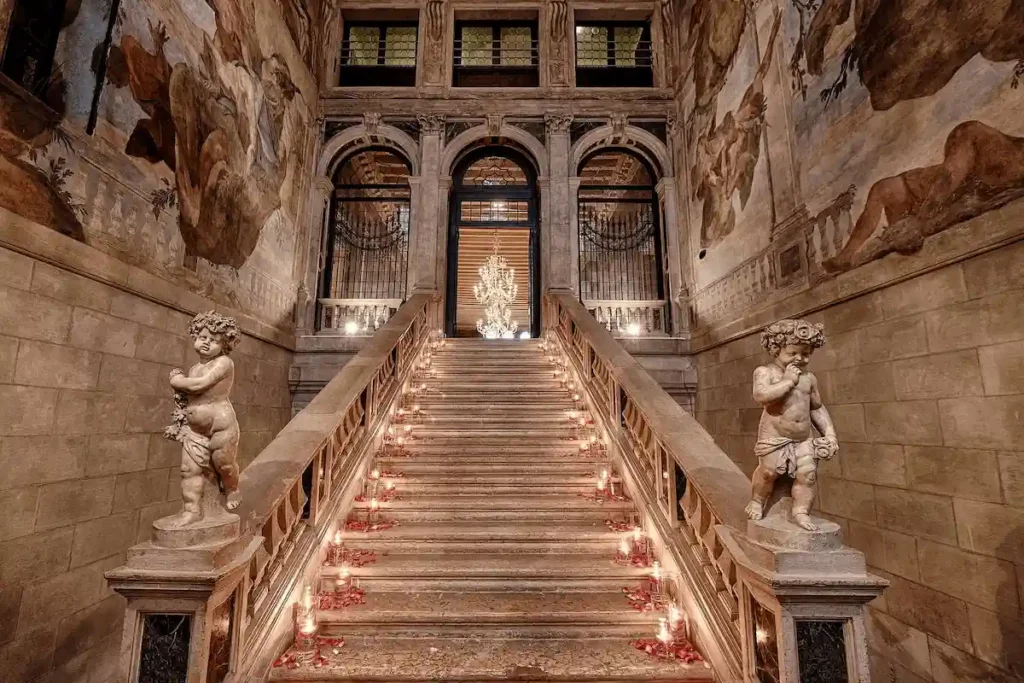
The Scalone dei Giganti, a massive marble staircase designed by Andrea Tirali in 1732, physically dominates the entry sequence. This was not decorative—it was engineered as a spatial declaration of the Sagredo family’s transition from merchant wealth to the Venetian nobility that controlled Mediterranean trade routes.
Ca’ Sagredo Hotel Venice is a prestigious 15th-century noble residence that preserves the city’s most significant private art collection within a National Monument, allowing guests to reside amidst the original 18th-century masterpieces of the Sagredo family.
The portego—the ceremonial central hall—spans an exceptional width reserved for the highest-tier palazzos. Cross-breeze ventilation from the Grand Canal to the Campo Santa Sofia created a thermal advantage that defined elite residency. The library hosted Galileo Galilei in the early 17th century. His friendship with the Sagredo family produced more than correspondence—the physical setting of his Dialogue Concerning the Two Chief World Systems was written into these specific rooms. The intellectual authority of the Venetian Republic operated within this spatial footprint.
The 18th-century transformation under Nicolò Sagredo—the 105th Doge of Venice—embedded the palazzo into the highest tier of European art patronage. Giambattista Tiepolo and Pietro Longhi were commissioned to execute permanent ceiling frescoes that remain in their original architectural context.
The Sala della Musica—the Music Ballroom—features double-height ceilings and wall-to-ceiling frescoes by Gaspare Diziani. The room functions as an acoustic chamber designed for Baroque concerts, where sound resonates through original 18th-century stuccowork by Abbondio Stazio. The palazzo is classified as a “Palazzo-Museo,” meaning every structural beam is cataloged under national protection. This is not a renovated building. This is a preserved seat of Venetian geopolitical influence.
Guest rooms occupy the original 17th-century residential quarters. Wood-beamed ceilings and frescoes by masters cataloged in the Accademia Gallery define the spatial envelope. The Sagredo Suite spans 100 square meters with nearly seven-meter-high ceilings—a scale that modern luxury construction cannot replicate.
Original “Casinos“—small private rooms used for 18th-century gambling and intellectual debate—retain hidden passages and observation “peep-holes” used by the nobility. These were the operational spaces where Venetian power functioned behind public ceremony.
The rooftop Altana—a traditional Venetian wooden terrace—provides 360-degree views over Cannaregio and the Grand Canal towards the Ca’ d’Oro. L’Alcova, the waterfront dining terrace, sits at eye level with the Grand Canal, providing a perspective of passing gondolas and traghetti closer to the water than nearly any other terrace on the canal.
The Rialto Market sits directly opposite—guests access the same 1,000-year-old culinary infrastructure that defined Venetian trade dominance. The preserved historical library contains documents spanning 600 years of Venetian enlightenment and scientific patronage.
This is the palazzo where the Sagredo family produced multiple Ambassadors to the Holy See and controlled political networks that extended across the Mediterranean. The spatial authority they engineered—from the monumental staircase to the acoustic perfection of the ballroom—remains intact. Guests do not visit Venetian history. They occupy the architecture where it was executed.
Check Availability & Rates →The marble staircase was not built to impress. It was built to signal dominance. The palazzo retains the spatial logic of a family that produced a Doge and hosted Galileo—where Venetian intellectual and political authority operated within the same walls.
FAQ: Ca’ Sagredo Hotel Venice
What makes Ca’ Sagredo Hotel Venice historically significant?
Ca’ Sagredo Hotel Venice is a National Monument and 15th-century Byzantine-Gothic palazzo that served as the residence of Galileo Galilei and the 105th Doge of Venice. It retains original Tiepolo ceiling frescoes, a monumental 1732 marble staircase, and 18th-century ballroom with acoustic engineering designed for Baroque concerts. Every structural element is protected under the Venetian Superintendency of Fine Arts.
What is the architectural significance of the Scalone dei Giganti?
The Scalone dei Giganti (Staircase of the Giants) was designed by Andrea Tirali in 1732 as a spatial declaration of the Sagredo family’s ascent to Venetian nobility. The massive marble structure dominates the entry sequence and represents one of the most significant Baroque architectural interventions in a Gothic palazzo on the Grand Canal.
What role did the palazzo play in Venetian political history?
The palazzo served as the primary residence of the Sagredo family, who produced multiple Ambassadors to the Holy See and the 105th Doge of Venice. It functioned as a center of Venetian geopolitical influence and intellectual patronage, hosting figures like Galileo and commissioning works by Tiepolo and Longhi during the height of the Venetian Republic’s power.
What is the Sala della Musica at Ca’ Sagredo?
The Sala della Musica is an 18th-century ballroom featuring double-height ceilings and wall-to-ceiling frescoes by Gaspare Diziani. It was engineered as an acoustic chamber for private Baroque concerts, with sound resonating through original stuccowork by Abbondio Stazio. The room represents the highest tier of 18th-century Venetian cultural patronage.
The Architecture Where Venetian Power Resided
Ca’ Sagredo Hotel Venice does not interpret history—it preserves the physical structure where Venetian intellectual and political authority operated for six centuries. The palazzo remains under National Monument protection, ensuring that the spatial logic of elite Venetian residency—the monumental staircase, the acoustic ballroom, the Grand Canal terrace—remains intact.
For modern Grand Canal elegance rooted in operational design, explore San Clemente Palace Venice or St Regis Venice.
More curated itineraries and luxury-focused travel insights at Your Luxury Guide. For official travel information and destination updates, visit Italy tourism.
Your Luxury Guide — Where Exceptional Travel Begins.