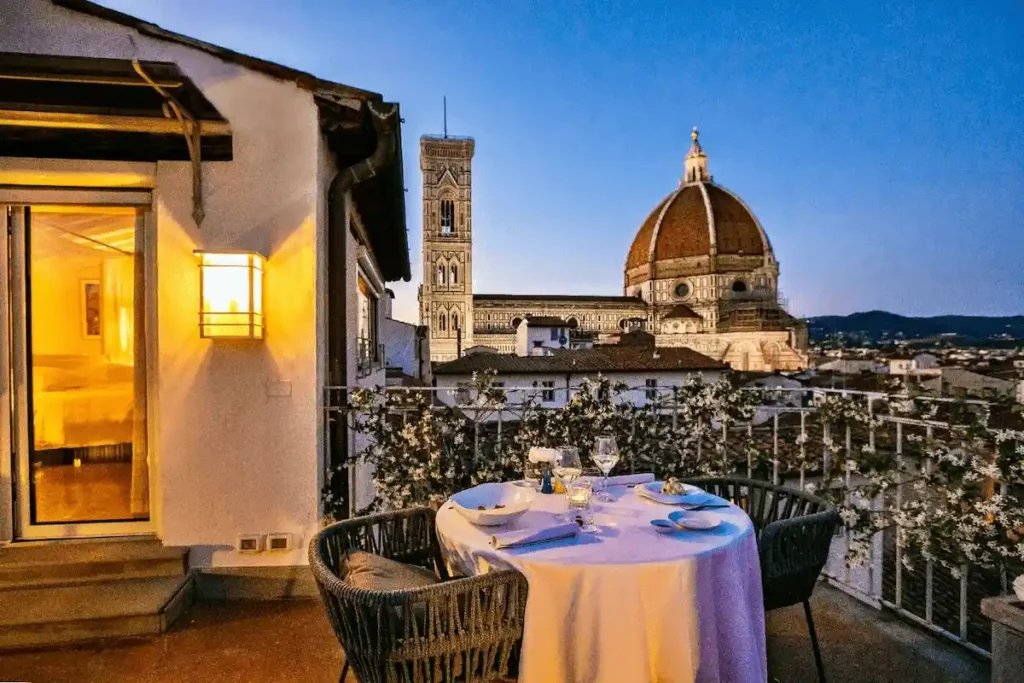
Brunelleschi Hotel Florence occupies the Torre della Pagliazza, a semi-circular Byzantine fortification from 541–544 AD and the oldest standing structure in Florence. This isn’t architectural nostalgia—it’s verified dominance. The hotel integrates a deconsecrated medieval church, excavated Roman thermal baths, and a private archaeological museum into a functioning luxury estate.
Guests inhabit the same stone-vaulted chambers that once imprisoned medieval nobility and housed sacred rites. The property’s Michelin-starred restaurant operates within the tower’s circular walls, while select suites command unobstructed views of Brunelleschi’s Dome from private terraces. This is Florence’s historical core converted into operational authority—1,500 years of documented power concentrated into 96 guest rooms.
Brunelleschi Hotel Florence ★★★★
The Torre della Pagliazza isn’t a design feature—it’s Florence’s oldest building, constructed during the Byzantine Empire‘s sixth-century expansion into Tuscany. The semi-circular tower served as a military watchtower before becoming a women’s prison in the 12th century, where straw pallets earned it the name “Pagliazza.”
Brunelleschi Hotel Florence offers a profound immersion into Italian history, allowing guests to stay within a restored Byzantine tower and a medieval church while enjoying ultra-modern luxury in the absolute center of the historic district.
The hotel’s restoration exposed this lineage: Roman thermal baths beneath the foundations, Renaissance ceramics embedded in medieval mortar, and the intact stone arches of San Michele in Palchetto, the noble families’ private church. These aren’t reproductions. They’re the original power structures, converted into guest corridors and dining halls through a multi-year preservation effort that earned multiple architectural distinctions.
The 96 rooms translate this archaeological depth into spatial hierarchy. Tower Suites occupy the Pagliazza’s circular walls, providing 360-degree views across the Giotto Bell Tower and the terracotta rooftops of the Centro Storico. “Pool & Cathedral View” suites position guests at eye level with Brunelleschi’s Dome, the lantern appearing close enough to touch from private terraces equipped with heated plunge pools.
Standard accommodations maintain the estate’s “Contemporary Classic” vocabulary: Pietra Serena stone sourced from the same Fiesole quarries used in the original construction, oak flooring reclaimed from Tuscan monasteries, and exposed medieval masonry defining every room’s geometry.
The fitness center operates against original sixth-century walls—Technogym equipment positioned where Byzantine soldiers once stored weapons.
The Museo della Pagliazza occupies the tower’s basement, displaying artifacts excavated during renovation: Imperial-era bath tiles, Montelupo ceramic fragments, and foundation stones bearing Byzantine toolmarks. It’s a private collection requiring no tickets, accessible exclusively to hotel guests.
Above this archaeological substrate, Santa Elisabetta Restaurant operates within the tower’s seven-table interior, where Chef is executing Mediterranean tasting menus beneath vaulted ceilings that once echoed with prisoners’ voices. The ground-floor Osteria Pagliazza offers less formal Tuscan dining on a pedestrian square connecting the Duomo to Palazzo Vecchio—the geographic center of Florence’s medieval government.
The concierge team holds Clefs d’Or status, managing access that reflects the property’s institutional leverage: after-hours entry to the Vasari Corridor (the Medici family’s private elevated walkway), skip-the-line Uffizi admissions timed to curator-led conservation areas, and private viewings at the Bargello sculpture collection. These aren’t tourist upgrades—they’re the preferential treatment historically reserved for Florence’s banking dynasties, now extended to guests occupying their former seats of authority.
Check Availability & Rates →The Pagliazza tower has stood through fourteen centuries of Florentine power—from Byzantine military command to Medici imprisonment—and now functions as the city’s most verifiable luxury anchor, where historical dominance translates directly into modern territorial advantage within the Centro Storico’s pedestrian-only zone.
FAQ: Brunelleschi Hotel Florence
What makes Brunelleschi Hotel Florence historically significant?
Brunelleschi Hotel Florence incorporates the Torre della Pagliazza, a Byzantine tower constructed between 541–544 AD and Florence’s oldest surviving building. The property includes excavated Roman thermal baths, a deconsecrated medieval church (San Michele in Palchetto), and operates a private archaeological museum displaying artifacts discovered during restoration, including Imperial-era ceramics and Byzantine foundation stones.
Does the hotel have Michelin-starred dining?
Yes. Santa Elisabetta Restaurant operates within the Torre della Pagliazza’s circular walls, seating only seven tables. Chef executes Mediterranean tasting menus in the same chamber that functioned as a 12th-century prison. The ground-floor Osteria Pagliazza offers traditional Tuscan cuisine in a more relaxed setting.
What views are available from the hotel?
Tower Suites provide 360-degree panoramas of the Florentine skyline, including direct sight lines to the Giotto Bell Tower. “Pool & Cathedral View” suites feature private terraces with heated plunge pools positioned at equal elevation to Brunelleschi’s Dome, offering unobstructed views of the cathedral’s lantern and terracotta cupola from the Centro Storico’s geographic center.
How close is the hotel to Florence’s main attractions?
The hotel occupies a pedestrian square equidistant from the Duomo (200 meters) and Palazzo Vecchio (150 meters), within the restricted-traffic Centro Storico zone. The concierge provides skip-the-line access to the Uffizi Gallery and after-hours entry to the Vasari Corridor, the Medici family’s private elevated walkway connecting the Pitti Palace to the Uffizi administrative offices.
Florence’s Archaeological Authority, Operational Today
The Brunelleschi Hotel Florence preserves the city’s oldest verified structure while functioning as a Michelin-starred estate. Guests inhabit the same Byzantine fortification that anchored six centuries of territorial control, now equipped with contemporary systems that maintain the tower’s architectural dominance.
Travelers comparing elite Florentine accommodations, consider the architectural heritage and contemporary design of NH Collection Firenze Porta Rossa or the palazzo grandeur of Hotel Bernini Palace Florence.
For more curated itineraries and luxury-focused travel insights, visit Your Luxury Guide. For official travel information and destination updates, visit Italy tourism.
Your Luxury Guide — Where Exceptional Travel Begins.