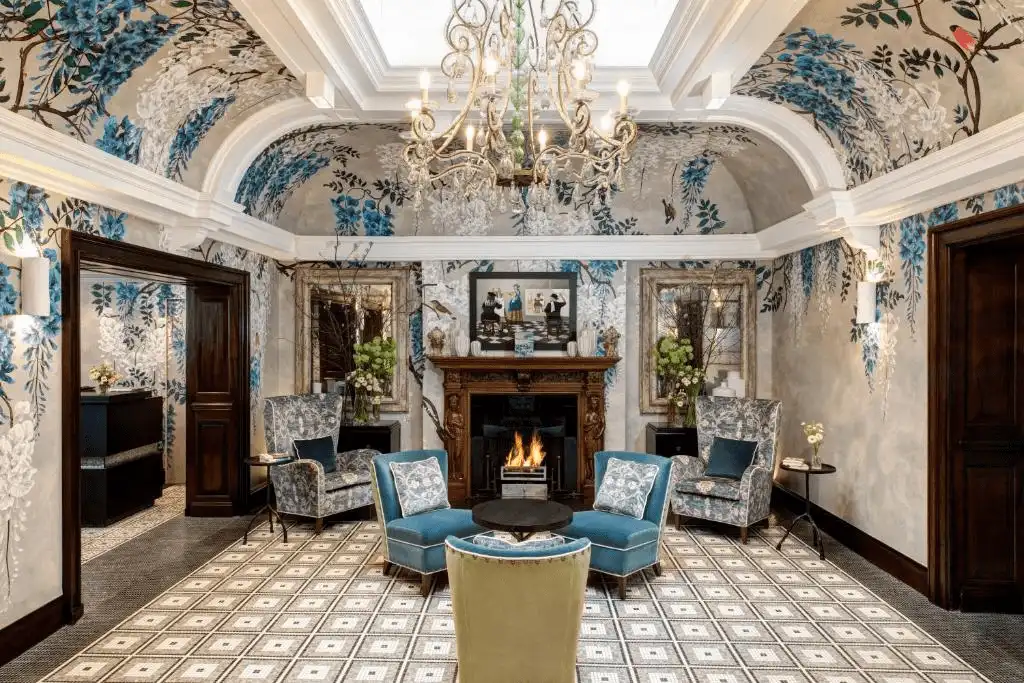
Brown’s Hotel London operates from 11 interconnected Georgian townhouses on Albemarle Street—the architectural footprint where Alexander Graham Bell demonstrated Britain’s first telephone transmission in 1876, where Rudyard Kipling drafted The Jungle Book, and where Queen Victoria held court outside Buckingham Palace. This is the original site of London’s first purpose-built hotel, established in 1837 by James Brown, former manservant to Lord Byron. The property functions today as a Rocco Forte operation, maintaining the spatial command of Mayfair’s most influential address while providing direct access to Bond Street, Cork Street galleries, and the Royal Academy.
Guests inhabit rooms where Roosevelt honeymooned, where exiled royalty governed in absence, and where Britain’s literary establishment negotiated contracts over afternoon service that has operated without interruption for 187 years.
Brown’s Hotel, a Rocco Forte Hotel ★★★★★
Brown’s Hotel London commands eleven contiguous Georgian structures—original 1837 construction—creating a 3,000-square-meter horizontal estate rare in central London’s vertical luxury market. The Kipling Suite occupies the northwest corner where Rudyard Kipling resided during extended 1890s stays, drafting significant portions of The Jungle Book manuscript in rooms that retain original crown molding, stained glass panels, and the floor-to-ceiling sash windows overlooking Albemarle Street’s gallery district.
Brown’s Hotel is a timeless Mayfair institution and the city’s oldest hotel, a historic literary sanctuary where Alexander Graham Bell made the UK’s first telephone call and Rudyard Kipling penned “The Jungle Book”.
The Drawing Room functions as London’s longest-operating afternoon tea service, a daily ritual established in the mid-1800s that Queen Victoria attended regularly, creating the social template that defined Victorian hospitality standards. The room maintains its original proportions—4.2-meter ceilings, Carrara marble fireplaces, hand-carved wainscoting—spaces designed for 19th-century diplomatic reception that now accommodate 40 seated guests per service. The resident pianist performs on a Blüthner grand, continuing a music program that has operated since the hotel’s opening year.
Donovan Bar occupies the ground-floor salon where Alexander Graham Bell conducted his 1876 telephone demonstration, transmitting voice 200 meters to a receiver in another wing—Britain’s first successful long-distance call, witnessed by hotel management and documented in The Times. The space now displays 50+ original Terence Donovan prints, floor-to-ceiling installations that transform the historic demonstration room into a gallery environment. The bar program focuses on pre-Prohibition American cocktails and British Colonial-era spirits, connecting the room’s communication history to its current social function.
Charlie’s restaurant operates in what were originally three separate Georgian dining rooms, now opened into a single 120-seat space through structural modifications completed during the 2005 Rocco Forte renovation. The kitchen executes modern British technique—Windsor beef, Scottish langoustines, Jersey dairy—served beneath restored botanical wallpaper patterns and original dark wood ceiling treatments. This is the room where Theodore Roosevelt took his honeymoon breakfast in June 1886; his marriage certificate remains in the hotel archives, stored in climate-controlled conditions alongside guest registers documenting nine years of residence by King George II of Greece during his 1923-1935 exile.
The 33 suites include the Roosevelt Room (original 1886 furnishings), the Kipling Suite (handwritten letter framed above the desk), and the Royal Suite (Queen Victoria’s preferred accommodations, retaining original four-poster framework). Room dimensions reflect Georgian residential scale—3.8-meter ceilings, 40-square-meter bedchambers, marble en-suites installed during the property’s 1889 plumbing modernization. The Albemarle Gallery program rotates contemporary British artists quarterly—Tracey Emin, David Hockney, Damien Hirst—creating deliberate tension between 1837 architecture and current production.
The basement spa occupies former servants’ quarters and wine storage vaults, barrel-vaulted brick construction converted into treatment rooms using Irene Forte formulations. This is utility space elevated to luxury function, maintaining the below-grade coolness and acoustic isolation that made these rooms operationally valuable in the 19th century.
Agatha Christie documented Brown’s in At Bertram’s Hotel (1965), using the property as the template for her fictional establishment where “nothing ever changed.” She stayed here 40+ times between 1920-1970, always requesting corner rooms overlooking Albemarle Street, the same spatial preference Queen Victoria maintained six decades earlier.
Check Availability & Rates →Brown’s Hotel London is not heritage accommodation—it is the uninterrupted operation of Britain’s first purpose-built hospitality structure, where eleven Georgian townhouses function as the architectural record of 187 years of diplomatic, literary, and royal residence. You are not visiting history. You are inhabiting the active headquarters where Britain’s command class has convened since Lord Melbourne was Prime Minister.
FAQ: Brown’s Hotel London
What makes Brown’s Hotel London historically significant?
Brown’s Hotel London is Britain’s first purpose-built hotel, established in 1837 by James Brown on Albemarle Street. The property hosted Alexander Graham Bell’s first UK telephone call in 1876, served as Rudyard Kipling’s residence during The Jungle Book manuscript development, and functioned as Queen Victoria’s preferred Mayfair address outside Buckingham Palace. The hotel consists of eleven interconnected Georgian townhouses maintaining original 1837 architectural elements including stained glass, crown molding, and marble fireplaces.
Which notable figures stayed at Brown’s Hotel?
Theodore Roosevelt honeymooned at Brown’s in 1886; his marriage certificate remains in hotel archives. Rudyard Kipling resided in what is now the Kipling Suite during the 1890s, writing significant portions of The Jungle Book on-site. King George II of Greece lived at the hotel for nine years (1923-1935) during his exile. Agatha Christie stayed 40+ times between 1920-1970, using the property as the basis for her novel At Bertram’s Hotel. Queen Victoria made regular visits throughout her reign.
What are Brown’s Hotel’s signature dining and bar experiences?
The Drawing Room has operated London’s longest-running afternoon tea service since the mid-1800s, featuring a resident pianist and the original Victorian service format Queen Victoria attended. Donovan Bar occupies the room where Alexander Graham Bell made Britain’s first telephone call, now displaying 50+ original Terence Donovan photographs. Charlie’s restaurant serves modern British cuisine in a space combining three Georgian dining rooms, focusing on Windsor beef, Scottish seafood, and heritage British ingredients.
What rooms and suites define Brown’s Hotel’s accommodation offering?
The Kipling Suite contains original furnishings and a framed handwritten letter from Rudyard Kipling, with floor-to-ceiling windows overlooking Albemarle Street. The Roosevelt Room maintains 1886 period elements from Theodore Roosevelt’s honeymoon stay. The Royal Suite preserves Queen Victoria’s preferred layout including the original four-poster bed framework. All 33 suites feature 3.8-meter Georgian ceilings, marble bathrooms from the 1889 modernization, and original architectural details including stained glass panels and dark wood wainscoting.
Brown’s Maintains London’s Longest Institutional Memory
Brown’s Hotel London operates as the physical archive of 187 years of British diplomatic and cultural authority, where eleven Georgian townhouses function as the architectural infrastructure that established modern luxury hospitality standards. This is residence at the site where communication, literature, and royal protocol were redefined—not commemorated, but actively continued through daily service in rooms that retain their original command function.
For comparable heritage operations in London’s luxury hotel sector, review Hotel Cafe Royal London and Raffles London at The OWO.
More curated itineraries and luxury-focused travel insights at Your Luxury Guide. For official travel information and destination updates, visit Britain tourism-info.
Your Luxury Guide — Where Exceptional Travel Begins.