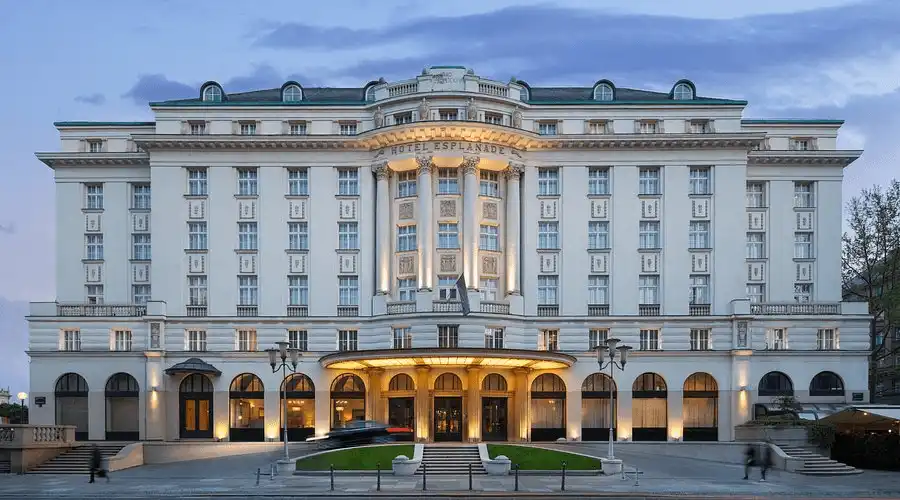
The best hotels in Zagreb aren’t hiding in generic five-star towers—they’re embedded in the city’s architectural memory. This is a capital built on Austro-Hungarian ambition, interwar banking empires, and neoclassical merchant wealth. The problem: most “luxury” searches lead to corporate chains where the only history is last year’s renovation. High thread counts don’t replace structural soul.
We’ve audited Zagreb’s historic hotel inventory and rejected every property without a verified past-life identity. What remains are former bank palaces with intact vaults, Art Deco landmarks built for Orient Express passengers, and neoclassical coaching inns that predate the nation itself. This is not a comprehensive list—it’s a filter. Every property below guarantees immersion in a building that was something significant before it became somewhere to sleep. Your time is saved. The soul is guaranteed.
For the broader Croatian context, explore our full audit of best historic hotels in Croatia.
Upper Town & City Center: Banking Palaces and Belle Époque Landmarks
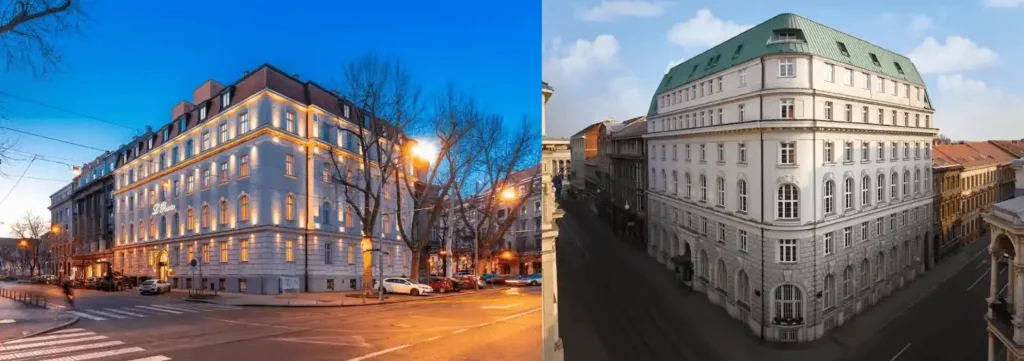
These properties anchor Zagreb’s most prestigious addresses—where early 20th-century financial power and Art Deco ambition converged. Expect grand lobbies, preserved vaults, and rooms where architectural restraint signals confidence, not austerity. This is the Zagreb that financed empires.
🎭 Esplanade Zagreb Hotel ★★★★★
Built in 1925 as the official reception point for Orient Express passengers arriving from Paris and Istanbul, the Esplanade remains Zagreb’s most architecturally intact Art Deco landmark.
The original Emerald Ballroom—a Viennese Secession masterpiece with hand-painted ceilings and crystal chandeliers—still anchors the ground floor, while the Oleander Terrace maintains its 1920s structural geometry. The rooms themselves occupy the building’s original guest wing, updated with contemporary bathrooms but preserving the high ceilings, oak herringbone floors, and oversized windows that defined interwar luxury.
What separates this property from modern reproductions is the absence of visual clutter: no faux-historic pastiche, just the restrained elegance of a building that never needed to prove itself. Step off Mihanovićeva and the lobby silence—thick marble, brass fixtures, the scent of old wood—immediately filters out the city’s tram noise. The Zinfandel’s Restaurant offers Michelin-level Croatian-French cuisine under the same vaulted ceilings that once hosted European aristocracy.
Best for: Travelers seeking Zagreb’s most significant Art Deco landmark with Orient Express heritage and palatial public spaces.
Signature Experience: Original 1925 Emerald Ballroom for private events, Oleander Terrace overlooking tram-lined boulevards, Zinfandel’s haute cuisine under preserved Secession vaults, Le Bistro for champagne in oak-paneled intimacy.
“Walking into that ballroom felt like stepping onto a film set—except every chandelier is real.” — Marko, ViennaCheck Availability & Rates →
🏦 Hotel Le Premier ★★★★★
This 1923 Secessionist landmark was originally constructed as a grand bank palace during Zagreb’s interwar financial boom—a period when banking institutions commissioned architects to build monuments, not just offices. The protected facade remains untouched, while the interior preserves the original high-ceilinged marble halls that once housed vault transactions and client consultations.
The conversion to hospitality maintained the building’s spatial hierarchy: rooms occupy former administrative floors, meaning ceilings reach 4.5 meters with original crown molding and oak window frames intact. What defines the experience here is the absence of compromise—no dropped ceilings, no subdivided volumes. The ground-floor lobby transitions directly from street noise into the acoustic stillness of 1920s marble and brass. The on-site restaurant occupies the former banking hall, where original columns and clerestory windows create dramatic natural light even at midday. This is Zagreb’s most architecturally pure Secessionist conversion.
Best for: Architecture enthusiasts prioritizing intact Secessionist interiors and palatial scale over contemporary amenities.
Signature Experience: Protected 1923 facade viewing from private balconies, breakfast in the former banking hall under original clerestory light, marble-floored lobbies with brass-and-oak period detailing, rooms with 4.5-meter ceilings.
“The ceiling height alone makes you feel like you’re staying in someone’s mansion, not a hotel room.” — Ana, LjubljanaCheck Availability & Rates →
🔐 Hotel Capital ★★★★
Another 1923 Secessionist landmark, originally the Zagreb headquarters of the Wiener Bank-Verein—one of Central Europe’s most powerful financial institutions. The defining feature: the original massive steel bank vaults remain intact in the basement, accessible for private tours and events. The heritage rooms on the upper floors maintain their original wood paneling, coffered ceilings, and oversized windows designed to project wealth and permanence.
The conversion preserved the building’s vertical hierarchy—ground floor for grand public interaction, upper floors for private retreat. What this property offers that Le Premier doesn’t is direct access to the vaults themselves, a tactile connection to Zagreb’s banking history that few conversions allow. The rooms balance period details with modern bathrooms and updated HVAC, but the architectural volume remains untouched. The on-site restaurant occupies the former client consultation hall, where wood-paneled walls and original brass light fixtures create an intimate, clubby atmosphere.
Best for: Guests seeking direct vault access and wood-paneled intimacy within a verified 1920s banking landmark.
Signature Experience: Private tours of original steel bank vaults, heritage rooms with preserved wood paneling and coffered ceilings, breakfast in the former consultation hall, Secessionist facade views from corner suites.
“Seeing those vault doors up close—knowing they’re original—made the stay feel like sleeping inside history.” — Ivan, PragueCheck Availability & Rates →
🏨 Best Western Premier Hotel Astoria ★★★★
Built in 1932 during Zagreb’s interwar urban expansion, this Modernist landmark represents the shift from Secessionist ornamentation to streamlined, function-driven design.
The building preserves its original 1930s architectural volume—high ceilings, grand-scale corridors, and a lobby wood-and-brass aesthetic that feels more like a private club than a commercial hotel. What distinguishes this property is its restraint: no excessive decoration, no nostalgic pastiche, just clean lines and honest materials. The rooms occupy the original guest floors, maintaining the proportions and window placement from the 1930s conversion.
The location—near the main railway station—echoes its original purpose as a transit hotel for business travelers moving between Vienna, Belgrade, and Zagreb. The on-site restaurant preserves the lobby’s original wood paneling and brass fixtures, offering Croatian cuisine in an atmosphere of understated mid-century elegance.
Best for: Modernist architecture admirers seeking streamlined 1930s design near the central railway station.
Signature Experience: Original 1930s wood-and-brass lobby aesthetic, grand-scale corridors with period proportions, rooms with high ceilings and oversized windows, Croatian cuisine in wood-paneled restaurant.
“The lobby feels like a scene from an old European film—elegant without trying too hard.” — Sofia, BudapestCheck Availability & Rates →
Upper Town: Zagreb’s Oldest Neoclassical Inn
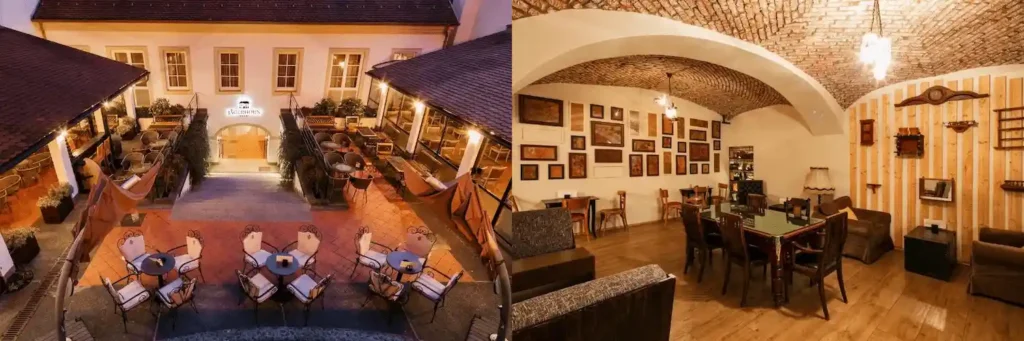
This section moves away from banking palaces and interwar grandeur to focus on the city’s oldest surviving hospitality structure—a neoclassical coaching inn that predates modern Croatia itself. Expect smaller scale, historical intimacy, and the architectural simplicity of early 19th-century merchant travel.
🕰️ Hotel Jägerhorn ★★★
Established in 1827, this is Zagreb’s oldest hotel—a neoclassical coaching inn built when the city was still part of the Habsburg Empire. The defining architectural feature: the original 1827 inner courtyard, fully preserved in its historical footprint, serves as the communal breakfast area and social hub. The 19th-century facade remains untouched, including the original window frames and street-facing entrance that once welcomed horse-drawn carriages.
The rooms themselves are modest by contemporary luxury standards—no spa, no rooftop bar—but the value lies in the building’s authenticity. This is not a reimagined “historic-style” property; it’s the actual structure, with original stone floors, exposed wooden beams, and period proportions intact.
The location in the Upper Town places guests within walking distance of St. Mark’s Church and the historic core, but the real draw is the building itself: a tangible link to Zagreb’s pre-industrial hospitality culture.
Best for: History-focused travelers prioritizing architectural authenticity and Upper Town location over contemporary amenities.
Signature Experience: Breakfast in the original 1827 inner courtyard, preserved neoclassical facade and entrance, rooms with exposed wooden beams and period proportions, walking access to St. Mark’s Church.
“That courtyard breakfast felt like stepping back two centuries—no pretense, just real history.” — Petra, GrazCheck Availability & Rates →
📊 Comparison: Best Hotels in Zagreb
| Hotel | Location | Wellness & Spa | Dining | Unique Perks | Best For |
|---|---|---|---|---|---|
|
🎭 Esplanade Zagreb Hotel ★★★★★ |
City Center, Upper Town edge |
Wellness center, massage services |
Zinfandel’s haute cuisine, Le Bistro champagne bar |
1925 Emerald Ballroom, Orient Express heritage |
Art Deco purists, palatial stays |
|
🏦 Hotel Le Premier ★★★★★ |
City Center, banking district |
Spa services, wellness packages |
Former banking hall restaurant, fine dining |
Protected 1923 facade, 4.5-meter ceilings |
Secessionist architecture lovers |
|
🔐 Hotel Capital ★★★★ |
City Center, near main square |
Wellness room, massage on request |
Wood-paneled restaurant, Croatian-European cuisine |
Original steel vaults, heritage wood paneling |
Vault access seekers, banking history enthusiasts |
- If you’re considering other Adriatic destinations, compare these options with our curated selection of best hotels in Split.
❓ FAQ: Best Hotels in Zagreb
What makes these hotels “historic” in Zagreb?
Every property listed maintains a verified past-life identity—former banking palaces, Art Deco landmarks built for Orient Express passengers, or neoclassical coaching inns from the Habsburg era. We prioritize buildings where the original architectural footprint, structural elements (vaults, facades, courtyards), and spatial hierarchy remain intact. This isn’t about “historic-style” theming; it’s about sleeping in structures that were something significant before they became hotels.
Which Zagreb hotel has the most intact Art Deco architecture?
The Esplanade Zagreb Hotel preserves the most complete Art Deco ensemble: the original 1925 Emerald Ballroom with hand-painted ceilings, Oleander Terrace with period geometry, and lobby spaces designed specifically for Orient Express passengers. The architectural restraint and material honesty separate it from modern reproductions that mimic the aesthetic without the provenance.
Can I access the original bank vaults at any of these hotels?
Hotel Capital offers private tours and event access to the original massive steel bank vaults from its 1923 Wiener Bank-Verein construction. These aren’t decorative features—they’re functional period structures preserved in the basement. It’s the only property in Zagreb where guests can experience this level of direct interaction with banking-era infrastructure.
What’s the difference between Le Premier and Capital if both are 1923 bank conversions?
Le Premier prioritizes palatial public spaces—4.5-meter ceilings, marble halls, protected facade—making it ideal for guests seeking Secessionist grandeur. Hotel Capital emphasizes intimate, wood-paneled heritage rooms and direct vault access, appealing to those who value tactile historical connection over monumental scale. Both are architecturally significant; the choice depends on whether you prefer visual drama or material intimacy.
Is Hotel Jägerhorn worth staying at despite being a 3-star property?
For architecture-focused travelers, yes. It’s Zagreb’s oldest hotel, with the original 1827 courtyard and neoclassical facade fully intact. You’re staying in an actual Habsburg-era coaching inn, not a recreation. The trade-off: fewer contemporary amenities (no spa, smaller rooms), but the structural authenticity and Upper Town location create historical immersion that higher-starred properties often sacrifice for modern luxury.
Which hotel is best for first-time visitors to Zagreb?
The Esplanade Zagreb Hotel combines central location, complete Art Deco preservation, and high service standards—making it the most accessible entry point for travelers unfamiliar with the city. Its Orient Express heritage and palatial public spaces provide immediate architectural impact without requiring deep historical knowledge to appreciate.
Do these hotels require advance booking during peak season?
Properties with limited rooms and high architectural significance—especially Hotel Jägerhorn and Hotel Capital—see inventory constraints during summer and holiday periods. The Esplanade and Le Premier have larger capacities but still experience demand spikes around major cultural events. Booking 8-12 weeks ahead ensures room category selection and rate stability.
Your Historic Stay in Zagreb Awaits
Choosing the best hotels in Zagreb means filtering past generic five-star labels to prioritize buildings with verified past-life identities. The properties above represent the city’s most architecturally significant conversions—from Art Deco palaces built for Orient Express travelers to neoclassical coaching inns that predate modern Croatia. This audit eliminates the guesswork. You’re not comparing amenity lists; you’re selecting between bank vaults, ballrooms, and Habsburg-era courtyards. Availability at this level shifts quickly once cultural events and peak travel windows open.
Explore nearby Adriatic options through our audit of best hotels in Opatija for Belle Époque coastal alternatives.
For more curated itineraries and luxury-focused travel insights, visit Your Luxury Guide. For official travel information and destination updates, visit Croatia tourism-info.
Book your Zagreb hotel to secure access to the city’s most architecturally intact landmarks—where structural heritage and verified provenance replace the visual noise of renovated generic luxury.
Your Luxury Guide — Where Exceptional Travel Begins.