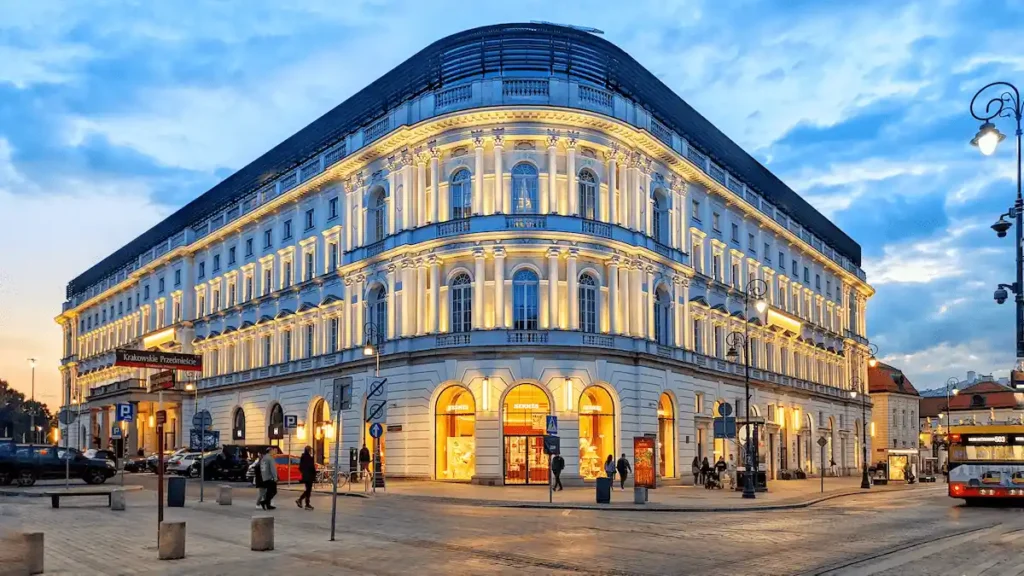
The best hotels in Warsaw are not found in glass-and-steel towers along sterile business districts—they occupy the city’s most significant architectural conversions. Warsaw’s hotel inventory presents a paradox: five-star labels saturate the market, yet many properties offer generic interiors that erase the city’s layered identity.
We audited Warsaw’s historic hotel stock and rejected weak renovations, brand-saturated lobbies, and properties lacking structural provenance. The selection below prioritizes verified “Past-Life Identity”—properties where the building itself is the primary cultural asset. Each hotel represents a specific chapter of Warsaw’s architectural evolution: 19th-century Neoclassical palaces that hosted Russian Empire elites, 18th-century Baroque residences designed by royal architects, and the rare pre-war Art Deco skyscraper that survived 1944.
This curated filter ensures your stay is not just luxury accommodation—it’s a living chapter of Warsaw’s resilience and grandeur, saving you from the overchoice of generic five-star anonymity.
For national context and cross-country architectural comparisons, explore our comprehensive audit of best historic hotels in Poland.
Old Town & Royal Route – Baroque Palaces & Neoclassical Icons
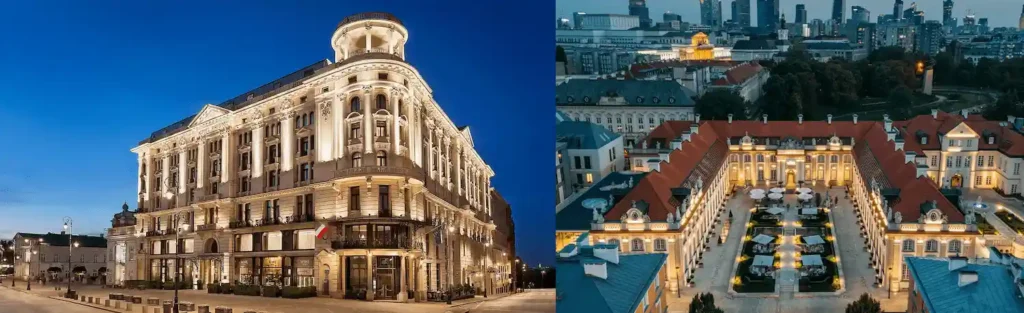
Warsaw’s historic core holds the city’s most prestigious architectural conversions—18th-century Baroque palaces designed for archbishops and aristocrats, and 19th-century Neoclassical landmarks that defined the Russian Empire’s western elite. These properties are not simply “near” history—they are structural witnesses to it.
Expect original brick vaults beneath Rococo salons, heritage staircases that once carried the creative intelligentsia, and marble craftsmanship preserved from pre-war Poland. Staying here places you inside the Royal Route’s cultural continuum, where each facade tells a story of survival, reconstruction, and Poland’s unbroken architectural memory.
🏛️ Raffles Europejski Warsaw ★★★★★
Once the most prestigious address in the 19th-century Russian Empire, this 1857 Neoclassical palace was designed by Enrico Marconi and hosted the creative elite of pre-war Poland. Today, Raffles Europejski combines that legacy with contemporary luxury—original marble craftsmanship and stuccowork frame modern suites, while the heritage staircase remains the structural centerpiece.
The meticulous restoration preserved 19th-century palace interiors while integrating a world-class spa and Michelin-level dining. You transition from the Royal Route’s energy into the silence of thick stone walls and the scent of polished oak. This is Warsaw’s only hotel where the building itself holds national landmark status, giving you overnight access to an architectural chapter most visitors only photograph from outside.
Best for: Discerning travelers seeking Poland’s most significant 19th-century palace hotel with contemporary five-star amenities and Royal Route positioning.
Signature Experience: Heritage staircase where Poland’s artistic elite once gathered, authentic 1857 marble interiors now housing a modern spa, Michelin-caliber dining beneath preserved stuccowork, direct access to Warsaw’s Royal Route and Old Town.
“Walking that heritage staircase every morning felt like stepping into a private museum—except the coffee was exceptional.” — Henrik, StockholmCheck Availability & Rates →
🎭 Hotel Bristol, A Luxury Collection Hotel, Warsaw ★★★★★
Founded in 1901 by Ignacy Jan Paderewski, this Neo-Renaissance landmark is among the rare structures in central Warsaw to survive WWII nearly intact, preserving original Art Nouveau interiors by Otto Wagner Jr.
The Column Bar and Malinowa Hall remain structural masterpieces from the 1900s—authentic frescoes, the city’s first historic elevator, and hand-carved detailing that predates Poland’s modern statehood. Today’s suites balance that heritage soul with contemporary comfort, while the ground-floor salons maintain their Belle Époque grandeur. You step off Krakowskie Przedmieście into a world where pre-war Poland’s cultural aristocracy gathered, and the transition from street noise to oak-paneled silence is immediate.
No other hotel in Warsaw offers this level of documented Art Nouveau preservation combined with five-star service and central Old Town access.
Best for: History-focused luxury travelers drawn to verified Art Nouveau preservation, Belle Époque salons, and Warsaw’s most intact pre-war palace interiors.
Signature Experience: Original 1901 Art Nouveau interiors by Otto Wagner Jr., Column Bar with authentic period frescoes, Malinowa Hall hosting Warsaw’s cultural elite since the early 1900s, first historic elevator in the city still operational.
“That elevator alone—riding the same lift that served pre-war Polish nobility—worth the stay just for that detail.” — Clara, ViennaCheck Availability & Rates →
🌿 Hotel Verte, Warsaw, Autograph Collection ★★★★★
Two 18th-century Baroque aristocratic palaces—the Branicki and Szaniawski residences designed by Jakub Fontana—merged into a singular heritage hotel. These were high-status noble estates, often called the “Polish Versailles” for their grandeur. The 2022 restoration preserved the original Baroque facade and exposed 18th-century brick vaults in the subterranean pavilions, now transformed into wellness spaces.
Modern suites occupy the palace’s upper floors, where original proportions and ceiling heights remain intact. You enter from the Old Town’s edge into a private courtyard that seals out the city’s noise, and the shift from cobblestone streets to marble corridors is visceral. This is the only hotel in Warsaw where you sleep inside verified Fontana-designed architecture, giving you direct access to Poland’s Baroque aristocratic legacy.
Best for: Travelers seeking 18th-century Baroque palace architecture with a contemporary wellness focus and proximity to Warsaw’s Old Town.
Signature Experience: Original Jakub Fontana-designed Baroque facade, 18th-century brick vaults converted into subterranean spa pavilions, private courtyard sealing out urban noise, rooms preserving noble-era ceiling proportions.
“The spa in those brick vaults—centuries-old stone above your head while you unwind—nothing else in Warsaw compares.” — Olivia, LondonCheck Availability & Rates →
⛪ Hotel Bellotto ★★★★★
This 16th-century Primate’s Palace originally served as the residence of the Archbishops of Gniezno, making it one of Warsaw’s oldest preserved ecclesiastical structures. The subterranean levels reveal original 16th-century brick arches—rare architectural evidence of pre-Baroque Warsaw.
The ground floor maintains the high-status Rococo and Classical layout that defined the residence during its peak, while contemporary suites occupy the upper floors. You cross from the bustling New Town into a space where stone walls absorb sound and centuries of ecclesiastical history linger in the masonry. This is Warsaw’s only hotel where you stay inside verified 16th-century Archbishop’s quarters, offering a heritage narrative that predates Poland’s Baroque transformation.
Best for: Guests drawn to ecclesiastical heritage, 16th-century masonry, and Warsaw’s oldest preserved palace architecture within the New Town.
Signature Experience: Original 16th-century brick arches in subterranean levels, Rococo and Classical ground-floor layout from Archbishop residence, oldest preserved ecclesiastical structure in Warsaw’s hotel inventory, New Town proximity with historical isolation.
“Those brick arches downstairs—knowing they were here before the Baroque era even began—that’s a memory you don’t forget.” — Thomas, BrusselsCheck Availability & Rates →
🏰 Mamaison Le Regina Boutique Hotel ★★★★★
The 18th-century Mokrowski Palace was originally an aristocratic urban residence in Warsaw’s New Town, designed with the high-ceiling proportions and private courtyards that defined noble estates. The restoration preserved an authentic 18th-century inner courtyard and original stone masonry, with several rooms retaining frescoes and the structural layout of a Baroque palace.
Modern suites maintain those historical proportions, and the transition from New Town cobblestones into the palace’s enclosed courtyard creates immediate sensory separation from the city. You’re staying in a verified Baroque residence where original frescoes still frame your sleep, a rare detail in a city where most interiors were lost to wartime destruction.
Best for: Boutique-hotel enthusiasts seeking 18th-century Baroque palace proportions, original frescoes, and New Town positioning with courtyard privacy.
Signature Experience: Authentic 18th-century inner courtyard with original stone masonry, rooms preserving Baroque frescoes and noble-era ceiling heights, intimate boutique scale within verified palace architecture, New Town location with heritage isolation.
“Waking up under those original frescoes—you forget you’re in a hotel and not a private aristocratic estate.” — Sophie, CopenhagenCheck Availability & Rates →
Central Warsaw – Pre-War Skyscrapers & Grand City Hotels
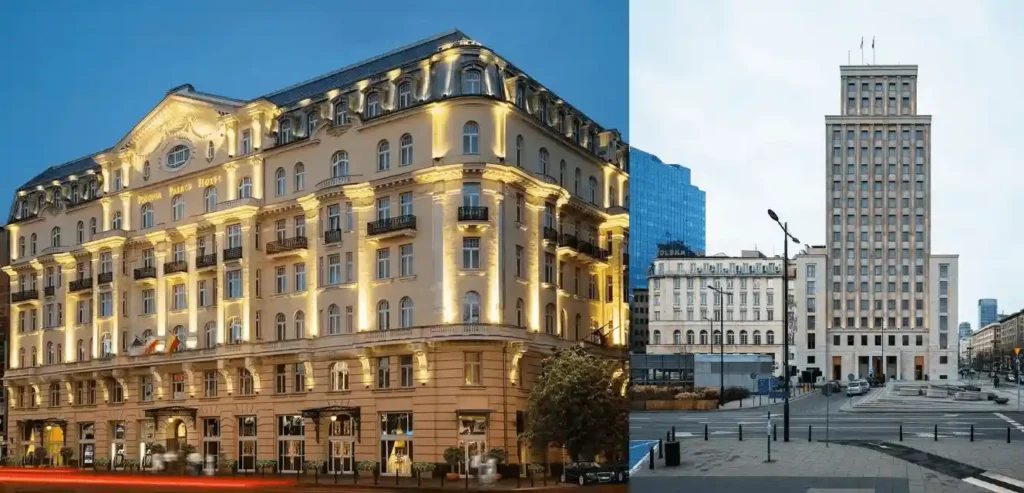
Beyond the Baroque and Neoclassical palaces, Warsaw’s central district holds a different architectural legacy—the pre-war modernist hotels and skyscrapers that defined Poland’s interwar ambitions. These properties survived the 1944 destruction or were meticulously reconstructed, preserving original Art Deco detailing, Louis XVI ballrooms, and 1930s steel skeletons.
Staying here connects you to the Warsaw that aspired to become the “Paris of the East,” where grand city hotels hosted international diplomats and the city’s first skyscraper symbolized financial power. These are not palace conversions—they are monuments to Poland’s modernist confidence before the war erased it.
🏛️ Hotel Polonia Palace ★★★★
This 1913 monumental city hotel was the first in Warsaw with central heating, and it survived the 1944 destruction that leveled most of the city center. The historic Louis XVI-style ballroom and grand marble fireplaces remain original, having hosted General Eisenhower and serving as a cultural landmark throughout Poland’s turbulent 20th century.
Today’s rooms blend early-1900s grandeur with modern comfort, and the ground-floor salons preserve the proportions and detailing of Warsaw’s Belle Époque hotel era. You step from the city’s commercial energy into a space where marble and stucco still echo pre-war hospitality standards. This is Warsaw’s only surviving grand city hotel from the early 1900s, offering a heritage narrative distinct from palace conversions.
Best for: Travelers drawn to early-1900s grand city hotel architecture, verified Louis XVI interiors, and Warsaw’s pre-war hospitality heritage.
Signature Experience: Original Louis XVI-style ballroom that hosted General Eisenhower, grand marble fireplaces from 1913, first hotel in Warsaw with central heating, Belle Époque proportions in ground-floor salons.
“That ballroom—knowing Eisenhower stood in the same space—history you can physically feel, not just read about.” — Marc, ParisCheck Availability & Rates →
🏢 Hotel Warszawa ★★★★★
Originally the 1933 “Prudential” building—the tallest financial and administrative skyscraper in pre-war Poland—this Art Deco landmark survived the 1944 siege and became a symbol of Warsaw’s resilience.
The restoration exposed the original 1930s steel skeleton and historic concrete foundations, now integrated as structural design features visible throughout the hotel. Modern suites occupy the tower’s upper floors, offering skyline views framed by Art Deco detailing. You transition from street level into a preserved vertical monument where the building’s bones—steel and concrete from interwar Poland—are the primary aesthetic.
No other hotel in Warsaw lets you sleep inside the city’s first skyscraper, giving you overnight access to a chapter of modernist ambition most visitors only observe from outside.
Best for: Architecture enthusiasts and modernist design seekers drawn to Art Deco skyscraper heritage and Warsaw’s interwar financial history.
Signature Experience: Original 1930s steel skeleton exposed as design feature, historic concrete foundations visible in public spaces, tallest pre-war skyscraper in Poland now converted to luxury hotel, Art Deco detailing preserved throughout.
“Sleeping in Warsaw’s first skyscraper—the exposed steel beams in the lobby alone made the booking worthwhile.” — Anna, BerlinCheck Availability & Rates →
📊 Comparison: Best Hotels in Warsaw
| Hotel | Location | Wellness & Spa | Dining | Unique Perks | Best For |
|---|---|---|---|---|---|
|
🏛️ Raffles Europejski Warsaw ★★★★★ |
Royal Route, Old Town |
World-class spa, heritage marble interiors |
Michelin-level, preserved stuccowork salons |
1857 Neoclassical palace, national landmark status |
Poland’s most significant 19th-century palace hotel |
|
🎭 Hotel Bristol ★★★★★ |
Krakowskie Przedmieście, Old Town edge |
Traditional wellness, Belle Époque setting |
Column Bar, Art Nouveau frescoes |
1901 Neo-Renaissance, city’s first historic elevator |
Art Nouveau preservation, Belle Époque salons |
|
🌿 Hotel Verte Autograph Collection ★★★★★ |
Old Town edge, private courtyard |
Subterranean spa, 18th-century brick vaults |
Contemporary European, palace setting |
Jakub Fontana Baroque palaces, “Polish Versailles” |
18th-century Baroque, wellness-focused stay |
|
⛪ Hotel Bellotto ★★★★★ |
New Town, ecclesiastical quarter |
Boutique wellness, heritage masonry |
Modern European, Rococo interiors |
16th-century Archbishop’s palace, oldest preserved structure |
Ecclesiastical heritage, 16th-century masonry |
- For broader context across Poland’s royal cities, continue with our audit of best hotels in Krakow.
❓ FAQ: Best Hotels in Warsaw
What makes Warsaw’s historic hotels different from modern luxury hotels?
Warsaw’s best historic hotels occupy verified architectural conversions—19th-century Neoclassical palaces, 18th-century Baroque residences, and the city’s first Art Deco skyscraper. Unlike modern glass-and-steel towers, these properties preserve original masonry, heritage staircases, and period interiors that survived WWII. You’re staying inside structural witnesses to Warsaw’s resilience, not generic five-star boxes.
Which historic hotel in Warsaw has the most significant architectural provenance?
Raffles Europejski Warsaw holds national landmark status as the most prestigious 19th-century hotel in the Russian Empire, designed by Enrico Marconi in 1857. Hotel Bristol follows closely with original Art Nouveau interiors by Otto Wagner Jr. and the city’s first historic elevator. Both offer documented heritage that predates Poland’s modern statehood.
Are Warsaw’s historic hotels centrally located for Old Town access?
Yes. Raffles Europejski and Hotel Bristol sit directly on the Royal Route with immediate Old Town access. Hotel Verte occupies the Old Town edge with a private courtyard, while Hotel Bellotto and Mamaison Le Regina position you in the New Town, a short walk from the main historic district. All selections prioritize walkable heritage proximity.
Do these historic hotels offer modern amenities like spas and fine dining?
Absolutely. Raffles Europejski features a world-class spa within preserved 1857 marble interiors and Michelin-level dining. Hotel Verte integrates a subterranean spa inside 18th-century brick vaults. Hotel Bristol maintains its Belle Époque Column Bar with original Art Nouveau frescoes. Heritage architecture and contemporary luxury coexist seamlessly in these conversions.
Which Warsaw hotel is best for Art Deco and modernist architecture enthusiasts?
Hotel Warszawa—the 1933 “Prudential” building and Poland’s first skyscraper. The restoration exposed original 1930s steel skeleton and historic concrete foundations, now integrated as design features. This is Warsaw’s only hotel where you sleep inside verified interwar modernist architecture, offering a distinct alternative to Baroque and Neoclassical palaces.
Can you stay in a former Archbishop’s palace in Warsaw?
Yes. Hotel Bellotto occupies the 16th-century Primate’s Palace, originally the residence of the Archbishops of Gniezno. The subterranean levels preserve original 16th-century brick arches—the oldest ecclesiastical masonry in Warsaw’s hotel inventory. This is the city’s only hotel where you stay inside verified Archbishop’s quarters.
How do I choose between a Baroque palace and a Neoclassical hotel in Warsaw?
If you’re drawn to 18th-century aristocratic architecture, Jakub Fontana-designed interiors, and intimate courtyard settings, choose Hotel Verte or Mamaison Le Regina. If you prefer 19th-century Neoclassical grandeur, imperial-era prestige, and monumental interiors, select Raffles Europejski or Hotel Bristol. Both heritage types offer distinct chapters of Warsaw’s architectural evolution—neither is superior, just different in character and period focus.
Final Verdict: Warsaw’s Finest Historic Hotels
Booking the right hotel in Warsaw isn’t about chasing the most expensive option—it’s about choosing the property whose architectural identity matches how you want to experience the city’s layered history.
The selections above represent the most consistently refined options for travelers who value verified provenance, structural authenticity, and cultural immersion over generic five-star anonymity. Availability at Poland’s most significant palace conversions and Art Deco landmarks shifts quickly, especially during cultural events and peak heritage tourism months.
If you’re drawn to Silesian industrial heritage mixed with Baroque grandeur, explore best hotels in Wroclaw.
For more curated itineraries and luxury-focused travel insights, visit Your Luxury Guide. For official travel information and destination updates, visit Poland tourism-info.
Booking your hotel in Warsaw unlocks access to Poland’s most architecturally significant conversions—19th-century palaces where the Russian Empire’s elite gathered, 18th-century Baroque residences designed by royal architects, and the nation’s first skyscraper still standing as a testament to interwar ambition.
Your Luxury Guide — Where Exceptional Travel Begins.