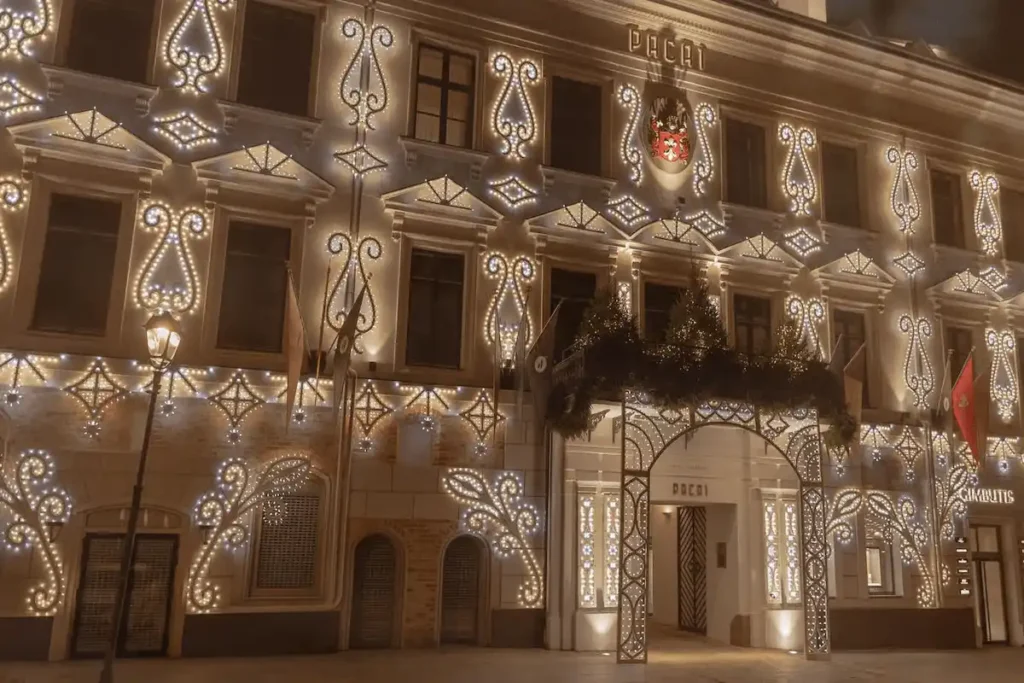
The best hotels in Vilnius occupy buildings that once defined the power structure of the Grand Duchy of Lithuania—Baroque noble palaces, Imperial treasuries, and medieval artisan quarters. This is a city where 16th-century defense walls run beneath hotel basements and where aristocratic courtyards remain the quietest rooms in the Old Town.
The challenge is separating properties with genuine architectural provenance from modern renovations dressed in “historic” marketing language.
We audited Vilnius’s entire inventory, rejecting weak conversions and brand-saturated boxes to focus exclusively on properties with verified “Past-Life” identities—buildings where the stone, the frescoes, and the spatial logic are original. This curated selection guarantees you’re staying inside a living chapter of Lithuanian history, not just near one.
For a deeper exploration of Lithuania’s architectural conversions beyond the capital, continue with our national audit of best historic hotels in Lithuania.
Historic Palaces & Noble Residences
These are the properties where Lithuania’s aristocratic past isn’t a theme—it’s the structure. Original courtyards, 17th-century frescoes, and Baroque facades define the spatial experience. If you’re drawn to the weight of history in the walls themselves, this is where Vilnius reveals its noble lineage.
🏛️ Hotel Pacai, Vilnius, a Member of Design Hotels ★★★★★
This is the 1677 palace of the Pacai family, one of the most powerful dynasties in the Grand Duchy of Lithuania, and the restoration uncovered layers most properties only claim to have.
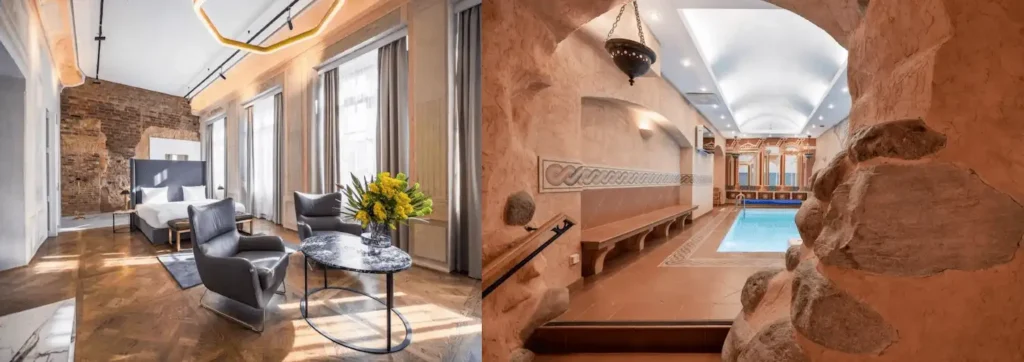
The central courtyard—original red-tile roofline intact—functions as the hotel’s spatial anchor, while 17th-century frescoes and 16th-century stone statues remain embedded in the walls and public corridors. The rooms blend contemporary minimalism with exposed Baroque masonry, creating a tension between the ornamental past and the functional present.
Walking from the Old Town’s cobblestone chaos into this courtyard is an immediate sensory shift—the stone absorbs sound, the proportions slow movement, and the light filters differently through centuries-old windows. No other property in Vilnius can claim this level of documented aristocratic lineage translated into preserved architectural detail.
Best for: Travelers seeking a stay inside the most architecturally intact Baroque palace conversion in the Baltic capitals, with original frescoes and a design-forward interior that doesn’t compete with the building’s heritage.
Signature Experience: 17th-century frescoes in public spaces, central courtyard with original roofline, exposed stone walls integrated into contemporary design, spa in restored vaulted cellars, Michelin-considered dining in former palace halls.
“Standing in that courtyard felt like being inside a painting—completely removed from the street outside.” — Helena, CopenhagenCheck Availability & Rates →
🍷 Stikliai Hotel – Relais & Châteaux ★★★★★
This is the heart of the 17th-century “Glassblowers Quarter,” a complex of buildings dating to the 1400s, with documented origins as a 16th-century glass manufactory.
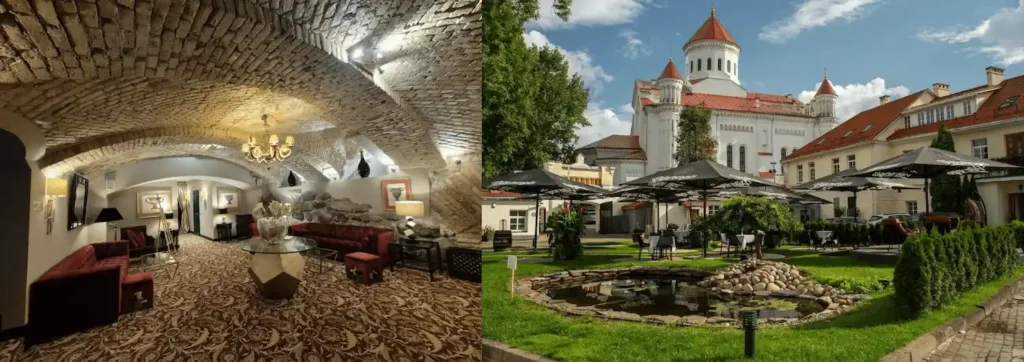
The restoration preserved the Baroque-Gothic facades and the private interior courtyard, creating a spatial sequence that feels like stepping through centuries rather than rooms. The brick-vaulted tavern and spa occupy the original production cellars, where the arched ceilings and unfinished stone walls anchor the modern luxury amenities without softening the industrial past. The rooms blend Renaissance-era timber beams with contemporary comforts, maintaining the compact, artisan-quarter proportions that define this district’s historic character.
The transition from street to courtyard to cellar spa is a masterclass in layered historical narrative—you feel the building’s past lives in the materials themselves, not through decor.
Best for: Guests drawn to artisan-quarter authenticity, where the industrial origins of the building are preserved in vaulted cellars and the Relais & Châteaux standard ensures refined service without corporate uniformity.
Signature Experience: 17th-century brick-vaulted tavern with original cellars, private courtyard enclosed by Gothic facades, spa in historic production vaults, Renaissance timber beams in suites, Michelin-level Lithuanian cuisine.
“The cellar spa made the whole trip—sitting in those vaulted stone rooms felt ancient and luxurious at once.” — Magnus, StockholmCheck Availability & Rates →
🏰 Grotthuss Boutique Hotel Vilnius ★★★★
This 18th-century aristocratic residence sits near the 16th-century fortress wall district, and the restoration prioritized the preservation of original ceiling decorations, stucco ornaments, and hand-painted murals that most conversions cover or replicate. The stone-arched conference rooms and the quiet inner courtyard garden remain fully intact, creating pockets of silence rare in Old Town hotels. The rooms maintain the residential scale and decorative detail of the 1700s, with authentic ceiling work and period-correct color palettes that feel intentional rather than themed.
The spatial logic of the building—small salons, narrow corridors, intimate proportions—remains unchanged, offering a stay that feels closer to a private residence than a commercial hotel. If you’re drawn to the decorative arts of 18th-century aristocratic life, this is where Vilnius preserves that chapter most faithfully.
Best for: Travelers who prioritize original decorative detail and residential-scale luxury over grand public spaces, seeking a quieter Old Town location with authentic 18th-century interiors.
Signature Experience: Original 18th-century ceiling decorations and stucco work, hand-painted murals in guest corridors, stone-arched conference rooms, enclosed courtyard garden, intimate residential proportions throughout.
“Those painted ceilings in the morning light—worth waking up early just to lie there and stare.” — Clara, ViennaCheck Availability & Rates →
Medieval & Gotic Heritage
These properties expose the oldest architectural layers of Vilnius—15th and 16th-century Gothic masonry, vaulted stone cellars, and fragments of medieval defense walls. If you’re drawn to the raw materiality of the medieval city, these conversions preserve that structural honesty without hiding it behind modern finishes.
⚔️ NARUTIS Hotel – Small Luxury Hotels of The World ★★★★★
This 1581 Classicist landmark began as a collection of medieval mansions, later serving as the city’s main post office, and the restoration earned UNESCO monument status for preserving 16th-century Gothic vaulted cellars and 18th-century mythological frescoes in the Column Hall.
The original timber ceiling joists remain exposed throughout the guest corridors, creating a visible record of the building’s construction methods. The rooms balance medieval spatial proportions—thick stone walls, narrow windows—with contemporary comfort, maintaining the fortress-like quiet that defines these Gothic structures. The Column Hall, with its ceiling frescoes intact, functions as the social and architectural centerpiece, a rare example of 18th-century decorative work integrated into a medieval shell.
This is the most complete Gothic-to-Baroque layering visible in any Vilnius hotel, offering a stay where centuries of architectural evolution remain legible.
Best for: Guests seeking a UNESCO-protected stay with visible Gothic and Baroque architectural layers, original ceiling frescoes, and the quiet solidity of 16th-century stone construction.
Signature Experience: UNESCO-protected Gothic vaulted cellars from 1581, 18th-century mythological frescoes in Column Hall, original timber ceiling joists throughout, medieval stone walls in suites, Small Luxury Hotels service standard.
“Walking those vaulted cellars at night felt like exploring a fortress—couldn’t believe it was part of the hotel.” — Oskar, BerlinCheck Availability & Rates →
🎨 Artagonist Art Hotel ★★★★
This property comprises two archaic buildings from the late 1400s, with 19th-century Neo-Classical additions, and the restoration preserved original exposed Gothic masonry and fragments of 15th-century wall paintings visible in guest corridors.
The heritage-listed wooden roof structure and stone arches remain the central interior features, creating a spatial experience defined by the building’s medieval bones rather than decorative layering. The rooms maintain the compact proportions and raw material honesty of late-medieval construction, where stone, timber, and plaster remain visibly distinct rather than blended. The art collection integrated throughout the property creates a contemporary dialogue with the Gothic architecture, but the building’s structural logic remains unchanged.
This is Vilnius at its most materially honest—a late-medieval shell adapted for modern use without erasing the construction methods that defined the city’s early growth.
Best for: Travelers drawn to raw Gothic materiality and contemporary art integration, seeking a stay where 15th-century construction methods remain visibly intact and central to the design narrative.
Signature Experience: Exposed 15th-century Gothic masonry throughout, fragments of original wall paintings in corridors, heritage-listed wooden roof structure, stone arches defining public spaces, contemporary art collection integrated with medieval fabric.
“Seeing those medieval wall paintings in the hallway before breakfast—felt like staying inside a museum without the glass barriers.” — Emma, AmsterdamCheck Availability & Rates →
🕯️ Mabre Residence ★★★★
This 16th-century monastic landmark occupies a collection of buildings from a historic monastery complex in the Old Town, and the restoration preserved the unique monastic architecture visible in vaulted stone ceilings and the secluded, enclosed courtyard.
The authentic 16th-century masonry remains visible in the structural fabric of the guest wings, offering a stay where the building’s religious origins inform the spatial experience—quiet, contemplative, defined by thick stone walls and minimal exterior exposure. The courtyard, fully enclosed and shielded from street noise, functions as the property’s emotional center, a rare outdoor space in the Old Town where silence is guaranteed. The rooms maintain the monastic cell proportions—compact, stone-walled, focused inward—adapted with modern comforts but without expanding the original spatial logic.
This is Vilnius’s most faithful monastic conversion, offering a stay defined by withdrawal rather than display.
Best for: Guests seeking the quiet intensity of a preserved monastic complex, where secluded courtyards and vaulted stone ceilings create a contemplative stay removed from Old Town foot traffic.
Signature Experience: 16th-century monastic vaulted stone ceilings, enclosed courtyard garden shielded from street noise, original masonry visible throughout guest wings, compact monastic cell proportions in rooms, rare Old Town silence.
“That courtyard in the early morning—absolute silence, felt like we’d stepped out of the city entirely.” — Ingrid, OsloCheck Availability & Rates →
Imperial & Institutional Landmarks
This is where Vilnius’s role as a strategic city in the Russian Empire becomes visible—buildings constructed to project state power, later converted into luxury accommodations that preserve the Neo-Classical grandeur and spatial scale of institutional architecture.
🏦 Grand Hotel Vilnius, Curio Collection by Hilton ★★★★★
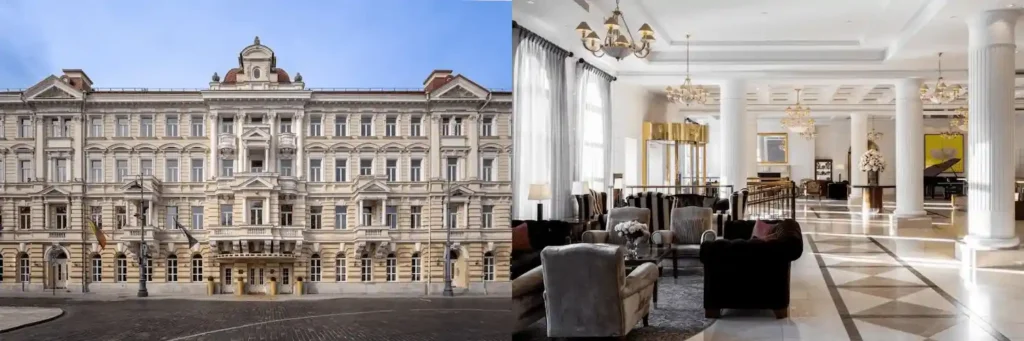
This 1900 Neo-Classical landmark originally served as the National Treasury of the Russian Empire and later as the city’s Central Telegraph Office, and the restoration preserved the iconic Neoclassical facade and grand late-Victorian interior proportions that defined Imperial institutional architecture.
Recent renovations uncovered fragments of the 16th-century Vilnius Defense Wall in the basement, now visible to guests and offering a rare layering of medieval and Imperial construction in a single building. The rooms maintain the high ceilings and monumental window proportions of the Treasury era, creating a spatial scale rare in Old Town conversions. The public spaces—grand staircases, vaulted ceilings, original stone detailing—remain intact, offering a stay where the building’s state function is still legible in the architecture.
This is the most complete Imperial-era conversion in Vilnius, balancing Hilton’s operational standards with genuine Neo-Classical preservation.
Best for: Travelers seeking Imperial-era grandeur with Hilton reliability, where Neo-Classical facades and Treasury-scale interiors are preserved alongside modern amenities and visibility of 16th-century defense wall fragments.
Signature Experience: 1900 Neo-Classical facade preserved, late-Victorian Treasury proportions in rooms, 16th-century defense wall fragments visible in basement, grand staircases and vaulted public spaces intact, Hilton Curio service standards.
“Finding those medieval wall fragments in the basement tour—wasn’t expecting layers that deep in a five-star hotel.” — Lukas, MunichCheck Availability & Rates →
📊 Comparison: Best Hotels in Vilnius
| Hotel | Location | Wellness & Spa | Dining | Unique Perks | Best For |
|---|---|---|---|---|---|
|
🏛️ Hotel Pacai ★★★★★ |
Old Town, Baroque palace |
Vaulted cellar spa, restoration treatments |
Michelin-considered, palace halls |
17th-century frescoes, intact courtyard |
Aristocratic lineage, design-forward stays |
|
🍷 Stikliai Hotel ★★★★★ |
Glassblowers Quarter, artisan district |
Brick-vaulted spa, cellar treatments |
Lithuanian cuisine, historic tavern |
16th-century production cellars, Relais & Châteaux |
Artisan authenticity, intimate luxury |
|
⚔️ NARUTIS Hotel ★★★★★ |
Old Town, UNESCO site |
Gothic cellar wellness, stone vaults |
Column Hall dining, frescoed ceilings |
16th-century Gothic cellars, 18th-century frescoes |
Gothic-Baroque layers, UNESCO heritage |
|
🏦 Grand Hotel Vilnius ★★★★★ |
Old Town, Imperial landmark |
Contemporary spa, Neo-Classical setting |
Fine dining, Treasury-scale rooms |
1900 Treasury, 16th-century wall fragments |
Imperial grandeur, Hilton reliability |
❓ FAQ: Best Hotels in Vilnius
What makes Vilnius hotels different from other Baltic capitals?
Vilnius preserves architectural layers no other Baltic capital can match—17th-century Baroque palaces, 16th-century Gothic cellars, and 1900 Imperial treasuries all within walking distance. The best hotels occupy buildings where aristocratic lineage, artisan heritage, or state power are still legible in the stone, frescoes, and spatial proportions. You’re not staying near history; you’re staying inside the structures that defined Lithuania’s Grand Duchy era and Imperial occupation.
Which Vilnius hotel has the most original historic details?
Hotel Pacai preserves the most complete set of 17th-century Baroque details—original frescoes, 16th-century statues, and an intact courtyard with the original roofline. NARUTIS Hotel offers the most visible Gothic-to-Baroque layering, with UNESCO-protected 16th-century vaulted cellars and 18th-century frescoes in the Column Hall. Both properties maintain structural honesty without covering historic fabric.
Are these hotels actually inside historic buildings or just themed?
Every property listed occupies a verified historic structure—palace, manufactory, treasury, or monastery—with documented origins from the 1400s to 1900. We rejected properties where “historic” was marketing language for generic renovations. The buildings here are UNESCO monuments, heritage-listed conversions, or documented aristocratic residences where the original architecture defines the spatial experience.
What’s the best location in Vilnius for a first-time visit?
Old Town is the only location that matters for first-time visitors seeking historic immersion. Hotel Pacai and Stikliai Hotel offer the most central positions with direct access to the Cathedral Square, Gediminas Tower, and the artisan quarter streets. Both properties sit within the original medieval street grid, where walking to any major landmark takes under ten minutes.
Do these hotels have modern amenities despite being historic?
All properties balance preservation with contemporary comfort—climate control, spa facilities, fine dining, and updated bathrooms are standard. Hotel Pacai and Stikliai Hotel integrate design-forward interiors with Baroque and Gothic structures without compromising the original spatial logic. Grand Hotel Vilnius offers Hilton’s operational standards within a 1900 Treasury, proving modern luxury doesn’t require erasing historic fabric.
Which Vilnius hotel is best for experiencing medieval architecture?
NARUTIS Hotel and Artagonist Art Hotel expose the oldest architectural layers—16th-century Gothic vaulted cellars, original timber ceiling joists, and fragments of 15th-century wall paintings. Both properties preserve the raw materiality of medieval construction without softening it through modern finishes. If you’re drawn to stone, timber, and the structural honesty of the 1400s-1500s, these conversions offer the most legible medieval fabric.
How far in advance should I book a historic hotel in Vilnius?
For peak season—May through September—booking 8-12 weeks ahead is essential, especially for properties like Hotel Pacai and Stikliai Hotel where room counts are limited by the original palace and manufactory structures. Winter offers more flexibility, but weekends around Christmas markets and New Year still require advance reservations. Properties with UNESCO status or Relais & Châteaux membership fill earliest.
Which Historic Hotel Is Right for You?
Choosing a hotel in Vilnius isn’t about chasing star ratings—it’s about matching your preference for architectural depth to the building’s preserved identity. The properties above represent the most structurally intact conversions where Gothic cellars, Baroque frescoes, and Imperial proportions remain central to the experience. Availability at these heritage-protected properties shifts quickly once summer season begins.
For more curated itineraries and luxury-focused travel insights, visit Your Luxury Guide. For official travel information and destination updates, visit Lithuania tourism-info.
Booking your hotel in Vilnius secures access to the Baltic’s most architecturally layered capital, where centuries of Polish, Russian, and Lithuanian heritage remain visible in palace courtyards, Gothic cellars, and Imperial facades—verified provenance guaranteed.
Your Luxury Guide — Where Exceptional Travel Begins.