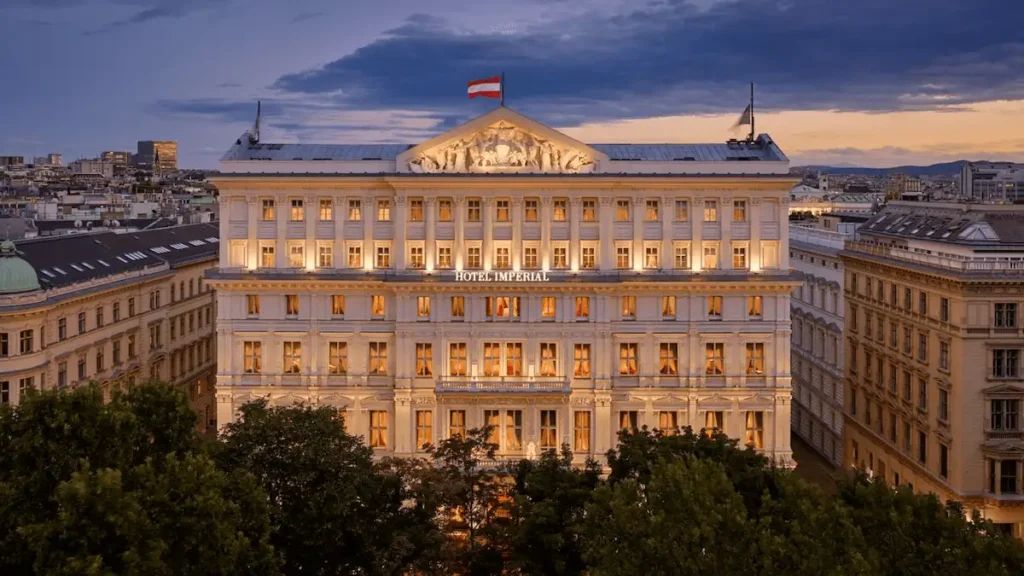
Choosing the best hotels in Vienna isn’t about chasing five-star labels—it’s about selecting properties where Habsburg grandeur and institutional authority remain intact, not replicated. Vienna’s most refined accommodations are former palaces, royal residences, and banking headquarters that defined Central European power for centuries.
After filtering Vienna’s luxury landscape, we narrowed the field to seven hotels where architectural heritage, service precision, and cultural positioning converge—not surface-level opulence.
Below are the properties that deliver imperial atmosphere, institutional gravitas, and contemporary polish without sacrificing historical soul. These are Vienna’s elite lodgings for travelers who recognize that the building matters as much as the bed count.
For broader heritage coverage across the country, explore best historic hotels in Austria.
Imperial Estates & Royal Residences
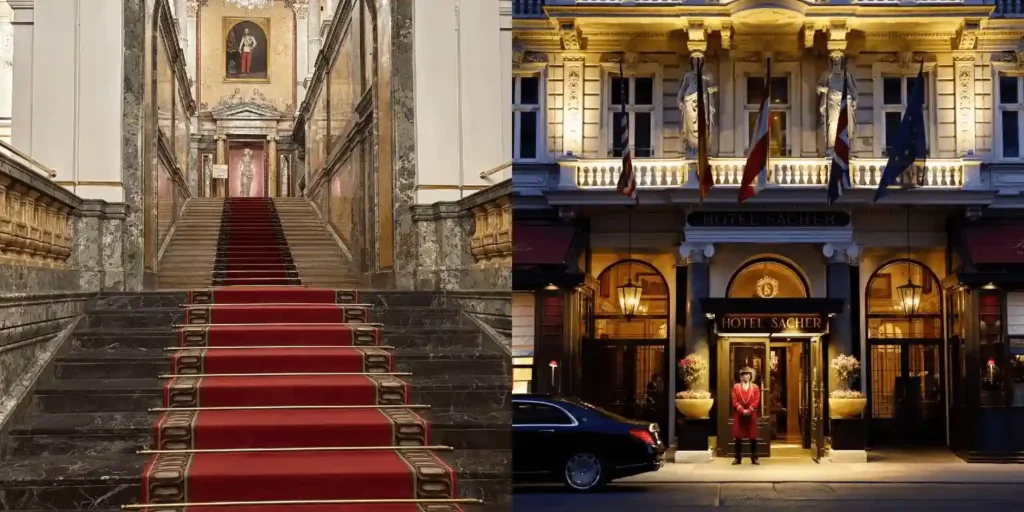
Vienna’s imperial hotels aren’t merely branded five-star properties—they’re former seats of Habsburg power where royal protocol shaped architecture, service culture, and spatial design. These estates anchored the empire’s public and private life, and their modern iterations preserve that ceremonial weight.
Expect grand staircases built for emperors, ballrooms that hosted state affairs, and service traditions refined under aristocratic scrutiny.
What follows are Vienna’s most architecturally significant imperial conversions.
⚔️ Hotel Imperial, a Luxury Collection Hotel, Vienna ★★★★★
Built as Palais Württemberg in 1863 for Duke Philipp of Württemberg, this Arnold Zenetti-designed estate was converted into a hotel for the 1873 World’s Fair—an event that solidified Vienna’s role as Europe’s cultural nexus.
The Royal Staircase was engineered specifically for Emperor Franz Joseph I’s formal entry, and that ceremonial grandeur remains the property’s defining feature today.
Guest rooms blend Biedermeier elegance with updated infrastructure, while public spaces retain original stucco work, crystal chandeliers, and marble detailing untouched since the Habsburg era.
The Imperial’s location on the Ringstrasse places guests at the threshold of Vienna’s museum quarter, state opera, and political institutions—proximity that mirrors the building’s original diplomatic function.
Service culture here reflects old-world protocol without excessive formality, balancing attentiveness with discretion. This is Vienna’s most historically layered hotel experience—ideal for travelers who want Habsburg Vienna as context, not decoration.
Booking the Imperial secures one of Central Europe’s most significant palace conversions before seasonal demand compresses availability.
Best for: Discerning travelers seeking authentic imperial atmosphere with ceremonial architecture and Ringstrasse cultural access.
Signature Experience: Royal Staircase entry designed for Emperor Franz Joseph I, original Habsburg-era stucco and marble detailing, Biedermeier suites overlooking Ringstrasse, Michelin-level Austrian cuisine in chandelier-lit salons.
“Walking that staircase felt like stepping into a state ceremony—exactly what Vienna should feel like.” — Thomas, MunichCheck Availability & Rates →
🎭 Hotel Sacher Wien ★★★★★
Hotel Sacher Wien opened in 1876 on the site of the Kärntnertor Theatre, adjacent to the Vienna State Opera, and functioned as the quasi-diplomatic “living room” of the Habsburg Court under Anna Sacher’s legendary stewardship. While purpose-built as a hotel, its proximity to power and Anna Sacher’s personal relationships with aristocracy and artists made it a cultural institution rather than mere lodging.
The property retains its 19th-century drawing rooms, original parquet flooring, and art collection spanning Old Masters to contemporary Austrian work.
Guest rooms merge period furniture with modern amenities, maintaining historical atmosphere without sacrificing comfort. The Sacher Café remains Vienna’s social epicenter for afternoon tradition, and its pastry output is protected by trademark law—evidence of the hotel’s enduring cultural authority.
Location directly opposite the State Opera makes this the most theatrically positioned hotel in the city, ideal for travelers whose Vienna centers on performance, music, and imperial-era ritual.
Best for: Opera devotees and cultural travelers prioritizing theatrical proximity with Habsburg-era social tradition.
Signature Experience: Original Sacher Torte protected by trademark, Anna Sacher’s preserved drawing rooms, art collection spanning centuries, direct State Opera access, afternoon salon culture.
“That first bite of torte in the café—worth the trip to Vienna entirely on its own.” — Elena, PragueCheck Availability & Rates →
Institutional Conversions: Banking & Government Palaces
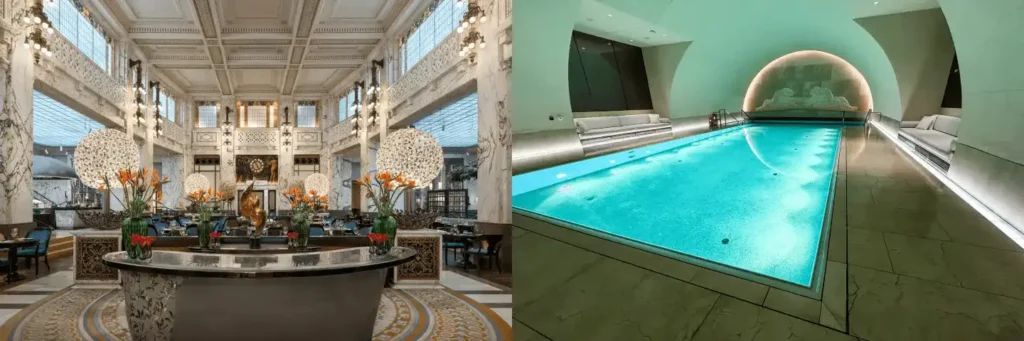
Vienna’s banking palaces weren’t merely financial offices—they were architectural statements of institutional power built to project permanence, authority, and imperial backing. These properties often housed gold vaults, ministerial offices, and diplomatic meeting rooms that shaped Central European finance and governance.
Converted into hotels, they retain marble banking halls, original vault spaces, and neoclassical grandeur that distinguish them from generic five-star builds. Below are Vienna’s most architecturally significant banking and government conversions.
🏛️ Park Hyatt Vienna ★★★★★
Completed in 1915 by architect Ernst Gotthilf, this property served as the headquarters of Länderbank—one of Austria’s most powerful financial institutions during the late Habsburg era and interwar period.
The Am Hof square location marks the site of Austria’s first bank, embedding centuries of financial authority into the site’s DNA. The current hotel preserves the building’s neoclassical façade, monumental banking hall, and original vault, which now functions as the property’s pool and spa—a rare example of adaptive reuse that honors rather than erases institutional history.
Guest rooms blend contemporary minimalism with architectural detail, while public spaces retain marble columns, coffered ceilings, and soaring proportions that telegraph permanence. The Am Hof square setting places guests at Vienna’s medieval core, within walking distance of St. Stephen’s Cathedral and the Hofburg complex.
Service culture reflects Hyatt’s global polish adapted to Vienna’s expectation of discretion and efficiency. This is Vienna’s most successful marriage of banking gravitas and modern luxury infrastructure—ideal for travelers who want historical soul without sacrificing contemporary comfort.
Booking Park Hyatt secures one of Vienna’s few gold-vault conversions before peak cultural season tightens inventory.
Best for: Business travelers and design-conscious guests seeking banking heritage with contemporary minimalist execution.
Signature Experience: Original Länderbank gold vault converted to pool and spa, neoclassical banking hall preserved as public space, Am Hof square medieval core access, marble and coffered ceiling grandeur.
“Swimming in a former gold vault—never thought I’d experience that level of adaptive reuse.” — Julia, ZurichCheck Availability & Rates →
🏦 Rosewood Vienna ★★★★★
Designed by Alois Pichl in 1835, this neoclassical masterpiece was the headquarters of Erste Österreichische Spar-Casse—Austria’s first savings bank and a cornerstone of Habsburg financial infrastructure.
The site incorporates the building where Mozart lived while composing The Abduction from the Seraglio, layering musical heritage onto institutional history. Rosewood’s conversion preserved the building’s original façade, banking hall, and Mozart-era residential quarters while introducing contemporary interiors that contrast rather than compete with historical architecture.
Guest rooms feature custom millwork, Venetian terrazzo flooring, and Jugendstil-inspired lighting that reference Vienna’s early 20th-century design movements. The rooftop bar overlooks St. Stephen’s Cathedral and the old city’s terracotta roofscape, offering visual context for Vienna’s layered urban history.
Service culture here balances Rosewood’s global hospitality standard with Vienna’s expectation of formal attentiveness. This is Vienna’s most design-forward banking conversion—suited to travelers who want architectural gravitas paired with modern material refinement.
Booking Rosewood places you inside Vienna’s financial and musical memory before spring opera season compresses availability.
Best for: Design-focused travelers drawn to neoclassical banking conversions with Mozart-era residential heritage.
Signature Experience: Mozart’s former residence integrated into hotel fabric, original Spar-Casse banking hall, Venetian terrazzo and Jugendstil-inspired interiors, rooftop views of St. Stephen’s Cathedral.
“Staying where Mozart wrote opera felt surreal—history you can actually touch here.” — Marco, MilanCheck Availability & Rates →
🏛️ Anantara Palais Hansen Vienna ★★★★★
Built by Theophil Hansen—architect of the Austrian Parliament—for the 1873 Vienna World Expo, this property originally served as the Municipal Exhibition Building before transitioning into government offices (police and municipal administration) over subsequent decades. Hansen’s neoclassical design reflects the same architectural language he applied to Vienna’s most important civic structures, giving the building institutional gravitas that transcends its later hospitality function.
Anantara’s recent renovation preserved Hansen’s symmetrical façade, grand entrance hall, and monumental staircase while introducing Thai-inspired hospitality elements that distinguish it from Vienna’s more traditional imperial properties.
Guest rooms blend European neoclassical proportions with Southeast Asian material palettes—teak accents, silk textiles, and spa-inspired bathrooms that create cultural contrast without diluting architectural heritage.
The rooftop bar and spa offer Ringstrasse views that contextualize the building’s role in Vienna’s 19th-century urban expansion. Service culture reflects Anantara’s global standard adapted to Vienna’s expectation of formality and precision. This is Vienna’s most culturally hybrid heritage hotel—ideal for travelers seeking neoclassical architecture paired with non-European hospitality influences.
Best for: Travelers drawn to architect-designed civic buildings with Thai-influenced hospitality and Ringstrasse cultural access.
Signature Experience: Theophil Hansen architecture (Austrian Parliament architect), original Municipal Exhibition Building from 1873 World Expo, Thai-European hybrid interiors, rooftop spa with Ringstrasse views.
“Hansen’s staircase paired with Thai spa culture—unexpected and absolutely brilliant.” — Sophie, BangkokCheck Availability & Rates →
Classic Grand Hotel & Historic Continuity
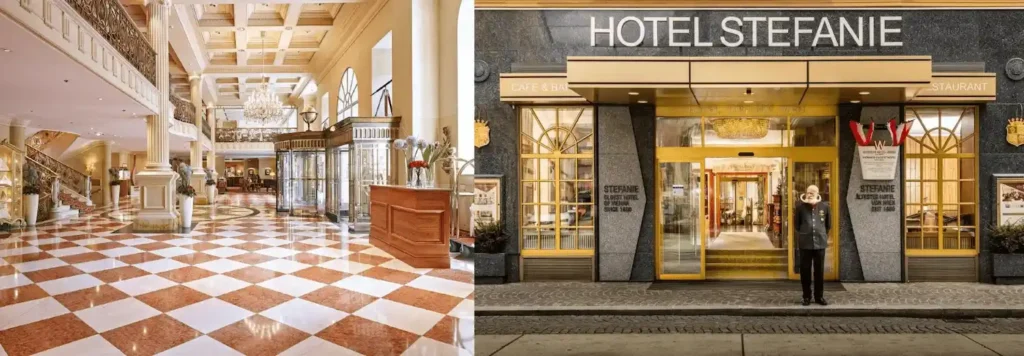
Vienna’s classic grand hotels and historic lodgings represent continuity rather than conversion—properties that have functioned as hotels since their founding and retain the service traditions, spatial arrangements, and cultural authority that defined elite hospitality across generations.
These hotels don’t merely occupy old buildings—they embody Vienna’s hospitality DNA.
🏨 Grand Hotel Wien ★★★★★
Grand Hotel Wien opened in the late 19th century and has maintained its role as one of Vienna’s premier grand hotels through political regime changes, world wars, and hospitality industry transformations.
The property’s Ringstrasse location places it at the cultural and political center of Habsburg-era Vienna, and its architecture reflects the imperial grandeur expected of elite 19th-century lodging.
Guest rooms blend period furniture with updated infrastructure, maintaining historical atmosphere without sacrificing modern comfort. Public spaces retain original chandeliers, marble staircases, and neoclassical detailing that telegraph continuity and permanence. The hotel’s dining rooms and salons have hosted diplomats, artists, and cultural figures for over a century, embedding social authority into its operational fabric.
Service culture reflects Vienna’s hospitality traditions refined over generations—attentive without intrusion, formal without stiffness. This is Vienna’s most traditionally executed grand hotel experience—suited to travelers who prioritize institutional continuity and classic Viennese service culture over architectural novelty.
Booking Grand Hotel Wien places you inside Vienna’s elite hospitality lineage before peak opera and ball season compresses availability.
Best for: Traditionalists seeking classic Viennese grand hotel culture with Ringstrasse access and institutional continuity.
Signature Experience: Late-19th-century grand hotel continuity, original chandeliers and marble staircases, Ringstrasse cultural positioning, multi-generational service traditions.
“This is what Vienna should feel like—no gimmicks, just impeccable old-world service.” — Robert, LondonCheck Availability & Rates →
🕰️ Hotel Stefanie ★★★★
Hotel Stefanie holds the title of Vienna’s oldest hotel, with documented continuity as a lodging establishment stretching back centuries. While its architecture lacks the monumental scale of Vienna’s imperial palaces or banking conversions, its historical continuity and role in Vienna’s civic hospitality fabric give it cultural authority that transcends star ratings. The property has hosted travelers, merchants, and cultural figures across political regimes, embedding centuries of Vienna’s social and economic life into its operational memory.
Guest rooms reflect updated interpretations of Viennese tradition—comfortable, functional, and designed for travelers who prioritize location and historical context over luxury amenities. The hotel’s Danube Canal proximity places guests at the edge of Vienna’s old city, within walking distance of St. Stephen’s Cathedral and the Hofburg complex.
Service culture reflects Vienna’s middle-class hospitality traditions—welcoming, efficient, and rooted in civic pride rather than aristocratic formality. This is Vienna’s most historically continuous lodging experience—ideal for travelers who value age, continuity, and civic heritage over architectural grandeur.
Best for: History-focused travelers prioritizing Vienna’s oldest hotel continuity over architectural grandeur or luxury amenities.
Signature Experience: Vienna’s oldest hotel with centuries of documented continuity, civic hospitality traditions, Danube Canal and old city access, multi-generational operational memory.
“Knowing you’re sleeping in Vienna’s oldest hotel adds a layer that no five-star can replicate.” — Anna, BerlinCheck Availability & Rates →
📊 Comparison: Best Hotels in Vienna
| Hotel | Location | Wellness & Spa | Dining | Unique Perks | Best For |
|---|---|---|---|---|---|
|
⚔️ Hotel Imperial ★★★★★ |
Ringstrasse, museum quarter |
Habsburg-era spa, wellness suites |
Michelin-level Austrian, chandelier salons |
Royal Staircase for Emperor, original stucco detailing |
Imperial atmosphere, ceremonial grandeur |
|
🎭 Hotel Sacher Wien ★★★★★ |
Directly opposite State Opera |
Historic spa, Habsburg traditions |
Original Sacher Torte, café culture |
Anna Sacher’s drawing rooms, art collection |
Opera devotees, cultural travelers |
|
🏛️ Park Hyatt Vienna ★★★★★ |
Am Hof square, medieval core |
Gold vault pool, spa in original vault |
Contemporary Austrian, banking hall dining |
Länderbank HQ, neoclassical banking hall |
Business travelers, design-conscious guests |
|
🏦 Rosewood Vienna ★★★★★ |
Old city center, St. Stephen’s views |
Rooftop spa, Jugendstil-inspired treatments |
Modern European, rooftop cathedral views |
Mozart’s residence, Spar-Casse banking hall |
Design-focused travelers, musical heritage enthusiasts |
- For insights into Austria’s broader historic hotel landscape, continue with best hotels in Salzburg.
❓ FAQ: Best Hotels in Vienna
What makes Vienna’s historic hotels different from standard five-star properties?
Vienna’s best hotels occupy former imperial palaces, banking headquarters, and government buildings where Habsburg-era architecture, ceremonial spaces, and institutional authority remain intact. Unlike generic luxury builds, these properties preserve royal staircases, banking halls, gold vaults, and neoclassical façades designed for emperors and financial ministers—spatial arrangements that communicate permanence rather than replication. Hotel Imperial’s Royal Staircase and Park Hyatt’s gold vault pool are examples of adaptive reuse that honors rather than erases historical function.
Which Vienna hotel has the strongest Habsburg imperial heritage?
Hotel Imperial offers Vienna’s most architecturally significant imperial conversion. Built as Palais Württemberg for Duke Philipp in 1863 and converted for the 1873 World’s Fair, the property retains its Royal Staircase designed for Emperor Franz Joseph I, original Habsburg-era stucco work, and Ringstrasse positioning that anchored Vienna’s diplomatic and cultural life. The building functioned as a quasi-state institution, and that ceremonial grandeur remains its defining characteristic today.
Are Vienna’s banking palace hotels worth the premium over modern five-star properties?
Vienna’s banking conversions—Park Hyatt Vienna and Rosewood Vienna—deliver architectural gravitas, institutional history, and adaptive reuse that generic luxury hotels cannot replicate. Park Hyatt’s Länderbank gold vault pool and Rosewood’s Spar-Casse banking hall represent rare examples of 19th-century financial architecture transformed into hospitality spaces. For travelers who value historical soul and design storytelling, these properties justify premium positioning over contemporary builds.
Which Vienna hotel is closest to the State Opera and cultural institutions?
Hotel Sacher Wien sits directly opposite the Vienna State Opera, making it Vienna’s most theatrically positioned hotel. The property’s 1876 opening adjacent to the Kärntnertor Theatre embedded it into Vienna’s performance culture, and its location remains ideal for travelers whose Vienna centers on opera, music, and Habsburg-era cultural ritual. The hotel’s proximity to the Hofburg and Museum Quarter reinforces its cultural access advantage.
Does Hotel Stefanie compete with Vienna’s five-star imperial hotels?
Hotel Stefanie operates in a different heritage category—it’s Vienna’s oldest hotel with documented continuity stretching back centuries, but it lacks the architectural grandeur of imperial palaces or banking conversions. Its value lies in historical continuity, civic hospitality traditions, and Danube Canal old city access rather than luxury amenities or monumental spaces. Travelers prioritizing age and operational memory over five-star infrastructure will find Stefanie’s heritage compelling.
What is the best time to book Vienna’s historic hotels for opera season?
Vienna’s opera and ball season (September through June) compresses availability at the city’s most refined historic hotels, particularly Hotel Sacher Wien and Hotel Imperial due to their proximity to cultural institutions. Booking three to six months ahead secures prime inventory before seasonal demand tightens. Summer months (July-August) offer more flexible availability but coincide with reduced opera programming, diminishing cultural access advantages for properties like Sacher.
Which Vienna hotel offers the most unique architectural adaptive reuse?
Park Hyatt Vienna’s conversion of the original Länderbank gold vault into a pool and spa represents Vienna’s most successful example of adaptive reuse that honors rather than erases institutional history. The property’s neoclassical banking hall, marble columns, and coffered ceilings remain intact while supporting contemporary hospitality infrastructure—evidence that historical preservation and modern comfort aren’t mutually exclusive when executed with architectural respect.
Choosing your Hotel in Vienna: Final Considerations
The best hotels in Vienna aren’t defined by star ratings—they’re distinguished by architectural heritage, institutional authority, and service traditions refined across political regimes and cultural movements.
The properties above represent Vienna’s most significant imperial, banking, and civic conversions, each offering different expressions of Habsburg-era grandeur adapted to contemporary hospitality expectations. Availability at Vienna’s elite historic hotels tightens once opera season begins and cultural event calendars compress inventory, making advance booking essential for travelers who prioritize specific heritage narratives.
For additional Austrian historic hotel options beyond the capital, explore best hotels in Graz.
For more curated itineraries and luxury-focused travel insights, visit Your Luxury Guide. For official travel information and destination updates, visit Austria tourism-info.
Booking a stay at Vienna’s top historic hotels places you inside Habsburg architectural legacy, financial power centers, and multi-generational hospitality traditions that shaped Central European cultural life for centuries.
Your Luxury Guide — Where Exceptional Travel Begins.