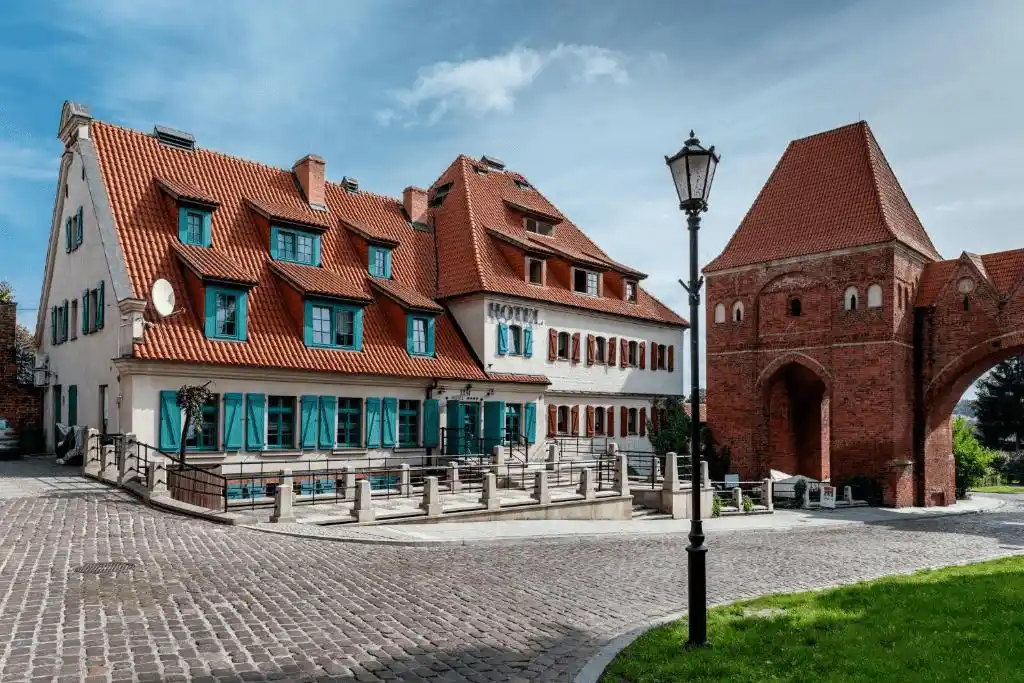
Finding the best hotels in Toruń means navigating one of Poland’s most architecturally intact medieval cities—a UNESCO World Heritage Site where the past isn’t a theme, it’s the structure. The overchoice problem here isn’t luxury; it’s authenticity. Many properties use “historic” as marketing while hiding generic renovations behind red-brick facades.
We’ve audited Toruń’s inventory to filter out superficial conversions and brand-saturated interiors. Our selection criteria prioritize verified “Past-Life Identity”—properties where the original use (Teutonic mills, Swedish maritime granaries, Gothic merchant houses) remains the soul of the stay. This curated collection saves you time and guarantees you’re sleeping inside living history, not just near it.
For a broader survey of Poland’s heritage inventory, explore our comprehensive audit of best historic hotels in Poland.
Medieval Landmarks Within the Teutonic Walls
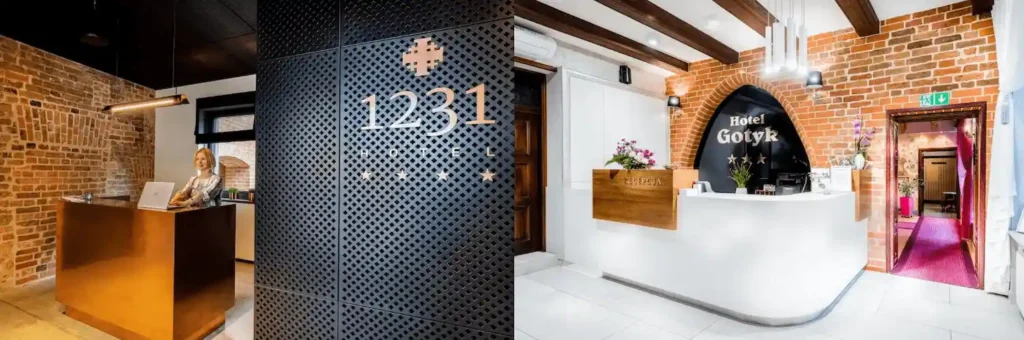
The most architecturally significant hotels in Toruń occupy buildings that once served the city’s medieval power structures—mills, infirmaries, and defensive complexes tied directly to the Teutonic Order. These aren’t conversions; they’re continuations. The original masonry, vaulted ceilings, and spatial logic remain intact, offering an immersion into 13th and 14th-century craftsmanship that no modern construction can replicate. Staying here means inhabiting spaces where merchants, knights, and healers once lived and worked.
⚙️ Hotel 1231 ★★★★
Positioned within the outer bailey of Toruń’s Teutonic Castle, Hotel 1231 occupies a 13th-century mill and 14th-century infirmary—two structures connected by an underground tunnel that once served as a functional artery for the castle complex. The meticulous restoration exposes original medieval red-brick walls and historic brick vaults, creating an atmosphere where the weight of eight centuries presses into every corner.
Modern rooms integrate seamlessly into these ancient frames, preserving the spatial integrity of the mill’s industrial past while offering contemporary comfort. Walking through the tunnel from reception to your room feels like moving through a private historical channel, closed to the public but open to guests. No other hotel in Toruń offers direct architectural access to the Teutonic Order’s operational infrastructure—the mill wheel may be silent, but the machinery of history remains visible in every archway and corridor.
Best for: History-focused travelers seeking direct access to Teutonic military architecture with upscale modern amenities and authentic medieval spatial immersion.
Signature Experience: Underground tunnel connecting mill and infirmary buildings, original 13th-century brick vaults, Teutonic Castle proximity with exclusive architectural access, wellness area within historic foundations.
“Walking through that medieval tunnel to our room—felt like stepping into a secret chapter of the castle’s past.” — Marek, WarsawCheck Availability & Rates →
🏛️ Gotyk ★★★★
This complex of restored 14th-century Gothic townhouses sits steps from the Nicolaus Copernicus House, representing the architectural wealth of Toruń’s merchant class during its Hanseatic League peak. The meticulous restoration preserves authentic Gothic brick niches and original structural proportions, integrating 14th-century elements with high-fidelity period-style interiors that honor the townhouse typology without compromising spatial clarity.
Each room reflects the vertical logic of medieval urban living—narrow, tall, intimate—while modern updates maintain the architectural grammar of the era. The lobby‘s exposed brickwork and Gothic detailing create an immediate sensory transition from the cobblestone streets outside into a merchant residence frozen at the height of the city’s commercial power.
The location amplifies the immersion: you’re not near history, you’re inside the same block where Europe’s most famous astronomer once walked. No other hotel in Toruń offers this precise combination of Gothic residential authenticity and proximity to the city’s intellectual legacy.
Best for: Travelers drawn to Gothic residential architecture seeking proximity to Copernicus heritage sites with historically accurate interior design and Old Town walkability.
Signature Experience: Authentic Gothic brick niches, 14th-century structural preservation, steps from Copernicus House, period-style interiors with original proportions, intimate merchant-house atmosphere.
“The Gothic niches in our room—original 14th-century details you can actually touch. Incredible preservation.” — Elena, KrakówCheck Availability & Rates →
Maritime Heritage & Baroque Townhouses
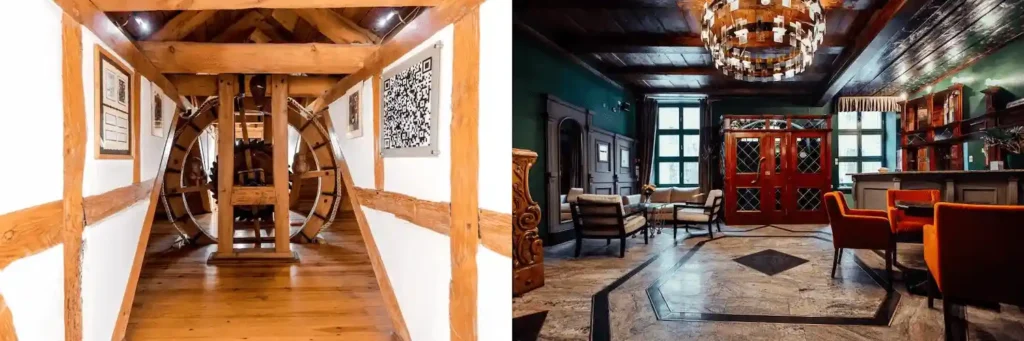
Toruń’s position on the Vistula River made it a critical node in Baltic trade networks, and the city’s merchant class commissioned granaries, warehouses, and townhouses that still define the Old Town skyline. These properties represent a different expression of historic architecture—focused on commerce, storage, and international trade rather than military or religious power. The scale is massive, the preservation is tactile, and the experience connects you to the city’s economic golden age.
🌾 Hotel Spichrz ★★★
Originally constructed as a four-story Swedish granary by merchant Jan Noggen in the 18th century, Hotel Spichrz later served as Prussian military food stores before its 1999 restoration. The conversion exposes the building’s original maritime warehouse arrangement—massive antique wooden beams, original timber ceilings, and a fully preserved mechanical crane wheel that once hoisted grain from barges on the Vistula.
The scale of the interior is overwhelming: ceilings soar, beams span entire rooms, and the structural logic of industrial storage remains completely legible. Modern rooms are integrated into this framework without disguising the granary’s original function. The scent of old wood and the visible patina of centuries-old timber create an atmosphere that feels more like a living museum than a hotel. No other property in Toruń offers this direct connection to the city’s Baltic trade infrastructure—the crane wheel alone is worth the stay.
Best for: Travelers seeking authentic maritime warehouse architecture with tactile industrial heritage, massive timber interiors, and direct connection to Vistula River trade history.
Signature Experience: Original 18th-century crane wheel, massive antique wooden beams, exposed timber ceilings, 1999 heritage restoration preserving granary layout, Old Town location with river views.
“That crane wheel in the lobby—a piece of working history still hanging there. Unbelievable.” — Jakub, GdańskCheck Availability & Rates →
🏚️ Heban Hotel ★★★
Occupying two 17th-century Baroque townhouses in the heart of the Old Town, Heban Hotel represents Toruń’s commercial peak when wealthy merchants commissioned elegant residences reflecting international trade wealth. The meticulous adaptation preserves the unique facade details and original spatial layout—each room follows the vertical residential logic of Baroque urban planning.
The interiors retain period-style craftsmanship within the historic walls: plasterwork, window proportions, and ceiling heights all reflect 17th-century design principles. The transition from the street into the lobby feels like entering a private merchant’s residence rather than a public hotel, a deliberate preservation of the building’s domestic scale.
The location amplifies the experience—surrounded by similarly preserved townhouses, cobblestone streets, and medieval infrastructure. For travelers drawn to Baroque residential elegance rather than Gothic grandeur, this property offers a quieter, more intimate expression of Toruń’s architectural soul.
Best for: Travelers seeking Baroque townhouse elegance with preserved residential character, intimate scale, and Old Town location favoring quiet historic immersion over grand interiors.
Signature Experience: Dual 17th-century townhouse complex, preserved Baroque facade details, period-style interiors with original spatial layout, merchant-residence atmosphere, central Old Town location.
“The Baroque details in the facade—you can see the wealth that built this place. Elegant, understated.” — Anna, WrocławCheck Availability & Rates →
🏰 Hotel Gromada Toruń ★★
Situated in a 14th-century Gothic tenement with direct links to the Copernicus family, Hotel Gromada Toruń is the oldest property in the Gromada chain. Despite multiple renovations, the building preserves its authentic medieval character through original-style vaulted ceilings and Gothic detailing in the “Zajazd Staropolski” interior.
The experience here prioritizes historical atmosphere over luxury amenities—the focus is on maintaining the medieval tenement typology rather than upgrading to contemporary hotel standards. The location within the Old Town and the building’s documented connection to Toruń’s most famous resident give the property cultural weight that transcends its two-star classification. For travelers prioritizing affordability and historic atmosphere over modern comfort, this represents accessible entry into Toruń’s Gothic architectural heritage without sacrificing authenticity.
Best for: Budget-conscious travelers seeking authentic Gothic tenement atmosphere with Copernicus family heritage connections and Old Town location prioritizing character over contemporary luxury.
Signature Experience: 14th-century Gothic tenement preservation, Copernicus family historical link, original-style vaulted ceilings, “Zajazd Staropolski” historic interior, accessible heritage stay.
“Not fancy, but genuinely historic. The vaulted ceilings tell you everything about this building’s age.” — Tomasz, PoznańCheck Availability & Rates →
📊 Comparison: Best Hotels in Toruń
| Hotel | Location | Wellness & Spa | Dining | Unique Perks | Best For |
|---|---|---|---|---|---|
|
⚙️ Hotel 1231 ★★★★ |
Teutonic Castle outer bailey |
Wellness area, historic foundations |
Contemporary, castle views |
13th-century mill, underground tunnel |
Teutonic history, architectural access |
|
🏛️ Gotyk ★★★★ |
Old Town, near Copernicus House |
Fitness facilities, wellness services |
Regional Polish, Gothic interiors |
14th-century Gothic niches, merchant townhouses |
Gothic architecture, Copernicus heritage |
|
🌾 Hotel Spichrz ★★★ |
Old Town, Vistula River proximity |
Basic wellness, sauna facilities |
Traditional Polish, granary setting |
18th-century crane wheel, maritime warehouse |
Industrial heritage, Baltic trade history |
- To continue your architectural survey along the Baltic coast, our audit of best hotels in Gdańsk covers shipyard conversions and Hanseatic League townhouses.
❓ FAQ: Best Hotels in Toruń
What makes Toruń’s historic hotels different from other Polish cities?
Toruń’s hotels occupy verified medieval infrastructure tied directly to the Teutonic Order and Baltic trade networks—mills, granaries, and Gothic townhouses that remain architecturally intact. Unlike Kraków or Warsaw, where many “historic” hotels are reconstructions, Toruń’s properties preserve original 13th to 18th-century structures with minimal modern interference. Hotel 1231’s underground tunnel and Spichrz’s crane wheel are examples of functional historical elements still visible and accessible to guests.
Which hotel offers the most authentic Teutonic heritage experience?
Hotel 1231 provides the most direct access to Teutonic military architecture, occupying a 13th-century mill and 14th-century infirmary within the castle’s outer bailey. The underground tunnel connecting the two buildings is a preserved operational feature of the castle complex, offering an immersive spatial experience unavailable elsewhere in the city. The brick vaults and medieval masonry are original, not reproductions.
Are Toruń’s historic hotels suitable for families or primarily for couples?
Most of Toruń’s heritage hotels cater to history-focused travelers prioritizing architectural authenticity over family amenities. Hotel 1231 and Gotyk offer larger room configurations suitable for families, while maintaining medieval spatial logic. Hotel Spichrz and Heban Hotel are better suited to couples seeking intimate, historically immersive stays without extensive child-oriented facilities.
What’s the best location for exploring Toruń’s Old Town on foot?
All five properties are within the UNESCO World Heritage Old Town perimeter, but Gotyk offers the closest proximity to the Copernicus House and Market Square. Hotel 1231 provides exclusive access to Teutonic Castle grounds, while Spichrz sits near the Vistula riverfront for views of the city’s maritime heritage. Walking distances between major sites are minimal—10 minutes maximum.
Do these hotels preserve original interiors or just facades?
Hotel 1231, Spichrz, and Gotyk preserve significant original interior elements—brick vaults, timber beams, Gothic niches, and spatial layouts remain intact and visible. Heban Hotel and Gromada Toruń maintain period-style interiors that honor original design principles without claiming complete authenticity. The restorations prioritize structural preservation over decorative reconstruction, meaning you’re experiencing genuine medieval or Baroque architecture, not themed replicas.
Which hotel offers the best value for historic atmosphere on a budget?
Hotel Gromada Toruń provides affordable access to a 14th-century Gothic tenement with documented Copernicus family connections and original vaulted ceilings. While it lacks luxury amenities, the building’s authentic medieval character and central Old Town location deliver genuine historic immersion at two-star pricing. For travelers prioritizing architecture over comfort, it represents accessible heritage value.
What time of year is best for booking historic hotels in Toruń?
May through September offers optimal weather for exploring the city’s medieval streets and riverfront, but summer (July-August) brings peak tourist volume and higher rates. Booking for late April or early October provides better availability at Toruń’s most architecturally significant properties while avoiding crowds. Winter (December-February) delivers the lowest prices and near-empty Old Town streets, ideal for intimate historic atmosphere without seasonal congestion.
Your Medieval Stay Awaits: Toruń’s Finest Historic Hotels
Booking the right hotel in Toruń means choosing a building whose original function still defines the experience—not a renovated shell with historic branding. The properties above represent the city’s most architecturally significant conversions, each offering verified access to Teutonic, Gothic, or maritime heritage that remains structurally intact and spatially immersive. Availability at this level shifts quickly once spring and summer travel begins.
For travelers extending south into Lesser Poland, our curated selection of best hotels in Krakow examines Renaissance palaces and Austro-Hungarian estates.
For more curated itineraries and luxury-focused travel insights, visit Your Luxury Guide. For official travel information and destination updates, visit Poland tourism-info.
Book your Toruń hotel to secure access to Poland’s most architecturally preserved medieval city—where the Teutonic Order’s mills and the Baltic trade’s granaries remain standing, inhabited, and ready to immerse you in eight centuries of verified history.
Your Luxury Guide — Where Exceptional Travel Begins.