The best hotels in The Hague aren’t just accommodations—they’re the city’s original power addresses, converted from the same buildings where kings negotiated, bankers governed, and laws were printed. Choosing where to stay here means selecting a structure with diplomatic soul, not just service standards.
After filtering the city’s most architecturally significant conversions, we identified six properties that deliver positioning, heritage depth, and service worthy of their governmental pedigree—not merely proximity to the Peace Palace or Mauritshuis.
Below are the stays that make sense if you prioritize historical legitimacy, cultural access, and interiors that reflect The Hague’s centuries as Europe’s judicial and royal capital.
For broader context across the country, explore our curated selection of the best authentic historic stays in the Netherlands.
Royal Quarter & Diplomatic District
These properties anchor The Hague’s most ceremonial corridors—the Lange Voorhout palace row and the parliamentary Buitenhof. Staying here positions you inside the nation’s power geography, where 17th-century townhouses and 19th-century banking fortresses frame your access to ministerial addresses, diplomatic residences, and royal collecting institutions.
Expect concierge teams accustomed to discretion and interiors that reflect the gravitas of their original state functions.
🏰 Hotel Des Indes The Hague ★★★★★
Hotel Des Indes occupies the 1858 city palace of Baron van Brienen, King Willem III’s personal treasurer, and remains the most architecturally recognized address on the Lange Voorhout—the same ceremonial boulevard where ambassadors present credentials and art collectors queue for the Mauritshuis.
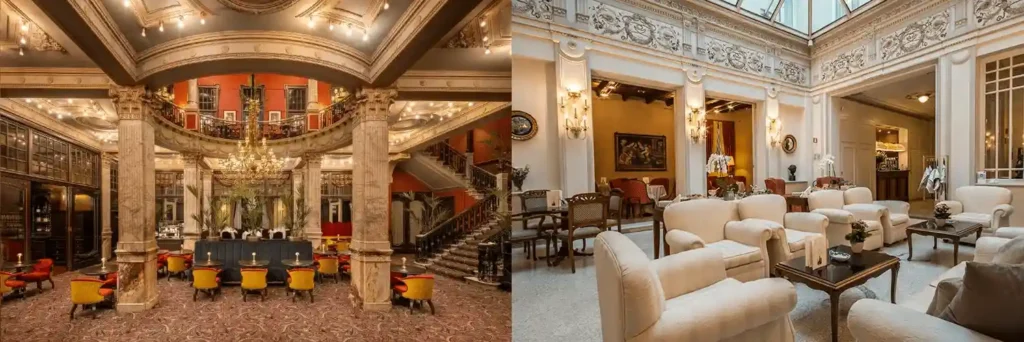
The interiors preserve the chandeliered salons, marble staircases, and stucco ceilings of the original aristocratic residence, while service operates at the level expected when hosting diplomats between treaty signings.
Its restaurant overlooks the same tree-lined avenue where parliamentary motorcades pass daily, and the concierge team knows which ministry officials control access to closed-door state collections.
This isn’t a hotel near power—it’s a hotel built by power, for those who recognize the difference between proximity and pedigree. Availability during parliamentary sessions and state visits closes out months ahead.
Best for: Executives and cultural travelers seeking The Hague’s most recognizable palace hotel with direct access to museum row and ministerial addresses.
Signature Experience: Chandeliered breakfast salon overlooking Lange Voorhout, private access to state-level concierge networks, original 1858 marble staircases and stucco ceilings, walking distance to Binnenhof and royal collecting institutions.
“Breakfast under those chandeliers, watching the city wake up through palace windows—it’s why you come to The Hague.” — Matthijs, BrusselsCheck Availability & Rates →
🏛️ Boutique Hotel Corona ★★★★
Boutique Hotel Corona comprises three interconnected 17th-century townhouses on the Buitenhof, making it the city’s oldest continuously operating hotel and the closest lodging to the Binnenhof parliamentary complex—close enough that ministers use its bar for post-session debriefs.
The building’s history predates the Dutch Republic’s formal establishment, and its location on the governmental square means your morning coffee overlooks the same courtyard where Spinoza walked and modern cabinets convene.
Interiors blend period woodwork with contemporary minimalism, avoiding museumification while respecting the structural bones that have housed travelers since The Hague became a diplomatic capital.
The concierge operates with insider access to political archives and closed parliamentary tours unavailable through standard tourist channels.
This property suits travelers who value location specificity and historical positioning over scale or brand recognition.
Best for: Political historians and solo travelers prioritizing architectural authenticity and proximity to Binnenhof over amenity scale.
Signature Experience: Views directly onto Buitenhof governmental square, access to political archive tours, 17th-century woodwork and original structural beams, ministerial-level bar frequented by parliamentary staff.
“Waking up in the city’s oldest hotel, steps from where the country’s laws are written—that’s positioning you can’t replicate.” — Elena, LuxembourgCheck Availability & Rates →
🏦 voco The Hague ★★★★
voco The Hague operates inside the 1923 ABN AMRO headquarters—a monumental stone bank fortress in the Royal Quarter that represents early 20th-century financial architecture at its most imposing.
The building‘s original vault rooms, marble counters, and coffered ceilings remain intact, converted into lounges and event spaces that maintain the gravitas of an institution that once controlled national capital flows.
Rooms occupy the upper banking floors with views toward Noordeinde Palace, and the concierge team provides access to private banking archives and royal quarter walking routes unavailable through standard hotel programs.
This property appeals to travelers who appreciate financial heritage as a subset of state architecture, and who value structural authenticity over boutique scale.
Best for: Business travelers and architecture enthusiasts seeking early 20th-century bank monumentality with Royal Quarter positioning.
Signature Experience: Original 1923 bank vault lounges, marble counters and coffered ceilings, views toward Noordeinde Palace, private banking archive tours, IHG service inside a state-level financial monument.
“Having drinks in the old vault room—you feel the weight of the building’s financial past in every detail.” — Thomas, FrankfurtCheck Availability & Rates →
Coastal Monument & Scheveningen
This section contains The Hague’s most visually dominant structure—a Belle Époque palace on the North Sea built to host emperors and touring royalty when seaside cures defined European aristocratic leisure. Staying here places you inside coastal monumentality rather than urban diplomatic positioning, with architecture designed for spectacle rather than discretion.
🌊 Grand Hotel Amrâth Kurhaus The Hague Scheveningen ★★★★★
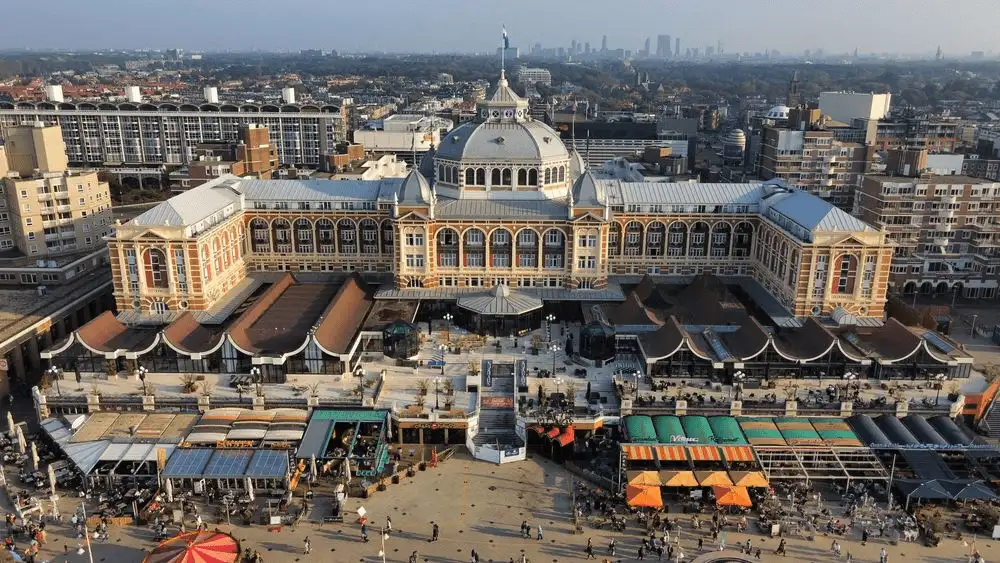
Grand Hotel Amrâth Kurhaus occupies the 1885 Belle Époque bathhouse and concert hall on Scheveningen Beach—a massive domed palace that remains the most recognizable coastal silhouette in the Netherlands, built to accommodate emperors seeking North Sea cures and attending world-class symphonies in the same structure.
The central dome and colonnaded facade dominate the beachfront like a government building transplanted to the dunes, while interiors preserve the chandeliered ballrooms, marble staircases, and gilt salons where European royalty once convened between thalassotherapy sessions.
The property operates as both a luxury hotel and an active concert venue, meaning your stay includes potential access to performances in the original 19th-century hall where Mahler and Strauss conducted.
This isn’t beachfront hospitality—it’s monumental leisure architecture that happens to face the sea, appealing to travelers who value structural grandeur and cultural programming over intimate boutique scale.
Best for: Couples and culture seekers prioritizing Belle Époque monumentality, concert access, and direct North Sea positioning over city-center diplomatic proximity.
Signature Experience: Original 1885 concert hall with active programming, domed ballrooms and chandeliered salons, direct North Sea beach access, thalassotherapy spa heritage, monumental facade recognized across European coastal architecture.
“Sunset under that dome, then a concert in the same hall where emperors listened—worth the higher rate just for the building’s soul.” — Isabelle, ParisCheck Availability & Rates →
State & Aristocratic Estates
These properties operate outside the city center, converted from structures that served national and aristocratic functions—a 16th-century state printing office and a 19th-century baronial castle. Staying here requires accepting peripheral positioning in exchange for estate-scale grounds and institutional pedigree unavailable in urban conversions.
📜 The Ald Hotel ★★★★
The Ald Hotel occupies the 16th-century Algemeene Landsdrukkerij—the National Printing Office where Dutch laws, decrees, and official state documents were produced for over 300 years, making it one of the most historically significant administrative buildings still functioning as a commercial property.
Interiors blend exposed beams with minimalist contemporary design, avoiding historical pastiche while respecting the site’s state archive legacy.
The location sits outside the immediate diplomatic core, requiring a short tram ride to reach Binnenhof, but offers courtyard privacy and access to concierge teams familiar with state archive research and closed institutional collections.
This property appeals to travelers who prioritize structural uniqueness and governmental pedigree over central positioning.
Best for: Legal historians and design-focused travelers seeking rare state archive architecture with courtyard privacy over immediate palace proximity.
Signature Experience: Original 16th-century brick vaulting and industrial proportions, courtyard privacy within a state printing archive, concierge access to governmental research collections, minimalist design respecting institutional heritage.
“Staying in the building that printed the nation’s laws for centuries—the history here runs deeper than palace hotels.” — Pieter, RotterdamCheck Availability & Rates →
🏰 Kasteel de Wittenburg ★★★★
Kasteel de Wittenburg operates as a 1899 baronial castle on a private wooded estate outside The Hague’s urban core—a massive stone manor used as a WWII German headquarters, then converted to a diplomatic retreat hosting world leaders during Cold War negotiations. The structure’s architectural scale and turret silhouette deliver aristocratic monumentality, while the surrounding grounds provide estate-level privacy unavailable in city-center conversions.
Interiors preserve period details—wood paneling, stone fireplaces, original staircases—while accommodating contemporary luxury standards expected by modern travelers.
The location requires a car or arranged transport to reach central diplomatic and museum districts, positioning this property for travelers prioritizing estate atmosphere and historical depth over walkable access to governmental addresses.
Concierge services include private estate tours and access to WWII archive materials related to the building’s occupation history.
Best for: Couples and retreat seekers valuing baronial estate privacy and WWII diplomatic heritage over central city positioning.
Signature Experience: Private wooded estate grounds, original 1899 baronial architecture with turrets and stone masonry, WWII headquarters and Cold War diplomatic retreat history, estate-level privacy with period interiors.
“Waking up in a castle that hosted world leaders during negotiations—the walls here have witnessed history most hotels only reference.” — Anneke, MaastrichtCheck Availability & Rates →
📊 The Hague Best Hotels Comparison
| Hotel | Location | Wellness & Spa | Dining | Unique Perks | Best For |
|---|---|---|---|---|---|
|
🏰 Hotel Des Indes The Hague ★★★★★ |
Lange Voorhout, Royal Quarter |
Palace spa, wellness suites |
Chandeliered salon, diplomat-level service |
1858 treasurer’s palace State concierge access |
Executives, cultural collectors |
|
🌊 Grand Hotel Amrâth Kurhaus ★★★★★ |
Scheveningen Beach, North Sea |
Thalassotherapy spa, historic bathhouse |
Belle Époque ballrooms, seaside terraces |
1885 concert hall Monumental dome |
Culture seekers, coastal monument stays |
|
📜 The Ald Hotel ★★★★ |
Near city center, courtyard estate |
Compact wellness, courtyard privacy |
Contemporary Dutch, archive atmosphere |
16th-C. state printing office Governmental archive |
Legal historians, design travelers |
- Continue your exploration of Dutch heritage conversions with our curated guide to best historic hotels in Amsterdam.
❓ FAQ: Best Hotels in The Hague
Which hotel in The Hague offers the most significant palace heritage?
Hotel Des Indes occupies the 1858 city palace of King Willem III’s treasurer on the Lange Voorhout, making it The Hague’s most architecturally recognized aristocratic conversion. The building preserves chandeliered salons, marble staircases, and stucco ceilings from its original state function, positioning guests inside the city’s ceremonial palace corridor alongside embassies and royal collecting institutions. Its concierge network provides access to ministerial-level cultural programming unavailable through standard luxury hotels.
What makes Grand Hotel Amrâth Kurhaus architecturally unique in The Hague?
Grand Hotel Amrâth Kurhaus operates inside the 1885 Belle Époque bathhouse and concert hall on Scheveningen Beach—the most visually dominant coastal structure in the Netherlands, built to host European royalty seeking North Sea cures. The property functions as both a luxury hotel and active concert venue, offering guests potential access to performances in the original 19th-century hall where Mahler and Strauss conducted. Its monumental dome and colonnaded facade define Dutch seaside architecture from the imperial leisure era.
Which best hotels in The Hague provide closest access to Binnenhof and parliamentary district?
Boutique Hotel Corona sits directly on the Buitenhof governmental square—the closest lodging to the Binnenhof parliamentary complex, comprising three interconnected 17th-century townhouses predating the Dutch Republic’s formal establishment. Hotel Des Indes offers secondary proximity from the adjacent Lange Voorhout palace row, providing access to ministerial addresses and diplomatic residences within immediate walking distance. Both properties deliver positioning inside The Hague’s power geography rather than near it.
What heritage significance does The Ald Hotel represent in The Hague?
The Ald Hotel occupies the 16th-century Algemeene Landsdrukkerij—the National Printing Office where Dutch laws and official state documents were produced for over 300 years. Its heritage ties it directly to the formation of the Dutch Republic, preserving industrial proportions and brick vaulting designed for governmental production rather than residential grandeur. The conversion maintains structural authenticity while providing concierge access to state archive research and closed institutional collections unavailable through standard hotels.
Which The Hague hotel best combines coastal positioning with Belle Époque monumentality?
Grand Hotel Amrâth Kurhaus delivers direct North Sea beach access inside an 1885 domed palace built to accommodate touring emperors and symphony audiences. The property’s architectural scale—massive colonnaded facade, chandeliered ballrooms, original concert hall—exceeds typical beachfront hospitality, positioning it as monumental leisure architecture that happens to face the sea. Travelers seeking intimate boutique coastal stays should consider alternatives; this property prioritizes structural grandeur and cultural programming.
Do The Hague’s best historic hotels require central city positioning?
Not necessarily—Kasteel de Wittenburg operates as a 1899 baronial castle on a private wooded estate outside the urban core, offering estate-level privacy and WWII diplomatic retreat heritage unavailable in city-center conversions. The trade-off requires arranged transport to reach governmental and museum districts. Hotel Des Indes and Boutique Hotel Corona provide walkable access to Binnenhof and Mauritshuis, prioritizing diplomatic proximity over estate grounds.
Which hotel in The Hague offers rare financial architecture heritage?
Voco The Hague occupies the 1923 ABN AMRO headquarters—a monumental stone bank fortress in the Royal Quarter preserving original vault rooms, marble counters, and coffered ceilings. The conversion maintains the gravitas of an institution that once controlled national capital flows, appealing to travelers who value financial monumentality as a subset of state architecture. IHG operates the property with preservation standards appropriate to its landmark status.
Choosing the Right Historic Stay in The Hague
Booking your best hotel in The Hague secures access to properties where the building’s governmental or aristocratic past defines the guest experience as much as service standards—these aren’t merely luxury accommodations near cultural sites, but structures that once housed the power networks shaping Dutch statehood.
The properties above represent the most architecturally significant conversions for travelers who value positioning inside diplomatic geography, institutional pedigree, and interiors that reflect centuries of state and royal function.
For alternative heritage options across the region, explore our selection of the best landmark hotels in Utrecht.
For more curated itineraries and luxury-focused travel insights, visit Your Luxury Guide. For official travel information and destination updates, visit Netherlands tourism-info.
Booking your best historic hotel in The Hague places you inside the architectural fabric where Dutch law was written, royal collections were assembled, and European leaders negotiated—a level of historical immersion standard luxury chains reference but landmark conversions actually deliver.
Your Luxury Guide — Where Exceptional Travel Begins.