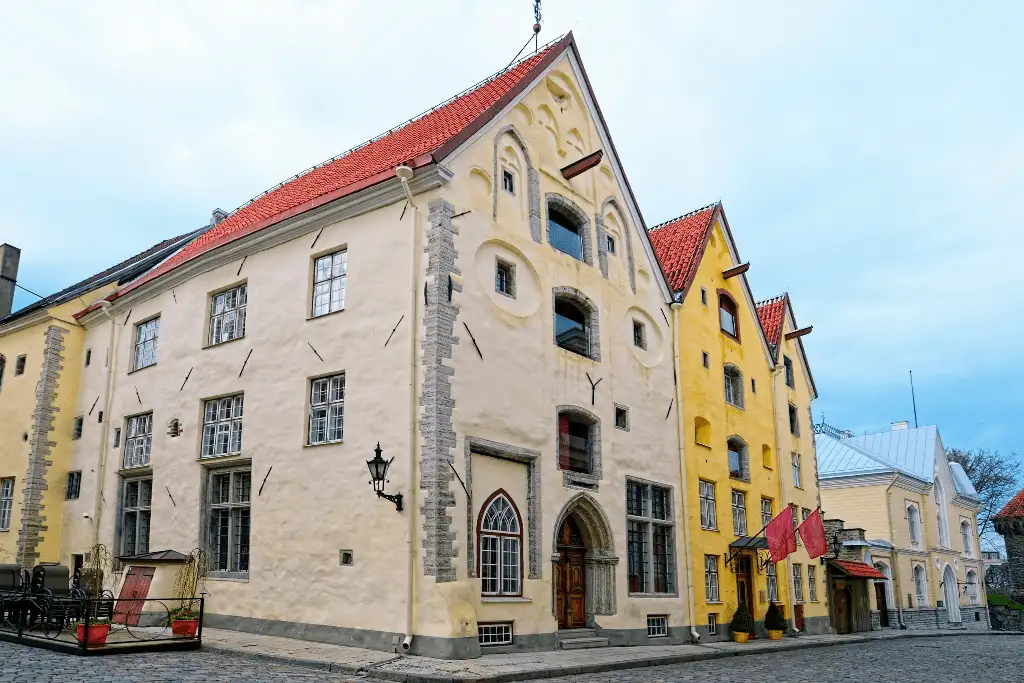
The best hotels in Tallinn occupy the actual fabric of medieval Europe—not replicas, not themed interiors, but the original stone, timber, and masonry that defined Hanseatic power from the 13th century forward. Most travelers searching for luxury in the Old Town encounter the same problem: properties marketed as “historic” often bury their architectural soul under heavy renovations, or worse, occupy reconstructed shells with no provenance at all.
We’ve audited Tallinn’s entire inventory and filtered out every property that lacks a verified Past-Life Identity. What remains are best conversions where the building itself—whether a Gothic merchant trio, a limestone fortress wall, or Estonia’s most important interwar structure—is the primary reason to stay. This selection eliminates the guesswork and guarantees you’re booking into living history, not just a room with old-looking furniture.
For broader context across the country, explore our complete audit of the best historic hotels in Estonia.
Medieval Core: Walls, Merchants & Defensive Architecture
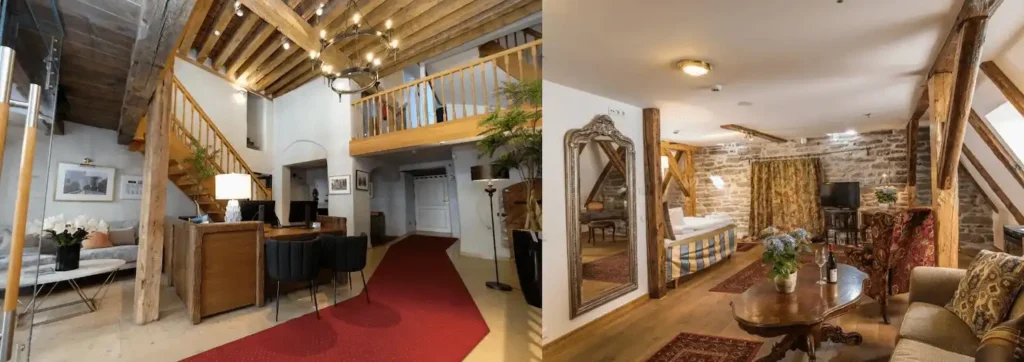
Tallinn’s Old Town isn’t a museum district—it’s a functioning medieval city where original 13th-century fortifications and Hanseatic trade houses still stand as operational buildings. The properties below occupy these structures directly, integrating limestone masonry, Gothic gables, and vaulted stone chambers into the guest experience. You’re not staying near history; you’re sleeping inside the physical architecture that defined Baltic commerce and defense for 700 years.
⚔️ The Three Sisters Hotel ★★★★
The Three Sisters Hotel is the defining example of Hanseatic merchant architecture in the Baltics—a trio of interconnected 14th-century trade houses with original stepped gables, limestone facades, and timber-beam ceilings intact throughout the property. Built in 1362 as the residence and warehouse complex of Tallinn’s wealthiest merchant families, the structure preserves the exact spatial logic of medieval commerce: ground-floor storage vaults, central living quarters, and upper-level sleeping chambers.
The conversion respects every architectural detail while embedding modern luxury—rooms feature exposed stone walls, original oak flooring, and sightlines through Gothic archways, while the spa occupies a vaulted medieval cellar with treatments designed around the building’s historic atmosphere.
The location on Pikk Street places you at the center of the Old Town’s original merchant quarter, steps from Town Hall Square but entirely removed from the tourist noise. This is the single most architecturally significant hotel in Tallinn, and the only property where the Hanseatic trading system is still legible in the physical structure around you.
Best for: Travelers prioritizing architectural authenticity and Hanseatic heritage within a fully preserved Gothic merchant complex.
Signature Experience: Private spa in medieval stone vaults, original 14th-century timber beams and limestone masonry throughout rooms, rooftop terrace overlooking Toompea Castle, michelin-level Nordic dining in the historic merchant hall.
“Waking up in a 14th-century merchant house—you can feel the weight of the stone around you.” — Henrik, StockholmCheck Availability & Rates →
🛡️ Nunne Boutique Hotel ★★★★
Nunne Boutique Hotel is built directly into Tallinn’s 13th-century defensive wall—the limestone fortress masonry isn’t decorative; it’s the structural backbone of the property. Originally part of the city’s northern fortification system, the building incorporates original wall segments, defensive towers, and stone passages into every floor, creating a vertical experience where medieval military architecture defines the spatial flow.
Rooms vary in configuration based on their position within the fortification—some occupy tower chambers with meter-thick walls and narrow defensive windows, others stretch along the wall’s length with exposed limestone surfaces and vaulted ceilings. The design doesn’t hide this history; it amplifies it, with modern glass panels revealing cross-sections of the wall’s construction and original arrow slits preserved as design elements.
The location on Nunne Street keeps you within the Old Town’s quietest residential quarter, yet still within two minutes of the main square. This is the only hotel in Tallinn where the building’s defensive function is still legible in every room.
Best for: History-focused travelers drawn to medieval military architecture and the rare experience of sleeping within a functioning fortress wall.
Signature Experience: Rooms integrated into 13th-century city wall with exposed limestone masonry, original defensive towers and stone passages, quiet residential Old Town location, breakfast in vaulted medieval cellar.
“The walls are so thick you hear nothing—just absolute medieval silence.” — Anna, BerlinCheck Availability & Rates →
🏛️ Merchants House Hotel ★★★★
Merchants House Hotel preserves the most complete collection of 14th-century merchant residences in Tallinn—a compound of interconnected trade houses spanning three centuries of Hanseatic expansion, with original winding staircases, timber galleries, and structural layouts intact. Unlike properties that gut interiors for standardization, this conversion maintains the irregular, organic architecture of medieval domestic life: no two rooms share the same floor plan, staircases spiral at unpredictable angles, and ceiling heights shift based on the building’s original function—storage below, living quarters above, sleeping chambers at the top.
The design embraces this complexity, using exposed oak beams, limestone masonry, and original leaded-glass windows as the primary aesthetic rather than covering them with modern finishes.
The property occupies a prime Old Town corner yet remains entirely removed from the main tourist corridors—guests access the compound through a private courtyard that functions as a medieval-style entry sequence. This is the best option for travelers who want the full spatial experience of Hanseatic living without the museum-like formality of Tallinn’s grander conversions.
Best for: Guests seeking an immersive medieval merchant experience with authentic architectural complexity and residential Old Town tranquility.
Signature Experience: Three centuries of preserved Hanseatic architecture across interconnected houses, original winding staircases and irregular medieval floor plans, private courtyard entry sequence, breakfast in 14th-century vaulted hall.
“Every staircase feels like a different century—you never quite know where you’ll end up.” — Lars, CopenhagenCheck Availability & Rates →
🏚️ CRU Hotel ★★★★
CRU Hotel occupies one of Tallinn’s oldest residential structures—a 15th-century street-front building that retains its original medieval living-hall proportions and structural timber framing. Unlike the grander merchant houses designed for trade and display, this property was built as a private residence for a single family, resulting in a more intimate architectural scale: lower ceilings, narrower rooms, and a vertical layout that mirrors domestic life rather than commercial function.
The conversion preserves this residential character while embedding boutique-level finishes—exposed limestone walls, original oak beams, and hand-plastered surfaces appear alongside contemporary furnishings designed to respect rather than compete with the historic fabric.
The location on Vene Street places you at the edge of the Old Town’s commercial core, close enough to reach Town Hall Square in under three minutes but far enough to avoid the pedestrian crowds. This property appeals to travelers who prefer understated heritage over monumental architecture—the building’s power comes from its age and authenticity, not its scale.
Best for: Travelers drawn to intimate medieval residential architecture and understated heritage within a boutique-scale property.
Signature Experience: 15th-century residential structure with original living-hall proportions, exposed timber framing and limestone masonry, boutique-level finishes respecting historic fabric, quiet Vene Street location.
“It feels more like someone’s medieval home than a hotel—in the best way.” — Sofia, HelsinkiCheck Availability & Rates →
Baroque Evolution & 19th-Century Civic Architecture
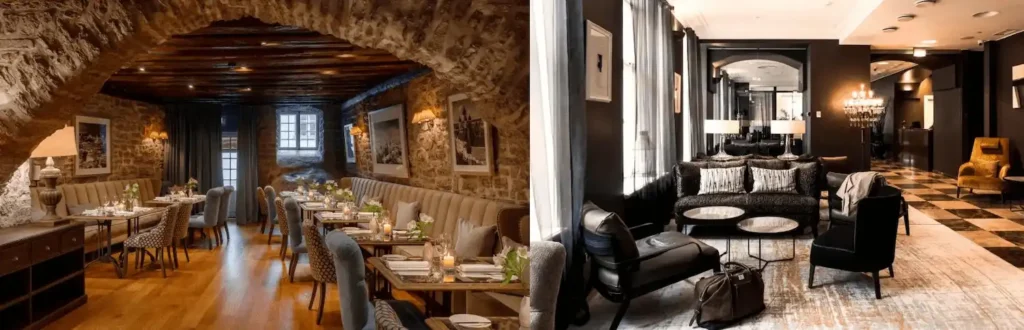
Tallinn’s architectural narrative extends beyond its medieval core—by the 17th and 19th centuries, the city had evolved into a financial and institutional hub, producing structures that reflect Baroque grandeur and late-Imperial civic ambition. The properties below represent this later architectural chapter, where original storage foundations, telegraph offices, and bank headquarters have been converted into luxury assets that preserve their institutional character while offering a different historical experience than the medieval quarter.
🏦 Schlössle Hotel ★★★★★
Schlössle Hotel is built on 13th-century warehouse foundations but reached its current architectural form during Tallinn’s Baroque period—a complex of medieval storage vaults converted into a luxury estate with ornate plasterwork, grand staircases, and high-ceilinged salons. The structure integrates multiple historical layers: original Gothic stone cellars below, Baroque-era living quarters above, and 19th-century additions that expanded the property into a full city-block compound.
The conversion preserves this architectural evolution rather than forcing a single aesthetic—rooms vary dramatically based on their position within the building, from vaulted stone chambers with medieval proportions to light-filled Baroque suites with original parquet floors and decorative moldings. The spa occupies the deepest medieval vaults, where limestone walls and low ceilings create a grotto-like atmosphere, while the restaurant operates in a grand Baroque salon with chandelier lighting and period furnishings.
The location on Pühavaimu Street places you at the absolute center of the Old Town, equidistant from Town Hall Square and Toompea Castle. This is Tallinn’s most architecturally layered hotel—ideal for travelers who want multiple centuries of history integrated into a single property.
Best for: Guests seeking architectural complexity across medieval, Baroque, and 19th-century layers within a Small Luxury Hotels property.
Signature Experience: 13th-century Gothic foundations with Baroque-era grand salons, spa in original medieval stone vaults, chandelier-lit restaurant in period salon, central Old Town location.
“The spa in those medieval vaults—feels like bathing in a fortress dungeon, but luxurious.” — Marta, WarsawCheck Availability & Rates →
📡 Hotel Telegraaf, Autograph Collection ★★★★★
Hotel Telegraaf occupies Tallinn’s most significant 19th-century civic structure—the 1878 central bank and telegraph office, a masonry landmark that represents the city’s shift from medieval trade hub to modern financial center. Unlike the Old Town’s Gothic and Baroque assets, this building expresses late-Imperial institutional architecture: symmetrical facades, grand arched windows, and high-ceilinged banking halls designed to project authority and permanence.
The conversion preserves these civic proportions while embedding full five-star infrastructure—original telegraph equipment is displayed as historical artifacts, banking hall columns frame the reception area, and rooms occupy former administrative offices with preserved ceiling heights and original woodwork. The spa is built into the building’s original vault system, where thick masonry walls and fireproof construction create a naturally insulated, silent environment.
The location at the edge of the Old Town places you within two minutes of medieval Tallinn but directly on the route toward the modern city center and port.
This property appeals to travelers who prioritize institutional grandeur and 19th-century architectural refinement over medieval character.
Best for: Guests drawn to 19th-century civic architecture and institutional grandeur within an Autograph Collection property.
Signature Experience: 1878 central bank and telegraph office with original banking hall columns, spa in historic vault system, preserved telegraph equipment as historical displays, edge-of-Old-Town location.
“Sleeping in the old telegraph office—there’s something powerful about that kind of history.” — Jan, AmsterdamCheck Availability & Rates →
🏛️ The Burman Hotel ★★★★★
The Burman Hotel is the most architecturally significant structure from Estonia’s first period of independence—a 1923 modernist masterpiece designed by Erich Jacoby, the nation’s premier architect, as a symbol of the newly sovereign state’s cultural ambition. Unlike Tallinn’s medieval and Baroque assets, this building represents interwar European modernism at its peak: clean lines, geometric facades, and an interior logic that prioritized light, proportion, and functional elegance over historical ornamentation.
The structure was originally built as a mixed-use commercial and residential building, and the conversion maintains this vertical organization—public spaces occupy the ground floor with soaring ceilings and original terrazzo floors, while upper-level suites preserve the residential scale with period fixtures, herringbone parquet, and oversized windows that flood rooms with natural light.
The design doesn’t attempt to medievalize the space; it celebrates the building’s 1920s identity through careful restoration of Art Deco details, original metalwork, and period-appropriate furnishings.
The location in the Rotermann Quarter places you outside the Old Town but within five minutes on foot, offering a different architectural perspective on Tallinn’s 20th-century evolution. This is the best option for travelers who prioritize modernist architecture and interwar design over medieval heritage.
Best for: Design-focused travelers drawn to interwar modernism and Estonia’s most significant architectural statement from its first independence period.
Signature Experience: 1923 modernist masterpiece by Estonia’s premier architect, original Art Deco details and terrazzo floors, herringbone parquet and oversized windows flooding rooms with light, Rotermann Quarter location.
“The 1920s modernism here feels like a completely different city—elegant, clean, and still historic.” — Eva, RigaCheck Availability & Rates →
📊 Comparison: Best Hotels in Tallinn
| Hotel | Location | Wellness & Spa | Dining | Unique Perks | Best For |
|---|---|---|---|---|---|
|
⚔️ The Three Sisters Hotel ★★★★ |
Old Town, Pikk Street |
Medieval vault spa, historic cellar treatments |
Nordic fine dining, merchant hall |
1362 Hanseatic trio, Gothic gables |
Hanseatic heritage, architectural purists |
|
🛡️ Nunne Boutique Hotel ★★★★ |
Old Town, city wall |
Vaulted cellar wellness area |
Breakfast in medieval cellar |
Built into 13th-century defensive wall |
Fortress architecture, defensive history |
|
🏛️ Merchants House Hotel ★★★★ |
Old Town, residential corner |
Historic courtyard, wellness services |
Vaulted hall, Estonian cuisine |
14th-century compound, winding staircases |
Merchant living, architectural immersion |
|
📡 Hotel Telegraaf, Autograph ★★★★★ |
Old Town edge, port route |
Vault spa, fireproof masonry |
Banking hall dining room |
1878 telegraph office, civic architecture |
19th-century grandeur, institutional design |
❓ FAQ: Best Hotels in Tallinn
What makes Tallinn’s historic hotels different from other European cities?
Tallinn preserves the most complete collection of functioning medieval Hanseatic architecture in Northern Europe—these aren’t reconstructed theme hotels; they’re the original 13th and 14th-century merchant houses, defensive walls, and residential structures still operating as buildings. Properties like The Three Sisters Hotel and Nunne Boutique Hotel integrate Gothic gables, limestone fortress masonry, and vaulted stone chambers directly into the guest experience, creating a level of architectural authenticity rarely found elsewhere.
Which hotel offers the most authentic medieval experience?
The Three Sisters Hotel represents the definitive medieval merchant experience—a trio of interconnected 14th-century trade houses with original stepped gables, timber beams, and spatial layouts that mirror Hanseatic commerce. Nunne Boutique Hotel offers a different medieval perspective through its integration into the 13th-century defensive wall, where fortress masonry and tower chambers define the architecture. Both provide authentic medieval environments, but The Three Sisters focuses on merchant life while Nunne emphasizes military fortification.
Are these hotels inside Tallinn’s Old Town or outside?
The Three Sisters Hotel, Nunne Boutique Hotel, Merchants House Hotel, and CRU Hotel occupy central Old Town positions within the medieval wall system. Schlössle Hotel sits at the Old Town’s geographic center, while Hotel Telegraaf operates at the edge, bridging medieval and modern Tallinn. The Burman Hotel is the only property outside the Old Town, located in the Rotermann Quarter five minutes on foot, offering a 1920s modernist alternative to medieval architecture.
Which hotel has the best spa facilities?
The Three Sisters Hotel operates the most architecturally significant spa—treatments take place in original medieval vaulted cellars where limestone walls and low ceilings create a grotto-like atmosphere. Hotel Telegraaf’s spa occupies the building’s original vault system, benefiting from thick masonry walls and fireproof construction that create a naturally silent environment. Both offer full wellness services, but The Three Sisters emphasizes medieval architecture while Telegraaf prioritizes 19th-century institutional design.
Is staying in a medieval building uncomfortable or outdated?
These conversions integrate modern luxury infrastructure—climate control, high-speed internet, contemporary bathrooms—while preserving the historic fabric as the primary aesthetic. Original limestone walls, timber beams, and Gothic windows appear alongside modern furnishings designed to respect rather than compete with the architecture. The experience prioritizes authenticity without sacrificing comfort; you’re not role-playing medieval life, you’re staying in a building that happens to be 700 years old with full five-star amenities embedded.
Which hotel is closest to Tallinn’s main attractions?
Schlössle Hotel occupies the most central Old Town position, equidistant from Town Hall Square and Toompea Castle with two-minute walking access to both. The Three Sisters Hotel sits on Pikk Street within the original merchant quarter, three minutes from the main square. Merchants House Hotel operates on a quieter residential corner but remains within five minutes of all major sites. All Old Town properties offer walkable access to Tallinn’s key landmarks.
Do these hotels offer dining that matches the historical setting?
The Three Sisters Hotel operates a Michelin-level Nordic restaurant in the original merchant hall with chandelier lighting and period architecture framing the dining experience. Schlössle Hotel’s restaurant occupies a grand Baroque salon with decorative moldings and high ceilings. Hotel Telegraaf uses the original banking hall columns as the structural backdrop for its dining room. Each property integrates dining into the historic architecture rather than creating separate modern spaces.
Your Historic Stay in Tallinn Awaits
Booking your best hotels in Tallinn secures access to the Baltics’ most architecturally significant medieval conversions before peak season reduces availability at properties like The Three Sisters Hotel and Nunne Boutique Hotel. These assets represent functioning medieval Hanseatic architecture at a level rarely preserved elsewhere in Europe—choosing the right property means matching your preference for merchant houses, defensive fortifications, or 19th-century civic structures to the specific historical narrative that resonates with how you want to experience the city. Availability at this caliber shifts quickly once summer and holiday periods begin.
For more curated itineraries and luxury-focused travel insights, visit Your Luxury Guide. For official travel information and destination updates, visit Estonia tourism-info.
Your Luxury Guide — Where Exceptional Travel Begins.