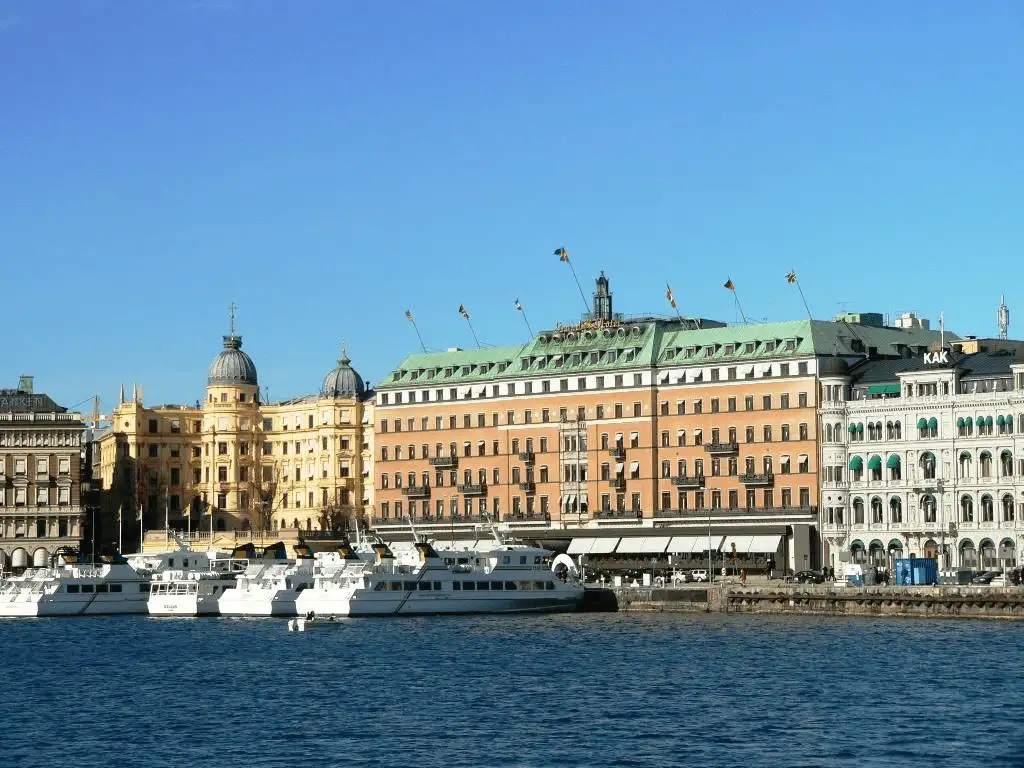
The best hotels in Stockholm are those where the building itself carries weight — former royal entertainment palaces, Renaissance banking headquarters, and naval barracks built for King Karl XII’s Marines. Stockholm’s luxury hotel inventory is dense, but most modern properties rely on design labels and waterfront views without any architectural substance.
We’ve audited the city’s full portfolio and rejected properties with weak renovations or generic Scandinavian minimalism that erases historical identity. What remains are seven conversions where the “Past-Life Identity” is still legible: original crystal chandeliers in 1863 ballrooms, banking hall ceilings protected by the National Heritage Board, and 17th-century brick floors discovered during restoration.
These selections prioritize buildings where you can trace the original function — royal gathering spaces, foreign embassy offices, or merchant houses built over medieval defensive towers. This list saves you from booking a “design hotel” that looks identical to properties in Copenhagen or Oslo. If you’re in Stockholm for the architecture and want your accommodation to extend that experience, these are the stays that deliver.
For a broader selection across the country, explore best historic hotels in Sweden.
Gamla Stan & Waterfront: Royal Gathering Spaces & Maritime Barracks
These properties occupy the geographic and cultural heart of Stockholm — Gamla Stan’s preserved 17th-century streets and the waterfront islands where royalty commissioned entertainment palaces. What unifies this group is proximity to the Royal Palace and direct engagement with Sweden’s maritime history.
Expect original ballrooms where Nobel Prize banquets were held, naval barracks built from ruined castle stones, and merchant houses constructed over medieval defense towers.
🏛️ Grand Hôtel Stockholm ★★★★★
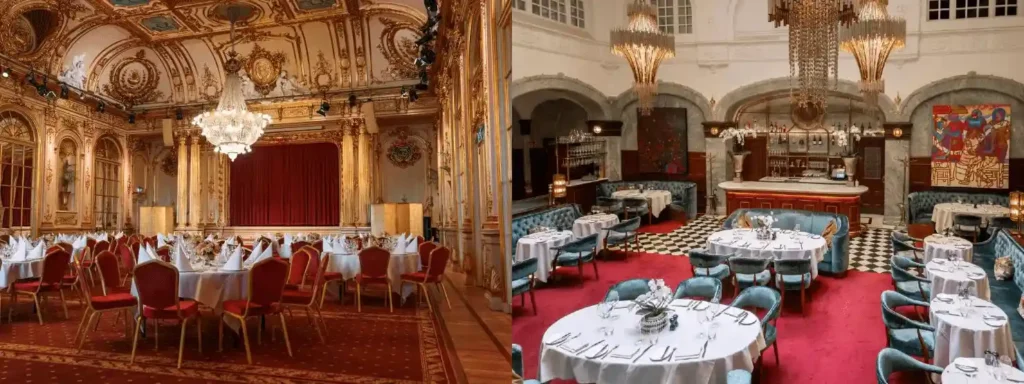
This property was commissioned in 1874 as the royal gathering space for Sweden’s cultural and political elite, and it retains that function today. The physical soul is the Spegelsalen (Hall of Mirrors), modeled after Versailles, where the first Nobel Prize banquets were held in 1901 and continue annually.
The main entrance opens to a marble staircase with wrought-iron railings and Art Nouveau stained glass — all original. Guest rooms overlook the Royal Palace and Gamla Stan’s skyline, maintaining the visual dominance the building was designed to command. The transition from Norrmalm’s busy streets into the Spegelsalen’s gilded silence is immediate and complete. The Mathias Dahlgren restaurants hold two Michelin stars combined, operating within the original ballroom and salon spaces.
No other hotel in Stockholm can claim direct lineage to the Nobel Prize tradition or offer this level of preserved ceremonial architecture. Availability in the palace-view suites becomes scarce once the Nobel Prize season approaches in December.
Best for: Travelers seeking Sweden’s most historically significant hotel experience, with direct ties to royal ceremonies and Nobel Prize heritage.
Signature Experience: Nobel Prize banquet hall access, palace-view suites with original Art Nouveau details, two-Michelin-star dining in preserved ballrooms, waterfront terrace overlooking the Royal Palace.
“Walking through the Hall of Mirrors at night felt like stepping into a state dinner from 1901.” — Lars, CopenhagenCheck Availability & Rates →
🏦 Bank Hotel, a Member of Small Luxury Hotels ★★★★★
Constructed in 1910 as the headquarters for Stockholms Enskilda Bank, this building represents the height of Swedish Renaissance Revival banking architecture. The conversion preserved the soaring main banking hall — now Bonnie’s Restaurant — with its original glass ceiling, marble columns, and terrazzo floors. The former bank director’s office suites have been converted into oak-paneled private bars, retaining the original wood paneling and brass fixtures.
Guest rooms occupy the upper floors where clerks once worked, but the real pull is ground-floor access to the banking hall’s 20-foot ceilings and natural light flooding through period glass.
The neighborhood (Östermalm) provides quiet residential streets lined with 19th-century apartment blocks, creating a buffer from the tourist density of Gamla Stan. The spa occupies the original vault chambers, with stone walls and steel doors still intact.
No other property in Stockholm offers this combination of banking-era grandeur and residential neighborhood calm.
Best for: Guests drawn to early 20th-century banking architecture and prefer boutique-scale properties with residential neighborhood access over waterfront tourist zones.
Signature Experience: Dining in the original glass-ceilinged banking hall, oak-paneled private bars in former director offices, vault-level spa with preserved steel doors, Östermalm residential calm.
“The glass ceiling in the restaurant makes you forget you’re in a former bank — until you see the vault spa downstairs.” — Emma, BerlinCheck Availability & Rates →
⚓ Hotel Skeppsholmen, Stockholm, a Member of Design Hotels ★★★★★
Built in 1699 as barracks for King Karl XII’s Marines, this property occupies Skeppsholmen Island — a location chosen for its strategic naval defense position and isolation from Stockholm’s main commercial center. The stones used in construction came from dismantled medieval castles, giving the building a deliberately rugged, utilitarian character.
During restoration, architects uncovered original brick floors and raw pine floorboards, which now define the ground-floor public spaces. The barracks layout has been preserved — long hallways with small, cell-like rooms converted into minimalist guest quarters.
The island itself remains quiet, with the Modern Art Museum and East Asian Museum as neighbors, maintaining the original military compound atmosphere. No cars, no commercial retail, just footpaths and waterfront access. The hotel’s sauna overlooks the harbor, positioned where marines once stored ammunition.
This is the only property in Stockholm where the building’s original military function is still legible in the architecture. Availability tightens during Stockholm Design Week when the design-focused crowd claims the island.
Best for: Travelers prioritizing architectural authenticity and island isolation over central Gamla Stan proximity, with appreciation for 17th-century military conversions.
Signature Experience: Island-based naval barracks with medieval castle stones, original brick and pine floors, harbor-view sauna in former ammunition storage, car-free isolation among art museums.
“The raw brick floors and military-scale hallways make you feel like you’re staying in actual Swedish history, not a hotel.” — Henrik, OsloCheck Availability & Rates →
🎭 Berns Hotel – Boutique Hotel in the heart of Stockholm ★★★★★
Opened in 1863 as a royal entertainment palace, Berns has functioned as Stockholm’s primary cultural venue for over 160 years — hosting everyone from Edvard Grieg to modern electronic music acts. The physical soul is the Main Ballroom, with gold-coated ceilings, oversized crystal chandeliers (original from 1863), and red velvet balconies that have never been replaced.
The building was designed for spectacle, and the conversion preserved that theatrical function rather than erasing it. Guest rooms occupy the upper floors, but the real experience happens in the ground-floor public spaces — the ballroom still hosts concerts, and the original salon serves as a bar with period furniture.
The location (Berzelii Park edge) places you at the intersection of Old Town access and modern commercial Stockholm. This is not a quiet heritage hotel; it’s a living performance space where the architecture supports the same function it was built for. The crowd skews younger and design-conscious, attracted by the cultural programming rather than traditional luxury.
Best for: Culture-focused travelers who want their accommodation to function as both lodging and performance venue, with appreciation for 19th-century entertainment palace design.
Signature Experience: Active ballroom with 1863 chandeliers and gold ceilings, red velvet balconies overlooking nightly concerts, original salon bar with period furniture, Berzelii Park location.
“Hearing live music in the same ballroom where Grieg performed in the 1800s — that’s not something you can do in a modern hotel.” — Sofia, StockholmCheck Availability & Rates →
Norrmalm & Östermalm: Banking Headquarters & Embassy Palaces
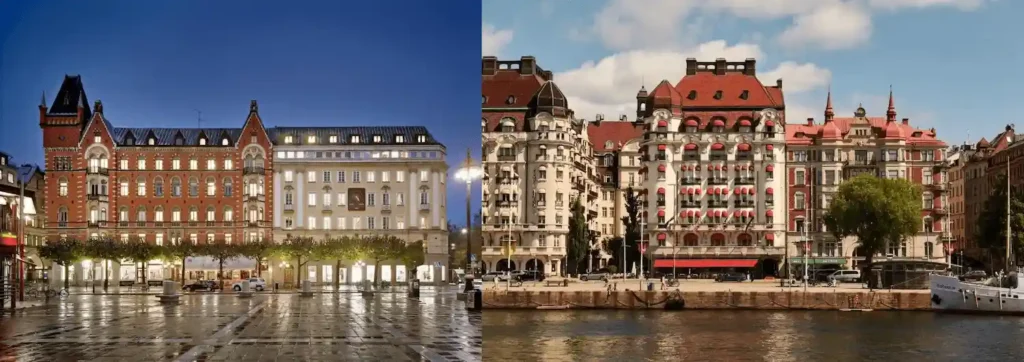
This grouping represents Stockholm’s 19th and early 20th-century financial and diplomatic expansion. These properties served as private banking headquarters and foreign embassy offices before conversion, and they retain the oak-paneled boardrooms, stucco ceilings, and stone courtyards that signal institutional power. The neighborhoods (Norrmalm and Östermalm) offer broader streets, fewer tourists, and proximity to shopping districts rather than medieval architecture.
Expect preserved Art Nouveau interiors, National Heritage Board protections, and buildings where significant historical events (like the 1973 Stockholm Syndrome robbery) occurred.
🏛️ Nobis Hotel Stockholm, a Member of Design Hotels ★★★★★
This site is famous as the location of the 1973 Norrmalmstorg robbery that coined the term “Stockholm Syndrome,” but the building’s architectural significance predates that event. Constructed in the 19th century as a series of private palaces and later converted into banking headquarters, the property retains original dark oak-paneled boardrooms and ornate stucco ceilings protected by Sweden’s National Heritage Board.
The ground-floor public spaces still display the marble columns and brass detailing typical of early 20th-century Scandinavian banking architecture. Guest rooms occupy the upper floors with high ceilings and tall windows overlooking Norrmalmstorg Square.
The neighborhood (Norrmalm) is commercial rather than medieval, dominated by banking offices and retail rather than cobblestones and churches. The hotel’s Gold Bar operates in a former vault space with original steel-reinforced walls. This is not a waterfront property, and it doesn’t offer royal palace views — the appeal is the preserved institutional interior and the historical event association. Availability remains steady except during Stockholm Fashion Week when the design crowd fills the boardroom suites.
Best for: Travelers interested in early 20th-century banking architecture and significant historical event sites, comfortable with commercial Norrmalm over Gamla Stan’s medieval character.
Signature Experience: Oak-paneled boardrooms with National Heritage Board protection, Gold Bar in original vault space, stucco ceilings and marble columns, Norrmalmstorg Square location tied to 1973 historical event.
“The oak boardrooms alone justify the stay — you’re drinking cocktails in rooms where Swedish banking history was written.” — Anders, GothenburgCheck Availability & Rates →
🏰 Hotel Diplomat Stockholm ★★★★★
Built in 1911 as an Art Nouveau palace, this building originally housed foreign embassies and remains family-owned, with interiors largely unchanged since 1917. The physical soul is the central stone courtyard — a rare preserved example of early 20th-century embassy architecture — surrounded by original wrought-iron balconies and stained glass windows.
The public spaces retain period Art Nouveau furniture, brass fixtures, and hand-painted wall panels commissioned during the original construction. Guest rooms occupy the upper floors with tall windows and decorative plasterwork typical of diplomatic residences.
The waterfront location (Strandvägen) offers direct harbor views, but the real appeal is the interior preservation. The family ownership has resisted major renovations, maintaining the building’s 1917 character rather than modernizing for contemporary luxury standards. The neighborhood is residential Östermalm — quiet, upscale, with fewer tourists than Gamla Stan.
This is the choice for travelers who prioritize original Art Nouveau interiors over modern amenities or high-profile cultural associations. Availability tightens during summer when waterfront demand peaks.
Best for: Guests drawn to preserved Art Nouveau embassy architecture and family-owned properties with minimal modernization, preferring residential Östermalm calm over central Old Town density.
Signature Experience: Original stone courtyard with wrought-iron balconies, Art Nouveau interiors unchanged since 1917, hand-painted wall panels and period furniture, Strandvägen waterfront views.
“The courtyard at dusk — stone, iron, and stained glass all original — felt like stepping into a diplomatic residence from another century.” — Maria, HelsinkiCheck Availability & Rates →
⚔️ Victory Hotel ★★★★
Constructed in the 1640s as merchant houses, this property sits directly above a 14th-century defensive tower (Leijontornet), with foundation stones still visible in the basement. The building’s medieval origins are preserved through exposed stone walls, low wooden beam ceilings, and narrow staircases typical of 17th-century Gamla Stan construction.
Guest rooms are intentionally kept small and authentically detailed, filled with nautical antiques and artifacts rather than modern luxury finishes. The physical soul is the tower foundation itself — you can descend to see the original medieval masonry that predates the merchant houses by 300 years.
The location (deep in Gamla Stan’s pedestrian core) places you in the densest concentration of preserved medieval architecture in Stockholm, surrounded by cobblestones and buildings from the same era. This is not a spa hotel or a design showcase; it’s an architectural artifact where the merchant house and defensive tower history remain legible. The scale is intimate (boutique-sized), and the crowd skews toward history-focused travelers rather than luxury amenity seekers.
Best for: History-focused travelers prioritizing 14th-century tower foundations and 1640s merchant house authenticity over modern luxury amenities or spacious room layouts.
Signature Experience: 14th-century defensive tower foundation with visible medieval stones, 1640s merchant house construction with low beam ceilings, nautical antique-filled rooms, deep Gamla Stan pedestrian core location.
“Descending to the tower foundation and touching 14th-century stones — that’s the kind of detail you don’t get in standard luxury hotels.” — Per, MalmöCheck Availability & Rates →
📊 Comparison: Best Hotels in Stockholm
| Hotel | Location | Wellness & Spa | Dining | Unique Perks | Best For |
|---|---|---|---|---|---|
|
🏛️ Grand Hôtel Stockholm ★★★★★ |
Waterfront, Royal Palace views |
Spa with harbor views, traditional treatments |
Two Michelin stars, Nobel banquet hall dining |
Hall of Mirrors, Nobel Prize heritage |
Royal ceremony seekers, palace-view suites |
|
🏦 Bank Hotel ★★★★★ |
Östermalm, residential calm |
Vault-level spa, original steel doors intact |
Glass-ceilinged banking hall, Nordic fine dining |
1910 bank headquarters, oak-paneled bars |
Banking architecture fans, boutique-scale preference |
|
⚓ Hotel Skeppsholmen ★★★★★ |
Island isolation, museum neighbors |
Harbor-view sauna, former ammunition storage |
Seasonal Nordic menu, island calm dining |
1699 naval barracks, medieval castle stones |
Architectural purists, car-free island seekers |
|
🎭 Berns Hotel ★★★★★ |
Berzelii Park, Old Town edge |
No traditional spa, focus on cultural programming |
Salon bar, active ballroom venue |
1863 entertainment palace, live concert ballroom |
Culture-focused stays, performance venue access |
- If you’re extending your trip beyond the capital, compare best hotels in Uppsala for university town heritage.
❓ FAQ: Best Hotels in Stockholm
What makes a hotel in Stockholm historically significant?
Stockholm’s most significant historic hotels are those where the original building function remains legible — royal entertainment palaces that still host Nobel banquets, banking headquarters with preserved oak boardrooms, or naval barracks built from medieval castle stones. Properties like Grand Hôtel Stockholm and Bank Hotel maintain National Heritage Board protections, ensuring original architectural details can’t be altered. Look for buildings where the “Past-Life Identity” (palace, bank, barracks) is still visible in the structure, not just mentioned in marketing materials.
Which Stockholm hotel offers the strongest connection to Swedish royal history?
Grand Hôtel Stockholm holds the most direct royal connection, serving as the official Nobel Prize banquet venue since 1901 in its Versailles-inspired Hall of Mirrors. The property was designed as the gathering space for Sweden’s political and cultural elite, and it retains that ceremonial function. Hotel Diplomat Stockholm also offers royal-era architecture through its 1911 Art Nouveau embassy palace design, though it functions as a quieter residential experience rather than an active ceremonial venue.
Are Stockholm’s historic hotels located in Gamla Stan or outside the Old Town?
Stockholm’s historic hotel portfolio is split between Gamla Stan (Victory Hotel with its 14th-century tower foundation) and waterfront/residential districts (Grand Hôtel, Bank Hotel, Hotel Diplomat). The most significant conversions — royal palaces and banking headquarters — tend to occupy waterfront or Norrmalm locations where institutional power was historically concentrated. If you prioritize medieval architecture over royal/banking heritage, Victory Hotel offers the deepest Gamla Stan immersion with 1640s merchant house construction.
Which Stockholm hotel is best for travelers focused on architectural authenticity over modern luxury?
Hotel Skeppsholmen offers the purest architectural experience, occupying 1699 naval barracks on a car-free island with original brick floors and raw pine floorboards preserved from restoration. The military compound atmosphere remains intact, with no commercial retail and minimal modernization. Victory Hotel provides a different kind of authenticity through its 14th-century tower foundation and 1640s merchant house construction, though the scale is more intimate and the focus is medieval rather than military.
Do Stockholm’s historic hotels require advance booking, or is availability generally stable?
Properties like Grand Hôtel Stockholm see availability tighten significantly during Nobel Prize season (December) when palace-view suites are claimed months in advance. Hotel Skeppsholmen fills during Stockholm Design Week when the design-focused crowd occupies the island. Bank Hotel and Berns Hotel maintain steadier availability except during major cultural events (Fashion Week, concerts). If you’re targeting specific heritage suites or waterfront rooms, booking 2-3 months ahead is recommended.
What’s the difference between Stockholm’s banking heritage hotels and royal palace conversions?
Banking heritage hotels (Bank Hotel, Nobis Hotel Stockholm) feature preserved institutional interiors — oak-paneled boardrooms, marble banking halls, and vault-level spa spaces — designed for financial power rather than royal ceremony. Royal palace conversions (Grand Hôtel Stockholm, Hotel Diplomat) prioritize public grandeur through ballrooms, chandeliers, and entertainment spaces. The banking properties tend to offer quieter, residential neighborhood experiences, while royal conversions occupy waterfront locations with direct palace views and active cultural programming.
Which Stockholm hotel offers the most unique architectural conversion story?
Nobis Hotel Stockholm carries the most unusual historical association as the site of the 1973 Norrmalmstorg robbery that coined “Stockholm Syndrome,” though its architectural significance predates that event through preserved 19th-century banking headquarters interiors. Hotel Skeppsholmen offers the most unusual material story, built from stones salvaged from dismantled medieval castles and converted from military barracks designed for King Karl XII’s Marines. Both properties represent non-traditional luxury conversions compared to standard palace-to-hotel narratives.
Where to Stay in Stockholm: Best Historic Picks
Selecting the right hotel in Stockholm isn’t about chasing Michelin stars or waterfront views — it’s about choosing a building where the original architectural function still defines the guest experience. The properties above represent the city’s most consistently preserved conversions, from Nobel banquet halls to naval barracks built with medieval castle stones.
For a broader selection of heritage conversions across the country, explore best historic hotels in Sweden. For island-based medieval architecture similar to Victory Hotel’s Gamla Stan character, acess best hotels in Visby on Gotland.
For more curated itineraries and luxury-focused travel insights, visit Your Luxury Guide. For official travel information and destination updates, visit Sweden tourism-info.
Booking your Stockholm hotel secures access to buildings where Swedish royal, banking, and maritime history converge — architecture that defines the city’s institutional power rather than simply decorating it.
Your Luxury Guide — Where Exceptional Travel Begins.