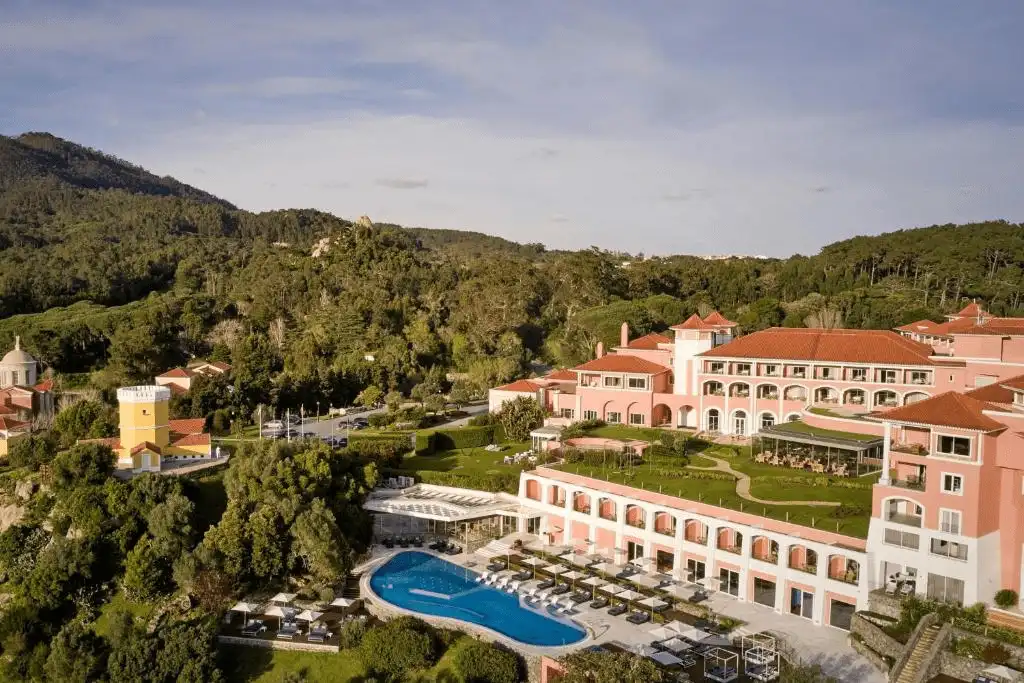
Best hotels in Sintra aren’t standard five-star resorts—they’re 18th-century palaces, former monasteries, and aristocratic estates where the building’s past defines the entire stay. This hilltop UNESCO World Heritage town demands properties that match its romantic, royal soul.
After filtering Sintra’s most elevated stays, we’ve identified five hotels where historical authenticity, architectural grandeur, and contemporary service converge. These aren’t conversions that simply slapped heritage onto marketing copy—they’re verified National Monuments, former royal retreats, and literary landmarks that shaped Portuguese culture.
Below are the only properties that deliver palace-level positioning without sacrificing modern luxury or service clarity. If you’re choosing between generic coastal resorts and something that justifies the premium through architectural soul, these five represent Sintra’s top tier.
For broader context across Portugal’s historic landscape, explore our curated selection in the best authentic historic stays in Portugal.
Sintra’s Royal Palace Hotels: Imperial Grandeur Meets Modern Refinement
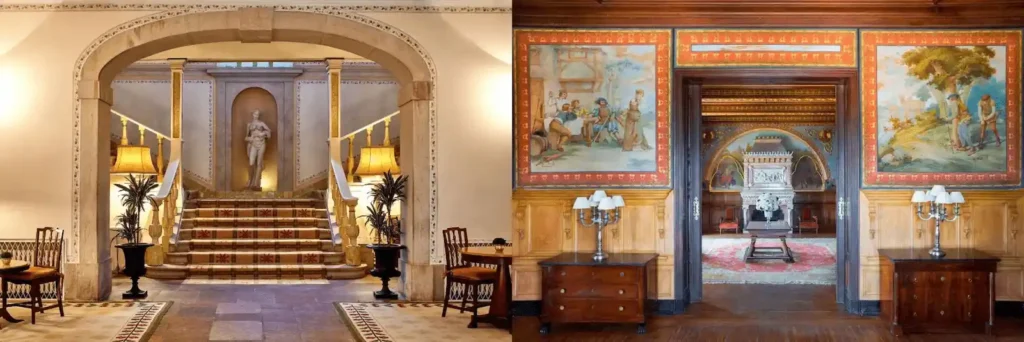
These two properties anchor Sintra’s palace hotel hierarchy. They’re not boutique conversions—they’re full-scale aristocratic estates and royal monuments where neoclassical architecture, National Monument status, and hilltop positioning create the most commanding stays in the region.
Expect grand salons, manicured grounds designed for Portuguese royalty, and service that matches the institutional scale of the buildings themselves.
🏛️ Valverde Sintra Palácio de Seteais ★★★★★
Built in 1787 as the residence of the Dutch Consul and later expanded for the Marquis of Marialva, this neoclassical palace is a designated National Monument and the only Sintra hotel that rivals the town’s royal palaces in architectural scale. The property sits atop a hilltop estate with sweeping views over Moorish Castle ruins and the Atlantic beyond, its triumphal arch connecting twin wings that frame formal gardens.
Guests move through original 18th-century salons with frescoed ceilings, gilded mirrors, and marble floors—this isn’t boutique intimacy; it’s imperial grandeur executed at museum-level preservation.
Service maintains Leading Hotels of the World standards while the building delivers more historical gravitas than any competitor in the region. If you’re choosing between palace hotels in Sintra, this represents the pinnacle—both architecturally and institutionally.
Best for: Travelers prioritizing verified palace architecture, National Monument status, and Leading Hotels service standards over boutique intimacy.
Signature Experience: Neoclassical gardens with ocean vistas, original 1787 triumphal arch, frescoed salons with period furniture, Michelin-level Portuguese dining in former state rooms, marble spa beneath palace foundations.
“Standing under that triumphal arch at sunset—pure Portuguese aristocracy frozen in stone.” — Henrik, StockholmCheck Availability & Rates →
⛪ Penha Longa Resort ★★★★★
Originally a 14th-century Hieronymite monastery founded in 1390 as a royal hunting retreat, Penha Longa sits within 545 acres of former royal parkland that includes a preserved Gothic church, medieval cloisters, and stone chapels woven into the resort grounds. The monastery’s original architecture remains intact—vaulted ceilings, ancient stonework, Manueline details—while the resort expands around it with contemporary wings, a championship golf course, and a Six Senses Spa housed in converted monastic quarters.
This is the most ancient institutional asset in Sintra’s hotel market, offering deeper historical roots than any palace conversion. Guests access both the monastery’s spiritual gravitas and modern resort infrastructure without compromise—rare for heritage properties at this scale.
Best for: Golfers and wellness travelers seeking Portugal’s oldest monastic conversion with championship course access and Six Senses spa integration.
Signature Experience: 14th-century Gothic chapel and cloisters, two championship golf courses on royal hunting grounds, Six Senses Spa in former monk quarters, Michelin-starred dining beneath vaulted stone ceilings.
“Walking through 600-year-old cloisters before morning tea—no resort comes close to this kind of depth.” — Clara, ZürichCheck Availability & Rates →
Sintra’s Literary & Noble Estate Hotels: Historic Soul, Boutique Scale
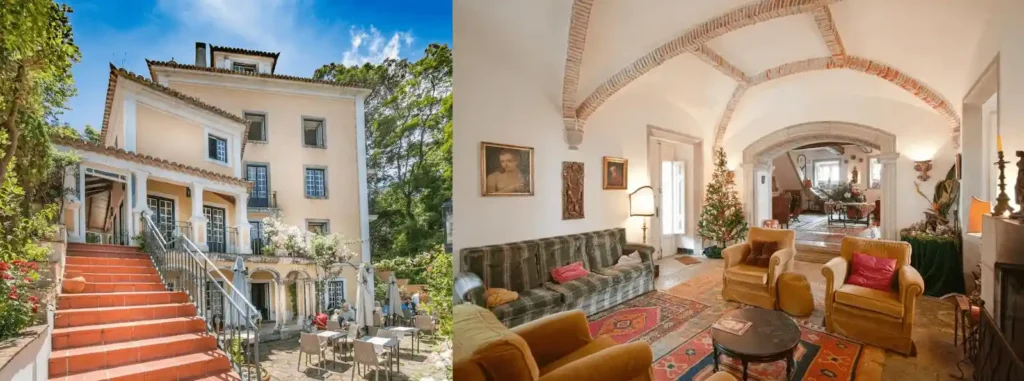
These three properties trade palace scale for intimate aristocratic heritage. They’re former noble quintas, literary landmarks, and royal marble estates where thick stone walls, garden courtyards, and personal service create stays defined by authenticity rather than institutional grandeur.
Expect smaller room counts, deeper local integration, and properties where the building’s past shapes every design decision.
📚 Lawrence’s Hotel ★★★★★
Established in 1764, Lawrence’s holds the title of the oldest hotel on the Iberian Peninsula and served as the preferred lodging for Lord Byron during his 1809 Portuguese sojourn. The building retains its original 18th-century inn structure—low ceilings, intimate salons, period furnishings—while modern updates preserve the literary atmosphere that made it a Romantic-era gathering point.
This isn’t grand palace luxury; it’s historic inn intimacy executed at five-star service levels, where the property’s literary legacy and central Sintra location outweigh larger competitors’ square footage.
Guests prioritizing heritage authenticity and pedestrian access to Sintra’s royal palaces over spa amenities or golf access will find this the most historically grounded option in town.
Best for: Literature enthusiasts and heritage purists valuing Iberian Peninsula’s oldest hotel, Lord Byron associations, and central Sintra access over resort-scale amenities.
Signature Experience: Original 1764 inn architecture, Lord Byron suite with period furnishings, rooftop terrace overlooking Sintra’s historic center, library salon with first-edition Romantic poetry, farm-to-table Portuguese dining.
“That rooftop view over Sintra at dawn—Byron knew exactly what he was doing choosing this spot.” — Thomas, LondonCheck Availability & Rates →
🕊️ Quinta de São Thiago ★★★★
This 16th-century estate served as a monastic retreat for Jerónimos monks and later became a Bragança family hunting lodge, its thick stone walls and terraced gardens embodying the quinta soul that defined Sintra’s aristocratic past.
The property maintains original chapel architecture, hand-painted azulejo tiles, and garden courtyards where citrus trees and stone fountains create a contemplative atmosphere absent from larger resorts. Service remains intimate—just 12 rooms—allowing for personalized attention while the estate’s monastic roots and royal hunting history provide heritage depth beyond typical boutique conversions.
Best for: Couples seeking monastic tranquility, original azulejo tilework, and Bragança royal estate heritage within walking distance of Sintra’s palace quarter.
Signature Experience: 16th-century chapel with original frescoes, terraced gardens with Moorish fountains, hand-painted azulejo tile suites, intimate Portuguese breakfast in former monk refectory.
“Those chapel bells at sunrise—felt like staying in Portugal’s hidden monastic past.” — Isabel, MadridCheck Availability & Rates →
🪨 Sintra Marmoris Palace ★★★★
Built in the 19th century by the family who owned Sintra’s royal marble quarries, this Romanticist manor literally embodies the stone that constructed the town’s most famous palaces. Original marble columns, fireplaces, and staircases sourced directly from the family quarries create interiors where material authenticity matches architectural heritage.
The property’s position within Sintra’s historic center and its connection to the town’s building legacy offer a heritage angle unavailable elsewhere—this is the place where Sintra’s physical identity was extracted and shaped.
Best for: Architecture enthusiasts and design-focused travelers drawn to verified marble heritage, Romanticist interiors, and central Sintra positioning in a boutique setting.
Signature Experience: Original royal marble quarry stone throughout interiors, 19th-century Romanticist architecture, terraced gardens with mountain views, curated Portuguese wine library, intimate marble spa.
“Touching the same marble that built Pena Palace—stayed in the literal source of Sintra’s architectural soul.” — Paolo, FlorenceCheck Availability & Rates →
📊 Comparison: Best Hotels in Sintra
| Hotel | Location | Wellness & Spa | Dining | Unique Perks | Best For |
|---|---|---|---|---|---|
|
🏛️ Valverde Sintra Palácio de Seteais ★★★★★ |
Hilltop estate, National Monument |
Marble spa, palace gardens |
Michelin-level, frescoed salons |
1787 triumphal arch Ocean vistas |
Imperial grandeur, palace architecture |
|
⛪ Penha Longa Resort ★★★★★ |
Royal parkland, 545 acres |
Six Senses Spa, monastic quarters |
Michelin-starred, vaulted ceilings |
14th-century monastery Championship golf |
Golf + wellness, ancient roots |
|
📚 Lawrence’s Hotel ★★★★★ |
Central Sintra, historic quarter |
Boutique spa, rooftop terrace |
Farm-to-table, library salon |
1764 founding Lord Byron legacy |
Literary heritage, intimate scale |
❓ FAQ: Best Hotels in Sintra
Which hotel in Sintra has the most historic significance?
Penha Longa Resort is the standout, originally serving as a Hieronymite monastery founded in 1390 as a royal retreat. It retains a 14th-century Gothic chapel, medieval cloisters, and original monastic architecture across 545 acres of former royal parkland, making it the top choice for travelers seeking the deepest institutional heritage in the region.
Are Sintra’s palace hotels within walking distance of the town’s main attractions?
Lawrence’s Hotel and Quinta de São Thiago sit within Sintra’s historic quarter, offering 10-15 minute walks to Sintra National Palace and the town center. Valverde Sintra Palácio de Seteais sits 2km outside the core on a hilltop estate—walkable for some, but most guests prefer taxis or hotel shuttles. Penha Longa Resort requires a car due to its 545-acre parkland location.
Do Sintra historic hotels require advance booking during peak season?
Properties like Valverde Sintra Palácio de Seteais and Penha Longa Resort fill 8-12 weeks ahead for summer and September dates due to limited room inventory and UNESCO World Heritage tourism demand. Lawrence’s Hotel’s 16-room count creates similar advance booking windows. Shoulder season (April-May, October) opens slightly more availability but still requires 4-6 week lead times for best room selection.
Which Sintra hotel is best for couples prioritizing romantic atmosphere over amenities?
Quinta de São Thiago delivers the most intimate experience—just 12 rooms within a 16th-century monastic estate featuring original chapel architecture, terraced gardens with Moorish fountains, and hand-painted azulejo tiles. The property’s small scale and contemplative grounds create a level of privacy unavailable at larger palace hotels or resort properties.
Can you access Sintra’s major palaces easily from historic hotels?
Central properties like Lawrence’s Hotel and Quinta de São Thiago place you within 1-2km of Pena Palace, Quinta da Regaleira, and Moorish Castle—all accessible via local buses or short taxi rides. Hilltop and resort properties (Valverde Sintra, Penha Longa) require dedicated transportation but often provide shuttle services or can arrange private drivers through concierge.
Do Sintra’s luxury hotels include original palace architecture or modern additions?
Valverde Sintra Palácio de Seteais preserves its 1787 neoclassical structure as a National Monument with original frescoed salons and triumphal arch intact. Penha Longa retains its 14th-century monastery core while adding modern resort wings. Lawrence’s Hotel maintains 1764 inn bones with period interiors. Sintra Marmoris Palace showcases 19th-century Romanticist design using original royal marble quarry stone throughout.
What’s the best time to visit Sintra for historic hotel availability and weather?
April-May and September-October offer ideal conditions—mild temperatures (18-24°C), fewer crowds than peak summer, and better hotel availability. Summer (June-August) brings higher rates and advance booking pressure due to European vacation demand. Winter (November-March) sees lowest rates but cooler, wetter weather that limits garden and terrace access at most properties.
Choosing the Right Palace Stay in Sintra
Selecting the best hotel in Sintra comes down to whether you prioritize verified National Monument grandeur, ancient monastic roots, or intimate literary heritage—each property above represents the pinnacle of its category without overlap or redundancy. The buildings’ past lives aren’t marketing angles; they’re the reason these stays justify premium positioning over standard coastal resorts. Availability narrows quickly once shoulder season bookings open.
If you’re evaluating Portugal’s broader historic landscape beyond Sintra, compare refined options across the capital in our best hotels in Lisbon guide. For northern Portugal’s aristocratic estate legacy, continue with the best hotels in Porto to explore properties where port wine heritage meets riverfront palace architecture.
For more curated itineraries and luxury-focused travel insights, visit Your Luxury Guide. For official travel information and destination updates, visit Portugal tourism-info.
Booking your hotel in Sintra opens the door to palace-level Portuguese luxury, where neoclassical grandeur, monastic soul, and literary legacy converge for stays where the building’s past defines the entire experience.
Your Luxury Guide — Where Exceptional Travel Begins.