Choosing the best hotels in Seville means prioritizing buildings that reflect the city’s imperial past—properties where Moorish arches, royal commissions, and Golden Age merchant palaces define the experience, not just service standards.
After filtering Seville’s historic portfolio, we identified seven properties that deliver architectural significance, privileged locations, and stays rooted in the city’s most consequential centuries. These aren’t generic luxury hotels—they’re verified landmark conversions where the building itself justifies the premium. If you’re traveling beyond cookie-cutter five-stars, these are the only addresses that matter.
For broader context across Spain’s outstanding stays, explore best authentic historic hotels in Spain.
Royal Commissions & National Monuments
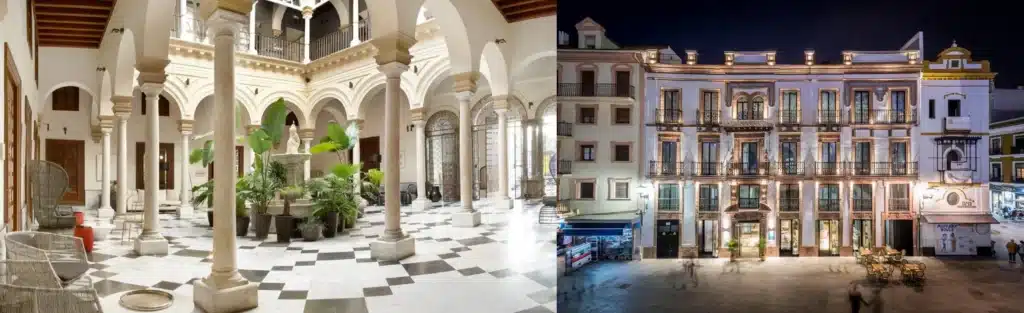
These properties represent Seville’s highest architectural tier—royal-backed projects and admiral estates that anchored the city’s political and cultural prestige. Expect monumental scale, protected facades, and interiors that function as living museums.
👑 Hotel Alfonso XIII, a Luxury Collection Hotel ★★★★★
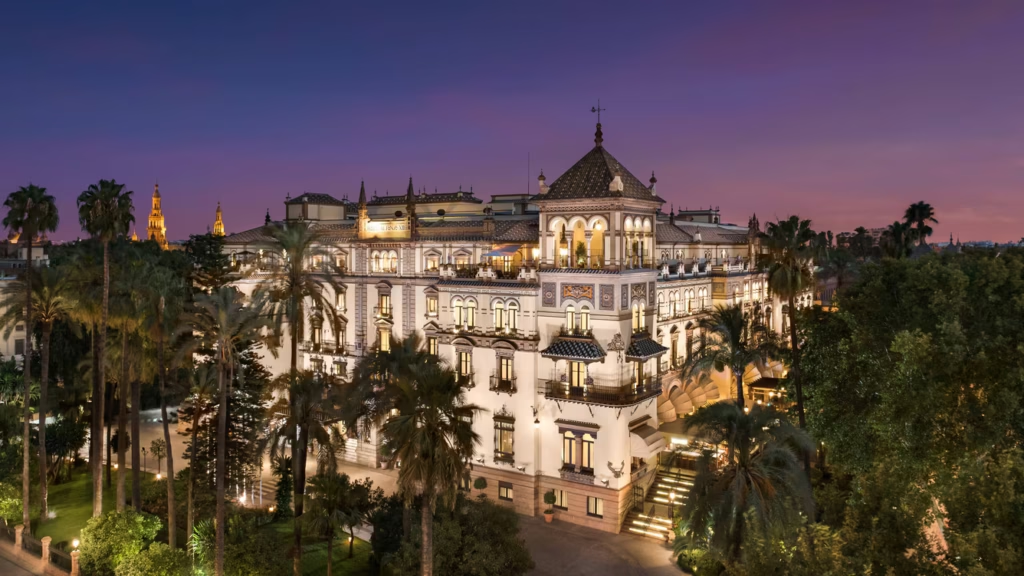
Built in 1929 as King Alfonso XIII’s personal commission for the Ibero-American Exposition, this Neo-Mudéjar landmark remains Seville’s most architecturally significant hotel.
Designed by José Espiau y Muñoz to showcase Andalusian regionalism, the property features hand-painted ceramic tile work, Moorish courtyards, and soaring coffered ceilings that set the standard for early 20th-century Spanish grandeur.
Positioned steps from the Alcázar and Cathedral, it functions as both luxury accommodation and architectural statement—the kind of stay that qualifies as a Seville visit in itself. The royal heritage isn’t decorative; it’s structural.
This is the property that defined what a Spanish palace hotel could be, and it still outperforms newer competitors on legacy alone.
Best for: Travelers seeking royal-commission architecture with privileged Santa Cruz access and National Monument-level design integrity.
Signature Experience: Original 1929 Andalusian tilework, central patio courtyard with fountain and orange trees, rooftop terrace overlooking Giralda Tower, Michelin-caliber Andalusian dining in vaulted salons.
“That courtyard at dawn—felt like stepping into a 1920s royal reception.” — Isabella, MilanCheck Availability & Rates →
🎖️ CoolRooms Palacio Villapanés 5 GL ★★★★★
This 18th-century admiral’s palace—former residence of the Marquis of Villapanés and Admiral of the Spanish Navy—now operates as a National Monument hotel with original Baroque courtyards and naval family crests intact.
The interior preserves marble staircases, frescoed ceilings, and courtyard gardens that reflect aristocratic Seville at its maritime peak. Unlike properties that renovate away historical detail, CoolRooms maintained the architectural bones while upgrading amenities—rooftop pool, contemporary suites, destination dining—making it the rare heritage stay that doesn’t sacrifice modern comfort for authenticity.
If you want naval aristocracy without museum stiffness, this is the most balanced option in the city.
Best for: Design-focused travelers prioritizing National Monument status with rooftop amenities and aristocratic interiors that feel lived-in, not staged.
Signature Experience: Original Baroque courtyards with marble columns, rooftop infinity pool overlooking Giralda, contemporary Andalusian dining in 18th-century salons, preserved naval family crests in common areas.
“The courtyard marble looked 300 years old—because it is.” — Luca, BarcelonaCheck Availability & Rates →
🌍 Intelier Casa de Indias ★★★★
Housed in a 17th-century building that formed part of the Casa de la Contratación—the royal institution controlling trade with the Americas—this property offers direct architectural ties to Seville’s Golden Age as Europe’s gateway to the New World. Original stone arches, colonial-era patios, and preserved mercantile details position it as the most historically significant four-star in the city.
The interior balances restored colonial elements with understated contemporary design, avoiding the overly decorative approach common in lesser conversions.
Location near Plaza Nueva and the Cathedral makes it functionally superior for cultural access, while the building’s mercantile past adds narrative weight that standard boutique hotels lack. This is the property that makes commercial history feel relevant, not academic.
Best for: History-focused travelers valuing colonial-era architecture with understated interiors and direct connections to Seville’s New World trading legacy.
Signature Experience: Original Casa de la Contratación stone arches, colonial courtyard with century-old fountain, preserved mercantile details, rooftop terrace with Cathedral views.
“Standing in that courtyard knowing merchants planned voyages here—goosebumps.” — Thomas, LondonCheck Availability & Rates →
Medieval Palaces & Noble Estates
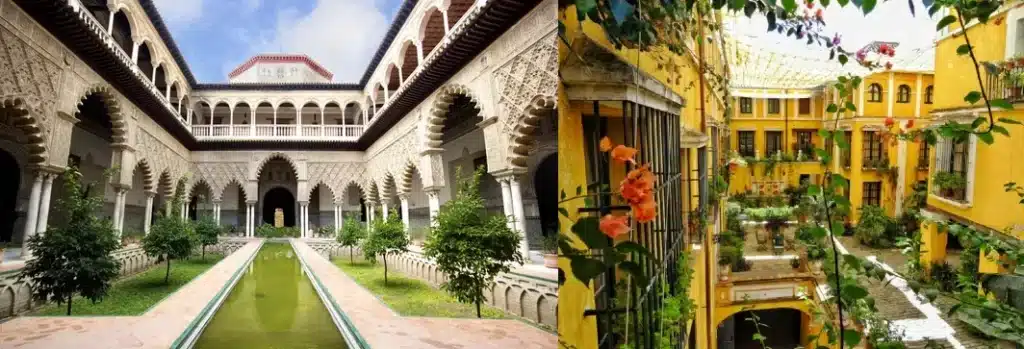
These properties represent Seville’s oldest residential architecture—15th and 16th-century noble houses and merchant palaces that predate the city’s Baroque expansion. Expect intimate scale, original terracotta floors, and Mudéjar ceilings that feel more private residence than hotel.
🏛️ Palacio Pinello ★★★★
A late-medieval palace built for the Pinello family—wealthy Genoese merchants who controlled Seville’s textile trade in the 1400s—this property retains original 15th-century terracotta floors, Mudéjar ceilings, and Renaissance arches that most hotels renovated away decades ago.
The interior functions as a living archive of Gothic-to-Renaissance transition, with preserved noble family details that give context to Seville’s merchant aristocracy. Rooms are compact by modern standards, but the architectural integrity compensates—this is the rare hotel where floors, ceilings, and courtyards are functionally unchanged from their 1400s configuration.
If you prioritize unaltered medieval fabric over contemporary amenities, this is the most authentic option in the city’s historic core.
Best for: Architecture purists seeking preserved medieval interiors with original 15th-century floors and the intimacy of a merchant family residence.
Signature Experience: Intact 15th-century terracotta floors, Mudéjar wooden ceilings, Renaissance stone arches, central courtyard with original well, Gothic-era merchant family crests.
“Walking on floors from 1470—that’s not something you get at a Marriott.” — Claire, ParisCheck Availability & Rates →
🕍 Hotel Las Casas de la Judería ★★★★
A labyrinth of 27 interconnected 15th-century houses that once belonged to Seville’s Sephardic nobility, this property offers the most immersive architectural experience in the Jewish Quarter. Built over Roman foundations with preserved underground tunnels, it functions as a living museum where guests navigate centuries of construction—Visigothic arches, Moorish courtyards, Renaissance patios—across a single stay.
The layout is intentionally disorienting, with hidden staircases and secret gardens that reward exploration. Unlike properties that consolidate history into a lobby display, Las Casas makes the building itself the attraction.
If you want to feel like you’re uncovering Seville’s layers rather than observing them, this is the most spatially complex hotel in the city.
Best for: Explorers seeking labyrinthine layouts with Roman foundations, Sephardic heritage, and the most architecturally layered stay in Seville’s Jewish Quarter.
Signature Experience: 27 interconnected 15th-century houses, Roman underground tunnels, multiple hidden courtyards with fountains, Moorish-Sephardic tile work, secret staircases connecting different eras.
“Got lost three times finding breakfast—loved every minute of it.” — David, New YorkCheck Availability & Rates →
🏨 Hotel Posada del Lucero ★★★★
A rare, intact 16th-century “Posada”—a traveler’s inn—listed as a National Monument, this property offers insight into Seville’s commercial hospitality history before the hotel industry existed. The structure retains original stone archways, courtyard stables (now dining areas), and merchant lodging rooms that show what accommodations looked like during the city’s Golden Age.
Unlike aristocratic palaces, this building served working travelers—traders, diplomats, clergy—making it the most democratically significant heritage stay in the city.
The interiors are simpler than noble estates, but the historical narrative is stronger. If you want to stay in a building that reflects Seville’s commercial past rather than its aristocratic one, this is the most authentic choice.
Best for: History-conscious travelers valuing National Monument status with preserved 16th-century inn architecture and the working-class side of Golden Age Seville.
Signature Experience: Original 16th-century stone archways, courtyard stables converted to dining terrace, preserved merchant lodging rooms, National Monument plaque dating structure to 1540s.
“Knowing merchants slept in these exact rooms 500 years ago—that’s the point.” — Elena, MadridCheck Availability & Rates →
📚 Hotel Casa Del Poeta ★★★★
A meticulously restored 17th-century aristocratic mansion famous for its acoustic perfection and original central patio, this property captures the domestic intimacy of Golden Age nobility.
The interior preserves hand-painted ceiling beams, period tilework, and courtyard proportions designed around natural light and sound—features that give context to how Seville’s elite lived during the Baroque era.
The scale is intentionally small, with just 19 rooms, making it feel more private residence than hotel. If you prioritize architectural authenticity over amenities and want to understand how wealthy families configured their homes before modern hospitality standards, this is the most residential-feeling heritage stay in the city.
Best for: Intimacy-seekers valuing 17th-century domestic architecture with acoustic-perfect courtyards and the smallest, most residential-scale heritage hotel in central Seville.
Signature Experience: Acoustically designed central patio with original fountain, hand-painted 17th-century ceiling beams, period tile work, just 19 rooms maintaining residential intimacy.
“That courtyard’s acoustics made every conversation feel like a secret.” — Sophia, ViennaCheck Availability & Rates →
📊 Comparison: Best Hotels in Seville
| Hotel | Location | Heritage Significance | Dining | Unique Perks | Best For |
|---|---|---|---|---|---|
|
👑 Hotel Alfonso XIII ★★★★★ |
Santa Cruz, Cathedral steps |
1929 royal commission National Monument |
Michelin-caliber Andalusian |
Original Neo-Mudéjar Rooftop terrace |
Royal architecture, iconic stays |
|
🎖️ CoolRooms Palacio Villapanés ★★★★★ |
Santa Cruz, central |
18th-century admiral’s palace, National Monument |
Contemporary Andalusian |
Baroque courtyards Rooftop pool |
Naval heritage, modern luxury |
|
🌍 Intelier Casa de Indias ★★★★ |
Plaza Nueva, Cathedral area |
17th-century Casa de la Contratación building |
Colonial-inspired dining |
New World trade history Colonial courtyard |
Golden Age, mercantile heritage |
|
🏛️ Palacio Pinello ★★★★ |
Historic center, quiet street |
15th-century merchant palace, original floors |
Traditional Andalusian |
Mudéjar ceilings Gothic arches |
Medieval purists, architectural integrity |
- For Andalusian castle stays beyond Seville, compare options at best luxury castle stays in Andalusia.
❓ FAQ: Best Hotels in Seville
Which hotel in Seville has the most historic significance?
Hotel Alfonso XIII is the standout, originally commissioned by King Alfonso XIII himself in 1929 for the Ibero-American Exposition. Designed by José Espiau y Muñoz to showcase Andalusian regionalism, it retains original Neo-Mudéjar tilework, Moorish courtyards, and hand-painted ceilings, making it the top choice for travelers seeking a royal-commission landmark stay.
What’s the best historic hotel in Seville’s Jewish Quarter?
Hotel Las Casas de la Judería offers the most immersive architectural experience—27 interconnected 15th-century houses built over Roman foundations with preserved underground tunnels. The property spans multiple centuries of construction, from Visigothic arches to Renaissance patios, making it the most spatially complex and historically layered stay in the Barrio Santa Cruz.
Are Seville’s historic hotels close to major attractions?
All seven properties sit within 10 minutes’ walk of the Cathedral and Alcázar. Hotel Alfonso XIII and CoolRooms Palacio Villapanés offer the most direct access to Santa Cruz’s main sites, while Intelier Casa de Indias provides easier entry to Plaza Nueva and the shopping district without sacrificing cultural proximity.
Which Seville hotel offers the most authentic medieval architecture?
Palacio Pinello preserves the most intact 15th-century interiors, including original terracotta floors, Mudéjar ceilings, and Renaissance arches that most hotels renovated away decades ago. Built for the Pinello family of Genoese merchants, it functions as a living archive of Gothic-to-Renaissance transition with details unchanged since the 1400s.
What’s the difference between Seville’s palace hotels and converted monasteries?
Seville’s heritage portfolio focuses on secular architecture—royal commissions, admiral estates, and merchant palaces—rather than religious conversions. Properties like Hotel Alfonso XIII and CoolRooms Palacio Villapanés represent political and naval power, while Palacio Pinello and Las Casas de la Judería showcase mercantile wealth. For monastery stays, you’d need to look beyond the city center.
Do Seville’s historic hotels require advance booking?
Properties like Hotel Alfonso XIII and CoolRooms Palacio Villapanés fill quickly during Semana Santa (March/April) and Feria de Abril, often booking out 6-8 months ahead. Smaller estates like Palacio Pinello and Casa Del Poeta offer more last-minute availability, but rooms with original architectural features (frescoed ceilings, exposed masonry) disappear first.
Which Seville hotel offers the best combination of history and modern amenities?
CoolRooms Palacio Villapanés strikes the balance—an 18th-century National Monument with preserved Baroque courtyards and naval family crests, but equipped with rooftop infinity pool, contemporary suites, and destination dining. Unlike properties that sacrifice historical integrity for renovations, it maintained architectural bones while upgrading comfort essentials.
The Right Historic Hotel Depends on What You Value
Booking the best hotel in Seville means choosing a building whose past life aligns with your travel priorities—royal commissions, colonial-era trade routes, or medieval merchant aristocracy.
The properties above represent the most architecturally significant options for travelers who measure luxury by historical integrity, not amenity lists. Availability at National Monument-level properties tightens quickly once spring season begins.
Continue exploring Spain’s finest historic stays with best hotels in Madrid for Habsburg palace conversions and royal estates, or discover Moorish-era architecture at best hotels in Granada.
For more curated itineraries and luxury-focused travel insights, visit Your Luxury Guide. For official travel information and destination updates, visit Spain tourism-info.
Booking your hotel in Seville secures direct access to architectural landmarks where 15th-century merchant palaces, royal commissions, and colonial-era trade houses define the experience—where historical soul justifies the stay as much as modern luxury amenities do.
Your Luxury Guide — Where Exceptional Travel Begins.