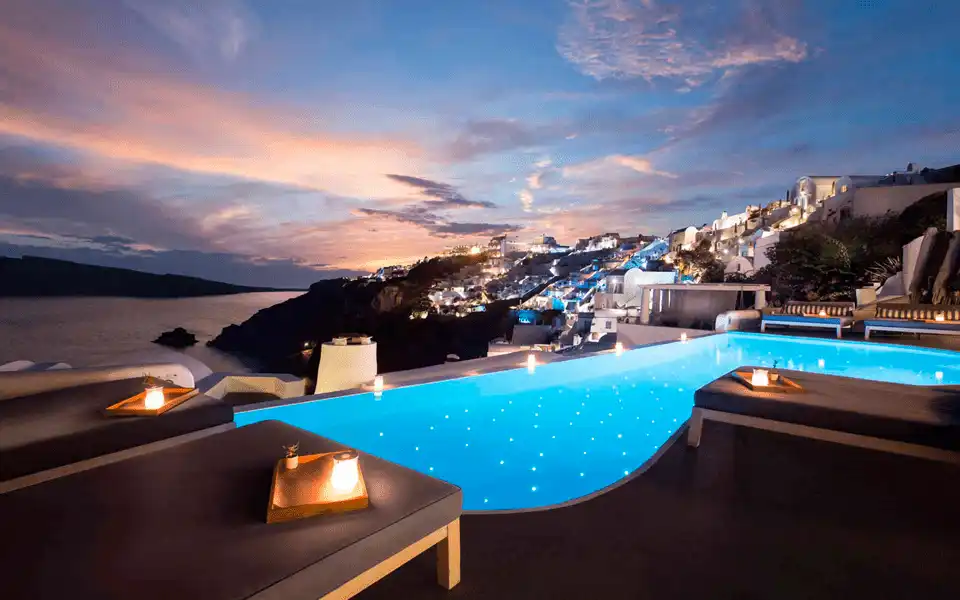
The best hotels in Santorini are not the whitewashed infinity-pool boxes dominating Instagram—they’re the island’s architectural conversions where volcanic stone tells centuries of history. Santorini’s caldera-edge luxury has become synonymous with “boutique minimalism,” but this aesthetic uniformity often masks soul-less construction built for turnover, not timelessness.
We’ve audited the island’s inventory and rejected the generic cave-suite replicas in favor of properties with verified “Past-Life Identities”: 15th-century pilgrimage sites, Venetian schools, monastic complexes, and sea captains’ mansions. These are not renovations—they are restorations that preserve cross-vaulted ceilings, original wine cellars, and aristocratic courtyards. This selection guarantees you’re staying inside Santorini’s institutional memory, not just overlooking it.
For broader context across the Greek islands, explore our audit of best historic hotels in Greece.
Caldera-Edge Monasteries & Institutional Conversions
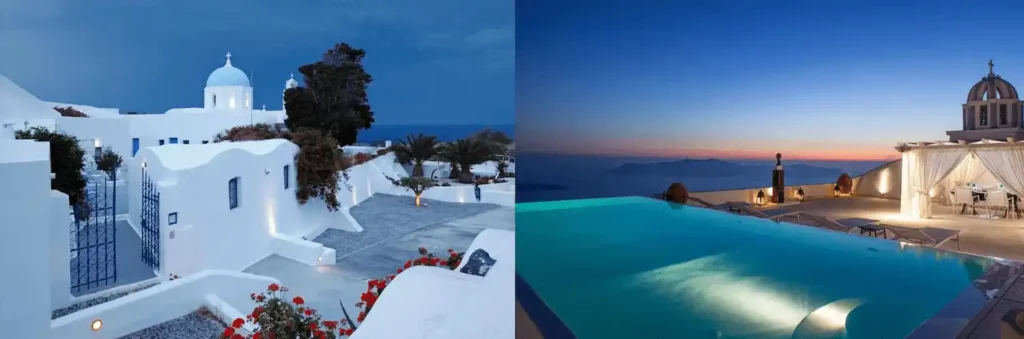
These properties occupy the caldera’s most privileged positions—not because of views alone, but because they were originally built as centers of religious, civic, or educational power. Expect original monastery gardens, Venetian structural bones, and architecture that predates the island’s tourism industry by three centuries. These are the conversions where heritage and location converge.
⛪ Aghios Artemios Traditional Houses
Vourvoulos holds Santorini’s most underestimated architectural prize: a 15th-century pilgrimage site that once sheltered religious travelers crossing the Aegean. Aghios Artemios preserves the original cross-vaulted rooms and monastic layout—thick volcanic stone walls that remain cool even in August, arched doorways that frame the northern caldera, and a silence that recalls the property’s contemplative origins.
The rooms are whitewashed cave suites, but unlike the island’s generic replicas, these spaces follow the monastery’s original floor plan: high ceilings, natural ventilation, and traditional sleeping alcoves carved directly into the rock. The property’s greatest asset? It remains unknown to the Instagram crowd, meaning you’ll experience the caldera from a ridge that feels private and historically untouched. No other Santorini hotel can claim a 500-year unbroken lineage as a place of sanctuary.
Best for: Travelers seeking monastic tranquility and authentic volcanic architecture away from Fira’s overcrowded caldera strip.
Signature Experience: Cross-vaulted sleeping quarters within original 15th-century monastery layout, private terraces overlooking northern caldera, stone-cool interiors that eliminate the need for air conditioning, unfiltered silence of a pilgrimage site repurposed for modern rest.
“Waking up in those vaulted rooms felt like time travel—no crowds, just stone and sky.” — Marco, MilanCheck Availability & Rates →
🏛️ Katikies Garden Santorini – The Leading Hotels Of The World ★★★★★
Fira‘s old Venetian quarter hides the island’s most refined monastic conversion: a 19th-century Catholic monastery that now operates under The Leading Hotels of the World. Katikies Garden occupies the monastery’s original inland site, preserving the Venetian architectural bones—arched cloisters, stone courtyards, and the monastery’s cultivated gardens.
The suites are built within the former monks’ quarters, maintaining the high ceilings and thick walls that regulate temperature naturally. The property’s defining feature is its garden sanctuary: terraced citrus groves and herb beds that were part of the monastery’s self-sustaining agricultural system. While other Santorini hotels manufacture “garden experiences” with imported greenery, this one inherits a 150-year horticultural legacy.
The spa occupies the former refectory, where vaulted ceilings and stone floors create a sense of ceremony around every treatment. You’re staying inside Fira’s oldest functioning institutional structure—a property that served the island’s spiritual life before luxury tourism existed.
Best for: Guests seeking Leading Hotels-level refinement with monastic gardens and Venetian architecture removed from caldera crowds.
Signature Experience: Terraced monastery gardens with 19th-century citrus groves, cloistered spa within original refectory, suites in former monks’ quarters with natural stone cooling, Venetian arches framing Aegean views without caldera congestion.
“That garden at sunrise—proof that Santorini’s best spaces aren’t always on the cliff edge.” — Elena, AthensCheck Availability & Rates →
🎨 The Tsitouras Collection ★★★★
Firostefani‘s most intellectually ambitious conversion: an 1780 Venetian school that later functioned as the island’s post office before becoming a private noble estate. Every suite doubles as an exhibition space: 19th-century oil paintings, Ottoman textiles, and Cycladic antiquities are integrated into the interiors, transforming accommodation into cultural immersion.
The rooftop terrace overlooks the caldera from Firostefani’s quietest ridge, a position that captures both sunrise and sunset without the crowds that overwhelm Oia. The property’s unique mandate? It refuses to function as a generic luxury hotel—guests are expected to engage with the art collection, attend the owner’s private exhibitions, and understand that they’re staying inside a functioning cultural institution.
Best for: Art collectors and culturally engaged travelers seeking museum-quality interiors within an 18th-century Venetian educational landmark.
Signature Experience: Curated art collection integrated into suites (19th-century oils, Ottoman textiles, Cycladic antiquities), private rooftop terrace with dual sunrise-sunset caldera views, owner-hosted cultural exhibitions, original 1780 Venetian school architecture.
“Sleeping surrounded by museum-grade art in an actual Venetian school—Santorini’s most underrated conversion.” — Philippe, ParisCheck Availability & Rates →
Wineries, Noble Estates & Maritime Power
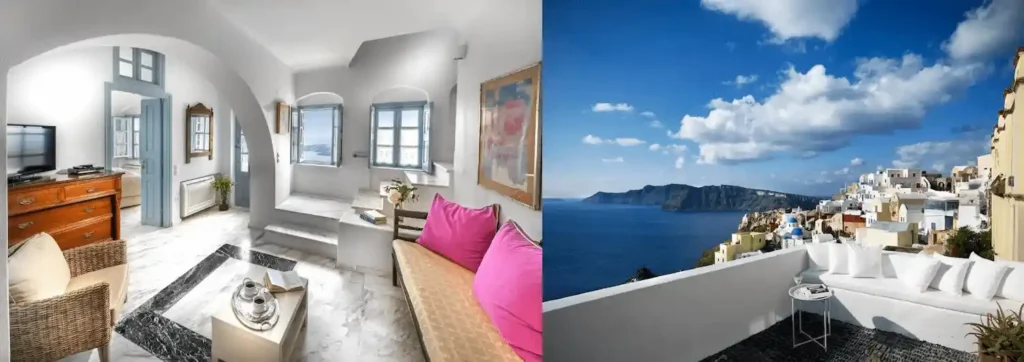
Santorini’s wealth was built on wine and sea trade—not tourism. These conversions represent the island’s economic aristocracy: 400-year-old wine cellars, Venetian manor estates, and sea captains’ mansions that housed the men who controlled Aegean commerce. Expect vaulted wine cellars repurposed as restaurants, aristocratic courtyards, and interiors that prove Santorini’s luxury pedigree existed centuries before the first infinity pool.
🍷 Vedema, a Luxury Collection Resort, Santorini ★★★★★
Megalochori‘s agricultural heartland holds Santorini’s most architecturally intact winery conversion: a 15th-century wine estate with 400-year-old vaulted cellars that now anchor a Luxury Collection resort. Unlike the island’s caldera properties, Vedema occupies an inland Venetian manor—thick stone walls, arched wine storage chambers, and the original estate courtyard that once served as the operational center for Santorini’s volcanic-soil viticulture.
The main restaurant operates inside the original wine cellars: cross-vaulted stone ceilings, candlelit alcoves, and a dining atmosphere that feels liturgical rather than commercial. The suites are built within the 17th-century manor’s residential wings, preserving the high ceilings and stone facades while integrating modern spa-level amenities.
The property’s defining characteristic? It’s the only Santorini resort where the “historic asset” is the winery itself—not a repurposed mansion or monastery, but the actual infrastructure that produced the island’s most valuable export for four centuries.
Best for: Wine-focused travelers and guests seeking Luxury Collection refinement within a 400-year-old winery estate removed from caldera tourism density.
Signature Experience: Candlelit dining inside 15th-century vaulted wine cellars, suites within 17th-century Venetian manor wings, estate courtyard that preserves original agricultural layout, spa treatments inspired by volcanic terroir, inland tranquility with village authenticity.
“Dinner in those wine cellars—400 years of volcanic soil and stone, best meal on the island.” — James, LondonCheck Availability & Rates →
👑 Aria Lito Mansion ★★★★★
Fira’s most diplomatically significant conversion: a 19th-century aristocratic mansion that hosted King Otto of Greece and German Emperor Wilhelm II during their Aegean tours. Aria Lito preserves the mansion’s original stucco-painted walls, high ceilings, and the traditional courtyard where royal entourages once gathered before descending to the caldera.
The suites occupy the mansion’s noble quarters—tall windows that frame the volcanic ridge, original wide-plank floors, and interiors that reject the island’s whitewashed minimalism in favor of period-accurate grandeur. The property’s greatest asset is its institutional memory: plaques document the royal visits, and the courtyard maintains the marble fountain that served as the mansion’s ceremonial entrance.
Unlike Santorini’s cave-suite replicas, Aria Lito proves that the island’s aristocracy built upward, not inward—prioritizing high ceilings, natural light, and formal entertaining spaces over volcanic burrowing. You’re staying in the mansion that Santorini’s elite chose to showcase to European royalty—a decision that validates its architectural authority.
Best for: History-focused travelers seeking neoclassical grandeur and documented royal provenance within Fira’s caldera-edge aristocratic quarter.
Signature Experience: Suites within mansion’s original noble quarters (royal guest rooms), 19th-century stucco-painted walls and high ceilings, courtyard with marble fountain that welcomed King Otto and Wilhelm II, period-accurate furnishings that reject generic Cycladic minimalism.
“Sleeping where emperors once stayed—Fira’s most underrated piece of living history.” — Anastasia, ThessalonikiCheck Availability & Rates →
🏘️ Aigialos Luxury Traditional Settlement ★★★★★
Fira’s clifftop ridge conceals Santorini’s most architecturally complex heritage project: an 18th-century noble settlement comprising 18 separate residences once owned by the island’s seafaring aristocracy. Aigialos isn’t a single mansion—it’s an entire neighborhood meticulously reconstructed by master masons using original volcanic stone quarried from the caldera.
Each suite occupies a different captain’s house, preserving the traditional Cycladic layout: barrel-vaulted ceilings, carved sleeping alcoves, and stone terraces that cascade down the cliff face. The reconstruction follows UNESCO-level preservation standards—no modern materials, no structural shortcuts—resulting in interiors that feel authentically 18th-century without sacrificing contemporary comfort.
The property’s defining edge? It’s the only Santorini hotel where you’re not staying in a historic building—you’re occupying an entire restored settlement, with stone pathways connecting individual residences just as they did when sea captains’ families lived here three centuries ago. The caldera views are exceptional, but the real luxury is the settlement’s architectural integrity.
Best for: Travelers prioritizing UNESCO-level preservation and authentic Cycladic architecture over modern luxury amenities.
Signature Experience: 18 separate captain’s houses reconstructed with original volcanic stone, barrel-vaulted ceilings and carved sleeping alcoves, cascading stone terraces connecting residences, master mason craftsmanship that follows 18th-century building techniques, caldera views from a living archaeological settlement.
“Walking those stone pathways between houses—this is what Santorini looked like before tourism.” — Dimitri, CyprusCheck Availability & Rates →
⚓ 1864 The Sea Captain’s House ★★★★
Oia’s maritime heritage distilled into a single property: an 1864 mansion built by one of Santorini’s most prominent sea captains when the island’s economy depended on Aegean trade routes. The house preserves the captain’s original residential layout—thick stone walls designed to withstand sea storms, high ceilings that ventilate during summer heat, and the traditional courtyard that served as the family’s private harbor overlook.
The suites occupy the mansion’s former living quarters, maintaining 19th-century proportions and stone-framed windows that capture Oia’s northern caldera. The property’s greatest strength is its authenticity: no luxury spa, no infinity pool—just the captain’s house as it functioned 160 years ago, updated only where modern comfort demands it. The location places you at the caldera’s edge while avoiding Oia’s commercial center. You’re staying inside Santorini’s seafaring aristocracy, where wealth was measured in ships, not hotel stars.
Best for: Minimalist travelers seeking authentic 19th-century maritime architecture and Oia caldera access without resort-level amenities.
Signature Experience: Original 1864 sea captain’s mansion with preserved stone shell, traditional courtyard overlooking northern caldera, suites within captain’s family quarters, high-ceiling stone architecture designed for natural ventilation, Oia edge location removed from pedestrian congestion.
“No pool, no spa—just a captain’s house that’s survived 160 years. That’s the real luxury.” — Luca, GenoaCheck Availability & Rates →
📊 Comparison: Best Hotels in Santorini
| Hotel | Location | Wellness & Spa | Dining | Unique Perks | Best For |
|---|---|---|---|---|---|
|
⛪ Aghios Artemios Traditional Houses |
Vourvoulos, northern caldera |
Natural stone cooling, no AC needed |
Traditional breakfast in monastery courtyard |
15th-century pilgrimage site Cross-vaulted rooms |
Monastic tranquility, authentic architecture |
|
🏛️ Katikies Garden Santorini ★★★★★ |
Fira, old Venetian quarter |
Cloistered spa in former refectory |
Garden-to-table Mediterranean cuisine |
19th-century monastery gardens Leading Hotels member |
Garden sanctuary, Venetian heritage |
|
🎨 The Tsitouras Collection ★★★★ |
Firostefani, caldera ridge |
Wellness treatments in art-filled suites |
Rooftop dining with curator-led tastings |
1780 Venetian school Private art museum |
Art collectors, cultural immersion |
|
🍷 Vedema Luxury Collection ★★★★★ |
Megalochori, inland estate |
Volcanic terroir spa, wine-infused treatments |
Vaulted wine cellar restaurant (15th-century) |
400-year-old winery Original estate courtyard |
Wine enthusiasts, agricultural heritage |
- For travelers extending their Greek island audit, continue with our classification of Crete’s Venetian harbor conversions in best hotels in Chania.
❓ FAQ: Best Hotels in Santorini
What makes a hotel in Santorini historically significant?
Santorini’s historic hotels are verified architectural conversions—former monasteries, Venetian schools, wine estates, and sea captains’ mansions with documented lineages spanning 150 to 500 years. These properties preserve original structural elements (vaulted ceilings, stone walls, agricultural courtyards) and maintain “Past-Life Identities” that predate the island’s tourism industry. Historic significance is measured by institutional provenance, not star ratings or modern luxury amenities.
Should I stay on the caldera edge or inland in Santorini?
Caldera-edge properties offer iconic volcanic ridge views but come with tourist congestion and premium pricing. Inland conversions (Vedema’s winery estate, Katikies Garden’s monastery) provide architectural authenticity, garden sanctuaries, and village-level tranquility while remaining within 10-15 minutes of caldera access. Choose based on priority: views versus heritage immersion. Both locations deliver historic provenance—the difference is setting, not architectural quality.
Are Santorini’s historic hotels suitable for families?
Most of Santorini’s monastery and mansion conversions prioritize couples and adult travelers due to cliffside locations, open terraces, and museum-quality interiors. Aigialos and Vedema offer multi-room suites within their settlement/estate layouts that accommodate families, but expect heritage-focused environments (stone staircases, traditional layouts) rather than child-centric amenities. Families seeking historic architecture should confirm room configurations and safety features directly via booking platforms.
How do I choose between Fira, Oia, and Firostefani for historic hotels?
Fira holds the densest concentration of institutional conversions (monasteries, noble mansions, settlements) with walkable village access and caldera views. Oia offers maritime heritage (sea captains’ houses) with northern caldera positioning and sunset proximity but suffers from peak-season overcrowding. Firostefani provides the quietest caldera ridge experience with properties like The Tsitouras Collection offering dual sunrise-sunset views. Choose Fira for architectural variety, Oia for maritime authenticity, Firostefani for calm refinement.
What is the best time to book historic hotels in Santorini?
Santorini’s historic properties—especially monastery conversions and Luxury Collection estates—maintain high occupancy from May through October. Book 4-6 months in advance for June-September stays to secure heritage suites with original architectural features. Shoulder seasons (April, October-November) offer better availability and lower rates while maintaining full property access. Winter closures affect some caldera-edge hotels but not inland estates like Vedema.
Do Santorini’s historic hotels include breakfast and amenities?
Most monastery and mansion conversions include traditional Greek breakfast (often served in original courtyards or cloistered gardens), but amenity levels vary by property type. Luxury Collection and Leading Hotels members (Vedema, Katikies Garden) offer full spa and dining facilities. Smaller conversions like Aghios Artemios and 1864 The Sea Captain’s House prioritize architectural authenticity over resort amenities—expect heritage immersion rather than infinity pools or fitness centers.
Are caldera views guaranteed at all these historic hotels?
Caldera views depend on property location, not historic status. Aghios Artemios, Aria Lito, and Aigialos offer direct caldera positioning. The Tsitouras Collection and 1864 The Sea Captain’s House provide caldera views from rooftop terraces. Katikies Garden (monastery gardens) and Vedema (inland winery estate) prioritize architectural sanctuaries over volcanic ridge positioning. Confirm view priorities via booking platforms—historic provenance and caldera access don’t always overlap in Santorini’s conversions.
Choosing Your Santorini Sanctuary
Booking best hotels in Santorini is not about chasing the most photographed sunset terrace—it’s about selecting a property where the architecture justifies the island’s premium. The conversions above represent Santorini’s most historically defensible options: verified monastery complexes, Venetian educational landmarks, and winery estates that predate mass tourism by centuries. These are properties where the “Building as Destination” principle delivers measurable value through institutional provenance and architectural integrity.
Compare Santorini’s monastic heritage against the aristocratic mansion conversions documented in best hotels in Mykonos town.
For more curated itineraries and luxury-focused travel insights, visit Your Luxury Guide. For official travel information and destination updates, visit Greece tourism-info.
Booking your Santorini hotel secures access to the island’s most architecturally intact conversions—properties where 15th-century pilgrimage sites, 1780 Venetian schools, and 400-year-old wine cellars prove that Santorini’s luxury pedigree existed long before the first infinity pool was installed.
Your Luxury Guide — Where Exceptional Travel Begins.