Finding the best hotels in Prague means filtering through hundreds of properties where high star ratings often mask generic renovations and brand-saturated lobbies that strip away the city’s architectural soul. Prague’s true luxury lies not in marble bathrooms or rooftop bars, but in the Gothic cloisters, Baroque frescoes, and Renaissance stone that define its thousand-year identity.
We conducted a heritage audit of Prague’s inventory, rejecting weak modern conversions and international brands to focus exclusively on properties with verified Past-Life Identities—1284 monasteries where monks still reside, 1400 medieval patrician houses with hidden frescoes, and 1548 palaces that hosted emperors. This curated selection guarantees you won’t waste time comparing soul-less five-stars; every property here is a living chapter of Prague’s history, not just a place to sleep.
For a broader view of Czech heritage conversions beyond the capital, explore our audit of the best historic hotels in Czech Republic.
Malá Strana & Castle District: Imperial Monasteries & Royal Gates
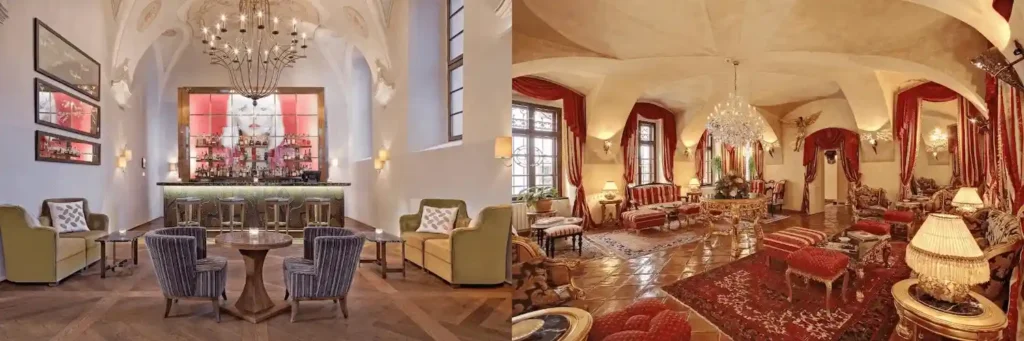
These properties occupy the historic heart of Prague’s power—the district where emperors walked, monks brewed secret beer, and astronomers charted the stars. Expect direct access to Prague Castle, original Gothic foundations beneath your feet, and the kind of preserved Renaissance corridors that make generic luxury feel shallow. The architecture here isn’t decorative; it’s structural, institutional, and irreplaceable.
🕯️ Augustine, a Luxury Collection Hotel, Prague ★★★★★
A 1284 Augustinian monastery where the St. Thomas monks still reside today, Augustine spans seven interconnected buildings centered on a 13th-century cloister that remains the spiritual and architectural anchor of the property. The original Baroque refectory, with its hand-painted archangel frescoes from the 1600s, now serves as the signature dining space, while the 700-year-old brewery cellar—still the exclusive source of the monks’ secret St. Thomas beer—operates as the property’s most distinctive amenity.
Guest rooms integrate Gothic masonry and exposed timber beams with contemporary luxury, creating a transition from the monastery’s stone walkways into spaces where 21st-century comfort respects 13th-century walls. The cloistered courtyard, silent and sheltered, offers an experience no modern hotel can replicate: the feeling of stepping into a sanctuary that has protected travelers for seven centuries. This is the only property in Prague where you can drink beer brewed by monks on-site since the Middle Ages, in cellars that predate the Charles Bridge.
Best for: Travelers seeking the most architecturally complete monastic conversion in Central Europe, with active religious continuity and direct Castle Quarter access.
Signature Experience: 13th-century cloistered walkways, exclusive St. Thomas beer from the 1384 brewery cellar, Baroque refectory dining beneath archangel frescoes, private monastery gardens.
“Walking through those stone cloisters at dawn—felt like I’d stepped into a world that predates everything.” — Henrik, CopenhagenCheck Availability & Rates →
🏰 Golden Well ★★★★★
A 1550 Renaissance landmark that served as Emperor Rudolf II’s private residence and famously hosted astronomer Tycho de Brahe during the peak of Prague’s imperial power. The property retains its original 16th-century facade and hand-painted wooden ceilings that were commissioned specifically for the emperor’s court, creating an architectural integrity rare even among heritage hotels.
What sets Golden Well apart is not just its provenance, but its physical position: guests enter through the “Emperor’s private gate,” a historic passageway providing direct, exclusive access into the Royal Gardens of Prague Castle—something no other hotel in the city can claim. The terrace overlooks the castle walls and the red rooftops of Malá Strana, offering a perspective that was once reserved for royalty alone. Inside, the Renaissance proportions remain intact, with rooms that feel more like private chambers in a nobleman’s residence than standardized hotel suites.
Best for: Couples and history enthusiasts drawn to verified imperial provenance, exclusive castle access, and panoramic positioning above Prague’s roofline.
Signature Experience: Emperor’s private gate into Royal Gardens, 16th-century hand-painted ceilings, terrace with direct castle views, intimate Renaissance proportions throughout.
“That private gate into the castle gardens—felt like we’d unlocked a door nobody else knew existed.” — Clara, ViennaCheck Availability & Rates →
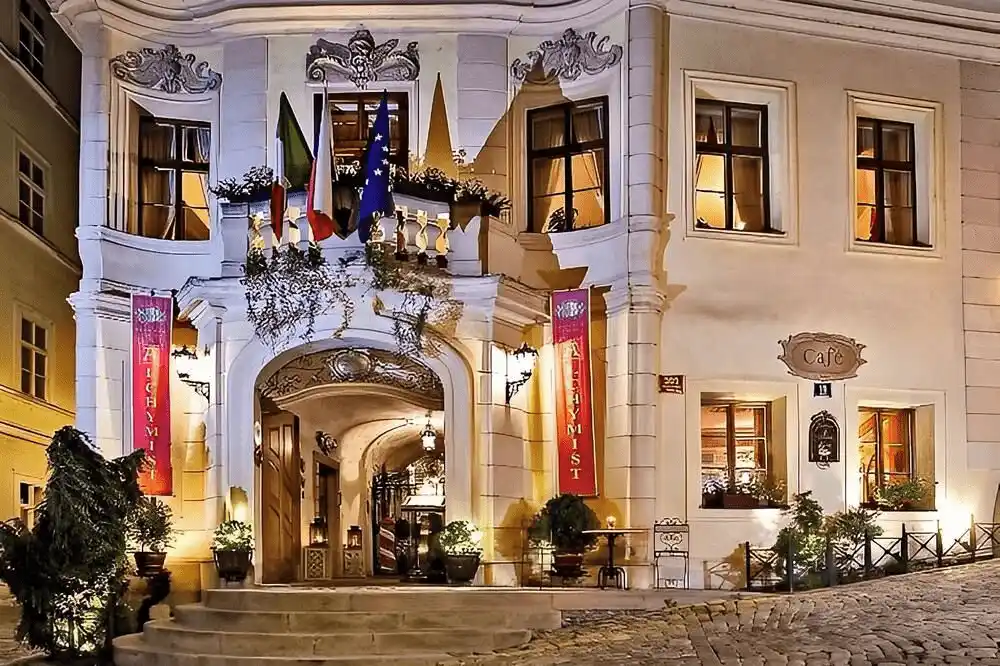
✨ Alchymist Grand Hotel and Spa ★★★★★
A 1548 Baroque palace known historically as the “House at the Infant Jesus,” this property incorporates a 13th-century stone tower from Prague’s original Premyslid fortifications, making it one of the city’s oldest continuously standing structures. The 11th-century vaulted cellars—once part of the medieval defense system—now house the spa, where stone arches and atmospheric lighting create an experience that feels more like a private crypt than a wellness facility.
Above ground, the Baroque facade preserves the original polychrome relief of Our Lady of Loretto, while the interiors feature extensive gilded stuccowork and hand-painted ceiling frescoes that represent the peak of 16th-century religious artistry. The grand suites retain original wall frescoes that were meticulously restored to expose layers of hidden religious iconography.
The Alchymist’s positioning is deliberately theatrical—this isn’t subtle heritage; it’s operatic, maximalist Baroque grandeur designed for travelers who want to feel the weight of centuries in every room.
Best for: Design-focused travelers drawn to Baroque maximalism, underground spa experiences in medieval crypts, and highly theatrical historic interiors.
Signature Experience: 11th-century vaulted spa cellars, polychrome relief facade, gilded stuccowork throughout, original Baroque ceiling frescoes in grand suites.
“That underground spa—like getting a massage in a 900-year-old stone fortress. Unforgettable.” — Elise, BrusselsCheck Availability & Rates →
Old Town & Lesser Quarter: Gothic Foundations & Cultural Landmarks
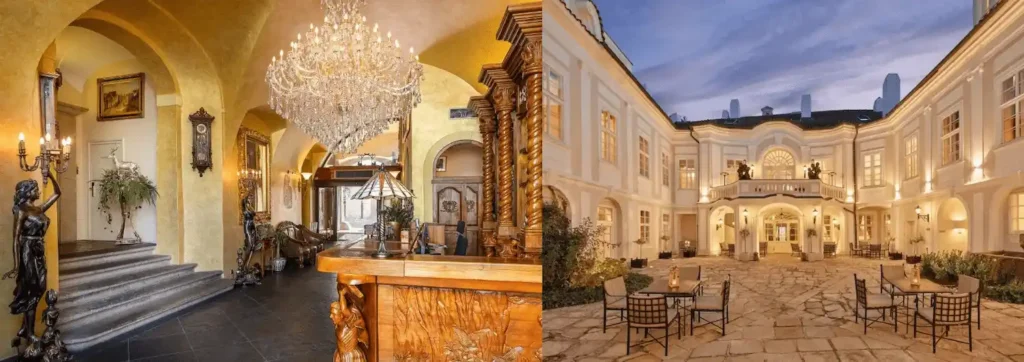
These properties occupy the commercial and cultural nucleus of medieval Prague, where Gothic stone foundations meet Art Nouveau grandeur and Renaissance patrician wealth. The architecture here reflects Prague’s evolution from a medieval trading hub to a 20th-century cultural capital, with layers of Gothic, Renaissance, and Neo-Gothic design preserved in properties that hosted Mozart, Casanova, and Czech national movements.
🗝️ Mandarin Oriental, Prague ★★★★★
A 14th-century Dominican monastery built on the site of the St. Mary Magdalene church, the Mandarin Oriental preserves over six centuries of Gothic, Renaissance, and Baroque architectural layers beneath its contemporary luxury operations.
The spa occupies a former Renaissance chapel, where original stone arches and ecclesiastical proportions create a setting unlike any modern wellness facility. Most striking are the Gothic foundations—14th-century stone footings from the original church are preserved and visible beneath glass floors in the lobby and main hallways, allowing guests to literally walk above Prague’s medieval past. The property integrates these historical elements without sacrificing modern amenities, offering a rare balance between verified provenance and five-star service standards.
The courtyard, once the monastery’s cloister, provides a sheltered, silent retreat in the center of Old Town’s busiest district.
Best for: Travelers seeking internationally recognized service standards combined with verified monastic architecture and central Old Town positioning.
Signature Experience: Spa in former Renaissance chapel, 14th-century Gothic foundations beneath glass floors, cloistered courtyard, layered architectural preservation across six centuries.
“Standing on that glass floor, looking down at 600-year-old church foundations—history you can touch.” — Thomas, ZurichCheck Availability & Rates →
🏛️ Iron Gate Hotel & Suites Prague by BHG ★★★★★
Originally the “Iron Gate House,” a high-status patrician residence built around 1400 on a 14th-century Gothic footprint, this property preserves some of Prague’s rarest medieval architectural details. The high-Gothic roof trusses from 1380 remain structurally intact, while the original hand-painted wooden “cassette” ceilings—spanning the 14th to 18th centuries—were restored after being hidden beneath plaster for over 300 years.
During renovation, wall frescoes were uncovered that had remained untouched since the late medieval period, adding a layer of authenticity that few hotels can document. The Iron Gate’s positioning at the threshold of Old Town Square makes it both architecturally significant and practically central, offering a Gothic foundation that transitions seamlessly into modern suites. The preservation here isn’t cosmetic; it’s structural, with medieval timber and stone forming the bones of the current property.
Best for: Architecture enthusiasts drawn to rare Gothic carpentry, uncovered medieval frescoes, and verified 14th-century structural preservation.
Signature Experience: 1380 high-Gothic roof trusses, 14th–18th-century hand-painted cassette ceilings, rediscovered wall frescoes hidden for 300 years, Old Town Square positioning.
“Those painted ceilings—hidden for centuries, now right above your bed. Unreal level of preservation.” — Lena, StockholmCheck Availability & Rates →
🎼 The Mozart Prague ★★★★★
A 1765 Baroque palace originally known as Pachtuv Palace, this aristocratic residence served as Count Pachta’s cultural salon where Mozart and Casanova were both guests during the height of Prague’s 18th-century Enlightenment.
The property retains two original Baroque courtyards and monumental stone masonry that define the architectural character of the period, while suites preserve 18th-century wall frescoes and exposed historic wooden beams from the era of Mozart’s residency. The Mozart’s cultural provenance is not just marketing—this is a documented site where Europe’s intellectual elite gathered, and that legacy remains tangible in the frescoed walls and period proportions.
The palace’s positioning in Lesser Quarter offers quieter, more residential surroundings than Old Town, appealing to travelers who want historic depth without tourist density.
Best for: Music and culture enthusiasts drawn to verified 18th-century salons, Baroque courtyard architecture, and documented connections to Mozart and Casanova.
Signature Experience: Two original Baroque courtyards, 18th-century wall frescoes, exposed wooden beams from Mozart’s era, cultural provenance as aristocratic salon.
“Knowing Mozart walked these same halls—it’s not just history, it’s presence. You feel it.” — Antoine, ParisCheck Availability & Rates →
🎨 Hotel Paris Prague ★★★★★
A 1904 Neo-Gothic landmark purpose-built by the Brandejs family to represent the cultural awakening of the Czech “First Republic” era, Hotel Paris is an intact Art Nouveau masterpiece that has remained architecturally unchanged for over a century.
The facade features original blue ceramic mosaics by J. Köhler, while the interiors preserve the brass fixtures, wood paneling, and decorative detailing that defined turn-of-the-century Prague design. The Sarah Bernhardt Restaurant retains its original 20th-century wood paneling and offers a dining experience that feels frozen in the Belle Époque. Unlike medieval or Baroque conversions, Hotel Paris represents a different chapter of Prague’s identity—the birth of Czech nationalism and cultural independence, expressed through architecture. The preservation here is absolute, making it the most complete Art Nouveau hotel experience in the city.
Best for: Design historians and travelers drawn to intact Art Nouveau architecture, Czech cultural identity, and Belle Époque dining atmospheres.
Signature Experience: Original 1904 blue ceramic mosaics by J. Köhler, intact brass fixtures, Sarah Bernhardt Restaurant with 20th-century wood paneling, Neo-Gothic cultural landmark.
“That restaurant—like stepping into a 1900s painting. Every detail original, nothing faked.” — Ingrid, OsloCheck Availability & Rates →
📊 Comparison: Best Hotels in Prague
| Hotel | Location | Wellness & Spa | Dining | Unique Perks | Best For |
|---|---|---|---|---|---|
|
🕯️ Augustine ★★★★★ |
Malá Strana, Castle District |
Monastery spa, cloistered courtyards |
Baroque refectory, monk-brewed beer |
1284 monastery, active monks on-site |
Complete monastic conversion |
|
🏰 Golden Well ★★★★★ |
Castle gates, panoramic terrace |
Terrace spa, castle views |
Castle-view dining, intimate scale |
Emperor’s private gate, Royal Garden access |
Imperial provenance, exclusive access |
|
✨ Alchymist ★★★★★ |
Malá Strana, Baroque quarter |
11th-century crypt spa, vaulted cellars |
Baroque dining hall, gilded stuccowork |
1548 palace, 13th-century tower |
Baroque maximalism, theatrical interiors |
|
🗝️ Mandarin Oriental ★★★★★ |
Old Town, central district |
Chapel spa, Renaissance arches |
Contemporary dining, cloister courtyard |
14th-century monastery, glass-floor foundations |
International standards, Gothic layers |
- If you’re exploring beyond Prague’s core, consider our audit of thermal palace conversions in the best hotels in Karlovy Vary.
❓ FAQ: Best Hotels in Prague
What makes these the best hotels in Prague?
These properties represent verified historic conversions with documented Past-Life Identities—1284 monasteries, 1400 medieval houses, and 1548 palaces where the architecture is the primary asset. We filtered out generic luxury hotels and weak renovations to focus exclusively on properties where Gothic foundations, Baroque frescoes, and Renaissance stone define the experience, not just marble bathrooms.
Which hotel in Prague has the most significant monastic heritage?
Augustine occupies a 1284 Augustinian monastery where monks still reside today, making it the most architecturally complete and spiritually active monastic conversion in Central Europe. The property includes original 13th-century cloisters, a 17th-century Baroque refectory, and a 700-year-old brewery cellar still producing the monks’ secret St. Thomas beer.
Can you stay in a hotel that was Emperor Rudolf II’s residence?
Yes. Golden Well served as Emperor Rudolf II’s private residence in 1550 and hosted astronomer Tycho de Brahe. Guests enter through the Emperor’s private gate—a historic passageway providing exclusive access into the Royal Gardens of Prague Castle, an amenity no other hotel in the city offers.
Which Prague hotel has visible Gothic foundations?
Mandarin Oriental preserves 14th-century Gothic foundations from the original St. Mary Magdalene church beneath glass floors in the lobby and main hallways, allowing guests to walk directly above Prague’s medieval past. The spa occupies a former Renaissance chapel with original stone arches.
Is there a hotel in Prague where Mozart stayed?
The Mozart Prague (formerly Pachtuv Palace) served as Count Pachta’s aristocratic salon where Mozart and Casanova were both documented guests during the 1700s. The palace retains two original Baroque courtyards, 18th-century wall frescoes, and exposed wooden beams from the era of Mozart’s residency.
Which Prague hotel offers the most intact Art Nouveau design?
Hotel Paris Prague is a 1904 Neo-Gothic landmark that has remained architecturally unchanged for over a century, featuring original blue ceramic mosaics by J. Köhler, intact brass fixtures, and the Sarah Bernhardt Restaurant with its original 20th-century wood paneling. It represents the most complete Art Nouveau hotel experience in the city.
Do any Prague hotels have medieval underground spas?
Alchymist Grand Hotel houses its spa in 11th-century vaulted cellars that were once part of Prague’s original Premyslid fortifications. The stone arches and atmospheric lighting create an experience that feels more like a private medieval crypt than a modern wellness facility.
Which Hotel Fits Your Stay in Prague?
These properties represent the most architecturally significant hotel conversions in Prague, filtered for travelers who prioritize verified heritage over generic five-star labels. Each asset offers a different expression of Prague’s layered past—monastic continuity, imperial provenance, Gothic carpentry, or Baroque grandeur. The right choice depends on whether you’re drawn to active religious heritage, exclusive castle access, or intact period design.
Continue with the medieval merchant houses and castle conversions in the best hotels in Český Krumlov.
For more curated itineraries and luxury-focused travel insights, visit Your Luxury Guide. For official travel information and destination updates, visit Czech Republic tourism-info.
Booking your hotel in Prague secures access to Central Europe’s most complete historic conversions—properties where 13th-century cloisters, Renaissance gates, and Gothic foundations remain structurally intact, not just decoratively referenced.
Your Luxury Guide — Where Exceptional Travel Begins.