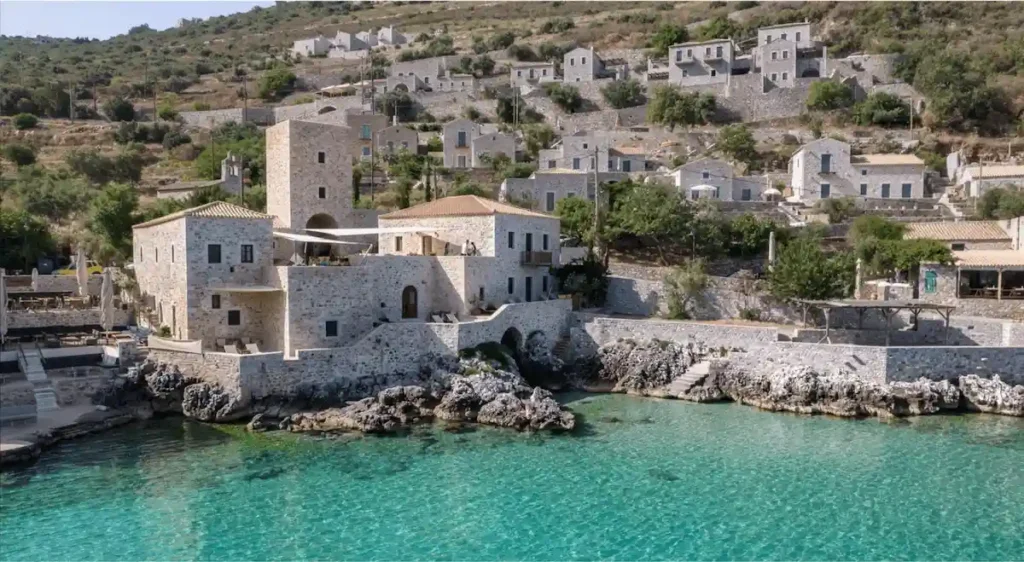
The best hotels in Peloponnese are not found through star ratings or beachfront marketing—they are identified through historical provenance. This peninsula contains Greece’s highest concentration of verified heritage conversions: war towers built during the Ottoman resistance, Byzantine governors’ palaces, and diplomatic headquarters from the first Greek parliament. The Luxury Paradox is acute here—generic five-star resorts dominate coastal search results, yet they offer no connection to the region’s revolutionary and mercantile soul.
We have audited the Peloponnese inventory and rejected modern constructions posing as “historic-inspired” properties. Our filtering criteria isolated only properties with documented Past-Life Identities: operational sanatoriums, fortified family strongholds, and trading complexes with original jetties. This selection guarantees you sleep within walls that shaped Greek independence, not replicas designed for Instagram.
For the broader national audit, explore our guide to best historic hotels in Greece.
Nafplio: The First Capital’s Diplomatic Core
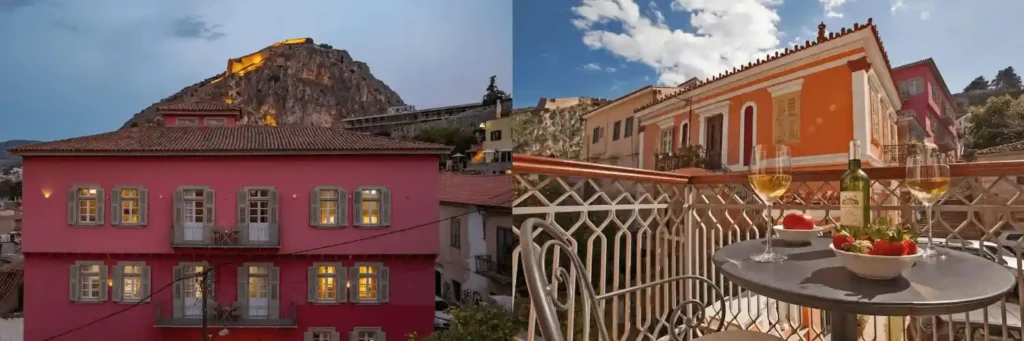
Nafplio served as Greece’s first capital after independence, and its architectural record reflects diplomatic urgency and institutional power. These properties were not private homes—they were governmental headquarters, printing houses, and elite merchant residences positioned within steps of the Palamidi fortress. What unifies them is their proximity to constitutional history: these buildings witnessed the formation of the modern Greek state.
🏛️ Grand Sarai Nafplio ★★★★
Originally the residence of the Ottoman Aga and later transformed into the first Government Printing House of Greece, Grand Sarai Nafplio holds diplomatic authority no coastal resort can replicate. Today, suites preserve the grand Ottoman-neoclassical volumes—high ceilings, thick masonry walls, and original proportions that once accommodated parliamentary operations.
The transition from Nafplio’s pedestrian lanes into this compound feels like entering a protected monument, because it is one. The courtyard garden, shaded by century-old citrus trees, offers the kind of silence only institutional stone can provide. No other hotel in the Peloponnese places you this close to the architectural nerve center of Greek independence.
Best for: History-focused travelers seeking verified diplomatic heritage with preserved Ottoman-neoclassical architecture in Greece’s first capital.
Signature Experience: Original Government Printing House interiors, Ottoman-era courtyard garden with heritage citrus trees, suites with preserved 17th-century stone volumes, walking distance to Palamidi fortress and Syntagma Square.
“Standing in that courtyard, you feel the weight of what happened here—this was the nation’s printing press.” — Dimitris, ThessalonikiCheck Availability & Rates →
🏠 Aetoma Hotel ★★★★
This 18th-century merchant mansion served as an elite private residence during Nafplio’s tenure as the Greek capital, and its structural integrity reflects the wealth and taste of the city’s mercantile class.
Inside, rooms balance period architecture with contemporary restraint: exposed stone walls, wooden ceilings, and carefully curated furnishings that respect the mansion’s residential origins. The hotel’s location within Nafplio’s historic center places you steps from constitutional landmarks, yet the interior courtyard offers complete acoustic isolation. This is not a palace conversion—it is a documented merchant home that has retained its scale and soul. For travelers prioritizing authenticity over grandeur, Aetoma delivers a residential experience no branded property can match.
Best for: Travelers valuing residential authenticity and preserved neoclassical architecture within walking distance of Nafplio’s constitutional landmarks.
Signature Experience: Original 18th-century merchant proportions, private courtyard offering acoustic isolation, preserved neoclassical façade, suites with exposed stone and wooden beam ceilings.
“It felt like staying in someone’s carefully preserved family home—no performance, just calm elegance.” — Elena, ViennaCheck Availability & Rates →
Monemvasia & Gerolimenas: Medieval Fortifications & Mercantile Power
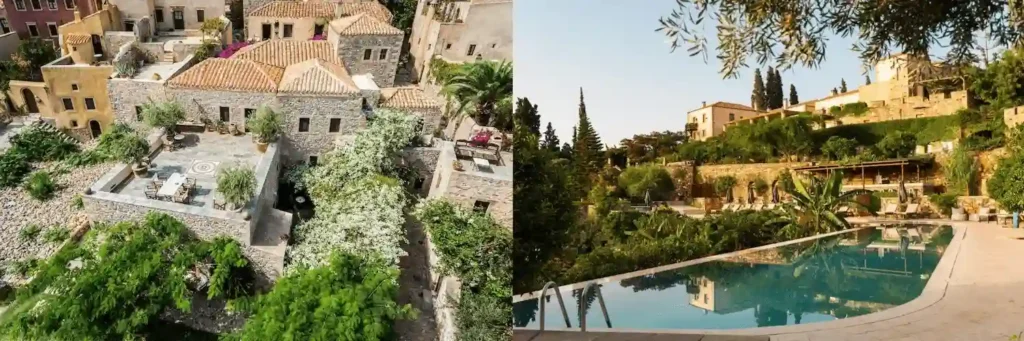
Monemvasia’s fortress town and the Mani Peninsula’s coastal strongholds represent Greece’s most architecturally defensible conversions. These were not symbolic structures—they were operational military and economic installations designed to withstand siege, control trade routes, and project family power across generations. What unifies these properties is their integration with natural fortification: castle rock, sheer cliffs, and stone jetties.
This is architecture as survival strategy, not decoration.
🏰 Ardamis ★★★★
Originally the 12th-century residence of the Byzantine Governor and later the Venetian military headquarters, Ardamis occupies Monemvasia’s castle rock with the authority of an operational command post. The building preserves 800-year-old stone vaults and a massive 14-meter-high medieval chimney—structural elements designed for both defense and ceremonial power.
Suites are carved into the original governor’s chambers, where thick walls and narrow windows once provided protection during sieges. The transition from Monemvasia’s cobblestone alleys into this residence feels like entering a living fortress, because the architecture was never softened for tourism. From the terrace, views extend across the Byzantine sea routes that made this position strategically critical.
Best for: History purists seeking verified Byzantine and Venetian military architecture within Monemvasia’s fortified castle rock.
Signature Experience: 800-year-old stone vaults, 14-meter medieval chimney, suites in original governor’s chambers, terrace overlooking Byzantine sea routes, preserved defensive masonry.
“That chimney alone is worth the stay—you’re inside a documented piece of Byzantine military history.” — Andreas, MunichCheck Availability & Rates →
🏛️ Kinsterna Hotel ★★★★★
This 13th-century Byzantine estate served as a fortified mansion under successive Byzantine, Ottoman, and Venetian lords, and its architectural layering reflects centuries of strategic adaptation. The property preserves its central Byzantine cistern—still functional—and Ottoman-era battlements that once defended the complex during regional conflicts.
Rooms are distributed across restored stone buildings, each preserving original masonry and vaulted ceilings. The estate’s scale is significant: this was a self-sufficient compound designed to withstand isolation during sieges, complete with water storage, defensive walls, and agricultural terraces.
Today, the grounds offer a spa, infinity pool, and farm-to-table dining, but the dominant experience remains the fortress-estate’s architectural gravity. For travelers seeking a verified aristocratic stronghold with preserved defensive infrastructure, Kinsterna delivers a residential experience rooted in survival, not luxury hospitality.
Best for: Travelers seeking a fortified Byzantine estate with preserved cisterns, battlements, and self-sufficient historical infrastructure.
Signature Experience: 13th-century Byzantine cistern, Ottoman-era defensive battlements, estate-wide spa and infinity pool, farm-to-table dining with estate-grown produce, preserved stone terraces.
“Walking those battlements at dawn—you understand why this location was worth defending for 800 years.” — Sophia, LondonCheck Availability & Rates →
⚓ Kyrimai Hotel ★★★★
Originally an 1870s mercantile complex comprising a mansion, warehouse, and private port, Kyrimai controlled Gerolimenas Bay’s shipping routes during the height of Mani’s trading power. The property preserves its original vaulted wine store—now the reception hall—and the 19th-century stone jetty that once serviced merchant vessels.
Suites are distributed across the mansion and warehouse, where exposed stone, arched ceilings, and maritime proportions reflect the building’s commercial origins. The hotel’s position directly on the bay offers unobstructed sea access, and the integration of the original jetty into the guest experience maintains the property’s operational identity. This is not a beachfront resort—it is a documented trading hub where the architecture still serves its original purpose: controlling access to the water.
Best for: Travelers seeking preserved mercantile architecture with original port infrastructure and direct bay access in the Mani Peninsula.
Signature Experience: 1870s vaulted wine store as reception, preserved stone jetty for private sea access, suites in original warehouse with arched ceilings, unobstructed bay views.
“That jetty isn’t decorative—it’s the real structure they used to load ships. You feel the trade power.” — Nikos, AthensCheck Availability & Rates →
Mani Peninsula & Arcadia: Revolutionary Towers & Institutional Monuments
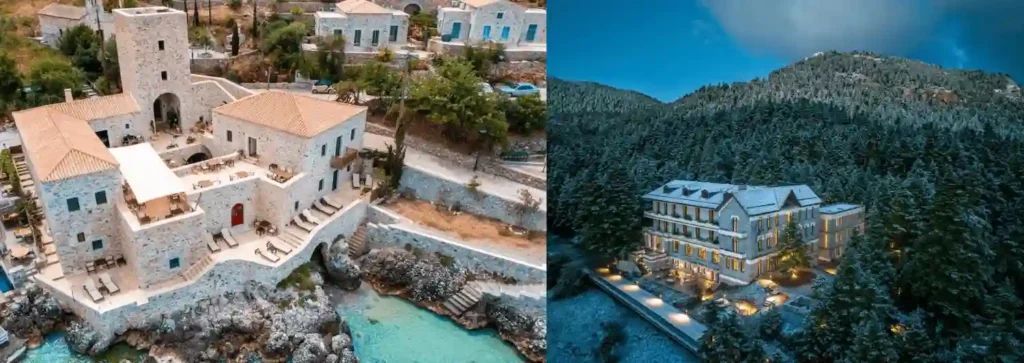
The Mani Peninsula and Arcadia’s mountain villages preserve Greece’s most concentrated collection of war towers and institutional conversions. These were not symbolic structures—they were operational fortifications built by revolutionary families and medical institutions that served the Balkans. What unifies these properties is their integration with resistance history: every stone wall, every tower height, every preserved cistern reflects a society organized for survival and revolt. This is not picturesque—it is documented power.
⚔️ Pirgos Mavromichali ★★★★
Originally the 18th-century fortified family seat and military stronghold of the Mavromichalis clan—leaders of the Greek War of Independence—this war tower preserves the architectural language of Maniot resistance. The building’s massive stone construction and defensive proportions were designed to project family power and withstand Ottoman retaliation.
Today, suites occupy the original tower levels, where narrow windows, thick walls, and vaulted ceilings maintain the structure’s martial character. The tower’s position overlooking the bay offered strategic surveillance during the independence struggle, and that same vantage now provides unobstructed sea views.
Best for: Travelers seeking verified revolutionary architecture with preserved war tower masonry and direct lineage to Greek independence leaders.
Signature Experience: 18th-century Mavromichalis family war tower, preserved defensive stone masonry, suites in original tower levels with vaulted ceilings, strategic bay overlook, documented resistance heritage.
“You’re not just staying in history—you’re inside the family fortress that helped free Greece.” — Kostas, CreteCheck Availability & Rates →
🏥 MANNA, a Member of Design Hotels ★★★★★
Originally the largest medical sanatorium in the Balkans, this 1929 institutional monument in Arcadia served patients from across Southern Europe until its closure in the 1980s. The building is a protected monument, preserving its original 1920s stone walls, heritage terrazzo floors, and the grand modernist proportions designed to maximize light and airflow for tuberculosis treatment.
Today, MANNA operates as a design-forward hotel, but the sanatorium’s architectural DNA remains dominant: long corridors, high ceilings, and clinical symmetry that now frame spa treatments, a rooftop pool, and contemporary Mediterranean dining. The transition from the mountain village into this complex feels like entering a preserved medical archive, where every structural choice was dictated by therapeutic function. No other hotel in the Peloponnese offers this combination of Balkan-scale institutional heritage and documented public health history.
Best for: Design-conscious travelers seeking a protected 1929 sanatorium with preserved modernist architecture and Balkan institutional significance.
Signature Experience: Largest Balkan sanatorium with protected monument status, original terrazzo floors and 1920s stone masonry, rooftop pool with mountain views, spa treatments in clinical-modernist interiors, contemporary Mediterranean dining.
“Those terrazzo floors and endless corridors—you’re inside a functioning piece of Balkan medical history.” — Maria, BerlinCheck Availability & Rates →
📊 Comparison: Best Hotels in Peloponnese
| Hotel | Location | Wellness & Spa | Dining | Unique Perks | Best For |
|---|---|---|---|---|---|
|
🏥 MANNA Design Hotels ★★★★★ |
Arcadia, mountain village |
Rooftop pool, spa in clinical-modernist interiors |
Contemporary Mediterranean |
1929 Balkan sanatorium Protected monument |
Design travelers, institutional heritage |
|
🏛️ Grand Sarai Nafplio ★★★★ |
Nafplio, first capital |
Courtyard garden, Ottoman-era volumes |
Heritage-focused Greek cuisine |
First Government Printing House Diplomatic heritage |
History purists, constitutional landmarks |
|
🏰 Ardamis ★★★★ |
Monemvasia, castle rock |
Medieval stone vaults, fortress terrace |
Traditional Greek, Byzantine views |
12th-century Governor’s Mansion 14-meter chimney |
Medieval enthusiasts, military architecture |
|
⚔️ Pirgos Mavromichali ★★★★ |
Limeni, Mani Peninsula |
Tower suites, bay overlook |
Maniot traditional, family recipes |
Mavromichalis war tower Revolutionary lineage |
Resistance history, coastal fortifications |
- Continue your audit with our guide to Athens’ conversions in best hotels in Athens.
❓ FAQ: Best Hotels in Peloponnese
What makes a hotel in the Peloponnese “historic”?
A historic hotel in the Peloponnese must occupy a documented conversion—war towers, Byzantine estates, sanatoriums, or diplomatic headquarters. Generic neoclassical styling or “inspired” design does not qualify. We verify original structural elements: stone vaults, defensive masonry, institutional proportions, or preserved jetties. The building’s Past-Life Identity must be architecturally legible and historically documented.
Are these hotels suitable for families with children?
Most properties prioritize architectural preservation over family amenities. War towers and fortress estates feature narrow staircases, unguarded terraces, and stone interiors designed for defense, not child safety. If traveling with children, verify room configurations and safety features directly with the property. These conversions reward focused travelers more than families seeking resort-style infrastructure.
Do I need a car to reach these hotels?
Yes. The Peloponnese’s most significant conversions—war towers, mountain sanatoriums, and coastal trading posts—are distributed across remote villages, fortress towns, and cliff positions. Public transport does not service these locations effectively. A rental car provides access to the region’s architectural depth and allows flexible exploration of multiple heritage sites.
What is the best season to visit the Peloponnese for historic hotels?
April through June and September through October offer the strongest combination of stable weather, fewer crowds, and operational properties. July and August bring peak season density, which can compromise the meditative experience these conversions offer. Winter months see some closures, particularly in mountain and coastal locations, so verify availability before booking.
How do I know if a hotel has genuine historic credentials?
Check for protected monument status, specific Past-Life documentation (e.g., “1870s mercantile complex” rather than “inspired by traditional architecture”), and preserved structural elements visible in property photos. Generic luxury language—”elegant,” “boutique,” “charming”—often signals weak heritage credentials. We audit properties using architectural records, heritage registries, and on-site verification of original materials.
Are these hotels more expensive than standard five-star properties?
Not necessarily. Verified heritage conversions often charge comparable or lower rates than branded luxury resorts, because their value derives from architectural provenance rather than amenity density. You pay for documented history, preserved masonry, and irreplaceable location—not marble lobbies or branded toiletries. Availability at this level shifts quickly during high season.
Can I visit multiple historic hotels in one Peloponnese trip?
Yes, and it is recommended. The region’s conversions are geographically dispersed: Nafplio’s diplomatic core, Monemvasia’s fortress rock, the Mani Peninsula’s war towers, and Arcadia’s mountain sanatoriums each offer distinct architectural narratives. A well-planned route allows you to experience three to four properties across a week-long stay, providing a comprehensive audit of the Peloponnese’s heritage conversions.
Where Architectural Depth Replaces Generic Luxury
Booking the best hotels in Peloponnese is about selecting properties where the building itself carries documented historical authority. The conversions above represent the most architecturally significant options for travelers who value verified provenance over amenity lists. These are not replicas or “heritage-inspired” constructions; they are operational war towers, diplomatic headquarters, and mercantile strongholds where the Past-Life Identity remains structurally legible. Availability at this level shifts quickly once spring and fall seasons begin.
Explore Greece’s coastal heritage through best hotels in Corfu town.
For more curated itineraries and luxury-focused travel insights, visit Your Luxury Guide. For official travel information and destination updates, visit Greece tourism-info.
Booking your Peloponnese hotel secures access to Greece’s most concentrated collection of revolutionary, Byzantine, and mercantile architecture—structures that no modern resort can replicate or replace.
Your Luxury Guide — Where Exceptional Travel Begins.