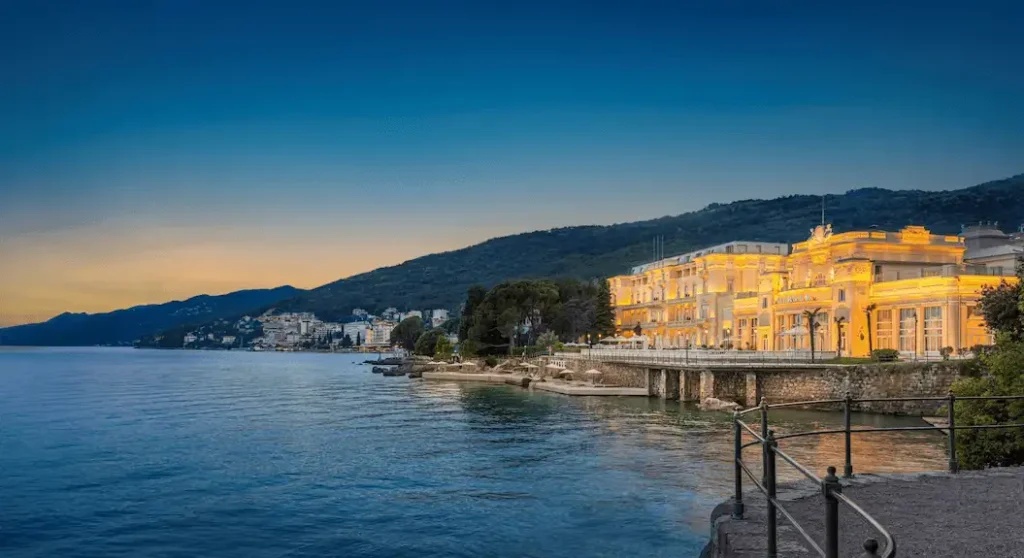
The best hotels in Opatija aren’t generic five-star boxes—they’re the preserved palaces and imperial villas that defined the Adriatic Riviera during the Austro-Hungarian Empire. Between 1884 and 1906, Opatija became the winter resort of Habsburg nobility, and today its architectural soul remains intact along the legendary Lungomare promenade.
The problem: most booking platforms bury these verified landmarks beneath renovated modern properties with no historical substance or structural identity. We’ve audited Opatija’s inventory and filtered out weak conversions and brand-saturated builds to focus exclusively on properties with documented “Past-Life Identity”—former imperial residences, Secessionist masterpieces, and Belle Époque social landmarks. What remains is a curated selection that guarantees your stay is a living archive of Habsburg grandeur, not just a room with Adriatic views.
For context on Croatia’s broader heritage portfolio, explore our full audit of best historic hotels in Croatia.
Imperial Promenade Icons
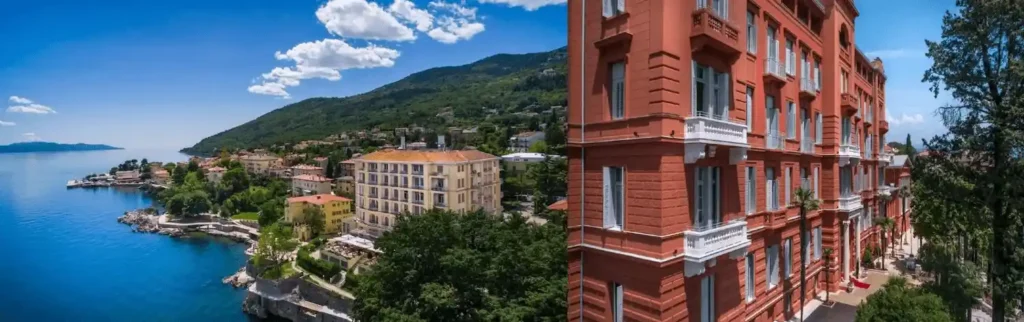
These properties define the Lungomare’s architectural identity—the original Habsburg landmarks that established Opatija as the “Nice of the Adriatic.” Expect monumental facades, preserved grand halls, and direct seafront positioning. These are the hotels that built the city’s reputation as an imperial winter capital.
🏛️ Hotel Kvarner ★★★★
Hotel Kvarner isn’t simply Opatija’s first hotel—it’s the Adriatic coast’s first. Built in 1884 as the imperial anchor of the Habsburg winter resort, this Neoclassical landmark preserves the original facade that once welcomed archdukes and European nobility.
The 1913 Crystal Hall still stands as the city’s most important architectural salon—a chandelier-lit volume with restored frescoes and original spatial geometry that no modern property can replicate. Rooms blend Belle Époque proportions with contemporary finishes, but the real luxury is the historic seafront terrace, a stone platform that has overlooked the same Adriatic horizon for 140 years. The transition from the promenade into Kvarner’s entrance hall is a step into preserved imperial authority—the kind of physical weight that modern builds simply cannot manufacture.
This is the only hotel in Opatija with documented claim to being “first,” and that provenance alone secures its position at the top of any serious audit.
Best for: History-focused travelers seeking the most architecturally significant property on the Adriatic coast with verified imperial provenance.
Signature Experience: Dining beneath restored frescoes in the 1913 Crystal Hall, direct Lungomare access from the original seafront terrace, preserved Neoclassical volumes, spa treatments in a modernized wellness wing integrated into the historic structure.
“That Crystal Hall at night—felt like dining in a Habsburg ballroom, not a hotel restaurant.” — Markus, ViennaCheck Availability & Rates →
🎭 BRISTOL Hotel Opatija ★★★★
BRISTOL Hotel Opatija was built in 1906 as a Viennese-style social palace, and its Secessionist facade remains one of the most photographed structures in the city center. The full restoration honors the original 1906 detailing—ornate stone balconies, arched windows, and the grand entrance hall that once served as the hotel’s primary social arena.
The Viennese Café on the ground floor isn’t a themed replica; it’s the original salon, preserved with period-accurate furnishings and the same chandeliers that illuminated Habsburg-era socialites. Rooms maintain high ceilings and oversized windows that flood the interiors with Adriatic light, but the real draw is the city-center positioning with direct views over Opatija’s historic core. Walking into the BRISTOL feels like entering a preserved Viennese coffeehouse, not a sanitized modern lobby. It’s the only property in Opatija that combines Secessionist architecture with intact Belle Époque cafe culture, making it the most complete cultural immersion in the city.
Best for: Architecture enthusiasts and couples seeking Viennese elegance with direct access to Opatija’s historic promenade and cultural landmarks.
Signature Experience: Morning coffee in the original 1906 Viennese Café, views from the restored stone balconies, high-ceilinged rooms with period-accurate detailing, central positioning for pedestrian exploration of Opatija’s heritage quarter.
“The café alone justified the stay—authentic Secessionist salon, not a replica.” — Clara, ZurichCheck Availability & Rates →
✨ Hotel Imperial ★★★★
Hotel Imperial opened in 1885 as the “Kronprinzessin Stephanie” and remains the most structurally intact Secession landmark in Opatija. The Golden Hall—a ballroom-scale volume with original gilded detailing and restored ceiling frescoes—is the centerpiece of the property and the most photographed interior in the city. Unlike properties that renovate away their heritage, the Imperial preserves the original spatial scale: impossibly high ceilings, grand staircases with wrought-iron railings, and facade stonework that hasn’t been stripped or modernized.
Rooms are updated with contemporary finishes, but the bones remain Habsburg—oversized windows, Belle Époque proportions, and direct Adriatic views from private balconies. The Imperial doesn’t compete on amenities; it competes on architectural authority, and that authority is undeniable the moment you step into the preserved entrance hall. This is the property for travelers who prioritize structural grandeur over spa menus and rooftop pools.
Best for: Design-focused travelers and heritage purists seeking the most architecturally preserved Secession interiors on the Adriatic coast.
Signature Experience: Evening receptions in the restored Golden Hall, direct seafront terrace access, preserved grand staircase photography, high-ceilinged rooms with original Belle Époque proportions and Adriatic balcony views.
“Golden Hall at sunset—impossible not to feel like you’ve stepped into 1885.” — Lena, BerlinCheck Availability & Rates →
🏰 Hotel Bellevue ★★★★
Hotel Bellevue is the most physically massive of Opatija’s imperial landmarks—a monumental 1891 Empire-style structure that dominates the Lungomare skyline. The facade alone is a preserved masterpiece: symmetrical columns, grand balconies, and stone detailing that remains untouched by modern interventions. Inside, the spatial planning reflects Belle Époque ambitions—wide corridors, oversized salons, and a grand entrance hall that was designed to accommodate carriages and nobility.
The property has modernized its interiors without sacrificing the original structural geometry, meaning rooms still feature the high ceilings and oversized windows that defined imperial-era hospitality. The seafront positioning is flawless—direct Adriatic views from every major room and terrace, with the promenade running directly beneath the property. Bellevue doesn’t rely on amenities or boutique touches; it relies on architectural scale and imperial presence, and both are delivered in excess.
Best for: Travelers seeking monumental Belle Époque architecture with direct promenade positioning and unobstructed Adriatic views.
Signature Experience: Morning walks on the historic Lungomare from the hotel’s direct seafront entrance, grand salon receptions, high-ceilinged rooms with Empire-style proportions, terrace dining with uninterrupted Adriatic horizon.
“That facade from the promenade—felt like walking into a preserved Habsburg painting.” — Stefan, GrazCheck Availability & Rates →
Noble Villa Conversions

These properties represent Opatija’s converted noble residences and Habsburg villas that preserve original architectural elements while integrating modern amenities. Expect smaller scale, more intimate positioning, and preserved facade work with contemporary interior finishes.
🌿 Amadria Park Hotel Milenij ★★★★
Amadria Park Hotel Milenij began as a 19th-century Habsburg villa at the start of the Lungomare and remains one of Opatija’s most carefully restored heritage conversions. The original villa structure is preserved in full—facade stonework, arched windows, and the famous Wagner Café terrace, a social landmark since 1904 that still overlooks the same Adriatic promenade.
The interior modernization is tasteful, blending Belle Époque proportions with contemporary finishes, but the real value is the positioning: direct promenade access, private garden terraces, and the preserved Wagner Café as the property’s emotional anchor. Rooms are updated with spa-level finishes, but the bones remain Habsburg—high ceilings, oversized windows, and preserved architectural detailing that modern builds cannot replicate. The Milenij offers a softer heritage experience than the monumental imperial hotels, but the authenticity is intact, and the Wagner Café alone justifies the selection.
Best for: Couples seeking a more intimate Habsburg villa experience with preserved Belle Époque cafe culture and direct Lungomare access.
Signature Experience: Morning coffee on the historic Wagner Café terrace, private garden access, preserved villa facade photography, direct promenade positioning for pedestrian exploration of Opatija’s heritage quarter.
“Wagner Café at sunrise—felt like a secret Habsburg salon, not a hotel terrace.” — Anna, LjubljanaCheck Availability & Rates →
⛪ Amadria Park Hotel Sveti Jakov ★★★★★
Amadria Park Hotel Sveti Jakov is the only five-star property in this audit, but it earns its position through architectural merit, not amenity bloat. Built in 1886 as an Austro-Hungarian noble villa next to the Church of St. James, the property preserves the original stone facade and the grand interior staircase that once connected private salons.
The restoration is meticulous—period-accurate detailing, preserved decorative stonework, and high-noble spatial planning that reflects the villa’s original function as a residence for Habsburg elite. The spa-level amenities (wellness center, gourmet dining) are housed in a contemporary extension that respects the historic core. The positioning is quieter than the promenade palaces, offering a more secluded heritage experience with direct access to Opatija’s religious and cultural landmarks. Sveti Jakov is the only property that combines five-star service with verified 1886 architecture, making it the strongest choice for travelers who refuse to compromise between heritage and luxury.
Best for: Heritage-focused luxury travelers seeking a five-star villa conversion with verified 1886 architecture and secluded positioning near Opatija’s cultural landmarks.
Signature Experience: Private wellness center with modern spa treatments, gourmet dining in a chandelier-lit historic salon, preserved grand staircase and noble residence proportions, direct access to the Church of St. James and cultural quarter.
“That staircase alone—pure Habsburg aristocracy, not hotel decoration.” — Petra, MunichCheck Availability & Rates →
🌊 Hotel Miramar ★★★★
Hotel Miramar preserves the structure of the original 1889 “Villa Meyne,” and remains one of Opatija’s most authentically scaled heritage conversions. The property maintains the original neoclassical window frames, the private seaside garden layout that once served the villa’s noble residents, and the intimate proportions that separate historic villas from monumental imperial hotels.
The interior modernization is complete, with contemporary finishes and updated amenities, but the exterior and spatial planning remain true to the 1889 design. Rooms feature Belle Époque proportions with direct sea views, and the private garden offers a rare quietness that the larger promenade hotels cannot match. Miramar is the most understated property in this audit, but for travelers who prioritize authentic villa architecture over grand imperial scale, it delivers the most honest heritage experience in Opatija.
Best for: Travelers seeking an intimate villa experience with preserved 1889 architecture, private garden access, and quieter positioning away from the main promenade crowds.
Signature Experience: Private seaside garden access, preserved neoclassical facade detailing, Belle Époque room proportions with direct Adriatic views, intimate scale that reflects original noble villa identity.
“The garden at dusk—felt like a private Habsburg retreat, not a hotel.” — Marco, TriesteCheck Availability & Rates →
📊 Comparison: Best Hotels in Opatija
| Hotel | Location | Wellness & Spa | Dining | Unique Perks | Best For |
|---|---|---|---|---|---|
|
🏛️ Hotel Kvarner ★★★★ |
Lungomare seafront |
Wellness wing, spa treatments |
1913 Crystal Hall, frescoed dining |
First Adriatic hotel, imperial terrace |
History purists, imperial provenance |
|
🎭 BRISTOL Hotel Opatija ★★★★ |
City center, historic quarter |
Modern wellness, spa facilities |
Original 1906 Viennese Café |
Secessionist facade, cafe culture |
Architecture lovers, central access |
|
✨ Hotel Imperial ★★★★ |
Lungomare promenade |
Updated spa, wellness center |
Restored dining halls, Adriatic views |
1885 Golden Hall, Secession interiors |
Design purists, structural grandeur |
|
🏰 Hotel Bellevue ★★★★ |
Seafront, Lungomare |
Spa amenities, wellness facilities |
Grand salon dining, terrace service |
Monumental facade, Empire-style scale |
Belle Époque scale, promenade positioning |
- For more Habsburg-era properties continue with our audit of best hotels in Zagreb, which maps the capital’s most significant imperial and interwar conversions.
❓ FAQ: Best Hotels in Opatija
What makes Opatija’s hotels historically significant?
Opatija became the official winter resort of the Austro-Hungarian Empire in the 1880s, and its hotels were built as imperial palaces and noble villas to accommodate Habsburg aristocracy. Properties like Hotel Kvarner (1884) and Hotel Imperial (1885) preserve original Neoclassical and Secessionist facades, grand halls, and Belle Époque spatial planning that modern hotels cannot replicate. These aren’t themed replicas—they’re verified architectural landmarks with documented provenance.
Which hotel in Opatija has the most significant architectural heritage?
Hotel Kvarner holds the strongest claim as the first hotel built on the Adriatic coast (1884) and preserves the most complete imperial infrastructure, including the 1913 Crystal Hall. For Secessionist architecture, Hotel Imperial’s Golden Hall (1885) remains the most structurally intact Secession interior in the city. Both properties offer preserved Habsburg grandeur that exceeds any modern luxury build.
Are these historic hotels updated with modern amenities?
Yes. Every property in this audit has integrated modern wellness facilities, updated bathrooms, and contemporary finishes while preserving the original architectural bones—facades, grand halls, high ceilings, and Belle Époque proportions. The difference is that these hotels prioritize structural integrity over brand-saturated renovations, meaning the heritage remains intact and visible.
Which hotel offers the most authentic Belle Époque experience?
BRISTOL Hotel Opatija preserves the most complete Belle Époque cultural experience with its original 1906 Viennese Café, Secessionist facade, and period-accurate interior detailing. For monumental imperial scale, Hotel Bellevue’s 1891 Empire-style facade and grand salon deliver the most physically imposing Belle Époque architecture on the Lungomare promenade.
Is it worth staying in a historic hotel versus a modern five-star property?
If your priority is physical immersion in Habsburg-era architecture, yes. Modern five-star hotels in Opatija offer amenities but lack the verified historical identity and preserved spatial planning of imperial-era landmarks. Properties like Hotel Kvarner and Hotel Imperial deliver architectural experiences that modern builds cannot manufacture, regardless of star rating or amenity menus.
What is the Lungomare, and why does it matter for hotel selection?
The Lungomare is Opatija’s historic 12-kilometer seaside promenade, built during the Austro-Hungarian era and still lined with the original imperial villas and palaces. Hotels positioned directly on the Lungomare (Kvarner, Imperial, Bellevue) offer seamless access to this preserved pedestrian corridor and the architectural continuity that defines Opatija’s heritage identity. It’s the physical anchor of the city’s Belle Époque legacy.
Which hotel is best for couples seeking privacy and heritage?
Amadria Park Hotel Sveti Jakov offers the most secluded positioning with preserved 1886 noble villa architecture and five-star amenities, making it the strongest choice for couples prioritizing privacy without sacrificing heritage authenticity. For a more intimate villa experience, Hotel Miramar’s private seaside garden and quieter location deliver the most understated Habsburg retreat.
Choosing the Right Hotel in Opatija
Opatija’s hotel inventory isn’t about chasing star ratings—it’s about selecting a property that matches your tolerance for architectural authenticity. The seven properties above represent the most consistently preserved imperial conversions in the city, verified for structural integrity, documented provenance, and seamless integration of heritage and hospitality. Availability at this level shifts quickly during high season, and properties like Hotel Kvarner and BRISTOL book months in advance among travelers who prioritize architectural rarity over generic luxury.
If you’re exploring Croatia’s southern heritage portfolio, discover the Dalmatian architectural landscape in our full survey of best hotels in Dubrovnik.
For more curated itineraries and luxury-focused travel insights, visit Your Luxury Guide. For official travel information and destination updates, visit Croatia tourism-info.
Booking your Opatija hotel secures access to the Adriatic’s most architecturally intact Habsburg winter resort—where Belle Époque grandeur is preserved infrastructure, not decorative theater.
Your Luxury Guide — Where Exceptional Travel Begins.