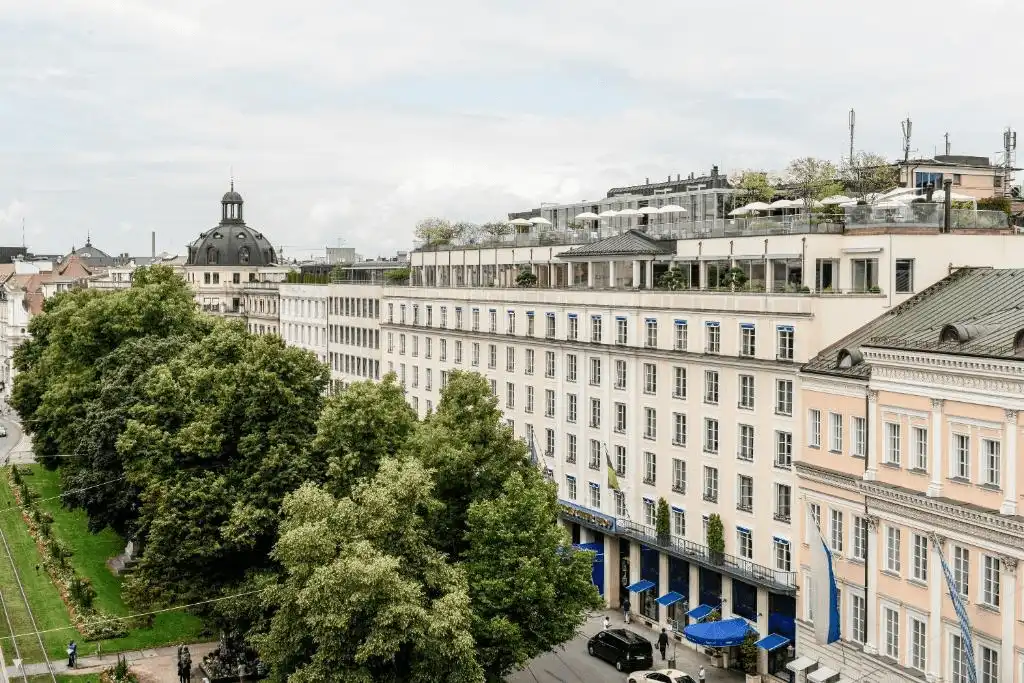
Choosing the best hotels in Munich isn’t about finding five stars—it’s about finding properties where the building’s soul matches your expectations for cultural depth and architectural significance. Munich’s true luxury assets are the conversions: former royal palaces, diplomatic headquarters, and civic institutions that now offer stays where history is structural, not decorative.
After filtering the city’s most refined historic properties, we’ve identified seven hotels that consistently deliver on historical authenticity, service precision, and location—not just brand recognition. Below are the stays that make sense if you value access to Munich’s royal legacy, architectural gravitas, and accommodations that feel curated rather than corporate.
Explore our complete guide to the best historic stays in Germany for broader context across the country’s most significant conversions.
Royal Diplomatic Landmarks
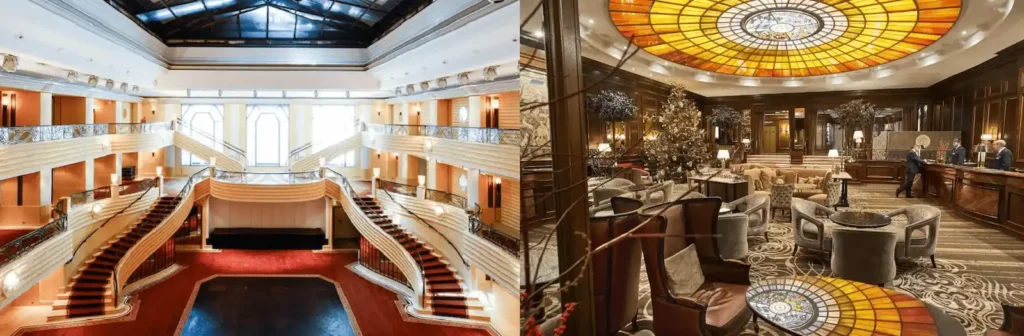
These aren’t just luxury hotels—they’re living monuments to Bavarian sovereignty. Both properties below were commissioned by Bavarian royalty and retain structural roles in European diplomatic and aristocratic life. If you’re booking Munich for cultural immersion at the highest level, this tier represents the city’s most historically significant luxury stays.
🏰 Hotel Bayerischer Hof ★★★★★
This property serves travelers who prioritize staying inside verified diplomatic and aristocratic infrastructure over contemporary design trends. Built in 1841 at King Ludwig I’s request, the hotel integrates the Palais Montgelas—the former Bavarian Ministry of Foreign Affairs—directly into its structure. That integration isn’t symbolic: the hotel remains the annual host site for the Munich Security Conference, positioning it as Europe’s most active diplomatic luxury asset.
The interiors balance Belle Époque grandeur with understated service precision, and the rooftop pool overlooks the Old Town’s spires and domes. Guests here aren’t paying for amenities—they’re paying for proximity to power and verified royal legacy.
Booking this level of heritage infrastructure secures a stay where the building’s diplomatic past informs every spatial decision, from the chandelier-lit lobby to the conference-ready suites.
Best for: Diplomats, cultural historians, and travelers who value verified aristocratic and governmental heritage over boutique intimacy.
Signature Experience: Rooftop pool with panoramic Old Town views, Michelin-level Atelier dining, Palais Montgelas wing access, in-house theater and nightclub, direct Maximilianstraße luxury shopping access.
“Standing in that lobby, you feel the weight of every summit and royal visit that’s passed through—it’s intoxicating.” — Henrik, StockholmCheck Availability & Rates →
👑 Vier Jahreszeiten Kempinski München ★★★★★
This property suits travelers who want to stay inside Munich’s most visually iconic royal monument—one designed explicitly to host European monarchs and elite society. Commissioned in 1858 by King Maximilian II, the hotel occupies a monumental position on Maximilianstraße, the avenue built as the king’s personal architectural legacy.
The defining feature is the stained-glass dome lobby, a soaring Neo-Renaissance space that functioned as Munich’s primary royal reception hall. Today, that spatial drama remains intact: guests enter through the same grand threshold designed for aristocratic arrivals.
Service here is formal without being stiff, and the Jahreszeiten Spa delivers modern wellness inside preserved 19th-century halls. You’re not booking a luxury hotel—you’re booking the sovereign urban palace that defined Munich’s royal social hierarchy for over 160 years.
Best for: Travelers seeking Munich’s most photographically iconic royal interior, couples prioritizing monumental architecture, guests who value formal European service culture.
Signature Experience: Stained-glass dome lobby, Jahreszeiten Spa with indoor pool, Michelin-recognized Schwarzreiter Tagesbar, direct Maximilianstraße shopping access, concierge-curated opera and museum bookings.
“That dome catches afternoon light in a way that makes you understand why kings built monuments to themselves.” — Elise, BrusselsCheck Availability & Rates →
Aristocratic & Cultural Conversions
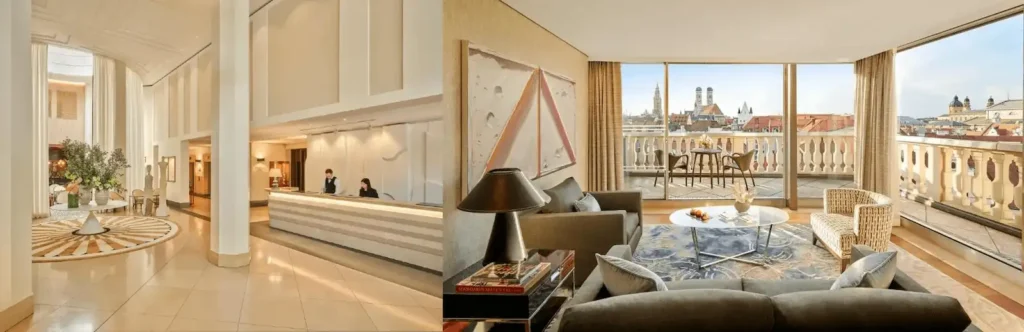
These properties occupy verified aristocratic residences, former bank headquarters, and civic institutions. They deliver strong architectural identity and cultural positioning without the diplomatic weight. If you want heritage authenticity with more contemporary service flexibility, this grouping offers the right balance.
🏛️ Rocco Forte The Charles Hotel ★★★★★
This property attracts travelers who want Neo-Renaissance aristocratic interiors without sacrificing modern wellness infrastructure or family-friendly service flexibility. The building is a preserved noble residence with original façade elements and restored interior detailing, but the Forte Group’s renovation introduced contemporary spa facilities and streamlined design that soften the formality.
The result is a property that feels more approachable than Kempinski or Bayerischer Hof while maintaining clear aristocratic positioning. The Sophia’s restaurant delivers Michelin-level Mediterranean cuisine, and the rooftop terrace offers unobstructed views toward the Old Town. Families appreciate the larger suite configurations and flexible dining hours, while solo travelers value the location directly adjacent to the Old Botanical Garden—a rare quiet green space in central Munich.
Best for: Families seeking aristocratic heritage with modern wellness amenities, travelers prioritizing spa-focused luxury, guests who want refined service without diplomatic formality.
Signature Experience: Rooftop terrace with Old Town views, Sophia’s Mediterranean fine dining, full-service spa with indoor pool, Old Botanical Garden access, family-friendly suite layouts.
“The rooftop at twilight—city lights blending with garden greens—felt like discovering Munich’s quieter aristocratic side.” — Laura, MilanCheck Availability & Rates →
🏢 Louis Hotel ★★★★★
This property serves travelers who prioritize central Marienplatz access and contemporary minimalist interiors over monumental heritage theatrics. The building maintains its historic façade and classic residential proportions, but the interior design philosophy leans toward Scandinavian-influenced restraint rather than Baroque ornamentation. That restraint appeals to design-conscious guests who want architectural context without feeling trapped inside a museum.
The rooftop bar delivers direct views of Viktualienmarkt and Frauenkirche, and the location—steps from Marienplatz—positions guests at Munich’s geographic and cultural center.
Service is warm but understated, and the smaller room count ensures a quieter, more intimate atmosphere compared to larger heritage properties.
Book here if you value walkability, design clarity, and a less formal approach to Munich luxury.
Best for: Design-focused travelers seeking minimalist elegance, guests prioritizing Marienplatz proximity, solo travelers valuing intimate boutique scale over grand ballrooms.
Signature Experience: Rooftop bar with Viktualienmarkt views, Japanese-inspired Emiko restaurant, Frauenkirche direct sight lines, minimalist suites with historic façade preservation, immediate Old Town pedestrian access.
“That rooftop view—beer hall energy below, church spires above—captured Munich’s soul in one frame.” — Daniel, CopenhagenCheck Availability & Rates →
🏦 Mandarin Oriental Munich ★★★★★
This property suits travelers who appreciate institutional civic heritage—specifically, the gravitas of staying inside a converted 19th-century bank headquarters. The building’s foundations incorporate a 56-meter section of Munich’s medieval city wall, creating a literal architectural bridge between the city’s fortified past and its financial Golden Age.
That historical layering informs the interiors: vaulted ceilings, preserved Neo-Renaissance detailing, and original stonework create a sense of permanence that pure luxury brands can’t replicate.
The rooftop pool overlooks the Old Town, and Matsuhisa Munich delivers the brand’s signature Japanese-Peruvian cuisine inside a chandelier-lit former banking hall. Service precision is exceptional—this is Mandarin Oriental executing at full capacity inside a structure that reinforces rather than competes with the brand’s refinement. Book here if you want Mandarin’s service culture anchored by verified Munich civic architecture.
Best for: Travelers valuing institutional heritage paired with Asian service precision, guests seeking medieval-era architectural context, couples prioritizing rooftop pool privacy and Michelin-level dining.
Signature Experience: Rooftop pool with Old Town views, Matsuhisa Munich in converted banking hall, medieval city wall foundations, full-service spa, preserved Neo-Renaissance vaulted ceilings.
“Dining in that former bank vault—chandeliers above, stone walls around—felt like tasting history with every course.” — Akiko, TokyoCheck Availability & Rates →
🏤 Sofitel Munich Bayerpost ★★★★★
This property attracts travelers drawn to industrial and civic heritage conversions—specifically, the spatial drama of a former central railway post office reimagined as contemporary luxury. Built as the Kingdom of Bavaria’s communications nerve center (separate from the German Reich system), the building features an Italian High Renaissance façade and a soaring 27-meter-high lobby hall that originally processed the kingdom’s mail and telegraph traffic.
That vertical grandeur remains the defining experience: guests enter through the same monumental threshold designed to project state power and efficiency. Today, the interiors blend exposed brick, original ironwork, and modern French elegance under the Sofitel brand’s design direction.
The location near Hauptbahnhof makes this ideal for travelers prioritizing rail connectivity and easy access to both Old Town culture and modern Munich business districts.
Best for: Travelers valuing industrial-civic heritage conversions, guests prioritizing Hauptbahnhof proximity for rail access, design enthusiasts drawn to adaptive reuse projects.
Signature Experience: 27-meter-high Renaissance lobby hall, Schwarz & Weiz Bavarian-French dining, Sofitel MyBed luxury sleep program, preserved industrial architectural elements, immediate Hauptbahnhof rail access.
“Walking into that lobby—columns soaring, light flooding through Renaissance windows—reminded me why civic buildings used to inspire awe.” — Marc, LyonCheck Availability & Rates →
Historic Social & Guild Heritage
This final property represents Munich’s oldest mercantile and social heritage—a different kind of luxury rooted in continuity rather than monumental architecture. If you prioritize staying inside the city’s longest-operating inn and value intimate scale over grand lobbies, this is Munich’s most authentic merchant-class heritage experience.
🏛️ Hotel Torbräu ★★★★
This property serves travelers who value operational longevity and merchant-class heritage over aristocratic theatrics. Established in 1490 (with documented roots to 1390), Torbräu holds the distinction of being Munich’s oldest continuously operating inn, positioned directly beside the Isartor medieval city gate.
That location wasn’t accidental: the inn served salt traders entering the city and later hosted cultural luminaries including Franz Liszt and Felix Mendelssohn. The interiors preserve guild-era proportions and detailing without feeling overly restored, and the smaller scale creates a more personal, less formal service dynamic.
Rooms overlook either the Isar River or the illuminated city gate, and the location provides immediate pedestrian access to Marienplatz while maintaining distance from tourist density.
Best for: History-focused travelers seeking Munich’s oldest operational inn, guests valuing guild-era social heritage, solo travelers prioritizing intimate scale and pedestrian Old Town access.
Signature Experience: Isar River and Isartor gate views, preserved medieval inn architecture, cultural luminaries’ historical stays, immediate Marienplatz pedestrian access, guild-era interiors.
“Sleeping beside the same gate where salt traders entered centuries ago—that’s the kind of history you feel, not just read about.” — Thomas, HamburgCheck Availability & Rates →
📊 Comparison: Best Hotels in Munich
| Hotel | Location | Wellness & Spa | Dining | Unique Perks | Best For |
|---|---|---|---|---|---|
|
🏰 Hotel Bayerischer Hof ★★★★★ |
City center, Maximilianstraße |
Rooftop pool, spa facilities |
Michelin-level Atelier dining |
Munich Security Conference host, Palais Montgelas wing |
Diplomats, power travelers |
|
👑 Vier Jahreszeiten Kempinski München ★★★★★ |
Maximilianstraße, city center |
Jahreszeiten Spa, indoor pool |
Schwarzreiter Michelin dining |
Stained-glass dome, royal social hall |
Royal heritage, monumental interiors |
|
🏛️ Rocco Forte The Charles Hotel ★★★★★ |
Old Botanical Garden adjacent |
Full spa, indoor pool |
Sophia’s Mediterranean fine dining |
Rooftop terrace, garden access |
Families, wellness seekers |
|
🏢 Louis Hotel ★★★★★ |
Marienplatz, Old Town core |
Compact facilities | Emiko Japanese dining |
Rooftop bar, Viktualienmarkt views |
Design lovers, central walkability |
- Continue your Bavarian historical journey with our curated selection of luxury castle stays.
❓ FAQ: Best Hotels in Munich
What makes Munich’s best hotels different from standard luxury properties?
Munich’s top-tier hotels occupy verified heritage structures—former royal palaces, diplomatic headquarters, and civic institutions built by Bavarian royalty or state power. You’re paying for architectural authenticity and historical infrastructure, not just amenities. Properties like Hotel Bayerischer Hof host the Munich Security Conference annually; Vier Jahreszeiten Kempinski was commissioned by King Maximilian II as a royal social monument. That institutional legacy translates into spatial grandeur, service precision, and cultural context that modern luxury builds cannot replicate.
Which Munich hotel offers the strongest royal historical experience?
Vier Jahreszeiten Kempinski München delivers Munich’s most visually iconic royal interior: the stained-glass dome lobby was designed in 1858 explicitly to host European monarchs and aristocratic society. The building occupies King Maximilian II’s personal architectural legacy avenue, and the interiors preserve Neo-Renaissance grandeur at scale. If monumental royal social history is your priority, this is Munich’s clearest choice.
Are Munich historic hotels suitable for families with children?
Rocco Forte The Charles Hotel offers the best balance for families: aristocratic heritage interiors paired with contemporary wellness facilities, flexible dining hours, and larger suite configurations. The location adjacent to the Old Botanical Garden provides rare green space access in central Munich. Other properties—particularly Bayerischer Hof and Kempinski—lean toward formal service cultures better suited to couples or solo travelers.
What’s the best location for first-time visitors to Munich?
Louis Hotel places you steps from Marienplatz—Munich’s geographic and cultural center—with immediate pedestrian access to Viktualienmarkt, Frauenkirche, and Old Town highlights. The rooftop bar delivers direct views over the market and church spires. If walkability and central positioning outweigh monumental heritage theatrics, this location maximizes cultural immersion efficiency.
Do Munich’s luxury hotels require advance booking?
Yes—particularly during Oktoberfest (late September to early October), Christmas markets (late November through December), and Munich Security Conference week (February). Properties like Bayerischer Hof and Kempinski fill months ahead during these periods. For standard spring and summer travel, 4-6 weeks advance booking secures better room selection and occasional package offers.
Which Munich hotel offers the most unique architectural conversion?
Mandarin Oriental Munich occupies a former 19th-century bank headquarters with foundations built directly into 56 meters of Munich’s medieval city wall. That layering—medieval fortifications supporting Golden Age financial infrastructure, now reimagined as contemporary luxury—creates architectural depth modern builds cannot match. The Matsuhisa restaurant operates inside a converted banking hall with preserved vaulted ceilings, and the rooftop pool overlooks the Old Town. If adaptive reuse and institutional civic heritage appeal to you, this conversion offers Munich’s most dramatic structural story.
What’s the best hotel for solo travelers prioritizing cultural access?
Hotel Torbräu delivers Munich’s most authentic merchant-class heritage at intimate scale: established in 1490 beside the Isartor medieval gate, it’s the city’s oldest continuously operating inn. Solo travelers gain immediate pedestrian access to Marienplatz without tourist density, and the smaller room count ensures personalized service. The property lacks grand ballrooms and rooftop pools, but if you prioritize operational continuity and guild-era social history over aristocratic monumentality, this is Munich’s most historically grounded solo stay.
Which Munich Historic Hotel Matches Your Travel Priorities?
Booking the best hotels in Munich secures access to properties where the building’s past defines your experience—not just the service or amenities. The hotels above represent the city’s most architecturally significant conversions, selected for travelers who value royal legacy, civic heritage, and institutional authenticity over generic luxury branding. Availability at this level tightens quickly during conference seasons and cultural events.
For broader German historical context, explore our guide to the best hotels in Berlin, or discover medieval conversions in our top tier historic hotels in Heidelberg collection.
For more curated itineraries and luxury-focused travel insights, visit Your Luxury Guide. For official travel information and destination updates, visit Germany tourism-info.
Booking your Munich historic hotel secures your stay in structures commissioned by Bavarian kings, diplomatic summits, and century-spanning cultural institutions—properties where history is structural, not decorative.
Your Luxury Guide — Where Exceptional Travel Begins.