Choosing the best hotels in Milan requires understanding that this city’s luxury properties aren’t just five-star accommodations—they’re converted banking headquarters, Neo-Renaissance palaces, and historic fashion-district where the building itself justifies the rate. Milan doesn’t trade on ancient ruins; it trades on institutional power reimagined as private sanctuary.
After reviewing the city’s most architecturally significant properties, we’ve identified seven hotels where historical conversion and contemporary service create stays that feel exclusive rather than branded. These aren’t hotels that happen to be historic—they’re architectural assets that happen to accept overnight guests.
Below are the historic buildings that matter if you value location near La Scala and Duomo, interiors designed by Milan’s own fashion elite, and the kind of discreet service that comes from properties managing guest lists, not check-in queues.
Get access here to legendary hotels in Italy for context on how Milan’s properties fit within Italy’s broader landmark collection.
Milan’s Banking District: Where Financial Power Became Five-Star Luxury
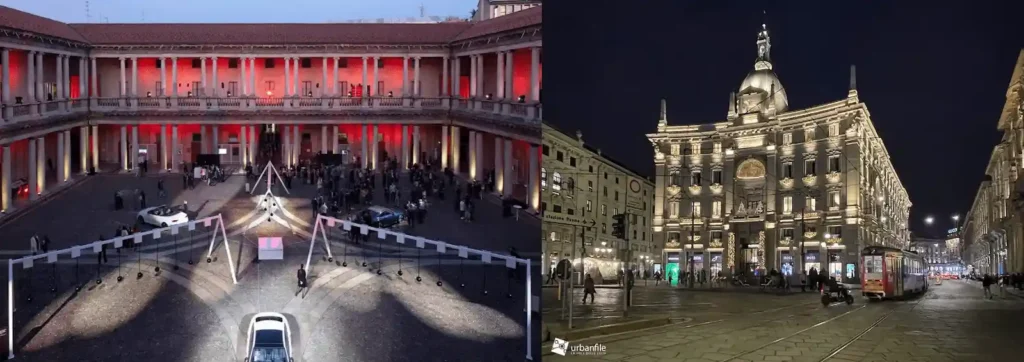
The quadrilatero della moda wasn’t always fashion’s fortress—it was finance’s. Three of Milan’s most compelling luxury stays occupy former banking headquarters and institutional buildings, where original marble lobbies, brass fixtures, and vault architecture now frame experiences designed for travelers who recognize that true luxury is about provenance, not just thread count.
Expect interiors that nod to Milan’s 20th-century economic dominance, Michelin-level dining in spaces that once hosted board meetings, and suites where the bones of the building—coffered ceilings, restored frescoes—do more storytelling than any concierge.
🏦 Four Seasons Hotel Milano ★★★★★
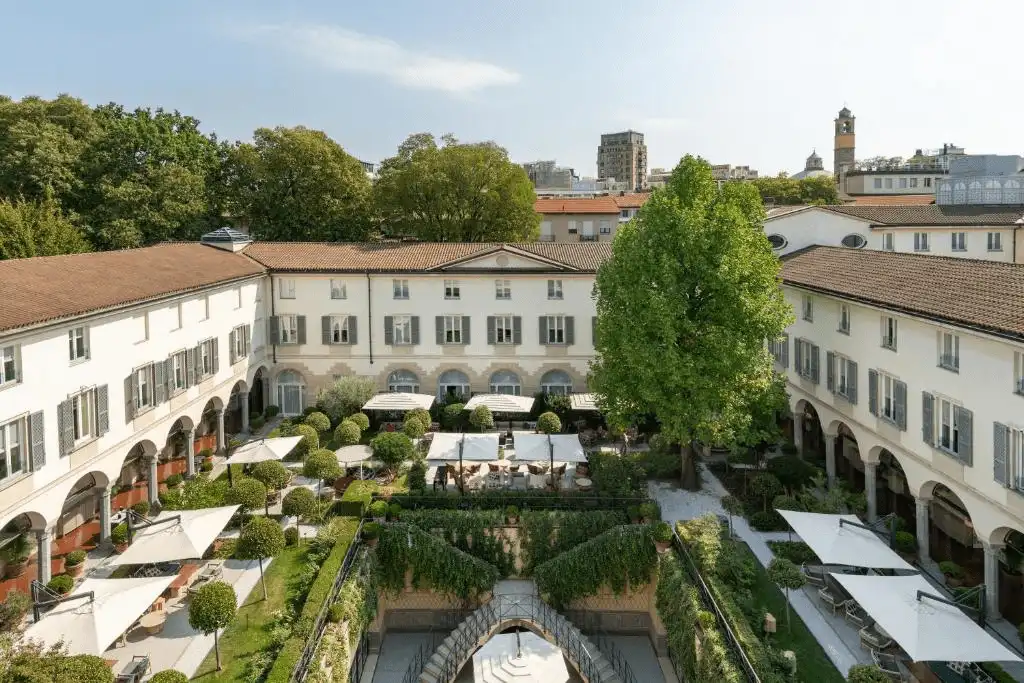
Built around a 15th-century convent that once served Milan’s elite during Habsburg rule, this property manages the rare feat of honoring monastic bones while delivering the service precision that keeps Four Seasons at the top of corporate travel lists.
The original cloister—frescoed arcades surrounding a magnolia-shaded courtyard—functions as the emotional center, a space so architecturally resolved that guests naturally gravitate there between meals and meetings.
What separates this from standard luxury is the duality: you’re staying in a structure that predates Columbus, but your suite has underfloor heating, blackout automation, and a bathroom larger than most Milan apartments.
The spa occupies restored Renaissance cellars; the rooftop bar overlooks Duomo spires. Location is Via Gesù—quiet enough for uninterrupted sleep, close enough to Montenapoleone that you’re never more than eight minutes from Prada’s flagship.
Best for: Senior executives and design-conscious couples seeking Habsburg-era architecture with Four Seasons operational consistency in the heart of fashion’s Golden Rectangle.
Signature Experience: Original 15th-century frescoed cloister courtyard for private aperitivo, Michelin-starred La Veranda restaurant in former convent refectory, subterranean spa in Renaissance vaulted cellars, rooftop terrace with Duomo views.
“That cloister courtyard at dusk—magnolias blooming, frescoes glowing—worth staying an extra night just for evening drinks there.” — Alessandro, ZurichCheck Availability & Rates →
🎨 Portrait Milano – Lungarno Collection ★★★★★
Owned by the Ferragamo family and positioned directly opposite Galleria Vittorio Emanuele, Portrait Milano occupies a 1930s Rationalist building that once served as the headquarters for Milan’s textile trade associations—fitting, given that fashion royalty now controls the property.
What makes this relevant is the curation: every room designed by Michele Bönan, the same architect behind Ferragamo’s global flagships, meaning you’re essentially staying inside the aesthetic that defines contemporary Milanese luxury retail.
Semioteca restaurant holds a Michelin star and sources entirely from northern Italian producers; the top-floor rooftop bar is members-only except for hotel guests.
Service operates on first-name recognition by day two. The building’s history isn’t medieval drama—it’s 20th-century mercantile precision, which means rooms prioritize natural light, storage space, and sightlines over Baroque flourishes.
Best for: Fashion insiders and design professionals requiring Ferragamo-family curation, Michelin dining, and direct Duomo-Galleria access without tourist-district chaos.
Signature Experience: Private rooftop bar overlooking Duomo (guest-only access), Michelin-starred Semioteca restaurant with northern Italian tasting menus, Michele Bönan interiors throughout, Salvatore Ferragamo custom toiletries and design library.
“The rooftop bar at sunset, Duomo lit up across the square—that’s the view you came to Milan for.” — Chiara, LondonCheck Availability & Rates →
🎭 Grand Hotel et de Milan – The Leading Hotels of the World ★★★★★
Opened in 1863 and never once closed since, this property has hosted Verdi (who lived here for 27 years and died in suite 105), Hemingway, Callas, and every conductor worth naming who performed at La Scala, which sits 200 meters up Via Manzoni.
The building‘s original Belle Époque interiors remain largely intact—marble staircases, gilded salons, frescoed ceilings—but what makes this more than a museum is how the current ownership balances preservation with modern luxury codes: heated bathroom floors, Diptyque amenities, soundproofing that blocks Milan’s Vespa symphonies.
Don Lisander restaurant operates in Verdi’s former dining salon, serving Lombard classics with enough restraint to avoid caricature. The Verdi Suite is bookable and retains his original piano, writing desk, and four-poster bed.
Location is unbeatable for opera season; La Scala’s stage door is a two-minute walk, Montenapoleone shopping five minutes south.
Best for: Opera devotees and cultural travelers seeking verified Belle Époque provenance, La Scala proximity, and interiors that remain architecturally honest to 1863 origins.
Signature Experience: Original Verdi Suite with composer’s piano and writing desk, Belle Époque frescoed salons and marble staircases, Don Lisander restaurant in Verdi’s former dining room, 200-meter walk to La Scala’s stage entrance.
“Staying in the same building where Verdi composed—that’s not marketing, that’s provenance you can feel in every hallway.” — Marco, ViennaCheck Availability & Rates →
💎 Palazzo Parigi Hotel & Grand Spa – LHW ★★★★★★
Originally constructed in the 1860s as a private residence for one of Milan’s most influential banking families, Palazzo Parigi occupies a full city block behind Corso Venezia, offering a rare combination: palatial architecture with a three-story spa that rivals anything in Switzerland.
The interiors lean heavily into Neo-Classical grandeur—marble everything, crystal chandeliers, hand-painted ceilings—but the spa (and this is why seasoned travelers choose Parigi over flashier options) operates on serious wellness infrastructure: hammam, sensory showers, a 15-meter indoor pool, and treatment protocols that go beyond generic massage.
The property’s private garden, nearly an acre of manicured green in a city that rarely offers outdoor breathing room, functions as the summer dining venue.
Service is discreet, multilingual, and operates on the assumption you’ve stayed here before. Via Turati location means you’re equidistant from Repubblica metro, Brera galleries, and Montenapoleone—central without being overrun.
Best for: Wellness-focused travelers and couples prioritizing spa infrastructure equal to accommodation quality, private garden dining, and Neo-Classical interiors in a quieter central district.
Signature Experience: Three-story Grand Spa with 15-meter indoor pool and hammam, private manicured garden for outdoor dining, Neo-Classical frescoed salons and marble interiors, discreet service culture for repeat guests.
“The spa alone justifies the stay—that hammam ritual before dinner became our daily reset.” — Elena, BrusselsCheck Availability & Rates →
Contemporary Milan: Where Fashion Heritage Meets Modern Design
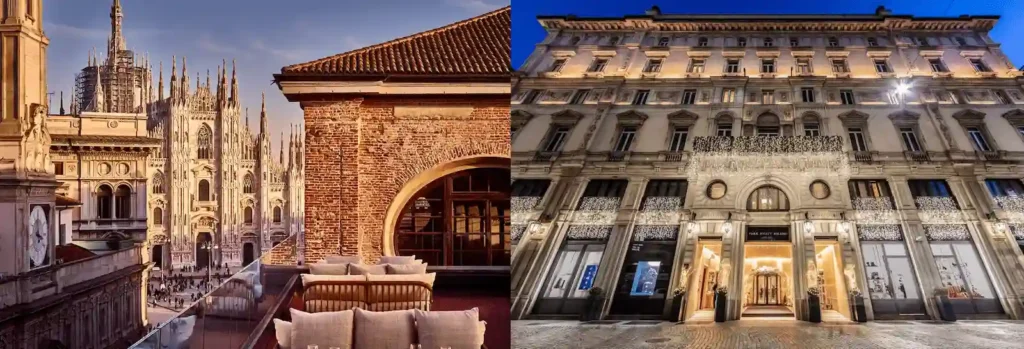
Not every Milan luxury stay trades on Renaissance bones. These properties represent the city’s contemporary identity—fashion-forward design, art gallery aesthetics, and service models built for travelers who spend more time in Fondazione Prada than Duomo.
Expect minimalist interiors by architects who’ve designed flagship stores for Armani and Versace, Michelin dining that prioritizes ingredient traceability over tableside theatrics, and a general atmosphere that assumes you already know why you’re here.
🌿 Park Hyatt Milano ★★★★★
Housed in a former 1870s bank headquarters on Via Tommaso Grossi, Park Hyatt Milano takes the brand’s signature minimalist aesthetic and applies it to a Milanese context: vaulted ceilings remain exposed, original marble columns frame the lobby, but everything else—furniture, lighting, art—follows contemporary design codes established by Ed Tuttle’s interiors.
Property feels more like a private members’ club than corporate hotel, particularly in the ground-floor lounge where Milan’s fashion and finance crowds conduct meetings over Negronis.
Vun restaurant holds a Michelin star and focuses on Lombard ingredients interpreted through modern technique; breakfast in the frescoed salon remains one of the city’s better morning rituals. Galleria Vittorio Emanuele sits 90 seconds south; La Scala two minutes north.
Rooms prioritize space and silence—soundproofing here is exceptional—making this ideal for travelers who need uninterrupted sleep in a city that doesn’t naturally provide it.
Best for: Business travelers and design-minded guests seeking Ed Tuttle’s minimalist interiors in a converted 1870s bank, Michelin dining, and prime Duomo-La Scala positioning with superior soundproofing.
Signature Experience: Michelin-starred Vun restaurant with Lombard-focused tasting menus, Ed Tuttle minimalist interiors in 1870s bank vaults, private lounge culture popular with Milan’s fashion-finance set, frescoed breakfast salon.
“That breakfast salon with original frescoes and perfect espresso—set the tone for every Milan morning.” — Luca, AmsterdamCheck Availability & Rates →
🏛️ Palazzo Cordusio Gran Melia
Originally the 1901 headquarters of Assicurazioni Generali (one of Europe’s oldest insurance companies), Palazzo Cordusio underwent a complete transformation by Spanish hospitality group Meliá, turning Liberty-style offices into a property that balances historical architecture with contemporary Mediterranean hospitality codes.
The building’s original grand staircase, marble floors, and stained-glass skylight remain focal points, but suites lean into warm tones, custom Italian furnishings, and bathrooms sized for extended stays.
Ristorante Isola occupies the former boardroom and serves northern Italian plates with enough creativity to avoid predictability; the rooftop terrace—rare for this part of Milan—provides direct Duomo views without the Galleria’s tourist density.
Best for: First-time Milan visitors prioritizing central Piazza Cordusio walkability, 1901 Liberty-style interiors, rooftop Duomo views, and Mediterranean hospitality culture in a converted insurance headquarters.
Signature Experience: Original 1901 Liberty-style grand staircase and stained-glass skylight, rooftop terrace with direct Duomo sightlines, Ristorante Isola in former Generali boardroom, Piazza Cordusio positioning for maximum walkability.
“That rooftop terrace at aperitivo hour—Duomo lit up, no crowds, just us and perfect Aperol Spritz.” — Sofia, MadridCheck Availability & Rates →
🗺️ Palazzo Touring Club Milan, A Radisson Collection Hotel ★★★★★
Originally built in 1915 as the headquarters for Touring Club Italiano (Italy’s oldest travel association), this Radisson Collection property occupies a Neo-Renaissance palazzo on Corso Italia, maintaining original period details—coffered ceilings, parquet floors, brass fixtures—while introducing contemporary functionality that business travelers require.
What makes this relevant beyond architecture is the location: you’re south of Duomo in a residential-commercial district that feels less tourist-dense, with Navigli canals a 10-minute walk south and Porta Romana metro directly accessible.
Rooms prioritize space and natural light; the rooftop bar, Terrazza Touring, provides 360-degree city views without the Galleria crowds. Service operates efficiently without excessive formality.
This works for travelers who want verified historical provenance and central access but prefer staying slightly removed from Via Montenapoleone’s intensity.
Best for: Business travelers and design enthusiasts seeking 1915 Touring Club Italiano headquarters conversion, Neo-Renaissance interiors, rooftop city views, and Corso Italia positioning south of tourist-heavy Duomo district.
Signature Experience: Original 1915 Neo-Renaissance coffered ceilings and brass fixtures, Terrazza Touring rooftop bar with 360-degree city panoramas, Corso Italia residential-district positioning, direct access to Navigli canal area.
“That rooftop bar at night—city lights stretching to the Alps—felt like discovering Milan’s best-kept secret.” — Giulia, ParisCheck Availability & Rates →
📊 Comparison: Best Hotels in Milan
| Hotel | Location | Wellness & Spa | Dining | Unique Perks | Best For |
|---|---|---|---|---|---|
|
🏦 Four Seasons Hotel Milano ★★★★★ |
Via Gesù, Fashion District |
Subterranean spa in Renaissance cellars |
Michelin-starred La Veranda |
15th-century cloister, Habsburg provenance |
Executives, design couples |
|
🎨 Portrait Milano Lungarno Collection ★★★★★ |
Opposite Galleria, Duomo district |
Private wellness facilities |
Michelin-starred Semioteca |
Ferragamo-owned, rooftop bar exclusive |
Fashion insiders, design professionals |
|
🎭 Grand Hotel et de Milan ★★★★★ |
Via Manzoni, 200m to La Scala |
Traditional spa, Diptyque amenities |
Don Lisander, Lombard classics |
Verdi’s suite, 1863 Belle Époque |
Opera devotees, cultural travelers |
|
💎 Palazzo Parigi Hotel & Grand Spa ★★★★★★ |
Corso Venezia, behind Brera |
3-story spa, 15m indoor pool |
Garden restaurant, Neo-Classical dining |
Private acre garden, 1860s banking palazzo |
Wellness-focused, spa prioritizers |
- Continue with best luxury castle hotels in Tuscany if countryside villa estates appeal more than urban historic properties.
❓ FAQ: Best Hotels in Milan
Which Milan hotel has the most historic significance?
Grand Hotel et de Milan holds the strongest historical provenance—opened in 1863 and never once closed, it served as Giuseppe Verdi’s primary residence for 27 years until his death in suite 105 in 1901. The property retains Belle Époque frescoes, marble staircases, and original architectural bones that remain largely unaltered, making it the top choice for travelers prioritizing verified 19th-century cultural heritage over contemporary design narratives.
Are Milan’s luxury hotels within walking distance of Duomo and La Scala?
All seven properties listed maintain strategic positioning within Milan’s centro storico—Four Seasons Hotel Milano, Portrait Milano, and Park Hyatt Milano sit within a 200-400 meter radius of both Duomo and La Scala, making them ideal for opera season and fashion week when proximity eliminates Milan’s unpredictable traffic variables. Grand Hotel et de Milan sits directly on Via Manzoni, placing La Scala’s stage door exactly 200 meters north.
What makes Milan’s historic hotels different from standard five-star properties?
Milan’s true historic hotels occupy buildings with verified institutional past lives—Four Seasons in a 15th-century Habsburg convent, Park Hyatt in an 1870s banking headquarters, Palazzo Cordusio in Assicurazioni Generali’s 1901 offices. These aren’t hotels designed to look historic; they’re architectural conversions where the building’s original function (monastery, bank, insurance company) remains visible in structural elements like vaulted ceilings, marble lobbies, and Renaissance frescoes.
Which Milan hotel offers the best spa experience?
Palazzo Parigi Hotel & Grand Spa operates the city’s most comprehensive wellness infrastructure—a three-story dedicated spa facility with a 15-meter indoor pool, full hammam circuit, sensory showers, and treatment protocols that go beyond standard massage offerings. Four Seasons Hotel Milano’s subterranean spa in original Renaissance cellars provides atmospheric appeal, but Palazzo Parigi delivers Swiss-level wellness operations for travelers prioritizing spa quality equal to accommodation standards.
When should I book luxury hotels in Milan for fashion week?
Milan Fashion Week operates twice annually (February and September), during which rates at premium properties increase 40-60% and availability contracts significantly. Portrait Milano and Four Seasons Hotel Milano, both positioned in the quadrilatero della moda, typically sell out 8-10 weeks in advance for fashion week dates. For standard season travel (November-January, April-June), booking 4-6 weeks ahead secures optimal rates without sacrificing room category selection.
Do Milan’s heritage hotels require formal dress codes?
Milan operates on “smart casual” codes even at Michelin-starred hotel restaurants—tailored trousers and collared shirts work for men, day dresses or elegant separates for women. Portrait Milano’s Semioteca and Park Hyatt’s Vun maintain the city’s most refined dining atmospheres but don’t enforce jacket requirements. Grand Hotel et de Milan’s Don Lisander leans slightly more formal due to its Belle Époque setting, though strict dress codes remain unenforced outside opera season gala nights.
Which hotel in Milan is best for first-time visitors prioritizing walkability?
Palazzo Cordusio Gran Melia occupies the geographic center point between Duomo (3-minute walk east), Castello Sforzesco (8 minutes northwest), Brera galleries (10 minutes northeast), and Navigli canals (15 minutes south), making it the most strategically positioned property for travelers prioritizing pedestrian access to Milan’s primary cultural sites without relying on metro or taxi infrastructure during their first visit.
Final Verdict: Milan’s Best Hotels That Justify the Premium
Booking the right hotel in Milan isn’t about chasing five-star ratings—it’s about choosing a building whose past life enhances your present stay.
The properties above represent Milan’s most architecturally significant conversions, where 15th-century convents, historic Belle Époque opera-district, and 1870s banking headquarters now function as luxury accommodations for travelers who understand that provenance matters as much as thread count.
Availability at converted palazzi and institutional landmarks shifts quickly once fashion week and opera season schedules firm up.
If you’re expanding your Italian historic hotel exploration beyond Milan, discover the best hotels in Turin for Savoy palace conversions and Baroque grandeur, or explore luxury stays in Florence for Renaissance palazzo stays along the Arno.
For more curated itineraries and luxury-focused travel insights, visit Your Luxury Guide. For official travel information and destination updates, visit Italy tourism-info.
Book early for Milan’s luxury hotels, verify La Scala opera season dates before finalizing travel windows, and prepare for accommodations where the building’s architectural bones deliver as much narrative value as the concierge’s restaurant recommendations.
Your Luxury Guide — Where Exceptional Travel Begins.