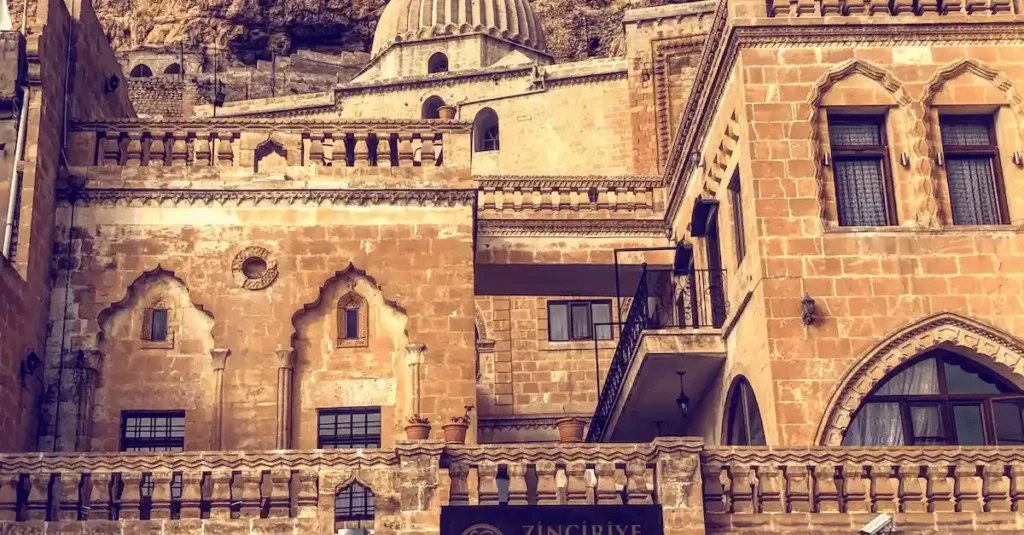
The best hotels in Mardin are not discovered through booking filters or star ratings—they’re recognized through verified architectural provenance. This is a city where the “luxury” tier is almost entirely comprised of 700- to 900-year-old stone mansions, former merchant hans, and medrese complexes carved directly into the citadel slopes. The problem: Mardin’s inventory is flooded with surface-level “boutique” conversions that erase the original ventilation systems, ogival arches, and cross-vaulted masonry that define the city’s Silk Road identity.
We audited Mardin’s historic accommodation stock and rejected every property that prioritized contemporary interiors over documented medieval infrastructure. What remains is a selection of verified landmark conversions—each one a former medrese, han, or noble konak with intact 14th- to 17th-century stonework. This guarantees you’re not just booking a room overlooking the Mesopotamian plains—you’re occupying a physical archive of Mardin’s role as a fortified trade nexus.
For broader context across Turkey’s most architecturally significant conversions, explore our audit of best historic hotels in Turkey.
Medieval Medrese & Citadel Conversions
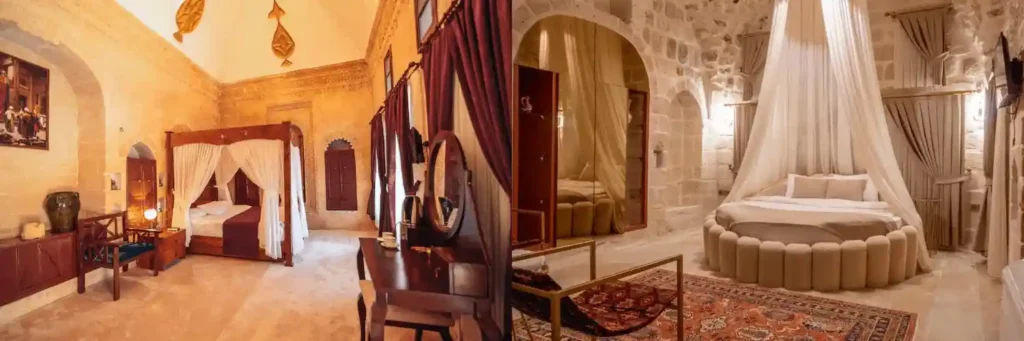
These are not hotels that “reference” Mardin’s medieval past—they are the medieval past. Each property on this section was originally built as part of the city’s monumental religious-educational infrastructure or as elite residences directly beneath the Roman-era citadel walls. What unifies them is the preservation of original load-bearing masonry, wind-catcher ventilation, and hand-carved limestone detailing that modern construction cannot replicate.
Expect thick stone walls that maintain constant interior temperature, arched terraces with panoramic views over the plains, and the kind of spatial silence that only 700-year-old architecture can deliver.
🕌 Zinciriye Hotel
This is the only hotel in Mardin—and one of the few in Turkey—where the accommodation structure is an integral architectural extension of a 1385 Sultan Isa Medrese complex. The building wasn’t adapted for tourism; it was designed as part of a monumental religious-educational ensemble, and that original function still governs the spatial logic.
Rooms utilize a 14th-century “wind-catcher” ventilation system—an engineered passive cooling method using strategically placed stone vents that create natural airflow without mechanical systems. The yellow limestone masonry and medieval ogival arches aren’t decorative flourishes; they’re load-bearing structural elements that have supported this building for 639 years.
The terrace overlooks the entire Mesopotamian plain, a view that historically served as a strategic observation point for the medrese’s scholars and administrators. No other property in Mardin can claim this level of architectural integration with the city’s medieval religious infrastructure.
Best for: Travelers seeking the most architecturally significant medrese conversion in southeastern Turkey, with intact 14th-century engineering systems and panoramic citadel views.
Signature Experience: 14th-century wind-catcher cooling system, original ogival arches and yellow limestone masonry, rooftop terrace overlooking Mesopotamian plains, direct connection to Sultan Isa Medrese complex.
“That natural ventilation system—no AC needed even in July. Genius medieval engineering.” — Elif, IstanbulCheck Availability & Rates →
🏰 Maristan Tarihi Konaka ★★★★
This is a 14th-century mansion positioned directly beneath the Roman-era citadel on the most historically fortified slope in Mardin. The location isn’t scenic coincidence—this was prime real estate reserved for the city’s elite, where proximity to the citadel walls signaled both protection and social status.
The property preserves the original 700-year-old foundation and hand-carved stone staircases, which means the spatial flow you experience today is identical to what medieval residents navigated centuries ago. Rooms maintain the traditional Mardin cross-vaulted ceilings, a construction technique that distributes weight across intersecting arches and creates the signature stone-canopy effect.
The terrace offers unobstructed views directly up to the citadel walls—a sight line that once served as a visual connection between the mansion’s occupants and the city’s central power structure. The stone masonry here is thicker than most conversions, resulting in near-total soundproofing and stable interior temperatures. This is the closest you can stay to the citadel without actually sleeping inside the archaeological zone.
Best for: Travelers prioritizing direct citadel proximity, intact 14th-century foundations, and traditional cross-vaulted masonry in a verified historic mansion.
Signature Experience: 700-year-old hand-carved stone staircases, cross-vaulted masonry ceilings, unobstructed citadel wall views, soundproof medieval stone construction, rooftop terrace with Mesopotamian panorama.
“Slept in a room older than most European cities. That cross-vaulted ceiling—pure medieval craftsmanship.” — Marco, MilanCheck Availability & Rates →
🕌 Ana Talia House
This is a 900-year-old residence—one of the oldest continuously standing structures in Mardin’s accommodation inventory. It was originally built as an elite residence near the Marufiye Medresesi, and its proximity to that religious complex confirms its historical status within the city’s upper social tier.
The property preserves the original 12th-century stone foundations, which means the load-bearing structure you’re occupying predates the Crusades. Rooms maintain the authentic cross-vaulted masonry, a signature Mardin construction method where intersecting stone arches create self-supporting ceilings that require no internal columns. The spatial layout follows the traditional “hayat” (central courtyard) design, where all rooms open onto a shared stone terrace that serves as both a circulation space and a private observation deck overlooking the plains.
The interior maintains a constant coolness that feels engineered, not accidental—a result of medieval builders understanding thermal mass principles that modern construction often ignores.
Best for: Travelers seeking the oldest verified residential conversion in Mardin, with intact 12th-century foundations and authentic cross-vaulted stonework.
Signature Experience: 900-year-old stone foundations, 12th-century cross-vaulted masonry, traditional “hayat” courtyard design, darkened weathered limestone from nine centuries of exposure, thermal mass cooling system.
“Nine hundred years old and still standing solid. That courtyard at sunrise—absolute silence.” — Leyla, AnkaraCheck Availability & Rates →
🏛️ Mirsoum Han
This is a 19th-century fortified urban han—originally a Silk Road merchant inn designed to accommodate both traders and their livestock in a single secured compound. The structure preserves the massive arched stone entryways and central stable courtyard.
The courtyard, once used for camel caravans, is now a shaded terrace where the original stone flooring and archways remain intact. Rooms open directly onto this central space, maintaining the traditional han layout where merchants could monitor their goods and animals from their quarters. The stonework here is rougher and more utilitarian than the elite mansions—this wasn’t built for aristocrats; it was built for commerce, security, and endurance.
The thick walls and limited window openings that once protected valuable cargo now create a naturally cool, fortress-like interior that stays comfortable even during Mardin’s hottest months. No other property in Mardin offers this level of preserved Silk Road commercial infrastructure.
Best for: Travelers seeking an authentic Silk Road han conversion with intact caravan courtyard, fortified entryways, and utilitarian Ottoman stonework.
Signature Experience: 19th-century Silk Road merchant han, massive arched stone entryways, central stable courtyard with original flooring, fortress-like thick walls, secured compound layout, natural thermal insulation.
“Staying in a real caravan inn—those archways, that courtyard. Felt like stepping into a trade route.” — David, LondonCheck Availability & Rates →
16th–17th Century Noble Konaks & Ancestral Mansions
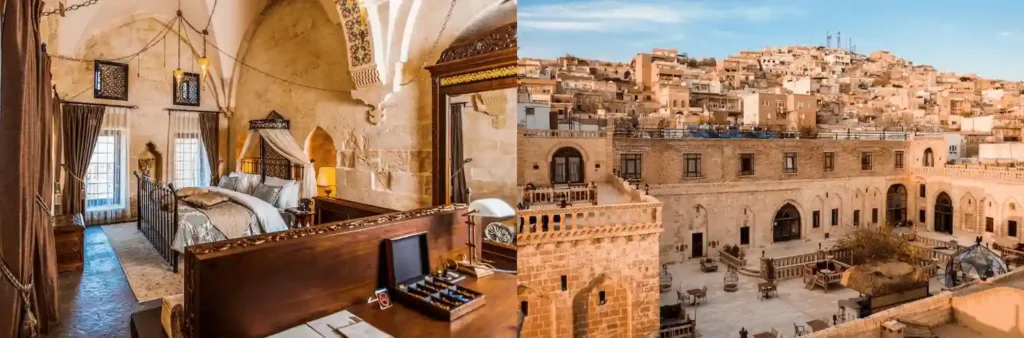
These are the hereditary estates—properties that remained within single aristocratic families for generations and were never designed for public access until recently. What separates them from earlier religious conversions is the emphasis on domestic luxury: original family kitchens, carved staircases, private terraces, and architectural details that signaled wealth rather than institutional power.
These are not museum pieces—they’re living family archives where the conversion process preserved the domestic soul of the original estate.
🏛️ Mardius Tarihi Konak
This is the ancestral mansion of the Ensari family, a noble lineage that has occupied this 1500s estate for over five centuries. What makes this property architecturally unique is that guests dine in the original 16th-century kitchen—now operating as Leyli Restaurant—where meals are still prepared using ancestral silver and secret family recipes passed down through generations.
The kitchen wasn’t renovated or adapted; it’s the same stone-vaulted space where the Ensari family cooked for their household 500 years ago, and the transition from accommodation to dining replicates the spatial flow of the original estate. Rooms preserve the traditional Mardin architectural vocabulary: hand-carved limestone detailing, arched doorways, and cross-vaulted ceilings that distribute structural load without internal columns.
The terrace overlooks the city’s honeycomb of limestone houses cascading down the hillside—a view that historically served as a visual reminder of the family’s elevated social position within Mardin’s urban hierarchy. The stone here is lighter in color than many other konaks, suggesting higher-quality limestone sourced from the region’s premium quarries. This is one of the few properties in Mardin where the conversion process didn’t erase the domestic identity—you’re not staying in a “former mansion”; you’re occupying a mansion that remains functionally connected to its original family lineage.
Best for: Travelers seeking a verified aristocratic estate with intact 16th-century family kitchen, hereditary dining traditions, and five centuries of documented noble lineage.
Signature Experience: Dining in the original 1500s Ensari family kitchen (Leyli Restaurant), ancestral silver and secret family recipes, hand-carved limestone detailing, panoramic terrace overlooking Mardin’s cascade of limestone houses.
“Ate dinner in their 500-year-old kitchen using family silver. That level of authenticity is rare.” — Ayşe, IzmirCheck Availability & Rates →
🏛️ Maridin Hotel
This is a 1600s Armenian-designed mansion that later served as a local school before its conversion into accommodation. The architectural signature here is the natural cold-water plunge pool carved directly into a cave beneath the property—a feature that predates modern plumbing and was engineered as a passive cooling and bathing system using the mansion’s subterranean water source.
The pool isn’t a spa addition; it’s an original infrastructural element that the conversion process preserved rather than modernized. Rooms maintain the traditional high ceilings and arched windows typical of Armenian stonework, with carved detailing that reflects the Christian architectural influence on Mardin’s urban fabric. The transition from the mansion’s stone-floored interior down into the cave pool creates a dramatic temperature drop—a physical reminder that medieval builders understood thermal stratification long before HVAC systems.
The terrace offers unobstructed views across the Mesopotamian plains, a sight line that once served the mansion’s role as both a residence and, later, an educational institution. This is the only property in Mardin where you can experience a 400-year-old subterranean bathing system still functioning as originally designed.
Best for: Travelers seeking Armenian architectural heritage, a natural cave plunge pool with original 17th-century engineering, and verified dual-use history as both mansion and school.
Signature Experience: Natural cold-water plunge pool carved into a cave, Armenian stonework with carved detailing, subterranean bathing system using original water source, terrace with Mesopotamian plain views.
“That cave pool—naturally cold, zero electricity. Pure 17th-century thermal engineering.” — Selin, AnkaraCheck Availability & Rates →
🏛️ Maran House Mardin
This is a 400-year-old stone konak named after the mythical Shahmaran—a symbol of wisdom and protection in Mesopotamian folklore. The property preserves the original 17th-century stone masonry and arched terraces, which means the spatial configuration you experience today reflects the mansion’s original layout as a high-status residence within Mardin’s urban core.
Rooms maintain traditional cross-vaulted ceilings and hand-carved limestone doorways, both signature elements of Mardin’s aristocratic domestic architecture. The terrace overlooks the city’s layered limestone houses and the plains beyond—a view that once served as a visual confirmation of the konak’s elevated position within the city’s social hierarchy.
The stone here is lighter and more finely cut than military or commercial structures, suggesting the original builders prioritized aesthetic refinement alongside structural durability. The name Shahmaran isn’t decorative branding—it reflects the property’s historical identity within a specific cultural-mythological tradition that still resonates in Mardin’s collective memory.
Best for: Travelers seeking a 17th-century noble konak with intact stone masonry, arched terraces, and cultural-mythological heritage rooted in Mesopotamian folklore.
Signature Experience: Original 17th-century stone masonry and arched terraces, cross-vaulted ceilings with hand-carved limestone, Shahmaran mythological heritage, panoramic terrace overlooking Mardin’s cascading limestone architecture.
“That terrace view at dusk—centuries of limestone houses glowing gold. Pure Mesopotamian magic.” — Fatma, IstanbulCheck Availability & Rates →
📊 Comparison: Best Hotels in Mardin
| Hotel | Location | Wellness & Spa | Dining | Unique Perks | Best For |
|---|---|---|---|---|---|
|
🕌 Zinciriye Hotel |
Medrese complex, citadel slopes |
14th-century wind-catcher natural cooling |
Rooftop terrace, Mesopotamian views |
1385 medrese integration, ogival arches |
Medieval engineering, religious heritage |
|
🏰 Mirsoum Han |
Historic bazaar, fortified compound |
Natural thermal insulation |
Central courtyard, shaded terrace |
Silk Road caravan inn, arched entryways |
Commercial heritage, fortress architecture |
|
🏰 Maristan Tarihi Konaka ★★★★ |
Beneath Roman citadel, fortified slopes |
Natural stone climate control |
Rooftop terrace, citadel views |
700-year foundation, cross-vaulted masonry |
Citadel proximity, medieval elite residence |
|
🕌 Ana Talia House |
Near Marufiye Medresesi, historic quarter |
Medieval thermal mass cooling |
Hayat courtyard, terrace dining |
900-year foundation, 12th-century stone |
Oldest conversion, Crusader-era heritage |
- For coastal heritage alternatives, compare our audit of the best hotels in Antalya to see noble mansions and historic harbor stays on the Mediterranean.
❓ FAQ: Best Hotels in Mardin
What makes Mardin’s historic hotels different from standard boutique hotels?
Mardin’s inventory is dominated by verified architectural conversions—900-year-old mansions, 14th-century medrese complexes, and Silk Road hans with intact stonework. These aren’t boutique “renovations”; they’re landmark buildings where the original load-bearing masonry, wind-catcher systems, and cross-vaulted ceilings remain functional. Standard boutique hotels replicate aesthetic elements; Mardin’s properties preserve the engineering systems that defined medieval Mesopotamian architecture. The difference is structural authenticity versus surface-level theming.
Are these historic hotels suitable for summer stays without modern air conditioning?
Most of Mardin’s heritage properties were engineered for passive climate control using thermal mass principles—thick limestone walls, cross-ventilation, and strategic window placement that maintain stable interior temperatures. Properties like Zinciriye Hotel use original 14th-century wind-catcher systems that create natural airflow without mechanical cooling. Some conversions do offer supplemental AC, but the original stone construction makes it optional rather than essential, even during peak Mesopotamian summer heat.
Which hotel offers the most significant architectural provenance?
Zinciriye Hotel holds the strongest documented provenance as an integral part of the 1385 Sultan Isa Medrese complex. It’s not a “nearby” conversion; it’s architecturally embedded within the medrese’s original infrastructure. Ana Talia House offers the deepest historical reach with 900-year-old foundations predating the Crusades. Mirsoum Han provides the most authentic Silk Road commercial experience with its fortified caravan courtyard. The “most significant” depends on whether you prioritize religious, residential, or commercial heritage.
Do these properties preserve original interiors, or are they modern redesigns?
The top-tier conversions preserve structural authenticity—original staircases, cross-vaulted masonry, limestone doorways, and spatial layouts remain intact. However, interior furnishings and bathrooms are typically modern additions designed for guest comfort. The distinction is that the architecture itself (walls, arches, ventilation systems) is original, while the décor is contemporary. Properties like Mardius Tarihi Konak go further, maintaining the original 16th-century kitchen and family dining traditions.
How does Mardin’s historic hotel inventory compare to other Turkish heritage destinations?
Mardin’s conversions skew older and more structurally intact than most Turkish destinations. While Istanbul and Cappadocia offer Ottoman-era boutiques and cave hotels, Mardin’s inventory includes 12th-century foundations and 14th-century medrese complexes that predate the Ottoman Empire entirely. The architectural vocabulary here is Mesopotamian-Arabic rather than Ottoman-European, which creates a distinctly different spatial and aesthetic experience. It’s less polished and more archaeologically raw than western Turkish conversions.
Are these hotels family-friendly, or are they better suited for couples?
The spatial layouts favor couples and solo travelers seeking architectural immersion. Most properties feature traditional konak or medrese configurations with interconnected stone rooms and limited soundproofing—not ideal for families with young children. Properties like Mirsoum Han with central courtyards offer more space for movement, but the overall inventory prioritizes heritage preservation over family amenities. If traveling with children, verify room layouts and courtyard access before booking.
What’s the best way to experience Mardin’s historic hotels if I only have one night?
Prioritize architectural uniqueness over modern amenities. Zinciriye Hotel offers the most significant medrese integration with panoramic terrace views. Ana Talia House provides the oldest residential structure with 900-year-old foundations. Mirsoum Han delivers the most authentic Silk Road commercial experience with its fortified courtyard. Choose based on which historical narrative—religious, residential, or commercial—aligns with your interest in Mesopotamian heritage. One night is sufficient to experience the architecture; longer stays allow deeper exploration of the city’s layered urban fabric.
Where Historic Architecture Defines the Stay
Choosing best hotels in Mardin isn’t about filtering star ratings—it’s about selecting a property where the architecture itself is the primary draw. The conversions above represent the city’s most structurally intact medrese complexes, Silk Road hans, and noble konaks, each one preserving the original engineering systems that defined medieval Mesopotamian domestic and institutional design. Availability at this caliber shifts quickly as these properties gain recognition beyond regional tourism circuits.
Explore Turkey’s most dramatic cave conversions through our curated selection of best hotels in Cappadocia.
For more curated itineraries and luxury-focused travel insights, visit Your Luxury Guide. For official travel information and destination updates, visit Turkey tourism-info.
Booking your Mardin hotel secures access to some of southeastern Turkey’s oldest continuously standing residential and religious structures—properties where the stone you touch is older than most European capitals.
Your Luxury Guide — Where Exceptional Travel Begins.