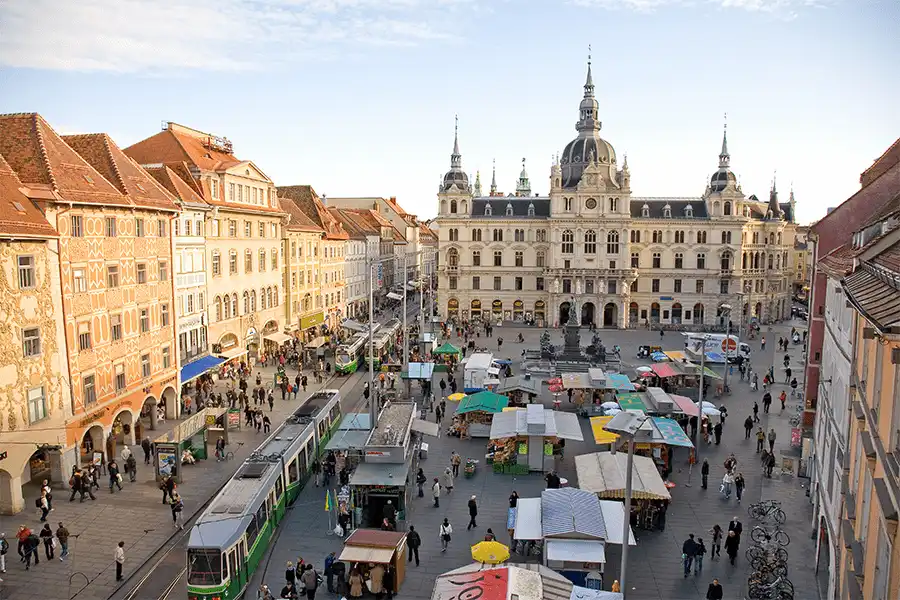
Selecting among the best hotels in Graz isn’t about finding five stars on a modern tower—it’s about staying inside the city’s architectural narrative.
After auditing the properties that anchor Graz’s historic core, we narrowed the field to five hotels where the structure itself tells a story worth experiencing. These aren’t accommodations retrofitted into old shells; they’re preserved monuments that offer direct access to 16th-century fortifications, baroque aristocracy, and Austria’s Belle Époque golden age.
Below are the stays that make sense if you value historic continuity, spatial drama, and accommodations that feel like they belong in the city’s museum registry—not its generic hospitality corridor.
For a broader perspective on Austria’s preserved architectural heritage, explore best historic hotels in Austria for properties spanning imperial palaces to alpine monasteries.
Fortress Foundations & Baroque Grandeur in the Old Town
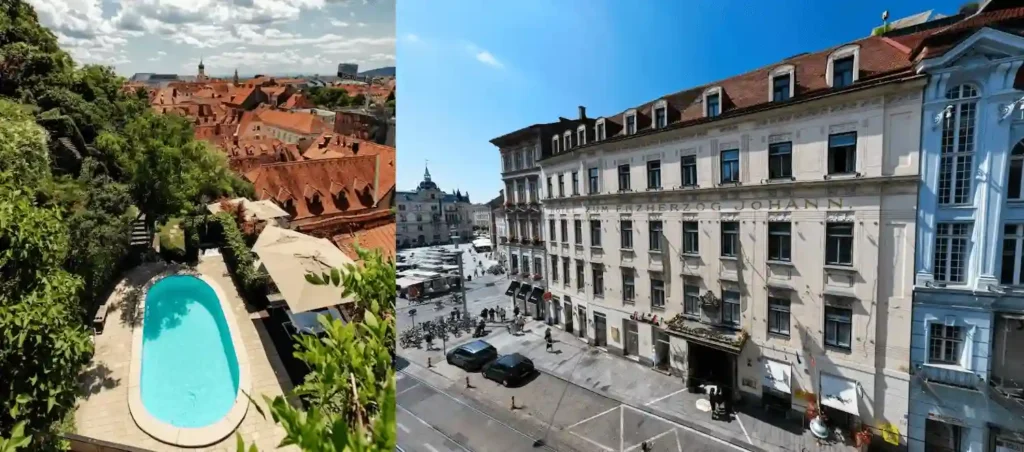
The hotels within Graz’s Altstadt aren’t built near history—they are history. These properties occupy infrastructure tied to the Schlossberg fortifications and baroque-era aristocratic power, offering travelers direct immersion into the city’s layered past without leaving their lobby.
🏔️ Schlossberghotel ★★★★★
This property occupies several interconnected 16th-century fortress houses integrated into the base of Schlossberg, Graz’s defining geographic and military landmark. Guests stay within original stone walls that once formed part of the fortified settlement’s defensive core, sleeping inside infrastructure designed to protect the city during Habsburg military campaigns.
The hotel’s rooftop terrace delivers unobstructed views of the Altstadt’s terracotta roofs and the Uhrturm clock tower directly above, creating a spatial relationship with the fortress that no other property in Graz can replicate.
Interior spaces preserve exposed masonry and vaulted ceilings while integrating contemporary spa amenities and a fine-dining restaurant that sources from Styrian farms.
This is the only hotel in Austria where your bedroom walls were once part of a Renaissance military defense system—a fact that repositions the entire stay as a living artifact. Booking here secures access to Graz’s most singular structural heritage without sacrificing modern luxury.
Best for: History-focused travelers seeking immersive fortress infrastructure with direct Schlossberg access and rooftop terrace views of the clock tower.
Signature Experience: Rooftop terrace with unobstructed Schlossberg vistas, spa with historic stone integration, fine dining sourced from Styrian producers, bedrooms within 16th-century defensive walls.
“Waking up inside fortress walls with that clock tower right there—this wasn’t just a hotel stay.” — Markus, ViennaCheck Availability & Rates →
🎭 Palais-Hotel Erzherzog Johann ★★★★
This hotel occupies a 16th-century baroque palace that remains the most architecturally significant secular building in the Altstadt used for hospitality. Originally constructed for Austrian aristocracy, the structure centers around a monumental glass-roofed inner courtyard that functions as both a spatial anchor and a visual landmark of Graz’s baroque urban design.
Guests move through high-ceilinged corridors lined with original stucco work and period detailing, staying in rooms that once hosted Habsburg nobility and Styrian landowners. The courtyard serves breakfast under natural light filtered through historic ironwork, creating a daily ritual that feels more like a palace residence than a commercial hotel.
Location places you within a three-minute walk of the Rathaus, the Landhaus, and the Opera, making this the default choice for travelers who want to move through Graz’s cultural core on foot without ever entering a modern district.
This property appeals to guests who prioritize architectural purity and central positioning over spa amenities or contemporary design interventions.
Best for: Travelers drawn to baroque aristocratic architecture, monumental courtyard spaces, and direct access to Graz’s opera and government landmarks.
Signature Experience: Glass-roofed baroque courtyard for breakfast service, high-ceilinged rooms with original stucco detailing, walking access to Rathaus and Landhaus, Habsburg-era spatial design.
“That courtyard breakfast under the glass roof—felt like staying in someone’s private palace.” — Elena, PragueCheck Availability & Rates →
Belle Époque Grandeur & 19th-Century Aristocratic Heritage
These hotels represent Graz’s expansion beyond the fortress walls during the Austrian-Hungarian Empire’s industrial and cultural boom. Each property preserves a specific chapter of the city’s 19th-century identity, from grand hotel theater to high-society mansion elegance.
🎨 Grand Hôtel Wiesler ★★★★
Established in 1870, this property stands as Graz’s defining Belle Époque monument, occupying the prime riverfront position along the city’s “Ringstraße” development. The hotel houses Leopold Forstner’s world-famous “Spring” mosaic—a masterpiece of Art Nouveau glasswork that remains one of the most significant decorative art pieces in Austria.
Interiors preserve original stucco ceilings, parquet flooring, and period lighting while integrating modern bathrooms and contemporary furniture that respects the building’s theatrical scale.
The guest list includes Mick Jagger, Austrian nobility, and European industrialists who valued the hotel’s proximity to the Opera and its status as the city’s social headquarters during the Empire’s golden age. Dining happens in spaces designed for 19th-century banquets, and the ground-floor bar retains its mahogany paneling and brass fittings.
This hotel suits travelers who want grand hotel theater without the anonymity of a chain property, offering a level of architectural drama that smaller boutique hotels cannot replicate.
Best for: Design-aware travelers seeking Art Nouveau artistry, grand hotel spatial drama, and Ringstraße positioning near the Opera and riverfront.
Signature Experience: Leopold Forstner’s “Spring” mosaic lobby, Belle Époque stucco ceilings and parquet floors, mahogany-paneled bar, Opera-adjacent location with river views.
“That Forstner mosaic alone—worth walking through the lobby just to see it every morning.” — Thomas, MunichCheck Availability & Rates →
🌳 Parkhotel Graz ★★★★
This hotel occupies an 1866 aristocratic mansion built during the Gründerzeit expansion, when Graz transformed from a walled fortress city into a regional capital of the Austrian-Hungarian Empire.
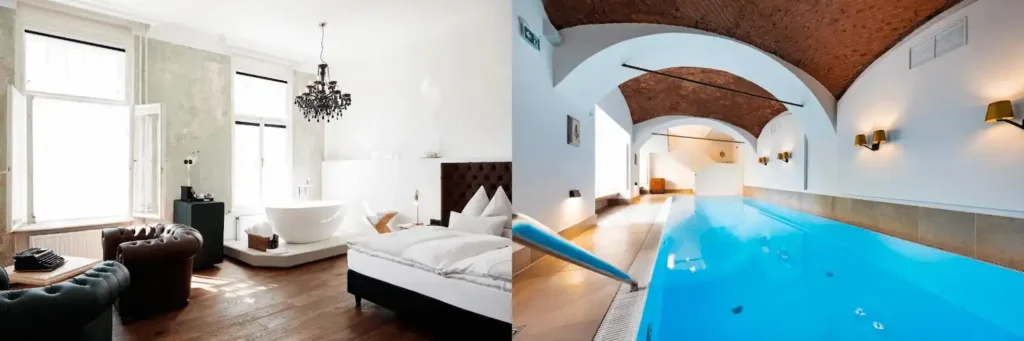
Originally designed as a high-society residence and social hub for visiting nobility and officer corps, the building preserves its 19th-century facade, grand staircase, and salon-style public rooms while offering modern wellness amenities including a rooftop pool and sauna complex.
The location positions you within walking distance of the Opera, Stadtpark, and the beginning of the Herrengasse shopping corridor, making this a functional base for travelers who want historic atmosphere without sacrificing access to the city’s contemporary commercial district.
Rooms retain period moldings and tall windows, but the overall aesthetic leans toward traditional comfort rather than museum-level preservation.
This property appeals to guests who value 19th-century architectural heritage combined with wellness facilities and a quieter positioning slightly outside the Old Town’s densest tourist zone.
Best for: Guests seeking Gründerzeit aristocratic heritage, rooftop wellness amenities, and proximity to Opera and Stadtpark without Old Town tourist density.
Signature Experience: 1866 mansion architecture with grand staircase, rooftop pool and sauna complex, salon-style public rooms, walking access to Opera and Stadtpark.
“That rooftop pool with city views—unexpected in a building this old, but it worked perfectly.” — Anna, SalzburgCheck Availability & Rates →
🎼 Hotel Gollner ★★★★
This property occupies a traditional 19th-century bourgeois building near the Opera, representing the merchant-class architectural expansion that defined Graz during the late 1800s. While the hotel has evolved through the 20th century with interior updates and modern amenities, the structure itself remains a classic example of the city’s urban residential typology from the imperial era.
Guests stay within walking distance of the Opera, the Old Town, and the Kunsthaus, making this a practical choice for travelers who prioritize central location and straightforward historic atmosphere over architectural showpieces or wellness facilities. The hotel appeals to a demographic drawn to traditional Austrian hospitality—family-run service, breakfast in wood-paneled rooms, and a neighborhood feel that avoids the formality of grand hotels.
This property suits guests who want historic continuity and Opera-adjacent positioning without paying for fortress views or Art Nouveau mosaics, offering a more accessible entry point into Graz’s preserved architectural fabric.
Best for: Travelers seeking traditional Austrian hospitality, Opera-adjacent location, and 19th-century bourgeois heritage at a more accessible positioning.
Signature Experience: 19th-century merchant-class architecture, wood-paneled breakfast rooms, family-run service, walking access to Opera and Kunsthaus.
“Simple, classic, near the Opera—exactly what we needed without any pretension.” — Stefan, InnsbruckCheck Availability & Rates →
📊 Comparison: Best Hotels in Graz
| Hotel | Location | Wellness & Spa | Dining | Unique Perks | Best For |
|---|---|---|---|---|---|
|
🏔️ Schlossberghotel ★★★★★ |
Schlossberg base, fortress walls |
Spa within historic stone vaults |
Fine dining, Styrian sourcing |
16th-century fortress Rooftop terrace |
Fortress immersion, architectural heritage |
|
🎭 Palais-Hotel Erzherzog Johann ★★★★ |
Altstadt center, near Opera |
Limited wellness, focus on heritage |
Courtyard breakfast, local cuisine |
Glass-roofed courtyard Baroque palace |
Aristocratic architecture, central positioning |
|
🎨 Grand Hôtel Wiesler ★★★★ |
Ringstraße, river frontage |
Standard amenities, no major spa |
Grand hotel dining, mahogany bar |
Forstner Art Nouveau Belle Époque grandeur |
Design enthusiasts, grand hotel theater |
- If you’re exploring Austria’s most refined cities, consider best hotels in Vienna for imperial palace conversions and Ringstraße grandeur.
❓ FAQ: Best Hotels in Graz
What makes Graz’s historic hotels different from standard luxury hotels?
Graz’s historic hotels occupy verified 16th- to 19th-century structures tied to the city’s military, aristocratic, and imperial heritage. These aren’t renovated buildings with historic styling—they’re preserved monuments like fortress houses, baroque palaces, and Belle Époque grand hotels where the architecture itself defines the guest experience. Staying here means sleeping inside infrastructure designed for Habsburg nobility, military defense, or Empire-era social theater, offering spatial drama and cultural continuity that modern luxury hotels cannot replicate through design alone.
Which hotel offers the most direct connection to Graz’s fortress history?
Schlossberghotel occupies interconnected 16th-century fortress houses built into the Schlossberg’s defensive infrastructure. Guests stay within original stone walls that once protected the city during Renaissance military campaigns, with rooftop access delivering unobstructed views of the Uhrturm clock tower directly above. This is the only property in Austria where your bedroom forms part of a preserved fortification system, making it the most structurally significant fortress hotel in the city.
Are these hotels located within walking distance of Graz’s cultural landmarks?
All five properties position you within a ten-minute walk of the Altstadt’s core landmarks, including the Opera, Rathaus, Landhaus, and Kunsthaus. Schlossberghotel and Palais-Hotel Erzherzog Johann occupy the Old Town’s densest historic quarter, while Grand Hôtel Wiesler sits along the Ringstraße riverfront. Parkhotel Graz and Hotel Gollner offer Opera-adjacent positioning with slightly quieter streets. No property requires taxi transfers for accessing Graz’s primary cultural and architectural sites.
Which hotel is best for travelers prioritizing Art Nouveau and Belle Époque design?
Grand Hôtel Wiesler houses Leopold Forstner’s “Spring” mosaic, one of Austria’s most significant Art Nouveau decorative pieces, alongside preserved Belle Époque interiors including stucco ceilings, parquet floors, and mahogany-paneled public rooms. Established in 1870, the hotel represents Graz’s grand hotel tradition during the Austrian-Hungarian Empire’s cultural peak, offering spatial drama and period artistry that smaller boutique properties cannot match.
Do these hotels offer modern wellness amenities alongside historic architecture?
Schlossberghotel integrates a spa within its historic stone vaults, combining fortress infrastructure with contemporary wellness facilities. Parkhotel Graz features a rooftop pool and sauna complex inside its 1866 aristocratic mansion. Palais-Hotel Erzherzog Johann and Hotel Gollner focus on architectural preservation over wellness, while Grand Hôtel Wiesler offers standard amenities but prioritizes grand hotel atmosphere over spa services. Travelers seeking both heritage and wellness should prioritize Schlossberghotel or Parkhotel Graz.
When is the best time to book historic hotels in Graz?
Availability tightens during Styriarte (June–July music festival), Opera season openings (September–October), and Christmas markets (late November–December) when cultural programming draws international visitors. Spring (April–May) and early autumn (September) offer optimal weather for exploring the Schlossberg and Altstadt on foot, with fewer crowds than summer peak. Booking three months ahead secures preferred room categories in properties with limited inventory like Schlossberghotel and Palais-Hotel Erzherzog Johann.
Which hotel suits travelers who want a quieter base outside the Old Town’s densest tourist areas?
Parkhotel Graz occupies a position near the Opera and Stadtpark, offering 19th-century mansion heritage with lower foot traffic than the Altstadt’s central corridor. The property appeals to guests who want walking access to cultural landmarks without staying on Herrengasse or directly adjacent to the Rathaus, where daytime tourist density peaks during high season. Hotel Gollner provides a similar positioning with traditional Austrian hospitality and a neighborhood feel that avoids grand hotel formality.
Final Thoughts: Choosing Your Stay in Graz
Booking the right hotel in Graz means selecting a property where the building’s past life enhances your present experience—not just decorates it. The options above represent the city’s most architecturally coherent historic accommodations, filtered for travelers who value spatial heritage, cultural positioning, and preserved infrastructure over generic luxury amenities.
Availability at properties like Schlossberghotel and Palais-Hotel Erzherzog Johann shifts quickly once festival seasons begin, particularly during Styriarte and Opera programming when international visitors fill the Altstadt’s limited historic inventory.
For further exploration of Austria’s preserved alpine heritage, best hotels in Innsbruck offers imperial infrastructure set against Tyrolean mountain architecture.
For more curated itineraries and luxury-focused travel insights, visit Your Luxury Guide. For official travel information and destination updates, visit Austria tourism-info.
Booking a stay at Graz’s finest historic hotels secures access to 16th-century fortress foundations, baroque aristocratic palaces, and Belle Époque grand hotel theater—properties where Austria’s layered architectural heritage remains structurally intact and experientially central to your time in the city.
Your Luxury Guide — Where Exceptional Travel Begins.