Choosing the best hotels in Granada isn’t about chasing five stars—it’s about sleeping inside the narrative that built this city.
After filtering Granada’s luxury inventory, we’ve narrowed the field to six properties that function as architectural witnesses: former convents that once housed monarchs, Neo-Moorish fortresses commissioned by kings, and Renaissance palaces that still contain original Nasrid capitals. These aren’t hotels with history—they are history. What separates them is whether the building itself justifies the premium, not the thread count or rooftop pool.
Below are the stays that make sense if you value monumental significance, spatial drama, and accommodations where the architecture tells a story more compelling than any concierge script.
For a broader perspective on Spain’s most significant conversions, explore our curated guide to the best authentic historic stays in Spain.
Inside the Alhambra Walls
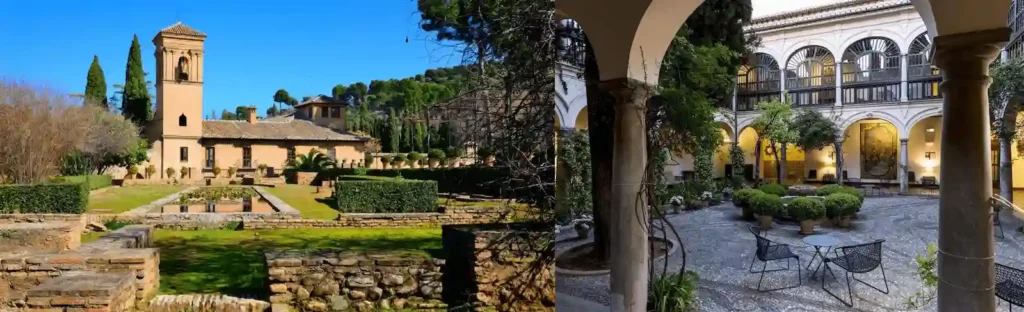
Only one hotel in the world sits inside the Alhambra complex, and it occupies the exact site where Spain’s Catholic Monarchs were first entombed. This isn’t proximity—it’s immersion. You’re not visiting the monument; you’re sleeping within its defensive perimeter, waking to views reserved for royalty, and walking corridors that witnessed the final chapter of Moorish Iberia.
If the goal is to experience Granada’s most sacred ground without leaving your room, this is the singular option.
🏛️ Parador de Granada ★★★★
This property suits travelers who understand that sleeping inside the Alhambra’s fortified walls transcends any five-star designation. Built over the 14th-century Palacio de los Infantes and converted in 1494 into the Royal Franciscan Convent where Ferdinand and Isabella were first laid to rest, the building functions as a physical marker of Granada’s most pivotal political shift—from Nasrid emirate to Christian kingdom.
Rooms occupy the former monastic cells, and the original convent chapel remains intact as a lounge. What makes this irreplaceable is access: you’re inside the complex after gates close to the public, with dawn light hitting the Generalife gardens from your terrace.
No other hotel in Spain offers this combination of UNESCO protection and overnight residency. Availability here books out months ahead once spring arrivals begin.
Best for: History-obsessed travelers prioritizing architectural significance and exclusive Alhambra access over contemporary luxury amenities.
Signature Experience: Private dawn walks through Alhambra gardens before public entry, original 15th-century convent chapel as guest lounge, terraces overlooking Generalife fountains, dining in former royal refectory with Nasrid-era stonework.
“Watching sunrise from the cloister while the Alhambra was still ours alone—worth the entire trip.” — Marcus, BerlinCheck Availability & Rates →
Neo-Moorish Assets & Royal Commissions

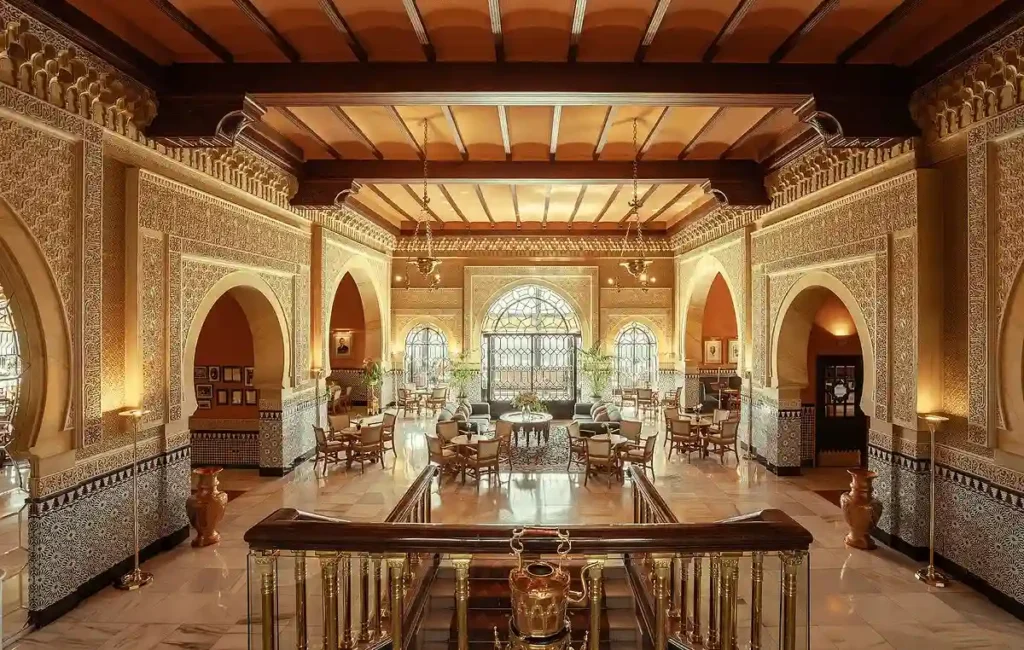
When King Alfonso XIII wanted to position Granada as Europe’s premier cultural destination in 1910, he commissioned a purpose-built palace-hotel that would embody Romantic Spain’s obsession with Alhambra aesthetics. This isn’t a conversion—it’s a theatrical monument designed to out-Moorish the Moors, built as a fortress overlooking the real thing.
The result is a Neo-Moorish fantasia with royal pedigree, soaring lobby vaults, and terrace views that frame the Alhambra as if it were designed for your camera.
🏰 Alhambra Palace Hotel ★★★★★
This hotel serves travelers who want cinematic grandeur and royal association without sleeping in monastic austerity. Commissioned by Alfonso XIII as Spain’s first purpose-built luxury hotel, it opened in 1910 as a showcase for visiting dignitaries drawn to the Alhambra’s mystique. Architect Modesto Cendoya designed it as a Neo-Moorish fortress, with horseshoe arches, azulejo tilework, and a columned lobby scaled for state receptions.
Rooms face either the Alhambra or the Sierra Nevada peaks, and the rooftop terrace delivers postcard-grade sightlines that made this property famous among early 20th-century aristocracy.
What separates it from generic five-star stays is its architectural theater—you’re inside a monument to Spain’s Romantic-era reverence for Moorish aesthetics. Service remains formal, and the terrace bar becomes the city’s most exclusive sunset vantage once high season begins.
Best for: Design-aware couples and solo travelers seeking royal-era drama, panoramic Alhambra views, and a historic hotel with verifiable 20th-century pedigree.
Signature Experience: Rooftop terrace with unobstructed Alhambra views, Neo-Moorish grand salon with original azulejo detailing, Michelin-level dining in vaulted hall, heated pool overlooking Sierra Nevada.
“That terrace at dusk—the Alhambra lit up across the valley—better than any postcard could capture.” — Elena, MadridCheck Availability & Rates →
Albaicín District: Aristocratic Conversions
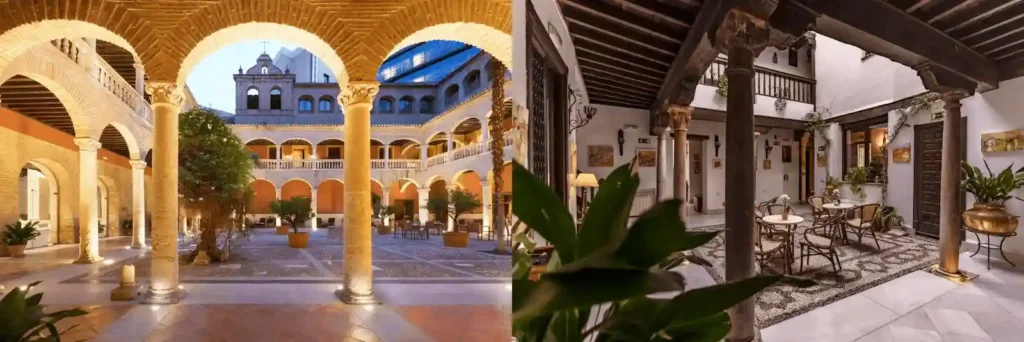
Granada’s Albaicín quarter holds the city’s densest concentration of Renaissance palaces and Nasrid-era residences—many now transformed into intimate heritage hotels that deliver architectural immersion without institutional scale. These aren’t anonymous luxury properties; they’re private palaces where original frescos, Moorish courtyards, and 16th-century carved ceilings remain intact.
What unifies them is intimacy: you’re sleeping in rooms that once housed noble families, political figures, and master builders who shaped the post-Reconquista cityscape. If the goal is to experience Granada’s layered history through residential architecture rather than monumental grandeur, these three properties anchor that narrative.
⛪ Hotel Palacio de Santa Paula, Autograph Collection ★★★★★
This property appeals to travelers who want institutional-scale heritage without sacrificing five-star service. The building fuses a 16th-century Hieronymite convent with a 12th-century Moorish house, preserving the original Renaissance cloister, refectory hall, and Nasrid stonework within its protected walls.
Rooms occupy former monastic cells and aristocratic chambers, with exposed brick vaulting and carved wooden ceilings that signal Granada’s architectural transition from Islamic to Christian rule. The central courtyard retains its convent arcades, and the spa occupies vaulted chambers once used for prayer.
What makes this significant is its designation as a BIC (Bien de Interés Cultural)—Spain’s highest architectural protection—meaning every restoration was state-supervised to preserve 500 years of layered history. It’s the rare fusion of monumental gravitas and contemporary luxury that doesn’t compromise either.
Best for: Architecture-focused travelers seeking monumental heritage with full-service luxury, couples who value preserved cloisters and spa amenities over boutique intimacy.
Signature Experience: Protected Renaissance cloister with original arcades, subterranean spa in former convent vaults, rooftop pool overlooking Cathedral towers, Michelin-level dining in refectory hall with 16th-century frescos.
“Walking through that cloister at night felt like stepping into a Velázquez painting come to life.” — James, LondonCheck Availability & Rates →
🕌 Casa del Capitel Nazarí ★★★
This hotel suits purists who prioritize architectural authenticity over star ratings. Built in 1503 for the architect of Granada’s Royal Chapel, the palace preserves a 12th-century Nasrid capital (capitel) embedded in its structure—a rare artifact from the Moorish period.
Rooms retain original carved wooden ceilings, Moorish tilework, and intimate courtyards that reflect the residential style of Granada’s transitional Renaissance elite. The building sits in the heart of the Albaicín, meaning cobblestone streets replace car access, and you’re surrounded by the same urban fabric that existed when the palace was built.
What separates this from boutique hotels with “Moorish-inspired” decor is legitimacy—this is verified archeology, not aesthetic pastiche. It’s a designated monument where the architecture itself is the primary amenity.
Best for: Solo travelers and couples seeking the most authentic Nasrid-to-Renaissance residential experience in Granada, history scholars who value physical artifacts over luxury amenities.
Signature Experience: Original 12th-century Nasrid capital visible in lobby, carved mudéjar wooden ceilings in guest rooms, intimate Moorish courtyard with fountain, location in UNESCO-protected Albaicín quarter.
“Touching that Nasrid column in the courtyard—knowing it was carved while the Alhambra was still in Muslim hands—unforgettable.” — Sara, BarcelonaCheck Availability & Rates →
🎨 Palacio de Santa Inés ★★★
This property serves travelers who want Renaissance aristocratic intimacy without institutional formality. Built as a 16th-century noble palacete, it retains original courtyard frescos from the 1500s and carved wooden galleries that overlook a central fountain.
Rooms occupy former private chambers, each featuring hand-painted ceilings and Moorish tile fragments that survived centuries of use. What makes this compelling is its domestic scale—this was never a monastery or government building; it was a family seat where Granada’s post-Reconquista elite lived behind carved wooden doors.
The location in the upper Albaicín means Alhambra views from the terrace and cobblestone silence after sunset. It’s designated as a city monument, which means limited rooms and no corporate chain expansion. Availability tightens once cultural festivals begin.
Best for: Design-focused couples seeking intimate Renaissance palace experience, travelers who prioritize original frescos and quiet Albaicín location over full-service amenities.
Signature Experience: Original 16th-century courtyard frescos, carved wooden galleries overlooking central fountain, Alhambra views from upper terrace, intimate scale with limited rooms ensuring exclusivity.
“Breakfast in that frescoed courtyard—pure Renaissance elegance without the museum crowds.” — Luca, MilanCheck Availability & Rates →
🏛️ Palacio de Mariana Pineda ★★★★
This hotel appeals to travelers who value political history as much as architectural heritage. Built in 1644, the palace served as the home of Mariana Pineda—Spain’s liberal heroine executed in 1831 for embroidering a banned constitutional flag. The building functions as a “living museum,” preserving the original 17th-century layout, courtyard fountain, and carved wooden balconies that witnessed Granada’s most turbulent political era.
Rooms occupy former aristocratic chambers, with high ceilings and period furnishings that reflect the palace’s role as a site of national resistance. What separates this from generic heritage hotels is its narrative weight—you’re sleeping in a building that shaped Spain’s modern identity.
The central location near Plaza Nueva means walkable access to the Alhambra and Cathedral, yet the palace’s interior courtyards retain the quiet intimacy of a private residence.
Best for: History-focused travelers seeking political significance alongside architectural beauty, couples who value narrative depth over contemporary luxury amenities.
Signature Experience: Original 17th-century courtyard with central fountain, carved wooden balconies overlooking Plaza Nueva, rooms preserving period furnishings tied to Spain’s liberal movement, intimate scale with personal service
“Standing on that balcony where Pineda once stood—feeling the weight of her story—made Granada suddenly feel urgent.” — Ana, SevilleCheck Availability & Rates →
📊 Comparison: Best Hotels in Granada
| Hotel | Location | Wellness & Spa | Dining | Unique Perks | Best For |
|---|---|---|---|---|---|
|
🏛️ Parador de Granada ★★★★ |
Inside Alhambra complex |
Monastic garden terraces |
Former royal refectory hall |
Only hotel inside Alhambra walls |
Architectural purists |
|
🏰 Alhambra Palace Hotel ★★★★★ |
Alhambra hillside, palace district |
Heated pool, rooftop terrace |
Michelin-level, Neo-Moorish hall |
Royal commission 1910 landmark |
Panoramic views, royal theater |
|
⛪ Palacio de Santa Paula ★★★★★ |
City center, Realejo quarter |
Subterranean spa, rooftop pool |
Michelin-level, refectory hall |
16th-century convent BIC protected |
Institutional scale, full-service luxury |
- For a broader view of Andalusia’s most significant conversions, continue with our guide to the best luxury castle stays in Andalusia.
❓ FAQ: Best Hotels in Granada
Which hotel in Granada has the most historic significance?
Parador de Granada is the standout, originally serving as the Royal Franciscan Convent where Ferdinand and Isabella were first entombed in 1494. It retains the original chapel and monastic cloisters, making it the top choice for travelers seeking a landmark stay inside the Alhambra complex.
What is the best hotel for Alhambra views in Granada?
Alhambra Palace Hotel delivers the city’s most dramatic panoramic sightlines, with terraces framing both the Alhambra and Sierra Nevada peaks. Commissioned by King Alfonso XIII in 1910, it was purpose-built to showcase Granada’s landscape from a Neo-Moorish fortress setting.
Are Granada’s historic hotels family-friendly?
Most historic hotels in Granada skew toward couples and solo travelers due to intimate scales and protected architectural interiors. Hotel Palacio de Santa Paula offers the most family-appropriate infrastructure, with larger suites, rooftop pool, and full-service amenities that accommodate children without compromising the property’s 16th-century significance.
Which Granada hotel offers the best spa experience?
Hotel Palacio de Santa Paula features a subterranean spa housed in the former convent’s vaulted chambers, combining Hammam-style treatments with original Renaissance stonework. Alhambra Palace Hotel’s rooftop heated pool provides outdoor relaxation with unobstructed mountain and monument views.
What is the most authentic Moorish palace hotel in Granada?
Casa del Capitel Nazarí preserves a verified 12th-century Nasrid capital within its structure, making it the most archaeologically authentic Moorish residential experience in the Albaicín. Built in 1503 for the architect of Granada’s Royal Chapel, it retains original carved wooden ceilings and Moorish courtyards.
Do Granada historic hotels require advance booking?
Yes—particularly Parador de Granada, which books 4-6 months ahead for peak season due to limited rooms and UNESCO-protected status. Albaicín properties like Palacio de Santa Inés and Casa del Capitel Nazarí also fill quickly during cultural festivals and spring arrivals.
Which hotel in Granada offers the best location?
Parador de Granada offers the singular advantage of overnight access inside the Alhambra complex. For city-center proximity, Palacio de Mariana Pineda sits steps from Plaza Nueva, providing walkable access to both the Cathedral and Albaicín while retaining quiet courtyard interiors.
Choosing the Right Stay in Granada
Booking the best hotel in Granada means prioritizing what matters most—sleeping inside the Alhambra walls, waking to panoramic palace views, or occupying a Renaissance aristocratic seat where original frescos and Nasrid stonework remain intact. The properties above represent the city’s most consistently refined options for travelers who value architectural legitimacy, spatial drama, and stays where the building’s history justifies the premium. Availability at this level tightens quickly once spring arrivals begin.
Expand your Andalusian historic journey by exploring the best hotels in Seville, or discover coastal refinement with our guide to the best hotels in Mallorca.
For more curated itineraries and luxury-focused travel insights, visit Your Luxury Guide. For official travel information and destination updates, visit Spain tourism-info.
Booking your hotel in Granada unlocks access to Spain’s most architecturally significant conversions, where Nasrid palaces, royal convents, and Neo-Moorish landmarks converge to redefine what luxury heritage hospitality truly means.
Your Luxury Guide — Where Exceptional Travel Begins.