The best hotels in Gothenburg occupy buildings that once ran the city’s commerce, government, and communications. Gothenburg’s architectural soul lies in its neoclassical facades, Art Nouveau detailing, and early-industrial grandeur—yet many modern “luxury” properties strip these interiors to sterile minimalism, erasing the very character that defines the city.
We audited Gothenburg’s historic hotel inventory and rejected properties with weak conversions, anonymous branding, or surface-level heritage theming. This selection focuses exclusively on verified landmark assets: former insurance headquarters, state postal halls, 18th-century merchant residences, and railway-era grand hotels.
Each property retains its “Past-Life Identity” through original mosaic floors, hand-forged staircases, crystal reception desks, or rooftop monuments. This isn’t a list of five-star labels—it’s a curated filter for travelers who expect their hotel to be a physical chapter of the city’s history, not just a place to sleep.
For a broader national perspective on Sweden’s most significant architectural conversions, explore best historic hotels in Sweden.
Historic Core & Neoclassical Monuments
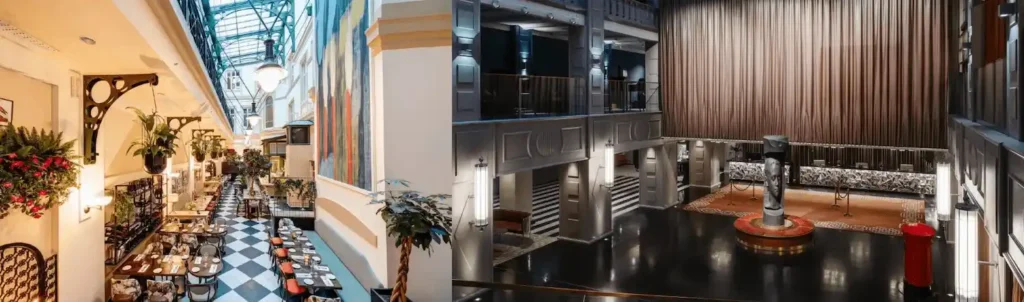
These properties anchor Gothenburg’s ceremonial and commercial heart—buildings where state institutions, insurance empires, and railway commerce once shaped the city’s identity. Expect grand entrance halls, preserved Art Nouveau details, and the kind of architectural authority that modern builds can’t replicate.
⚖️ Elite Plaza Hotel ★★★★
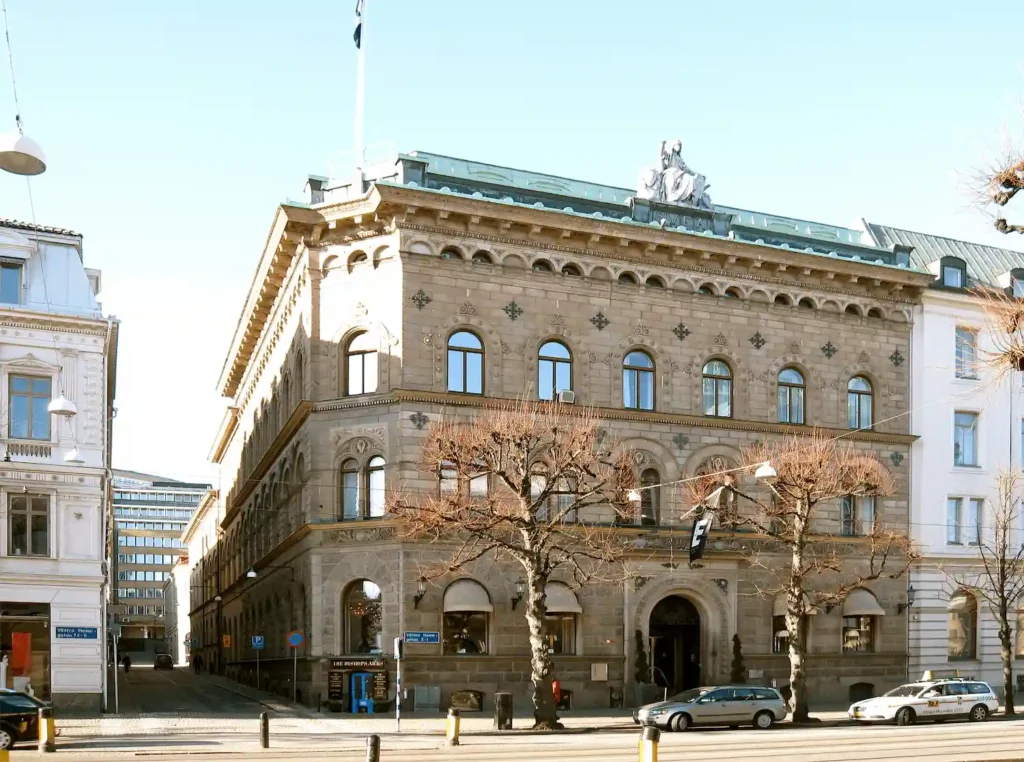
The Elite Plaza was Gothenburg’s “Svea” insurance headquarters—erected in 1889 to project institutional power through neoclassical grandeur.
The building’s soul is Mother Svea, the rooftop statue personifying Sweden, the city’s only monument visible from the street below. Inside, the English mosaic floors and stucco ceilings remain intact, framing a modern interior that respects the original spatial logic.
This isn’t a hotel that happened to land in an old building—the insurance palace is the experience. The ground-floor brasserie operates beneath original ceiling frescoes, and the upper suites retain the tall windows and walnut paneling from the executive floors. Gothenburg has no shortage of “boutique” conversions, but only Elite Plaza offers a rooftop monument and preserved institutional detailing at this level.
Best for: Travelers drawn to neoclassical architecture, institutional grandeur, and properties where the building itself carries symbolic weight.
Signature Experience: Mother Svea rooftop statue, English mosaic entrance floors, preserved stucco ceilings, modern brasserie beneath original frescoes, heritage suites with walnut paneling and tall executive windows.
“The rooftop statue alone makes this hotel unforgettable—Gothenburg’s only monument you can stay beneath.” — Anna, CopenhagenCheck Availability & Rates →
📮 Clarion Hotel Post ★★★★
The Clarion Post is Gothenburg’s 1925 Central Post Office—a neoclassical state landmark that coordinated Sweden’s national mail system for over seven decades.
The building’s soul is the Kassahallen (Main Hall), now transformed into a grand restaurant but preserving the 9-meter reception desk carved from Orrefors crystal and the original postal counter archways. This isn’t cosmetic preservation—the hotel’s spatial hierarchy follows the post office’s original flow, with sorting rooms converted to suites and telegram halls now hosting cocktail bars.
The upper floors retain the tall postal clerk windows, and the rooftop terrace overlooks the same industrial harbor the post office once served. Gothenburg has boutique hotels, but none occupy a building with this level of civic importance.
Best for: Design-conscious travelers seeking state-landmark conversions, neoclassical detailing, and properties where public architecture meets modern hospitality.
Signature Experience: Kassahallen grand restaurant, 9-meter Orrefors crystal reception desk, preserved postal counter archways, rooftop terrace with harbor views, suites in former sorting rooms.
“That crystal desk in the old postal hall—it’s the kind of detail that defines the entire stay.” — Lars, OsloCheck Availability & Rates →
🚂 Hotel Eggers ★★★★
Hotel Eggers opened in 1859 as Gothenburg’s first Railway Grand Hotel—designed to accommodate diplomats, merchants, and travelers arriving on Sweden’s newly built rail network.
The building’s soul is the 1893 ornate elevator, one of Sweden’s oldest functioning lifts, and the spiral staircase that served as the social and political stage for over a century. This isn’t a renovation that buried history beneath modern aesthetics—the staircase banisters, original wood paneling, and tall railway-era windows remain untouched.
The hotel hosted spies during both World Wars, and the upper-floor suites retain the same floor plans and window proportions from the 1860s. Gothenburg has modern “heritage” hotels, but Eggers is the only property where you’re sleeping in the same rooms that shaped 19th-century Swedish diplomacy.
Best for: History-focused travelers seeking railway-era grandeur, preserved 19th-century interiors, and properties with verified diplomatic and espionage heritage.
Signature Experience: 1893 ornate elevator, spiral staircase with original banisters, railway-era window proportions, upper-floor suites with 1860s floor plans, wood-paneled common areas.
“Riding that 1893 elevator felt like stepping into a Scandinavian noir film—perfectly preserved.” — Ingrid, StockholmCheck Availability & Rates →
Merchant Houses & Belle Époque Residences
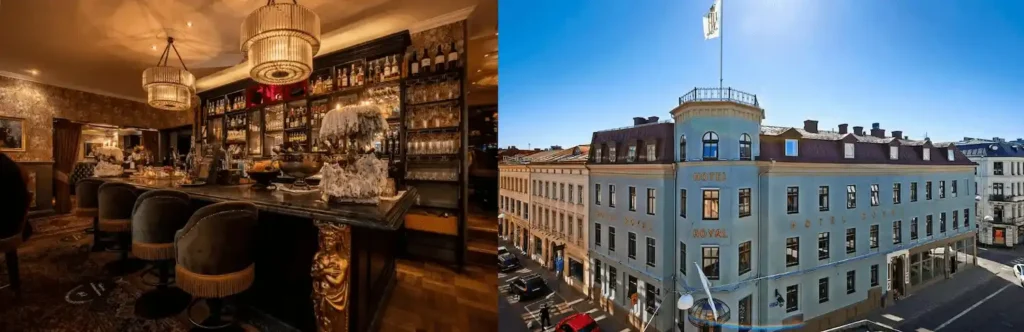
These properties reflect Gothenburg’s maritime trading elite—private residences and commercial vaults that housed the city’s wealthiest merchants.
Expect thick 18th-century stone walls, Belle Époque opulence, and the intimate scale of buildings designed for private wealth, not public ceremony.
🎭 Hotel Pigalle ★★★★★
Hotel Pigalle occupies an 18th-century merchant house—originally built in 1749 and expanded in the 1800s to accommodate Gothenburg’s mercantile elite.
The building’s soul is preserved in the thick stone walls (over 60 cm in places) and the Belle Époque atmosphere of a private trading residence. This isn’t a conversion that gutted interiors for modern suites—the original spatial hierarchy remains, with the ground floor retaining the merchant’s reception rooms and the upper floors maintaining the intimate proportions of private chambers.
The hotel channels Parisian cabaret aesthetics (hence “Pigalle”), but the architecture is pure Swedish mercantile power. Gothenburg has boutique hotels in old buildings, but Pigalle is the only property where you’re staying in the preserved home of 18th-century traders.
Best for: Travelers seeking Belle Époque intimacy, 18th-century merchant architecture, and properties where private wealth shaped the spatial experience.
Signature Experience: 60 cm-thick stone walls, Belle Époque interior styling, preserved merchant reception rooms, intimate upper-floor suites, Parisian cabaret-inspired design within Swedish mercantile architecture.
“Those stone walls made the city disappear—it felt like hiding in an 18th-century trading vault.” — Marie, ParisCheck Availability & Rates →
👑 Hotel Royal ★★★
Hotel Royal is Gothenburg’s oldest continuously operating hotel—opened in 1852 as a city-center grand hotel serving merchants, artists, and Scandinavian nobility. The building’s soul is the hand-painted glass ceiling in the entrance hall, the patterned stone floor that has welcomed guests for 170 years, and the hand-forged Art Nouveau staircase banisters added during the 1890s expansion.
This isn’t a hotel that chased five-star labels by modernizing everything—Royal kept the original spatial flow, with the ground-floor café operating beneath the same ceiling that hosted 19th-century traders. The rooms are smaller and simpler than newer conversions, but the architecture is authentic. Gothenburg has sleeker options, but Royal is the only property where you’re staying in a building that predates Sweden’s industrialization.
Best for: Travelers prioritizing architectural authenticity over modern luxury, Art Nouveau detailing, and properties with continuous 170-year hospitality heritage.
Signature Experience: Hand-painted glass ceiling, patterned stone entrance floor, hand-forged Art Nouveau banisters, 1852 spatial layout, ground-floor café beneath original ceiling.
“The staircase alone is worth the stay—you can feel 170 years of footsteps in those banisters.” — Erik, BergenCheck Availability & Rates →
📊 Comparison: Best Hotels in Gothenburg
| Hotel | Location | Wellness & Spa | Dining | Unique Perks | Best For |
|---|---|---|---|---|---|
|
⚖️ Elite Plaza Hotel ★★★★ |
Historic core, insurance district |
Fitness center, wellness treatments |
Brasserie beneath frescoed ceilings |
Mother Svea rooftop statue, English mosaic floors |
Neoclassical grandeur, institutional architecture |
|
📮 Clarion Hotel Post ★★★★ |
Central, former postal hub |
Rooftop terrace, fitness facilities |
Kassahallen grand restaurant |
9-meter Orrefors crystal desk, state-landmark conversion |
Design travelers, civic architecture |
|
🚂 Hotel Eggers ★★★★ |
Railway district, historic station quarter |
Traditional sauna, wellness services |
Classic Swedish dining |
1893 ornate elevator, spiral diplomatic staircase |
Railway heritage, 19th-century history |
- For a broader view of Sweden’s most significant conversions, compare with best hotels in Stockholm.
❓ FAQ: Best Hotels in Gothenburg
What makes Gothenburg’s historic hotels different from modern luxury properties?
Gothenburg’s historic hotels occupy buildings that once ran the city’s commerce, government, and communications—insurance headquarters, postal halls, and railway-era grand hotels. These properties preserve original mosaic floors, crystal reception desks, and Art Nouveau staircases that modern builds cannot replicate. Elite Plaza, for example, is the only hotel beneath a rooftop monument visible across the city.
Which Gothenburg hotel has the most significant architectural heritage?
Clarion Hotel Post occupies the 1925 Central Post Office, a neoclassical state landmark with the original Kassahallen hall and 9-meter Orrefors crystal reception desk. Hotel Eggers, however, holds the title of oldest railway-era grand hotel, dating to 1859 with a functioning 1893 elevator. Both represent different expressions of Gothenburg’s civic and transportation history.
Are these historic hotels suitable for travelers seeking modern wellness amenities?
Most properties balance heritage architecture with contemporary wellness facilities. Elite Plaza offers fitness and wellness treatments within the insurance palace, while Clarion Post features a rooftop terrace and modern gym. Hotel Eggers provides traditional sauna services. These aren’t full-scale spa resorts, but they meet the needs of travelers prioritizing architectural character over extensive wellness programming.
What is the oldest hotel in Gothenburg?
Hotel Royal, opened in 1852, is Gothenburg’s oldest continuously operating hotel. The building features a hand-painted glass ceiling, patterned stone floors, and hand-forged Art Nouveau banisters added in the 1890s. It predates Sweden’s industrialization and offers the most authentic spatial layout from the mid-19th century.
Which hotel is best for travelers focused on Belle Époque design?
Hotel Pigalle occupies an 18th-century merchant house with thick stone walls (over 60 cm) and Belle Époque interior styling. The property channels Parisian cabaret aesthetics while preserving Swedish mercantile architecture. It’s the most intimate conversion on this list, ideal for travelers seeking private-residence scale over monumental grandeur.
Do these hotels require advance booking during peak season?
Yes. Heritage suites at Elite Plaza and Clarion Post fill quickly during Swedish summer weekends (June–August). Hotel Eggers sees high demand from railway enthusiasts in spring, while Hotel Pigalle attracts European design travelers year-round. Booking 4–6 weeks ahead ensures access to the best heritage rooms.
How do Gothenburg’s historic hotels compare to Stockholm’s offerings?
Gothenburg’s heritage hotels lean toward neoclassical and industrial conversions—insurance palaces, postal halls, and railway-era properties. Stockholm offers more royal and diplomatic heritage, including former embassies and aristocratic residences.
Which Hotel Is the Right Fit for You?
Choosing the right hotel in Gothenburg isn’t about chasing star ratings—it’s about deciding which chapter of the city’s architectural history resonates with your travel priorities. The properties above represent Gothenburg’s most consistently preserved landmark conversions, from insurance palaces and postal halls to railway-era grand hotels and Belle Époque merchant vaults. Availability at heritage properties shifts quickly once Scandinavian travelers begin booking for summer and autumn.
Continue with best hotels in Visby to explore Sweden’s medieval Hanseatic conversions.
For more curated itineraries and luxury-focused travel insights, visit Your Luxury Guide. For official travel information and destination updates, visit Sweden tourism-info.
Booking your Gothenburg hotel secures access to buildings that shaped Sweden’s commerce, state communications, and 19th-century diplomacy—properties where the architecture defines the experience, not the amenities list.
Your Luxury Guide — Where Exceptional Travel Begins.