The best hotels in Florence aren’t defined by star ratings—they’re measured by architectural legacy and how deliberately a property honors the city’s Renaissance soul. Florence demands accommodations that understand proportion, restraint, and the power of a frescoed ceiling to anchor a room’s emotional impact.
After filtering through converted palazzos, former monasteries, and historic banking halls, we’ve narrowed the selection to seven properties that justify their rates through verified heritage and design authority—not just proximity to the Duomo.
These are stays that transform the hotel from a base camp into a reason to visit Florence in the first place. Below are the hotels that matter if you value buildings with documented past lives, architecture that commands respect, and interiors curated by people who understand why Florentine craftsmanship still sets the global standard.
For broader Italian curation, explore the finest historic stays across Italy.
Medici-Era Palazzos & Neo-Renaissance Banking Halls
Florence’s most compelling hotel assets occupy buildings that once housed power—whether political, financial, or ecclesiastical.
The properties below represent the city’s most architecturally significant conversions, each anchored by verified heritage that transforms a standard luxury stay into an encounter with Florentine history.
Expect soaring frescoed ceilings, original stonework preserved through meticulous restoration, and interiors that balance period authenticity with contemporary comfort. These aren’t hotels that reference the Renaissance—they’re Renaissance structures reimagined for travelers who understand why staying inside a documented landmark matters more than a rooftop pool.
🌿 Four Seasons Hotel Firenze ★★★★★
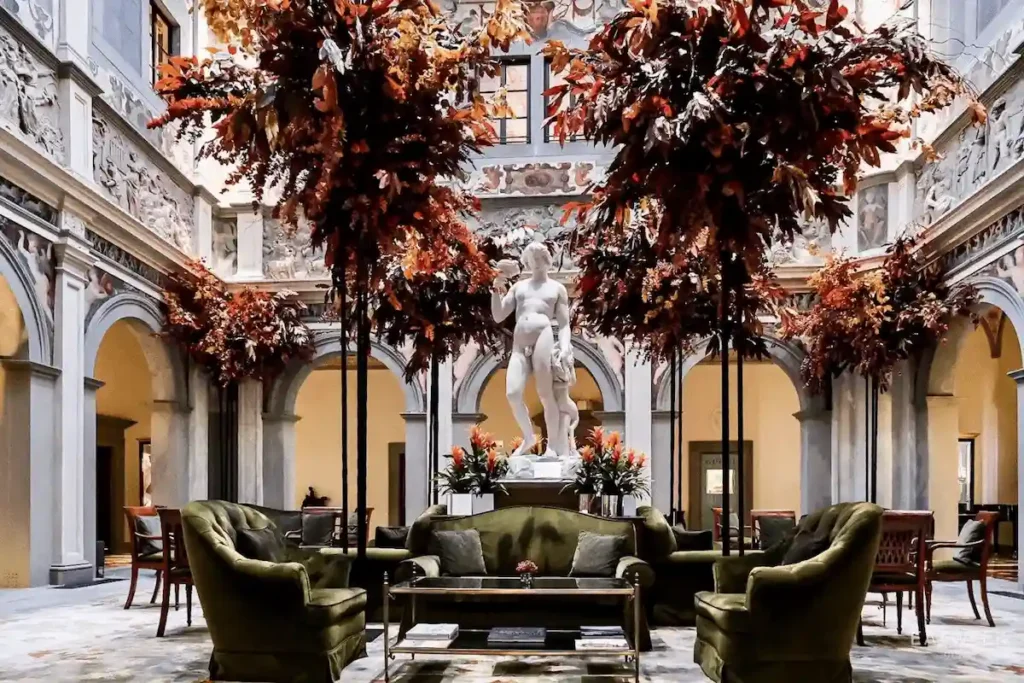
Occupying two joined Renaissance palaces—the 15th-century Palazzo della Gherardesca and the Conventino—this property delivers the city’s most expansive private garden, an 11-acre Florentine rarity that alone justifies the rate. The Conventino wing retains its original frescoed chapel and cloistered architecture, while guest rooms balance period ceiling work with contemporary Italian furnishings that respect rather than compete with the building’s bones.
Service operates at the level you’d expect from a brand managing landmark properties globally, but the real differentiator here is access to gardens that most Florentine hotels can’t offer—outdoor space this protected and this historically significant doesn’t exist elsewhere in the city center.
This is Florence’s definitive garden palazzo conversion, and the only hotel where stepping outside your room means stepping into living Renaissance landscape architecture.
Best for: Travelers seeking Florence’s most significant private garden combined with dual-palazzo heritage and service that matches the architectural gravitas.
Signature Experience: 11-acre formal gardens designed by Niccolò Tribolo (architect of Boboli Gardens), original 16th-century frescoes in the Conventino chapel, Michelin-level Il Palagio restaurant under vaulted ceilings, spa treatments in former monastic cells.
“The garden at golden hour—it’s the Florence no guidebook can access.” — Claudia, MilanCheck Availability & Rates →
👑 The St. Regis Florence ★★★★★
This 1890s Grand Hotel occupies Florence’s prime Arno riverfront position, built during the city’s brief reign as Italy’s capital when the neighborhood transformed into a diplomatic and financial district.
The property retains its Belle Époque banking hall proportions—soaring ceilings, marble columns, and a ballroom-scale lobby that signals institutional rather than residential heritage.
Rooms facing the river deliver unobstructed views toward the Duomo, while south-facing suites capture both the Arno and the hills beyond, a sight line that explains why this building became Florence’s power address in the first place.
The Winter Garden restaurant operates under a frescoed glass atrium original to the 1904 expansion, and butler service remains standard across all room categories—a legacy detail most Florentine hotels abandoned decades ago.
If you need a hotel that commands the riverfront and understands formal European service protocols, this is the only credible choice.
Best for: Guests prioritizing Arno views, Belle Époque grandeur, and institutionalized butler service within walking distance of Uffizi Gallery access.
Signature Experience: River-facing suites with Duomo sight lines, Winter Garden atrium dining under original 1904 frescoes, 24-hour butler service standard, curated Tuscan wine library in former vault space.
“The butler knew my espresso preference before I did—that’s institutional memory.” — Andreas, ZurichCheck Availability & Rates →
⛪ Villa San Michele, A Belmond Hotel, Florence ★★★★★
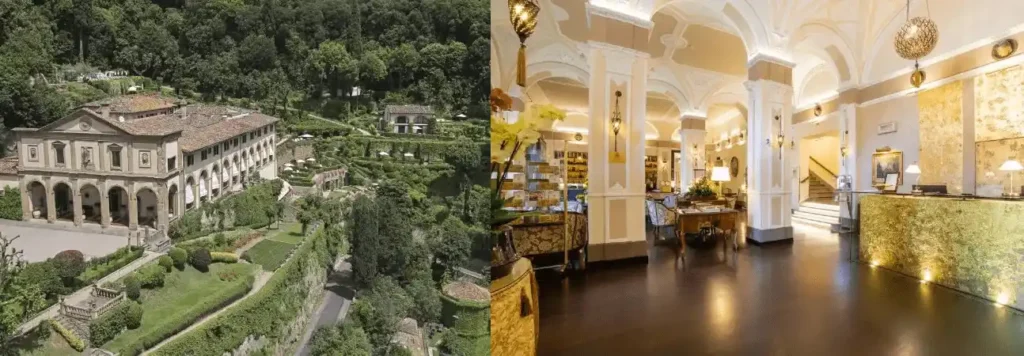
Positioned in the Fiesole hills above Florence, this former 15th-century Franciscan monastery trades city-center proximity for elevation and architectural purity—a calculated decision that defines the property’s appeal.
The façade is attributed to Michelangelo, a claim substantiated by documented Renaissance records, and the original monastic loggia remains the hotel’s emotional center, offering Brunelleschi’s Duomo framed by stone arches that haven’t changed since 1438.
Rooms occupy former monks’ cells, many retaining original frescoed ceilings and monastery stonework, while terraced gardens cascade downhill toward Florence in geometric patterns that mirror Renaissance landscape theory.
The 20-minute drive into the city center filters guests—this isn’t a hotel for those prioritizing walkability, but for travelers who understand why Medici nobles built villas at this exact elevation to escape summer heat and gain visual command of the valley below. This is Florence’s only credible monastic conversion at altitude.
Best for: Travelers valuing architectural attribution, hillside monasteries with Michelangelo provenance, and elevated panoramas over central Florence convenience.
Signature Experience: Michelangelo-attributed Renaissance façade, hillside infinity pool with Duomo views, frescoed dining under 15th-century vaults, terraced Renaissance gardens replicating period landscape design.
“Breakfast on the loggia—Brunelleschi’s dome framed by Michelangelo’s arches. Not close.” — Isabelle, ParisCheck Availability & Rates →
Medieval Banking Towers & Compact Palazzo Conversions
For travelers prioritizing walking distance to the Duomo and historic architecture over garden acreage, Florence’s historic center offers a concentrated selection of tower conversions and compact palazzos that honor the city’s medieval banking legacy.
These properties occupy buildings that predate the Renaissance—structures originally built as fortified banking towers or guild headquarters when Florence controlled European finance through wool trade and Medici banking networks.
Expect lower ceilings than palazzo properties, original tower stonework, and locations that place you within the medieval street grid rather than above it.
🗼 Hotel Brunelleschi ★★★★
Built into Florence’s only surviving Byzantine tower—the 6th-century Pagliazza Tower—and incorporating a circular medieval church now converted into the hotel’s museum-grade breakfast room, this property delivers verified architectural layering no other Florentine hotel can match.
The tower’s original stone walls remain exposed throughout guest corridors, and select rooms retain medieval window apertures with views directly onto the Duomo’s north façade, a sight line protected by the building’s UNESCO-adjacent landmark status.
The property’s compact footprint means fewer than 100 rooms, and the Duomo sits 200 meters away, making this the only tower conversion with both documented Byzantine origins and immediate cathedral access.
Service lacks the institutional polish of branded five-stars, but guests choosing this property prioritize sleeping inside a 1,400-year-old structure over turndown protocols—this is Florence’s oldest continually standing building reimagined as a hotel.
Best for: Architecture enthusiasts prioritizing Byzantine tower authenticity, direct Duomo proximity, and breakfast inside a deconsecrated medieval church.
Signature Experience: 6th-century Pagliazza Tower with exposed Byzantine stonework, circular church breakfast room with original frescoes, museum-grade Etruscan artifact collection on-site, medieval window views toward Duomo north façade.
“Sleeping inside walls older than most European cities—that’s not hyperbole here.” — Marcus, BerlinCheck Availability & Rates →
🏦 NH Collection Porta Rossa ★★★★★
Operating since 1386 and claiming the title of Florence’s oldest continuously running hotel, this property occupies a medieval tower-house that once served as a Medici family banking outpost before transitioning into hospitality during the Renaissance. The lobby retains original stone vaulting and medieval floor patterns, while upper-floor rooms balance period ceiling work with contemporary Italian minimalism that respects rather than competes with the building’s bones.
Location places you equidistant between Ponte Vecchio and the Duomo, embedded within the medieval grid where streets follow 13th-century banking routes.
This isn’t a museum conversion—it’s a working hotel that’s been refining guest operations for six centuries, and that institutional memory shows in routing efficiency and staff knowledge of Florentine logistics.
If you need a hotel that understands Florence because it predates most of the city’s tourist infrastructure, this is the documented oldest choice.
Best for: Travelers seeking Florence’s longest-operating hotel with verified medieval banking heritage and central positioning between major landmarks.
Signature Experience: 1386 founding date with continuous hotel operation, original medieval stone vaulting in public spaces, tower-house architecture predating the Renaissance, location within 13th-century banking district.
“Six hundred years of guests—you feel that continuity in how smoothly everything works.” — Elena, RomeCheck Availability & Rates →
🎨 Bernini Palace Hotel ★★★★
This 15th-century palazzo conversion sits one block from the Duomo on a quieter side street that filters foot traffic while maintaining immediate access to the cathedral’s east façade.
The property retains original frescoed ceilings in public spaces and select suites, with restoration work prioritizing period authenticity over contemporary reinterpretation—expect muted color palettes and furnishings that defer to the building’s Renaissance proportions.
Rooms vary significantly in scale and ceiling height depending on their position within the original palazzo structure, making room selection critical (upper floors retain more original architectural details).
The rooftop terrace delivers unobstructed Duomo views from a vantage point that explains why Florentine nobility built upward—elevation meant visual command of Brunelleschi’s dome and the surrounding terracotta roofscape.
This is a solid palazzo choice for travelers who prioritize rooftop access and side-street quiet over brand recognition.
Best for: Guests seeking rooftop Duomo views, authentic palazzo atmosphere one block from the cathedral, and original frescoed interiors at a lower price point than five-star palazzos.
Signature Experience: 15th-century palazzo with original frescoes in public spaces and select suites, rooftop terrace with unobstructed Duomo views, side-street location filtering tourist traffic while maintaining immediate cathedral access.
“The rooftop at sunrise—just us and Brunelleschi’s dome, no crowds.” — Thomas, AmsterdamCheck Availability & Rates →
🏛️ Westin Excelsior Florence ★★★★★
Positioned on Florence’s prime Arno riverfront stretch between Ponte Vecchio and Ponte Santa Trinita, this 1927 palazzo conversion delivers the city’s most commanding river-facing rooms, with floor-to-ceiling windows that frame both the Arno and the southern hills beyond.
The building’s Neo-Renaissance façade and lobby interiors reference Florentine palazzo architecture without occupying a period structure—this is 1920s interpretation rather than authentic conversion, which matters for travelers prioritizing documented heritage over period-revival styling.
Rooms balance contemporary Westin comfort protocols with Italian marble detailing, and the property’s size (171 rooms) means more standardized service than boutique palazzo intimacy.
The location is the primary asset here—you’re positioned at the river’s photographic bend with immediate access to both Oltrarno artisan districts and Uffizi Gallery entrances. If you need reliable brand service, guaranteed river views, and Arno positioning without palazzo authenticity requirements, this delivers.
Best for: Travelers prioritizing Arno riverfront views, reliable Westin service standards, and central positioning over verified palazzo heritage or boutique intimacy.
Signature Experience: Prime Arno riverfront location between Florence’s two most photographed bridges, floor-to-ceiling river-view windows in signature rooms, 1920s Neo-Renaissance interiors, immediate access to Oltrarno artisan districts.
“The river view alone—worth every euro for those three mornings watching Florence wake up.” — Sophie, LyonCheck Availability & Rates →
📊 Comparison: Best Hotels in Florence
| Hotel | Location | Wellness & Spa | Dining | Unique Perks | Best For |
|---|---|---|---|---|---|
|
🌿 Four Seasons Firenze ★★★★★ |
Two joined Renaissance palaces |
Spa in former monastic cells |
Michelin-level Il Palagio |
11-acre private Renaissance gardens |
Garden palazzo heritage seekers |
|
👑 The St. Regis Florence ★★★★★ |
Prime Arno riverfront |
Wellness center with river views |
Winter Garden atrium dining |
24-hour butler Belle Époque landmark |
Arno views, formal service |
|
⛪ Villa San Michele ★★★★★ |
Fiesole hills above Florence |
Hillside infinity pool, spa treatments |
Frescoed vaults, Tuscan cuisine |
Michelangelo façade monastery conversion |
Hilltop views, architectural purity |
|
🗼 Hotel Brunellesch ★★★★ |
Medieval tower, 200m to Duomo |
Compact wellness area |
Church breakfast room, original frescoes |
6th-century Byzantine tower, Etruscan artifacts |
Byzantine heritage, Duomo proximity |
- For a complete Tuscan experience beyond Florence’s city walls, continue with best luxury castle stays in Tuscany.
❓ FAQ: Best Hotels in Florence
Which Florence hotel has the most significant historical heritage?
Hotel Brunelleschi occupies Florence’s only surviving 6th-century Byzantine tower—the Pagliazza Tower—making it the city’s oldest continually standing structure converted into a hotel. It also incorporates a circular medieval church now serving as the breakfast room, delivering architectural layering no other Florentine property can match.
Are Florence’s best hotels within walking distance of the Duomo?
Four of the seven hotels listed sit within 300 meters of the Duomo—Hotel Brunelleschi (200m), Bernini Palace (one block), NH Collection Porta Rossa (equidistant between Duomo and Ponte Vecchio), and Four Seasons Firenze (10-minute walk). Villa San Michele requires a 20-minute drive from Fiesole hills.
Which Florence hotel offers the most private outdoor space?
Four Seasons Hotel Firenze delivers 11 acres of formal Renaissance gardens designed by Niccolò Tribolo, the same architect behind Boboli Gardens. No other luxury hotel in Florence’s historic center offers comparable private garden acreage—most properties have rooftop terraces or courtyards measured in square meters, not acres.
Do any Florence hotels occupy former monasteries?
Villa San Michele is a 15th-century Franciscan monastery conversion in the Fiesole hills, retaining its original loggia, frescoed interiors, and terraced gardens. Four Seasons Firenze incorporates the Conventino, a former Renaissance convent, within its dual-palazzo structure. Both properties preserve monastic architecture as core design elements.
Which Florence hotel has the best Arno river views?
The St. Regis Florence and Westin Excelsior both occupy prime riverfront positions, but The St. Regis delivers superior views due to its 1890s construction—higher ceilings and larger windows designed during the Belle Époque era when river panoramas were a primary architectural objective. Request river-facing rooms on floors 3–4 for optimal Duomo sight lines combined with Arno vistas.
Can you stay inside a medieval banking tower in Florence?
Hotel Brunelleschi incorporates the 6th-century Pagliazza Tower, originally built during Byzantine rule and later used by medieval banking guilds. NH Collection Porta Rossa occupies a medieval tower-house that served as a Medici banking outpost before becoming Florence’s oldest continuously operating hotel in 1386. Both properties retain original tower stonework in guest corridors and public spaces.
Which Florence hotel is best for first-time visitors prioritizing location?
Hotel Brunelleschi sits 200 meters from the Duomo with immediate access to the cathedral, Baptistery, and Uffizi Gallery—making it the most efficient base for first-time visitors covering major landmarks on foot. Four Seasons Firenze requires a 10-minute walk but offers the city’s most expansive gardens as a trade-off for slightly reduced proximity.
Choosing Your Florence Best Stay: Final Curation
Booking the right hotel in Florence means understanding whether you prioritize garden acreage, riverside positioning, or sleeping inside the city’s oldest surviving structure.
The properties above represent the most architecturally significant options for travelers who value documented heritage over generic luxury—whether that’s Byzantine tower walls, Michelangelo-attributed façades, or 11-acre Renaissance gardens that redefine what “hotel grounds” mean in a UNESCO city center. Availability at historic properties shifts quickly once shoulder season begins, and room categories with the most authentic architectural details typically book first.
For Rome’s parallel historical curation, compare best hotels in Rome, or explore Venice’s canal-facing conversions at best hotels in Venice.
For more curated itineraries and luxury-focused travel insights, visit Your Luxury Guide. For official travel information and destination updates, visit Italy tourism-info.
Booking your best hotel in Florence secures access to Renaissance palazzos, monastery conversions, and medieval banking towers where the building’s soul defines the stay—not just proximity to the Duomo.
Your Luxury Guide — Where Exceptional Travel Begins.