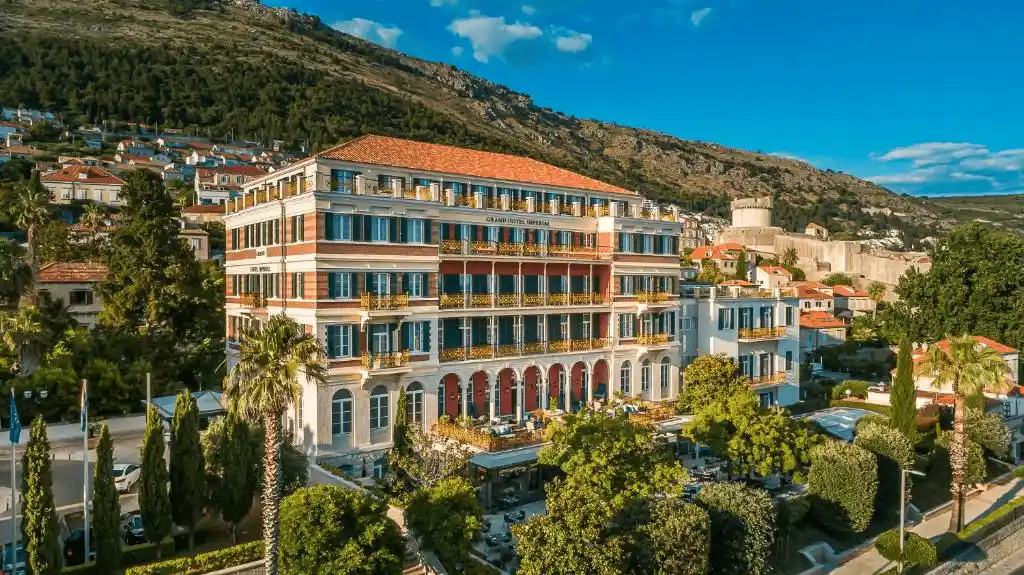
The best hotels in Dubrovnik occupy buildings that predate most European capitals—Renaissance fortresses, Baroque palaces, and imperial landmarks from the Republic of Ragusa. Yet the city’s “luxury” inventory is flooded with generic Adriatic villas wrapped in marble veneer and branding contracts that obscure any meaningful architectural soul. High rates don’t guarantee historical integrity.
We audited Dubrovnik’s inventory using a strict filtering protocol: we rejected shallow renovations, modern seafront towers, and properties lacking documented provenance. What remains are verified conversions—assets with a “Past-Life Identity” spanning five centuries, from 1470 Gothic residences to 1913 royal villas. Each property preserves original stone masonry, vaulted halls, or Renaissance spatial planning that modern construction cannot replicate.
This selection saves you from the overchoice paradox and guarantees a stay where the building itself is the primary cultural experience. You’re not booking a room—you’re occupying living history within the walls of the Adriatic’s most architecturally significant city.
For broader context across the country, explore our audit of the best historic hotels in Croatia.
Imperial & Royal Landmarks: The Grand Hotel Legacy
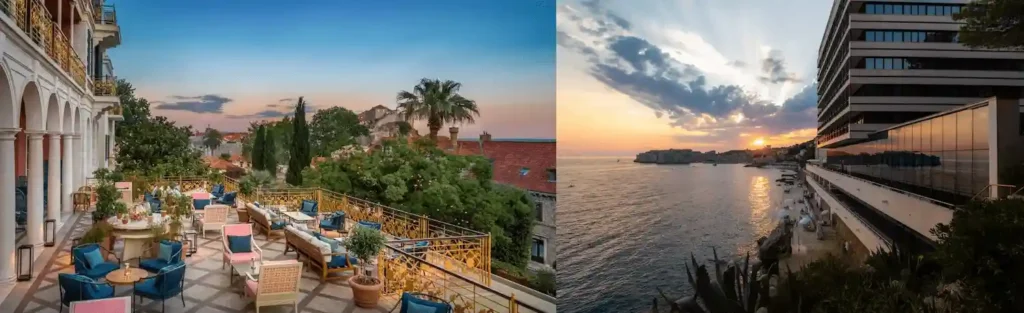
These are Dubrovnik’s institutional anchors—the properties that defined luxury hospitality when crowned heads and diplomats first arrived on the Adriatic. Built during the empire’s final decades and the Republic’s golden age, they preserve the full imperial scale: high ceilings, grand staircases, and lobbies designed for state receptions. What sets them apart is not renovation quality—it’s structural authenticity. These buildings still operate at their original volume.
🏛️ Hilton Imperial Dubrovnik ★★★★★
The 1897 Imperial Landmark stands as Dubrovnik’s original grand hotel—the city’s first purpose-built modern hospitality palace. Built during Austro-Hungarian rule, it welcomed European nobility and diplomatic missions long before the coastal villa boom.
Today, the property preserves the full 19th-century facade and grand-scale lobby with high-ceilinged public halls that retain their imperial proportions. Modern renovations respected the architectural volume; the rooms blend contemporary comfort with period details like restored moldings and original hardwood accents. What you feel upon entry is the transition from the crowded Old Town into a space designed for ceremonial arrivals—soaring ceilings, limestone columns, and the weight of a building that predates mass tourism. The rooftop infinity pool overlooks Lokrum Island, but the real differentiator is the proximity: you’re steps from Pile Gate, yet insulated by walls thick enough to silence the harbor traffic.
Best for: Travelers seeking imperial-era grandeur with full-service amenities, direct Old Town access, and the institutional credibility of Dubrovnik’s first modern hotel.
Signature Experience: Rooftop infinity pool with Adriatic panoramas, restored 1897 lobby with original limestone columns, spa treatments in vaulted lower halls, Michelin-level dining in chandelier-lit salons overlooking the city walls.
“The lobby alone justified the stay—those ceilings make you understand what ‘imperial scale’ actually means.” — Marco, ViennaCheck Availability & Rates →
👑 Hotel Excelsior ★★★★★
The 1913 Royal Landmark rises from Villa Odak, the original neoclassical stone residence that hosted European royalty before Yugoslavia even existed. The hotel’s “Wall of Fame” documents the crowned heads and statesmen who occupied these rooms when Dubrovnik was still an Adriatic diplomatic crossroads.
Today, the property fully preserves the original villa structure—neoclassical stone masonry, high-ceilinged salons, and the spatial layout designed for royal entourages. Modern wings expanded capacity, but the core remains untouched.
What you experience is a seamless transition from the villa’s preserved interiors to contemporary luxury: spa suites overlook the private beach, terraces cascade down limestone cliffs, and the Michelin-starred restaurant occupies a glass pavilion that contrasts—but doesn’t compete with—the 1913 stonework. The private beach club is cut directly into the Adriatic rock face, accessible via a historic stone staircase that predates the hotel itself.
No other Dubrovnik property can claim this combination: royal provenance, cliffside privacy, and direct sea access within walking distance of the Old Town.
Best for: Discerning travelers valuing royal-era authenticity, private beach access, and the institutional gravitas of a verified 1913 landmark with documented guest heritage.
Signature Experience: Private cliffside beach club with historic stone access, Michelin-starred dining in glass pavilion overlooking Lokrum, spa suites with Adriatic terraces, preserved neoclassical villa interiors with royal guest archives.
“Swimming off those limestone steps felt like joining a century of travelers who understood luxury differently.” — Elena, MilanCheck Availability & Rates →
Renaissance & Baroque Palaces: The Old Town Core
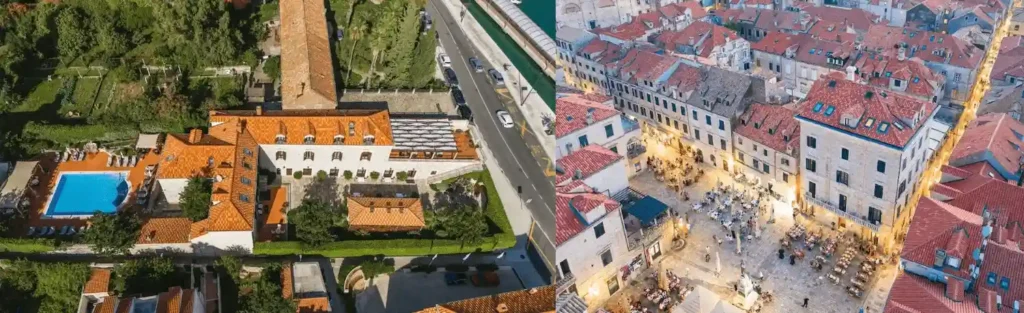
These are not “palace-style hotels”—they are actual aristocratic residences from the Republic of Ragusa, when Dubrovnik rivaled Venice in maritime trade and diplomatic influence. Built between 1470 and the 18th century, they occupy the Old Town’s most historically layered blocks.
What matters here is structural authenticity: original vaulted marble staircases, hand-carved ceiling beams, Gothic window frames, and Renaissance spatial planning that modern architects study but cannot replicate. You’re sleeping in rooms designed for noble families who shaped Mediterranean trade routes.
⚔️ Boutique Hotel Kazbek ★★★★★
The 1573 Renaissance Landmark began as a fortified summer residence for the Zamanja family, one of Dubrovnik’s most influential noble houses during the Republic’s golden age. The building’s military-grade stonework reflects its dual purpose: aristocratic comfort and defensive capability during Ottoman naval threats.
Today, a meticulous restoration preserves the Renaissance courtyard with original coats of arms still embedded in limestone walls, stone vaults that kept interiors cool during Mediterranean summers, and the authentic 16th-century spatial layout—small, defensible rooms that open onto communal courtyards. Modern interventions are minimal: contemporary suites maintain the fortress-like stone thickness, ensuring complete silence despite Old Town foot traffic outside. The rooftop terrace occupies what was once a defensive lookout, now offering unobstructed views of terracotta rooftops and the Adriatic.
What sets Kazbek apart is the preservation philosophy—this isn’t a themed renovation; it’s a structural time capsule where you occupy the same stone geometry that sheltered Renaissance merchants.
Best for: History-focused travelers seeking authentic Renaissance living quarters with documented noble provenance, fortress-grade stonework, and Old Town immersion without modern hotel aesthetics.
Signature Experience: Preserved 16th-century courtyard with original family coats of arms, stone vaults maintaining Renaissance cooling systems, rooftop terrace on former defensive lookout, intimate salon with hand-carved limestone fireplaces.
“Those stone vaults kept the room cooler than any AC unit—500-year-old climate engineering that still works.” — Thomas, BerlinCheck Availability & Rates →
🏛️ The Pucic Palace ★★★★★
The 18th-century Baroque Landmark occupies a site that encapsulates Dubrovnik’s layered history—originally a noble residence during the Republic of Ragusa’s final prosperous decades. The building preserves the structural DNA of Baroque aristocratic life: vaulted marble staircases worn smooth by centuries of use, massive olive wood floors hand-planed from trees that no longer exist in commercial lumber, and the ceremonial spatial flow designed for receiving diplomats and merchant allies.
Modern luxury fits within this framework—suites maintain the original ceiling heights and window proportions, while bathrooms are discreetly integrated without compromising 18th-century stonework. The dining room occupies the former grand salon, where Michelin-level cuisine is served beneath restored frescoes. What you experience is not “historical theming” but authentic Baroque domestic architecture—the same stone thresholds, the same marble staircases, the same play of natural light through original windows.
The location is unbeatable: Gundulic Square, the cultural heart of the Old Town, is your front door.
Best for: Discerning guests prioritizing Baroque authenticity over modern hotel amenities, central Old Town positioning, and verifiable architectural integrity from the Republic’s final golden age.
Signature Experience: Vaulted marble staircases with centuries of patina, massive olive wood floors from historic timber stocks, Michelin-level dining beneath restored Baroque frescoes, suites maintaining 18th-century ceiling heights and window geometry.
“Walking those marble stairs felt like stepping into someone’s private centuries—not a museum, but a living residence.” — Claire, LondonCheck Availability & Rates →
🍷 Prijeko Palace ★★★★
The 1470 Gothic-Renaissance Landmark is Dubrovnik’s oldest verified hotel conversion—designed by Giorgio da Sebenico, the same architect responsible for Šibenik’s UNESCO-listed cathedral. Originally the Isusović-Braichi palace, it represents the transition from medieval defensive architecture to Renaissance elegance.
The restoration preserves the original 15th-century stonework, Gothic window frames with their distinctive pointed arches, and a massive arched water tank now converted into an atmospheric wine cellar that still maintains its structural stone geometry. What makes this property exceptional is not luxury amenities—it’s architectural purity. The rooms occupy the original palace chambers with hand-hewn ceiling beams, limestone walls bearing tool marks from 1470, and spatial proportions designed for pre-electric candle lighting. The wine cellar experience is singular: you descend into a Gothic cistern where noble families stored fresh water during sieges, now lined with regional vintages.
The location on Prijeko Street positions you in the Old Town’s most historically dense corridor.
Best for: Architecture-focused travelers valuing Gothic-Renaissance provenance over modern comforts, medieval spatial authenticity, and the oldest verified palace conversion in Dubrovnik’s inventory.
Signature Experience: Wine cellar in converted 1470 Gothic water cistern, original stonework bearing 15th-century tool marks, hand-hewn ceiling beams from medieval timber stocks, Gothic window frames preserving pointed-arch geometry.
“That wine cellar alone justified the visit—drinking in a Gothic cistern where families once stored siege water.” — Andreas, MunichCheck Availability & Rates →
🕯️ St. Joseph’s ★★★★
The 16th-century Noble Landmark occupies a restored aristocratic home from Dubrovnik’s maritime golden age—when the Republic’s merchant fleet competed with Venice across Mediterranean trade routes.
The building preserves the domestic architecture of that era: original stone walls with the thickness required for both structural stability and summer cooling, massive hand-carved ceiling beams hewn from old-growth timber, and the Baroque layout that prioritized communal reception halls over private chambers. Modern renovations respected this spatial logic—suites maintain the original proportions and ceiling heights, while contemporary bathrooms are discreetly integrated within stone alcoves.
What you experience is authentic aristocratic domesticity: the scale feels human rather than institutional, windows frame Old Town rooftops rather than distant sea views, and the silence is absolute due to meter-thick masonry. The breakfast courtyard occupies the original family garden, shaded by a centuries-old fig tree. This is not a grand hotel—it’s a preserved noble residence that offers intimacy and architectural honesty.
Best for: Travelers seeking intimate aristocratic authenticity over grand hotel formality, original 16th-century domestic architecture, and a preserved Baroque spatial layout prioritizing quietude and historical honesty.
Signature Experience: Hand-carved ceiling beams from 16th-century timber stocks, breakfast courtyard beneath centuries-old fig tree, original stone walls with meter-thick masonry ensuring complete silence, Baroque spatial layout preserving reception-hall hierarchy.
“Breakfast under that ancient fig tree felt like joining a family tradition that predates tourism by centuries.” — Sophie, ParisCheck Availability & Rates →
🌿 Palace Natali ★★★★★
The 16th-century Aristocratic Landmark began as a noble summer estate when Dubrovnik’s merchant elite maintained dual residences—defensive urban palaces and coastal retreats for escaping summer heat and plague seasons. Natali preserves this duality: Renaissance gardens designed for contemplative walks and medicinal herb cultivation, and a massive stone cisterna (reservoir) that once supplied the estate with fresh water during seasonal droughts.
The restoration maintains the original 1500s stone masonry—limestone blocks hand-cut and fitted without modern mortar techniques—and the spatial flow between interior salons and exterior courtyards that defined aristocratic summer living. Modern suites occupy the original chambers, maintaining period ceiling heights and window placements that maximize cross-ventilation and garden views.
What sets this property apart is the preserved landscape architecture: the Renaissance gardens still follow their original geometric layout, and the cisterna now functions as an atmospheric wine cellar. The location offers Old Town proximity with estate-like seclusion.
Best for: Guests valuing Renaissance garden heritage and estate-level privacy over central positioning, original 1500s stonework, and the rare combination of aristocratic summer architecture with modern boutique service.
Signature Experience: Preserved Renaissance gardens with original geometric layout, wine cellar in converted 16th-century stone cisterna, hand-cut limestone masonry from 1500s quarries, suites maintaining original cross-ventilation and garden view geometry.
“Those Renaissance gardens made you understand why nobles fled the city every summer—this is what refuge looked like.” — Julia, StockholmCheck Availability & Rates →
📊 Comparison: Best Hotels in Dubrovnik
| Hotel | Location | Wellness & Spa | Dining | Unique Perks | Best For |
|---|---|---|---|---|---|
|
🏛️ Hilton Imperial Dubrovnik ★★★★★ |
Pile Gate, Old Town steps |
Rooftop infinity pool, spa in vaulted halls |
Michelin-level, chandelier salons |
1897 imperial lobby, city’s first grand hotel |
Imperial grandeur, full-service luxury |
|
👑 Hotel Excelsior ★★★★★ |
Cliffside, Old Town proximity |
Spa suites, private beach club |
Michelin-starred, glass pavilion |
1913 royal villa, Wall of Fame |
Royal provenance, beach access |
|
⚔️ Boutique Hotel Kazbek ★★★★★ |
Old Town, historic core |
Intimate wellness, rooftop terrace |
Local cuisine, courtyard dining |
1573 fortress, Renaissance courtyard |
Renaissance authenticity, fortress architecture |
|
🏛️ The Pucic Palace ★★★★★ |
Gundulic Square, cultural heart |
Intimate spa, courtyard relaxation |
Michelin-level, Baroque frescoes |
1700s palace, marble staircases |
Baroque elegance, central positioning |
- For travelers expanding their Dalmatian exploration, continue with our curated audit of the best hotels in Split, where Diocletian’s Palace conversions offer equally significant Roman-to-Renaissance architectural continuity.
❓ FAQ: Best Hotels in Dubrovnik
What makes Dubrovnik’s historic hotels different from standard luxury properties?
Dubrovnik’s verified historic hotels occupy documented conversions—Renaissance fortresses, Baroque palaces, and imperial landmarks from the Republic of Ragusa. They preserve original structural elements like vaulted marble staircases, Gothic stonework, and 16th-century spatial layouts that modern construction cannot replicate. You’re occupying buildings with architectural provenance spanning five centuries, not generic luxury boxes.
Are historic palace hotels in Dubrovnik’s Old Town worth the premium?
The premium reflects structural rarity and central positioning. Properties like Boutique Hotel Kazbek and The Pucic Palace preserve Renaissance and Baroque architecture within walking distance of Dubrovnik’s cultural core. You avoid daily commutes from modern seafront towers while occupying buildings that predate most European capitals—authentic aristocratic residences, not themed replicas.
Which Dubrovnik hotel offers the best combination of beach access and historical architecture?
Hotel Excelsior uniquely combines verified 1913 royal villa provenance with private cliffside beach access. The property preserves the original neoclassical Villa Odak structure while offering direct Adriatic swimming via historic stone staircases. No other Old Town-adjacent hotel delivers this dual value: documented royal heritage and private beach infrastructure.
What’s the difference between a “palace hotel” and an actual historic palace in Dubrovnik?
A “palace hotel” often refers to modern theming or branding. Actual historic palaces—like Prijeko Palace (1470) or Palace Natali (1500s)—are verified aristocratic residences with original Gothic window frames, hand-carved ceiling beams, and Renaissance spatial planning. These buildings have documented noble ownership and preserve structural elements you can physically verify, not decorative approximations.
Do Dubrovnik’s historic hotels sacrifice modern comfort for authenticity?
No. Properties like Hilton Imperial Dubrovnik and The Pucic Palace integrate contemporary luxury within preserved 19th-century and Baroque frameworks. You get climate control, modern bathrooms, and full-service amenities while occupying rooms with original ceiling heights, limestone walls, and architectural integrity. The best conversions respect historical structure without compromising functional comfort.
How far in advance should I book Dubrovnik’s top historic hotels?
Properties with verified Renaissance or Baroque provenance—especially those in the Old Town core—operate with limited inventory due to protected heritage status. Boutique conversions like Kazbek or St. Joseph’s fill early during peak Adriatic season (May–September). Booking 3–4 months ahead secures choice of suites and avoids generic alternatives.
Which Dubrovnik historic hotel is best for first-time visitors prioritizing architectural significance?
Hilton Imperial Dubrovnik offers the most accessible entry point: 1897 imperial-era architecture with full-service infrastructure, direct Old Town access, and institutional brand reliability. It preserves Dubrovnik’s first grand hotel legacy while providing modern logistics ideal for first-time navigators. You experience authentic imperial scale without sacrificing contemporary travel conveniences.
Why These Hotels Define Dubrovnik’s Architectural Soul
Selecting best hotels in Dubrovnik isn’t about choosing between “luxury options”—it’s about deciding which layer of the city’s history you want to occupy. The properties above represent the most structurally intact conversions, spanning five centuries from Gothic fortresses to imperial-era palaces. They preserve original stonework, spatial layouts, and architectural details that no modern renovation can recreate.
What separates these selections from generic Adriatic villas is documented provenance and physical integrity. You’re not staying in a “palace-themed” hotel—you’re occupying actual Renaissance residences, Baroque noble homes, and verified 19th-century landmarks. This isn’t theming; it’s structural authenticity verified through architectural audits and heritage protection status.
If seeking Austro-Hungarian coastal elegance, discover our selection of the best hotels in Opatija, where imperial-era grand hotels maintain their Belle Époque structural integrity along the Kvarner Gulf.
For more curated itineraries and luxury-focused travel insights, visit Your Luxury Guide. For official travel information and destination updates, visit Croatia tourism-info.
Booking your stay in Dubrovnik’s historic core unlocks direct access to the Adriatic’s most architecturally significant conversions—where the building itself delivers cultural immersion beyond any curated experience or concierge itinerary.
Your Luxury Guide — Where Exceptional Travel Begins.