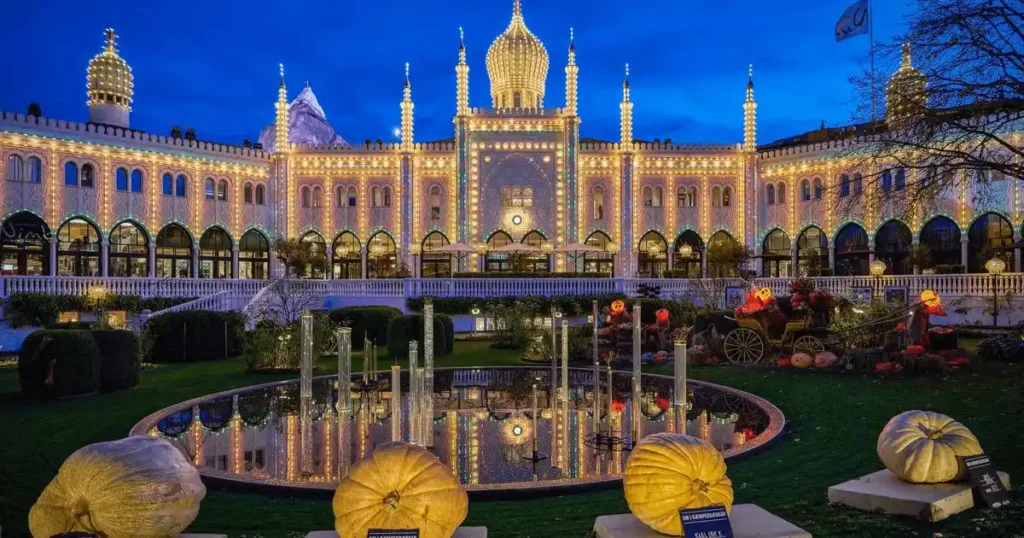
Best hotels in Copenhagen aren’t defined by marble lobbies or rooftop pools — they’re measured by the weight of their past lives. This city doesn’t preserve history; it repurposes it. Choosing where to stay means choosing which era of Copenhagen’s architecture you want to inhabit: Moorish fantasy from Tivoli’s Belle Époque, Neo-Baroque postal power, or raw maritime engineering from the Royal Navy’s granaries.
Most luxury hotel lists treat historic properties as aesthetic footnotes. We filtered Copenhagen’s accommodations by verifiable heritage conversions — buildings with documented former functions that shaped the city’s identity. The problem isn’t finding five-star service in Copenhagen; it’s finding properties where the structure itself carries institutional memory and architectural significance.
Below are six hotels that function as both refined accommodations and access points to Copenhagen’s industrial, aristocratic, and cultural past.
For a broader view of Denmark’s most architecturally significant conversions, explore best historic hotels in Denmark.
Tivoli Gardens & Central Station District
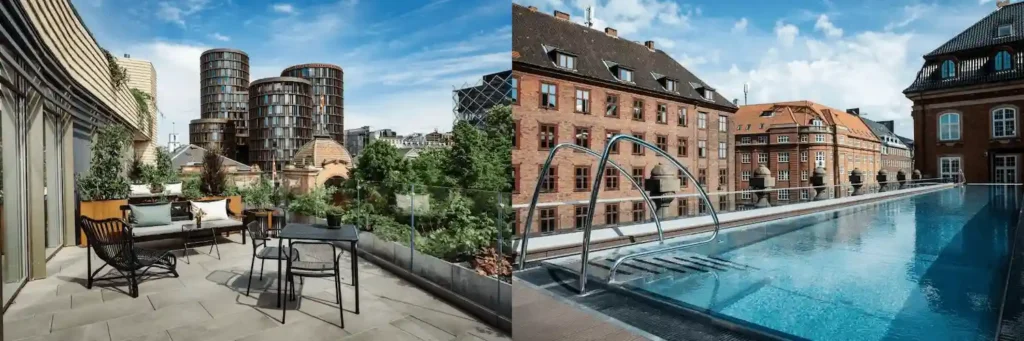
These properties anchor Copenhagen’s most recognizable cultural landmarks — Tivoli Gardens and the Central Station transport nexus. Staying here places you inside the city’s theatrical Belle Époque grandeur and early 20th-century infrastructural power. Both hotels served institutional roles before their luxury conversions: one as a royal entertainment landmark, the other as the nation’s communications headquarters.
Expect Moorish fantasy architecture, preserved postal vaults, and direct access to Copenhagen’s most visited cultural sites.
🕌 Nimb Hotel ★★★★★
This property occupies a Moorish palace originally designed as the architectural centerpiece of Tivoli Gardens in 1909 — a deliberate fantasy structure inspired by Taj Mahal aesthetics and Knud Arne-Petersen’s Belle Époque vision. Staying here means inhabiting a theatrical landmark built to serve as both high-end bazaar and royal entertainment venue.
The interiors preserve intricate plasterwork, arched hallways, and original tilework that reflect early 20th-century Orientalist luxury design. Nimb functions as the only hotel embedded within Tivoli’s gates, offering private garden access and proximity to Copenhagen’s most iconic cultural institution.
Service here operates with quiet formality — concierge staff coordinate private Tivoli experiences, and dining spans Michelin-level refinement to traditional Danish smørrebrød. The rooftop terrace overlooks the gardens’ illuminated attractions, creating an elevated vantage point unavailable to day visitors.
This hotel suits travelers seeking immersive access to Copenhagen’s entertainment history rather than generic city-center convenience.
Best for: Travelers prioritizing Tivoli immersion, theatrical Moorish architecture, and private garden access within Copenhagen’s most visited cultural landmark.
Signature Experience: Private Tivoli Gardens access after hours, rooftop terrace overlooking illuminated attractions, Michelin-starred dining in preserved Moorish salons, original 1909 tilework and plasterwork interiors.
“Watching Tivoli light up from the rooftop, alone with champagne — that’s the memory that justified the entire trip.” — Henrik, OsloCheck Availability & Rates →
📮 Villa Copenhagen ★★★★★
Converted from Denmark’s Central Post & Telegraph Head Office (1912), this Neo-Baroque building served as the nerve center of national communications for nearly a century. The original structure’s massive scale reflects early 20th-century government infrastructure ambitions — ornate masonry, soaring ceilings, and preserved postal vaults now function as design anchors for the hotel’s contemporary interiors.
The architecture carries institutional gravitas: thick stone walls, arched windows, and engineering designed to support telegraph systems and postal logistics.
Villa Copenhagen preserves this functional heritage while layering in Scandinavian minimalism — original beams frame clean-lined guest rooms, and former administrative halls now house lounge spaces and dining areas. The rooftop pool and bar offer views across Copenhagen’s station district, contrasting 1912 Neo-Baroque formality with modern urban energy.
This property suits travelers drawn to adaptive reuse projects where original purpose remains visible through preserved structural elements.
Best for: Design-conscious travelers valuing adaptive reuse, Neo-Baroque governmental architecture, and modern Scandinavian interiors within preserved postal infrastructure.
Signature Experience: Rooftop pool overlooking Central Station, preserved postal vaults repurposed as lounge spaces, original 1912 masonry and telegraph-era engineering, Nordic-Asian fusion dining in former administrative halls.
“Swimming on the roof of Denmark’s old post office at sunset — that juxtaposition alone made the stay unforgettable.” — Clara, StockholmCheck Availability & Rates →
Kongens Nytorv & Royal District
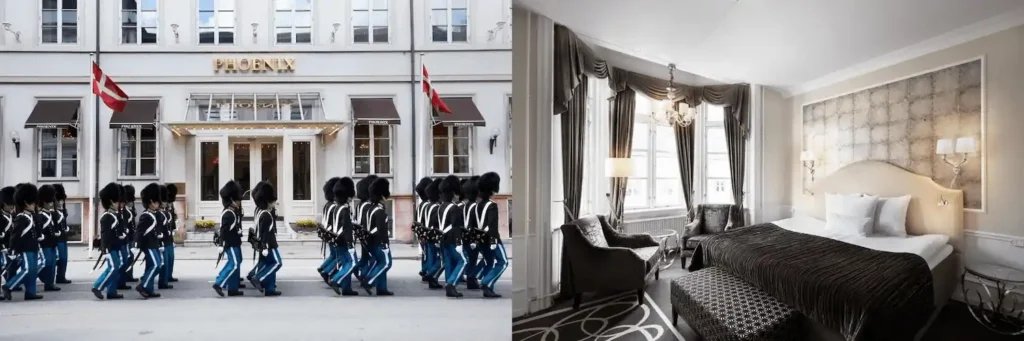
The Royal District represents Copenhagen’s aristocratic and theatrical continuity — properties here served the Danish court, housed noble families, and anchored the city’s 17th-century elite social infrastructure. Staying in this area means occupying buildings that survived the Great Fire of 1794 and witnessed centuries of royal influence.
Expect preserved 1680s architecture, Royal Theatre proximity, and interiors defined by historical restraint rather than modern reinvention.
👑 Phoenix Copenhagen ★★★★
Originally built as a grand aristocratic residence in the 1680s, Phoenix Copenhagen later functioned as the Royal Court’s premier guest house — a formal seat for visiting dignitaries and noble families. The building survived Copenhagen’s catastrophic 1794 fire, making it one of the city’s oldest continuously standing structures.
Interiors reflect this longevity: thick stone walls, preserved staircases, and original woodwork frame guest rooms that balance 17th-century architectural integrity with contemporary hospitality standards.
The property’s location on Bredgade positions guests within Copenhagen’s royal corridor — walking distance to Amalienborg Palace, Marble Church, and the Royal Theatre. Service here operates with understated formality; staff prioritize discretion over spectacle.
Phoenix appeals to travelers seeking accommodation where historical continuity outweighs design trends — this isn’t a showpiece conversion but a preserved aristocratic residence that’s never stopped hosting guests.
Best for: History-focused travelers valuing 17th-century royal continuity, proximity to Amalienborg Palace, and understated aristocratic architecture over contemporary design.
Signature Experience: Original 1680s staircases and woodwork, Royal Court guest house heritage, Bredgade location within Copenhagen’s royal district, preserved fire-survivor architecture.
“Walking the same halls Danish nobility used in the 1700s — you feel the weight of that continuity in every creaking floorboard.” — Thomas, HamburgCheck Availability & Rates →
🎭 Hotel Sanders ★★★★★
This 19th-century townhouse served Copenhagen’s theatrical and artistic elite, positioned directly behind the Royal Danish Theatre in the city’s cultural epicenter. The building’s refined proportions and discreet facade reflect its original function as a sophisticated residence for actors, playwrights, and patrons of the arts. Interiors preserve this bohemian-aristocratic balance: high ceilings, parquet floors, and original moldings create an atmosphere of cultured restraint rather than opulent display.
Hotel Sanders operates as an intimate property — fewer than 60 rooms maintain a residential scale where service feels personalized rather than institutional. The in-house restaurant and ground-floor bar attract Copenhagen’s creative professionals, reinforcing the building’s historical role as a gathering point for the city’s cultural class.
This property suits travelers drawn to literary and artistic heritage over royal grandeur, offering access to Copenhagen’s theater district and Kongens Nytorv without the formality of palace-adjacent hotels.
Best for: Art and theater enthusiasts seeking intimate scale, bohemian-aristocratic heritage, and proximity to Royal Danish Theatre within a refined 19th-century townhouse.
Signature Experience: Original parquet floors and 19th-century moldings, Royal Theatre district location, intimate 60-room scale, ground-floor bar frequented by Copenhagen’s creative professionals.
“Drinks in the bar felt like joining a private gathering — the building’s theatrical past still defines the atmosphere.” — Sofia, MilanCheck Availability & Rates →
Nyhavn Harbor & Maritime Quarter
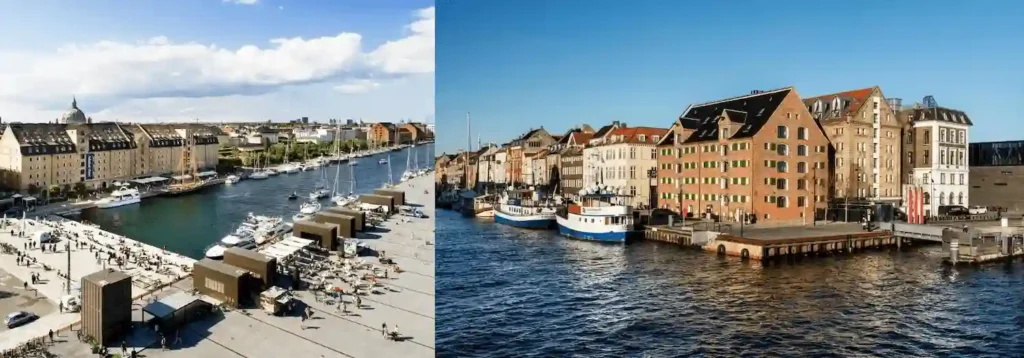
Nyhavn’s waterfront preserves Copenhagen’s mercantile and naval heritage — these properties occupy 18th and 19th-century warehouses and granaries that once stored grain for the Royal Navy and goods for Baltic trade routes. Staying here means inhabiting raw industrial architecture: exposed timber beams, harbor-front walls, and structural engineering designed for maritime logistics, not luxury.
Expect preserved functional elements, direct canal access, and interiors where original materials remain visible.
⚓ Copenhagen Admiral Hotel ★★★★★
This property occupies an 18th-century Royal Navy granary (1787) — a colossal military-industrial asset built to store grain supplies for Denmark’s maritime fleet. The building’s interior preserves massive Pomeranian pine beams, original flooring, and load-bearing structures designed to support tonnage, not travelers. Walking through the hotel means navigating spaces defined by naval engineering: low doorways, thick walls, and timber frameworks that reflect Copenhagen’s era as a dominant Baltic Sea power.
The Admiral’s scale distinguishes it from boutique conversions — over 350 rooms occupy multiple warehouse floors, maintaining the granary’s institutional footprint while introducing modern hospitality infrastructure.
Service balances maritime heritage with contemporary efficiency; staff emphasize the building’s naval history without theatrical excess.
This property suits travelers drawn to industrial-scale adaptive reuse projects where original function remains architecturally dominant.
Best for: Travelers prioritizing 18th-century naval architecture, industrial-scale warehouse interiors, and direct Nyhavn waterfront access within preserved Royal Navy infrastructure.
Signature Experience: Massive original Pomeranian pine beams, 1787 Royal Navy granary heritage, harbor-front location with direct canal views, industrial-scale adaptive reuse preserving maritime engineering.
“Those timber beams aren’t decoration — they’re the entire reason the building still stands. That authenticity is rare.” — Andreas, CopenhagenCheck Availability & Rates →
🟨 71 Nyhavn Hotel ★★★★★
Converted from an 1804 merchant warehouse, this yellow-brick structure served Copenhagen’s harbor trade for over a century before its luxury transformation. The building’s facade remains a Nyhavn landmark — bright yellow paint, narrow proportions, and waterfront positioning make it one of the canal’s most photographed structures. Interiors preserve raw timber beams, exposed brick, and original flooring that reflect the warehouse’s mercantile function.
71 Nyhavn operates with intimate scale — fewer than 150 rooms maintain residential proportions despite the building’s commercial origins. The ground-floor restaurant extends onto the canal-side terrace, offering direct harbor views that mirror the property’s original shipping-access function.
This hotel suits travelers seeking boutique intimacy within preserved industrial architecture, prioritizing Nyhavn’s postcard aesthetic over institutional grandeur.
Best for: Travelers valuing boutique scale, iconic yellow-brick Nyhavn positioning, and intimate warehouse interiors with preserved mercantile architecture.
Signature Experience: Canal-side terrace dining with direct harbor views, original 1804 timber beams and exposed brick, iconic yellow facade on Nyhavn’s most photographed stretch, boutique-scale warehouse conversion.
“Morning coffee on the terrace, watching boats pass — you’re living inside the Copenhagen postcard everyone tries to capture.” — Emma, LondonCheck Availability & Rates →
📊 Comparison: Best Hotels in Copenhagen
| Hotel | Location | Historic Identity | Signature Features | Unique Perks | Best For |
|---|---|---|---|---|---|
|
🕌 Nimb Hotel ★★★★★ |
Tivoli Gardens, Belle Époque palace |
Moorish Palace (1909), Royal bazaar |
Private garden access, Michelin dining |
After-hours Tivoli, rooftop terrace |
Theatrical grandeur, cultural immersion |
|
📮 Villa Copenhagen ★★★★★ |
Central Station, Neo-Baroque |
Central Post Office (1912), Telegraph hub |
Rooftop pool, preserved vaults |
Adaptive reuse design, station access |
Neo-Baroque infrastructure, modern design |
|
👑 Phoenix Copenhagen ★★★★ |
Bredgade, Royal District |
Aristocratic Residence (1680s), Royal guest house |
Original staircases, fire-survivor |
Amalienborg proximity, 17th-century continuity |
Royal heritage, discreet formality |
|
⚓ Copenhagen Admiral ★★★★★ |
Nyhavn Harbor, waterfront |
Royal Navy Granary (1787), Naval warehouse |
Massive pine beams, harbor views |
Industrial-scale conversion, maritime engineering |
Naval architecture, waterfront access |
- Continue exploring Denmark’s most architecturally significant conversions with best hotels in Aarhus
❓ FAQ: Best Hotels in Copenhagen
Which Copenhagen hotel offers the most significant historic architecture?
Nimb Hotel occupies a Moorish palace built in 1909 as Tivoli Gardens’ architectural centerpiece — a Belle Époque fantasy structure inspired by Orientalist luxury design. Villa Copenhagen preserves Denmark’s former Central Post & Telegraph Office (1912), offering Neo-Baroque governmental infrastructure. Both properties represent institutional landmarks, but Nimb’s theatrical design and private garden access position it as Copenhagen’s most visually distinctive historic hotel.
Where should I stay in Copenhagen to access royal heritage sites?
Phoenix Copenhagen sits on Bredgade within walking distance of Amalienborg Palace, Marble Church, and Rosenborg Castle. Originally built as an aristocratic residence in the 1680s and later serving as the Royal Court’s guest house, this property survived the 1794 fire and maintains direct royal district positioning. Hotel Sanders offers proximity to the Royal Theatre but caters to artistic heritage rather than aristocratic continuity.
What’s the best hotel in Copenhagen for Nyhavn harbor views?
Both Copenhagen Admiral Hotel and 71 Nyhavn Hotel occupy preserved 18th and 19th-century warehouses directly on Nyhavn canal. Admiral preserves an 1787 Royal Navy granary with massive Pomeranian pine beams and industrial-scale interiors. 71 Nyhavn offers boutique intimacy within an 1804 merchant warehouse, featuring the canal’s iconic yellow-brick facade. Admiral suits travelers prioritizing maritime engineering, while 71 Nyhavn appeals to those seeking intimate boutique scale.
Which Copenhagen hotel has the most preserved original architecture?
Copenhagen Admiral Hotel retains the most extensive original structural elements — massive 18th-century Pomeranian pine beams, load-bearing frameworks, and naval engineering designed for grain storage. Phoenix Copenhagen preserves 1680s staircases, woodwork, and fire-survivor architecture. Villa Copenhagen maintains Neo-Baroque postal vaults and telegraph-era masonry. Admiral’s industrial scale and functional maritime interiors make it Copenhagen’s most architecturally intact historic conversion.
Are there any Belle Époque hotels in Copenhagen?
Nimb Hotel represents Copenhagen’s only Belle Époque Moorish palace conversion, designed in 1909 by Knud Arne-Petersen as Tivoli Gardens’ theatrical centerpiece. Villa Copenhagen’s 1912 Neo-Baroque Post Office building reflects early 20th-century governmental grandeur but follows different architectural traditions. Nimb remains the city’s singular example of Orientalist fantasy architecture repurposed for luxury hospitality.
What’s the best Copenhagen hotel for travelers prioritizing adaptive reuse design?
Villa Copenhagen exemplifies contemporary adaptive reuse — Scandinavian minimalism layered into preserved Neo-Baroque postal infrastructure, including original vaults, masonry, and telegraph-era engineering. The rooftop pool and modern interiors contrast 1912 governmental formality with urban energy. Copenhagen Admiral Hotel offers industrial-scale reuse but prioritizes heritage preservation over contemporary design integration. Villa Copenhagen balances both approaches most successfully.
Which best hotels in Copenhagen offer private cultural access?
Nimb Hotel provides exclusive after-hours access to Tivoli Gardens, allowing guests to experience the park beyond public operating hours. This private garden access, combined with rooftop terrace views overlooking illuminated attractions, offers cultural immersion unavailable at other Copenhagen hotels. No other property in the city provides comparable private access to a major cultural landmark.
Your Copenhagen Stay: Historic Architecture Meets Modern Hospitality
Choosing the right hotel in Copenhagen depends on which chapter of the city’s past resonates with your travel priorities. The properties above represent verified historic conversions where original function remains architecturally visible — not replicas or themed renovations. Whether you prioritize Moorish theatricality, royal continuity, or maritime industrial scale, these hotels offer direct access to Copenhagen’s preserved institutional memory.
Discover regional heritage beyond the capital through best hotels in Odense.
For more curated itineraries and luxury-focused travel insights, visit Your Luxury Guide. For official travel information and destination updates, visit Denmark tourism-info.
Booking your hotel in Copenhagen secures access to properties where past and present coexist through adaptive reuse — choices that place you inside the city’s architectural narrative, not alongside it.
Your Luxury Guide — Where Exceptional Travel Begins.