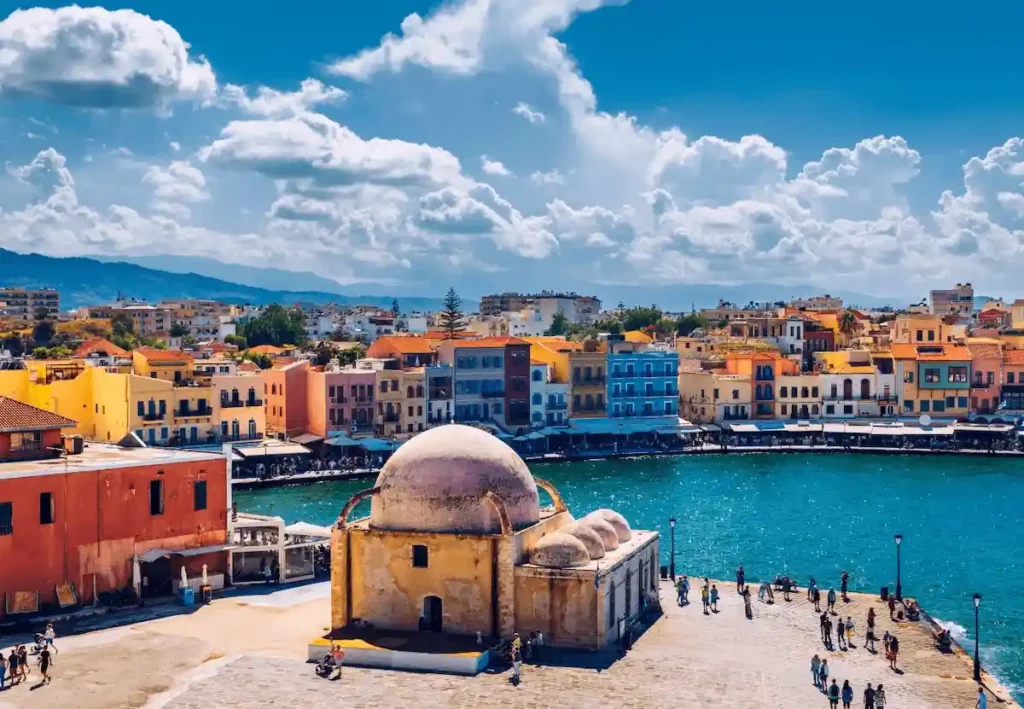
Chania’s architectural soul is not Greek. It is Venetian, Ottoman, and Neoclassical—a compressed archive of four centuries of imperial occupation and aristocratic ambition. The city’s Old Harbor is one of Europe’s most intact Venetian ports, and the best hotels in Chania are those that occupy the original structures: the palazzos of ruling families, the manors of knights, and the consulates of foreign powers.
But the city’s reputation as a “boutique hotel destination” has created a paradox: every property claims “historic charm,” yet many are shallow renovations of generic townhouses with no verified pedigree.
This audit rejects that noise. We filtered Chania’s inventory for properties with a verified “Past-Life Identity”—structures with recorded ownership, architectural authority, and physical continuity from the 15th to 19th centuries. You are not booking a room; you are occupying a piece of imperial infrastructure. This selection guarantees that your stay is a living archive, not a staged set.
Explore the complete audit of best historic hotels in Greece for context across the mainland and islands.
Venetian Harbor Buildings: 15th to 17th-Century Palazzos
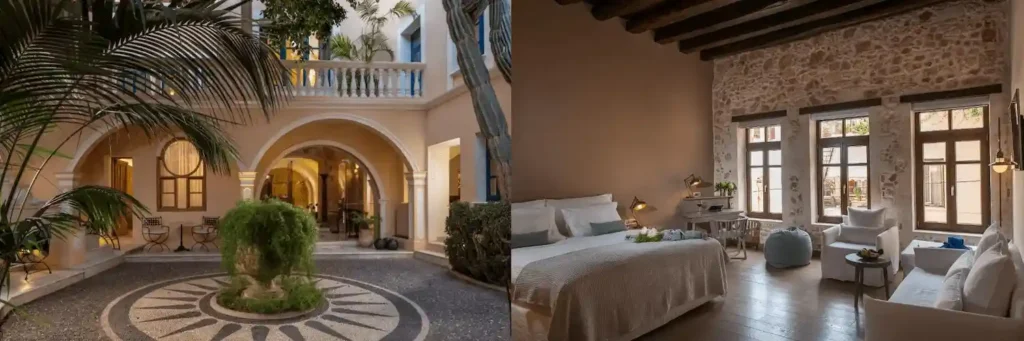
These are the harbor’s original power structures—the palazzos and manors that defined Chania’s role as a Venetian military and commercial stronghold. Expect silence, stone walls that absorb heat, and the sensation of walking through a structure that was designed to project authority, not comfort.
🏛️ Domus Renier Boutique Hotel ★★★★★
The Domus Renier is not just a Venetian palazzo; it is the central power residence of the Renier family, the Venetian rulers who governed Chania during the 15th century. The structure was built as a statement of imperial control, and it remains one of the few properties in Crete with a verified “Cretan Renaissance” architectural pedigree.
The original 15th-century stone facade faces the harbor, while the interior preserves the 19th-century master ceiling—a rare example of layered preservation. The rooms are not spacious; they are deliberate. The stone walls are thick enough to silence the harbor noise entirely, and the windows frame the Venetian lighthouse and shipyard ruins.
The primary amenity here is the sensation of occupying a structure that was built to last five centuries. The rooftop terrace overlooks the harbor without obstruction, offering the only elevated vantage point where you can see the full arc of Chania’s Venetian fortifications.
Best for: Architecture scholars and design-conscious travelers seeking the most historically significant palazzo in Chania with verified Renaissance provenance.
Signature Experience: Rooftop terrace with unobstructed harbor views, original 15th-century stone facade, 19th-century neoclassical ceiling, curated wine cellar featuring Cretan varietals, private dining in the palazzo courtyard.
“Standing on that rooftop at dawn—you understand why they chose this exact location.” — Marco, MilanCheck Availability & Rates →
🕌 Casa Delfino Hotel & Spa ★★★★★
Casa Delfino is the private palazzo of the Delfino family, knights from Marseille who governed Chania in the 17th century. The property has remained in the same family for six generations, making it one of the few verified “family-held conversions” in the Mediterranean.
The original 17th-century structural arches are intact, supporting the upper floors without modern reinforcement, and the courtyard preserves the rare pebble-mosaic flooring (alitana)—a Venetian decorative technique that has largely disappeared. The spa is not a modern addition; it is integrated into the lower vaults, where the stone walls maintain a constant cool temperature.
The rooms vary in scale—some are compact, reflecting the original palazzo layout, while the suites occupy the full width of the building. The primary advantage here is not luxury amenities; it is the sensation of staying in a structure that was never intended to be a hotel.
Best for: Couples and wellness travelers seeking a family-held Venetian palazzo with integrated spa facilities and verifiable six-generation continuity.
Signature Experience: Spa treatments in 17th-century stone vaults, pebble-mosaic courtyard (alitana), rooftop views of Venetian shipyards, curated Mediterranean breakfast in the palazzo salon, private harbor-view suites.
“That courtyard at night—candlelit stone and absolute quiet. Worth the entire trip.” — Elena, AthensCheck Availability & Rates →
🏰 Serenissima Boutique Hotel ★★★★★
The Serenissima is a 16th-century Venetian manor that later became a high-status Ottoman residence. The original Venetian structural arches remain intact, and the interior preserves a fully restored 16th-century Ottoman hammam, one of the few surviving examples of this typology in a private residence.
The hammam is not decorative; it is functional, with original marble benches and a domed ceiling designed to circulate steam. The rooms—each reflects a different phase of the building’s history, from Venetian stone walls to Ottoman wooden ceilings.
The rooftop terrace overlooks the harbor and the Turkish quarter, offering the only vantage point where you can see the full architectural dialogue between Venetian fortifications and Ottoman residential quarters.
Best for: History-focused travelers and design purists seeking a verified Venetian-Ottoman conversion with a rare 16th-century hammam and architectural layering.
Signature Experience: Restored 16th-century Ottoman hammam, Venetian structural arches, rooftop terrace overlooking harbor and Turkish quarter, curated Ottoman-Venetian breakfast, private suites with wooden Ottoman ceilings.
“That hammam session—marble benches from the 1500s. Nothing modern comes close.” — Thomas, BerlinCheck Availability & Rates →
🏛️ Monastery Estate Venetian Harbor ★★★★★
The Monastery Estate is a 16th-century Venetian castle built over Roman foundations. The original 16th-century stone vaults are intact, and the internal courtyard preserves the authentic layout of a Venetian nobleman’s residence. The property is not large; it occupies a compact footprint designed to maximize defensive advantage, with thick walls and minimal openings.
The rooms are not spacious, but the stone vaults provide natural cooling and silence. The primary advantage here is not luxury amenities; it is the sensation of occupying a structure that was built to last a millennium. The courtyard is the centerpiece, with original stone paving and a well that dates to the Roman period. The rooftop offers unobstructed views of the Venetian harbor and the Cretan Sea.
Best for: Architecture purists and history travelers seeking a verified three-layer conversion with Roman foundations, Venetian vaults, and courtyard preservation.
Signature Experience: 16th-century stone vaults, Roman foundation preservation, internal courtyard with original well, rooftop harbor views, curated Cretan breakfast in the vaulted salon, private suites with stone walls.
“Those vaults at sunrise—silent stone and three layers of history. Unforgettable.” — Giulia, FlorenceCheck Availability & Rates →
Ottoman Quarter Conversions: 17th to 18th-Century Residences
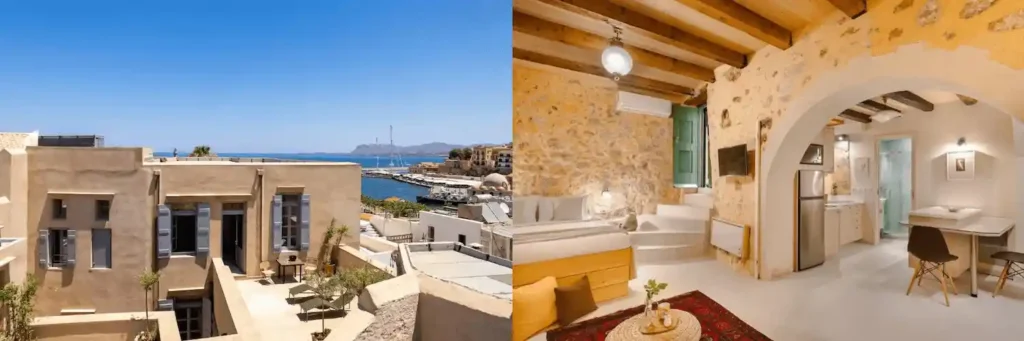
These are not generic “Old Town hotels.” These are verified Ottoman-era residences built during the 300-year Ottoman occupation of Chania, when the city became a provincial capital of the empire. Expect smaller rooms, original wooden ceilings, and the sensation of occupying a structure that was never meant to project power, only discretion.
🕌 AZADE Chania
AZADE is a 17th-century Ottoman Pasha’s residence with a construction history that extends 380 years—one of the oldest continuously occupied structures in Chania’s Old Town. The enclosed wooden balconies (sachnisia) are intact, a feature that has disappeared from most Ottoman conversions due to fire damage or modern renovations.
The rooms—some preserve the original wooden ceilings, while others feature exposed Venetian stone walls. The primary advantage here is not luxury amenities; it is the sensation of occupying a structure that was designed for the Ottoman ruling class, with privacy and seclusion as the core design principles.
The courtyard is small but intact, with original stone paving and a fountain that dates to the 17th century. The rooftop offers views of the Turkish quarter and the harbor.
Best for: Culture-focused travelers and Ottoman architecture enthusiasts seeking a verified 17th-century Pasha’s residence with rare enclosed balconies and 380-year continuity.
Signature Experience: Preserved Ottoman enclosed balconies (sachnisia), 17th-century Pasha’s courtyard with fountain, rooms with original wooden ceilings, rooftop views of Turkish quarter, curated Ottoman-Cretan breakfast.
“Sitting in that wooden balcony—enclosed, silent, untouched. Pure Ottoman discretion.” — Mehmet, IstanbulCheck Availability & Rates →
🏛️ Alcanea Boutique Hotel ★★★★
Alcanea is an 18th-century Ottoman residence in the Old Port that later served as the office of Eleftherios Venizelos, one of Greece’s most significant statesmen and the architect of Cretan independence. The property preserves the 18th-century exterior architecture, with original stone walls and wooden detailing that reflect the Ottoman residential typology.
The rooms are compact, designed for the domestic scale of an Ottoman townhouse rather than the grandeur of a Venetian palazzo. The courtyard is small but functional, with original stone paving and a seating area shielded from the harbor noise. The rooftop offers views of the Old Port and the Venetian lighthouse.
Best for: History travelers and Greek independence enthusiasts seeking an 18th-century Ottoman residence with verified political lineage and Old Port proximity.
Signature Experience: 18th-century Ottoman exterior architecture, verified office of Eleftherios Venizelos, courtyard with original stone paving, rooftop Old Port views, curated Greek breakfast in the historic salon.
“That Venizelos connection—you feel the weight of history in every corner.” — Dimitris, ThessalonikiCheck Availability & Rates →
Neoclassical Quarter: 19th-Century Diplomatic Residence
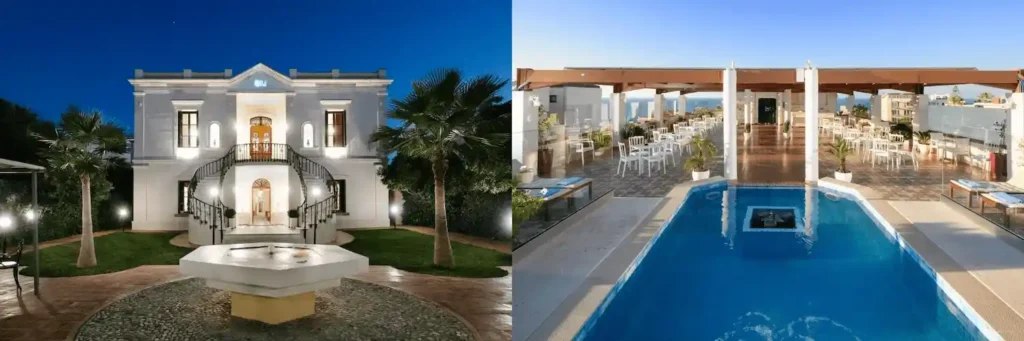
This is not the Venetian harbor. This is Halepa, Chania’s 19th-century diplomatic quarter, where European consulates and aristocratic residences were built during the brief period of Cretan independence. Expect high ceilings, formal salons, and the sensation of occupying a structure that was designed to host diplomats, not merchants or soldiers.
🏛️ Halepa Hotel ★★★★
Halepa Hotel is the former British Embassy and Consulate during the Cretan Republic in the late 1800s—a verified diplomatic building. The structure preserves the original dual marble staircase, a rare architectural feature that signaled diplomatic status and aristocratic authority. The 19th-century neoclassical facade remains intact, with formal gardens, and the original gate.
The rooms—some occupy the former consular offices, while others reflect the private quarters of the British consul. The primary advantage here is not luxury amenities; it is the sensation of occupying a structure that was designed to project European power during a critical period of Cretan history. The gardens are the centerpiece, with original stone pathways and Mediterranean plantings. The salon preserves the formal layout of the consular reception hall.
Best for: Diplomatic history travelers and neoclassical architecture enthusiasts seeking a verified 19th-century British Embassy with formal gardens and dual marble staircase.
Signature Experience: Original dual marble staircase, 19th-century neoclassical facade, formal gardens with Mediterranean plantings, rooms in former consular offices, curated European breakfast in the diplomatic salon.
“That marble staircase at dusk—formal, untouched, pure diplomatic elegance.” — James, LondonCheck Availability & Rates →
📊 Comparison: Best Hotels in Chania
| Hotel | Location | Wellness & Spa | Dining | Unique Perks | Best For |
|---|---|---|---|---|---|
|
🏛️ Domus Renier ★★★★★ |
Venetian Harbor, waterfront |
Rooftop terrace, wine cellar |
Private courtyard dining, Cretan wine |
15th-century palazzo Renier family lineage |
Architecture scholars, Renaissance purists |
|
🕌 Casa Delfino ★★★★★ |
Venetian Harbor, Old Town |
Spa in stone vaults, wellness treatments |
Mediterranean breakfast, palazzo salon |
Six-generation family Pebble-mosaic courtyard |
Wellness travelers, family-held conversions |
|
🏰 Serenissim Boutique Hotel ★★★★★ |
Venetian Harbor, Turkish quarter edge |
16th-century hammam, marble benches |
Ottoman-Venetian breakfast, rooftop |
Venetian-Ottoman fusion Rare hammam preservation |
Design purists, Ottoman architecture lovers |
|
🏛️ Monastery Estate ★★★★★ |
Venetian Harbor, compact castle |
Stone vaults, natural cooling |
Cretan breakfast in vaulted salon |
Roman foundations Three-layer preservation |
History travelers, three-layer conversions |
|
🕌 AZADE Chania |
Turkish Quarter, Old Town |
Courtyard fountain, Ottoman privacy |
Ottoman-Cretan breakfast, salon |
380-year Pasha residence Enclosed balconies (sachnisia) |
Ottoman enthusiasts, architectural dialogue |
- Compare the complete audit of best hotels in Rethymno to explore Crete’s Venetian and Ottoman conversions beyond Chania’s harbor district.
❓ FAQ: Best Hotels in Chania
What makes a hotel in Chania “historic”?
A historic hotel in Chania must occupy a verified structure with recorded construction dates and documented past-life identity—Venetian palazzos, Ottoman residences, or neoclassical consulates. Generic “Old Town boutique hotels” without architectural pedigree do not qualify. Preservation of original structural elements (stone vaults, wooden ceilings, pebble-mosaic courtyards) and verified family ownership or diplomatic use are critical markers. This audit excludes modern renovations that erase historical layering.
Which Chania hotel has the most significant Venetian heritage?
Domus Renier Boutique Hotel holds the strongest Venetian pedigree. It was the central palace of the Renier family, Venetian rulers of Chania during the 15th century. The property preserves the original 15th-century stone facade and 19th-century master ceiling, making it one of the few verified “Cretan Renaissance” conversions. Casa Delfino follows closely, with six-generation family ownership and a preserved 17th-century pebble-mosaic courtyard (alitana).
Are there Ottoman-era hotels in Chania’s Old Town?
Yes. AZADE Chania is a 17th-century Pasha’s residence with 380 years of construction history, preserving the rare Ottoman enclosed balconies (sachnisia) where wooden additions meet Venetian stone masonry. Alcanea Boutique Hotel is an 18th-century Ottoman residence that later served as the office of Greek statesman Eleftherios Venizelos. Both properties preserve Ottoman residential typology—wooden ceilings, courtyards designed for privacy, and stone walls that reflect the 300-year Ottoman occupation.
Which hotel offers the best spa experience in a historic setting?
Casa Delfino Hotel & Spa integrates a full spa into the original 17th-century stone vaults, where the thick walls maintain constant cool temperatures. Serenissima Boutique Hotel preserves a fully restored 16th-century Ottoman hammam with original marble benches and a domed ceiling designed for steam circulation. Both offer wellness treatments in verified historic structures, not modern additions.
What is the best location for first-time visitors to Chania?
The Venetian Harbor concentration (Domus Renier, Casa Delfino, Serenissima, Monastery Estate) offers direct access to Chania’s most significant architectural landmarks—the Venetian shipyards, lighthouse, and fortifications. These properties are within walking distance of the Old Port, Turkish quarter, and waterfront dining. For diplomatic history and neoclassical architecture, Halepa Hotel in the diplomatic quarter offers a quieter alternative with formal gardens and marble staircases.
Do these hotels preserve original architectural elements?
Yes. Domus Renier preserves the 15th-century stone facade and 19th-century ceiling. Casa Delfino preserves the 17th-century pebble-mosaic courtyard (alitana) and structural arches. Serenissima preserves a 16th-century Ottoman hammam. Monastery Estate preserves Roman foundations and 16th-century Venetian vaults. AZADE preserves Ottoman enclosed balconies (sachnisia). Halepa Hotel preserves the dual marble staircase from the British Embassy period. All properties meet the audit’s threshold for physical continuity.
Which hotel is best for architecture and design travelers?
Domus Renier Boutique Hotel for verified Renaissance provenance and ruling-class lineage. Serenissima Boutique Hotel for Venetian-Ottoman architectural dialogue and rare hammam preservation. Monastery Estate Venetian Harbor for three-layer preservation (Roman, Venetian, modern). Casa Delfino for family-held conversion with six-generation continuity. Each represents a distinct typology within Chania’s architectural archive.
Making the Right Choice for Your Chania Stay
Selecting best hotels in Chania is not about chasing harbor views or five-star labels. It is about choosing a structure where the building’s history is the primary experience—where Venetian vaults, Ottoman courtyards, or neoclassical staircases define the stay more than amenities or service. The properties above represent the city’s most architecturally significant conversions, filtered for verified provenance, original structural preservation, and continuity from the 15th to 19th centuries.
For island-level historic conversions, continue with the audit of best hotels in Santorini, where volcanic caldera hotels meet Cycladic minimalism and archaeological proximity.
For more curated itineraries and luxury-focused travel insights, visit Your Luxury Guide. For official travel information and destination updates, visit Greece tourism-info.
Booking your hotel in Chania secures access to the city’s most intact Venetian, Ottoman, and neoclassical buildings—structures that cannot be replicated and are concentrated in a compact quarter where every turn reveals four centuries of imperial occupation.
Your Luxury Guide — Where Exceptional Travel Begins.