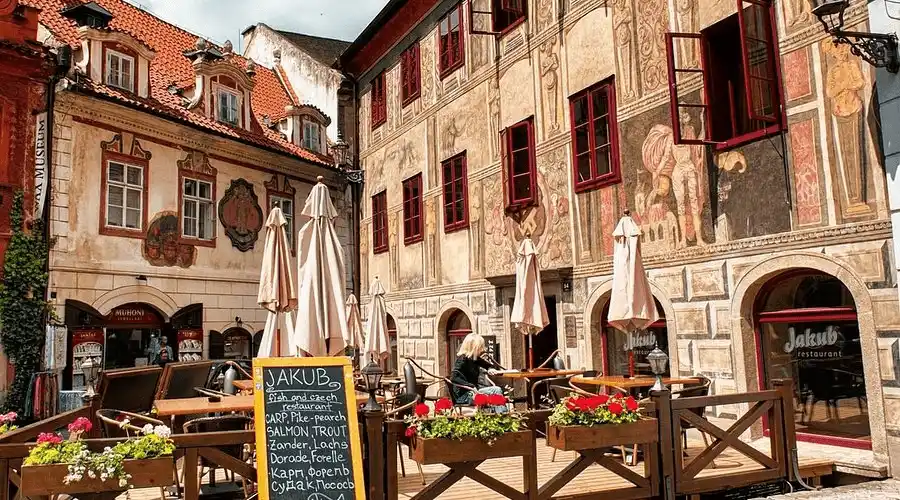
Choosing the best hotels in Český Krumlov means understanding that this UNESCO-protected medieval city doesn’t offer generic luxury—it offers something far rarer: intact Renaissance and Gothic structures where the building itself is the primary asset. The overchoice problem here isn’t about too many five-star chains—it’s about distinguishing between properties that have genuinely preserved their 16th-century soul and those that have buried it under modern renovation.
We audited the town’s historic inventory and rejected every property where the “heritage” narrative couldn’t be verified through tangible architectural evidence. What remains are former Jesuit colleges with original frescoes, 14th-century burgher houses with Gothic vaulting, and Renaissance inns with hand-painted beamed ceilings. This selection guarantees you’re staying inside Český Krumlov’s recorded history, not just near it.
For a broader perspective on the Czech Republic’s most significant architectural conversions, explore our audit of best historic hotels in Czech Republic.
The Landmark Renaissance Conversions
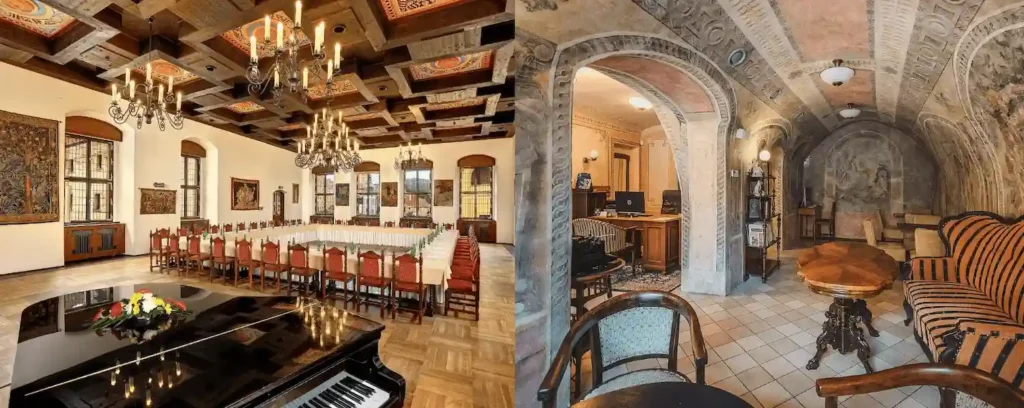
These aren’t hotels that reference history—they are history. Both properties represent the highest tier of Renaissance preservation in Central Europe, where the original 16th-century structure remains the dominant experience. Original Jesuit frescoes, monumental Renaissance halls, and hand-painted ceilings aren’t decorative choices—they are the physical fabric of the building. Staying here means occupying spaces where Jesuit scholars once studied or where Renaissance nobility held court, with the architectural proof still intact.
🎨 Hotel Ruze & Wellness ★★★★★
This is the 1586 Jesuit College—the most architecturally significant estate in Český Krumlov and the only five-star property in the city that can claim complete Renaissance provenance.
Built for the Jesuit Order during the Counter-Reformation, it retains its monumental Jesuit Hall with original 16th-century frescoes depicting biblical scenes, vaulted corridors with Renaissance masonry, and a preserved library wing. Guest rooms feature heavy Renaissance-style furnishings set against exposed stone walls and original ceiling beams, creating an immersive monastic atmosphere. The wellness center occupies the former Jesuit cellars, where 16th-century vaulting frames the spa’s thermal pools.
Stepping through the entrance means crossing from a tourist-crowded medieval square into a silent Renaissance cloister where every corridor feels like a private museum wing. This is the only hotel in Central Europe where you can sleep in a fully preserved Jesuit educational complex.
Best for: Travelers seeking the most architecturally intact Renaissance landmark hotel in the Czech Republic, with luxury wellness amenities integrated into 16th-century monastic infrastructure.
Signature Experience: Original 16th-century Jesuit frescoes in the monumental hall, Renaissance vaulted spa in former Jesuit cellars, private courtyard garden surrounded by monastic cloisters, fine dining in the Renaissance refectory.
“Walking through those frescoed halls at night—felt like I had the entire Renaissance to myself.” — Thomas, ViennaCheck Availability & Rates →
🏛️ Hotel Krčínův Dům ★★★★
This 14th-century Gothic burgher house carries one of the most significant architectural pedigrees in Český Krumlov—it was owned by Jakub Krčín, the legendary pond-builder of South Bohemia whose hydraulic engineering projects shaped the region’s landscape.
The exterior preserves rare Renaissance sgraffito that survived centuries of weathering, while the interior reveals original Gothic vaulted ceilings in the breakfast hall and 16th-century hand-painted beamed ceilings in select guest rooms. The preservation here is tangible—you’re not looking at reproductions or inspired-by designs, but at the actual structural bones of a 600-year-old Gothic residence. Walking through the oak-beamed corridors means occupying the same spatial logic that medieval merchants and Renaissance nobility experienced. The ground-floor vaulted breakfast room, with its Gothic ribs still visible, provides a daily reminder that this building predates most European capitals.
Best for: Architecture-focused travelers who prioritize verifiable Gothic and Renaissance preservation over modern luxury amenities, seeking an authentic burgher-house experience.
Signature Experience: Rare Renaissance sgraffito on historic facade, original 16th-century hand-painted beamed ceilings in guest rooms, Gothic vaulted breakfast hall with medieval masonry, central Old Town location.
“Those painted ceilings in our room—you don’t get that kind of authenticity anywhere else.” — Elena, PragueCheck Availability & Rates →
The Unpolished Medieval Character
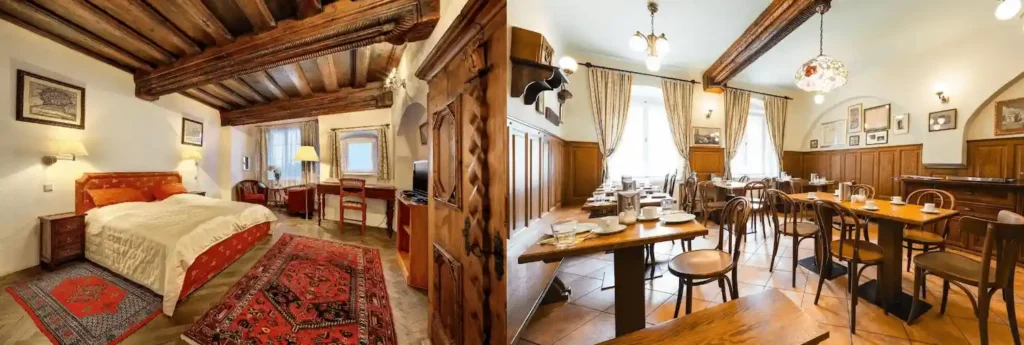
Not every historic hotel needs to feel like a museum. These two properties represent a different preservation philosophy—one that favors medieval authenticity over luxury polish. Original 16th-century structural elements remain visible and unrestored, creating a raw, tangible connection to the past that modern renovations deliberately erase. For travelers who find over-curated heritage hotels sterile, these offer something rarer: the feeling of staying inside a building that hasn’t been forced into 21st-century luxury standards.
🔑 Hotel Konvice
This 1539 Renaissance inn on Horní Street has operated continuously as a lodging house for nearly 500 years, and its interior still reflects that long, layered history. The building’s layout is famously labyrinthine—no two rooms share the same floor plan, staircase access varies wildly, and corridors twist in ways that feel more Escher than Renaissance. This isn’t accidental—it’s the result of centuries of organic growth within medieval property boundaries.
The preservation philosophy here avoids sterile luxury: original 16th-century structural elements remain exposed, wooden beams show their age, and the spatial irregularity creates an immersive medieval atmosphere that newer hotels can’t replicate. Walking through the narrow corridors at night, with uneven floors underfoot and low ceilings overhead, provides a tactile reminder of how medieval travelers experienced inns. This is the only hotel in Český Krumlov where the architectural disorientation is the selling point.
Best for: Travelers who value unpolished medieval authenticity over luxury amenities, seeking a genuinely labyrinthine Renaissance inn experience that avoids modern hospitality standards.
Signature Experience: Escher-like labyrinthine layout with no two rooms identical, exposed 16th-century structural elements, centuries-old inn atmosphere, central Horní Street location with original Renaissance character.
“Getting lost on the way to breakfast became part of the charm—every corridor a new discovery.” — Marco, MilanCheck Availability & Rates →
🎭 Hotel Leonardo ★★★
Two unified 16th-century townhouses that avoided the “sterile modernization” trap most boutique hotels fall into. Built in 1582, this Renaissance property preserves original wooden beamed ceilings in guest rooms—not decorative replicas, but the actual 16th-century structural timbers that have held these houses upright for over 400 years.
The central Baroque staircase, added in the 18th century, remains the architectural spine of the building, and the layout still follows the spatial logic of Renaissance burgher residences. Walking through the entry hall means stepping directly into a preserved 16th-century interior where wall fragments and ceiling beams provide tangible proof of the building’s age. The rooms themselves avoid over-decoration—wooden beams frame simple whitewashed walls, and period furnishings sit comfortably within the original proportions. This is heritage without pretension, where the building’s authenticity speaks louder than luxury amenities.
Best for: Travelers seeking a preserved Renaissance townhouse experience with prominent original beamed ceilings, favoring architectural authenticity over contemporary luxury polish.
Signature Experience: Original Renaissance wooden beamed ceilings in guest rooms, preserved Baroque staircase as central architectural feature, visible 16th-century wall fragments, intimate burgher-house layout.
“Those ceiling beams—knowing they were cut and installed in the 1500s—made every morning feel historic.” — Anna, BratislavaCheck Availability & Rates →
The 19th-Century Riverside Landmark
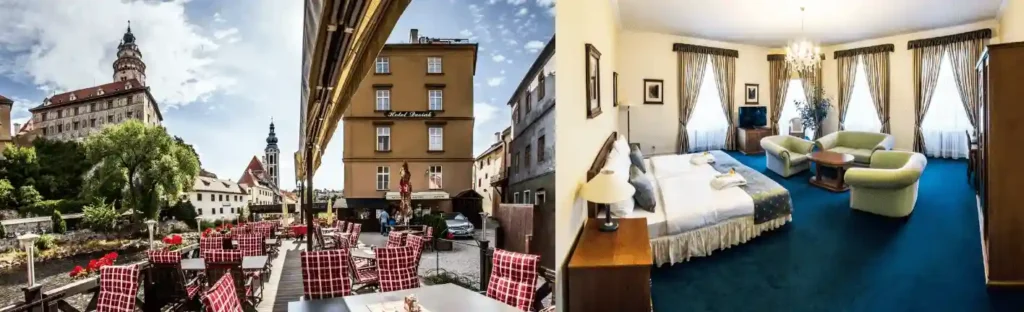
For travelers who prefer the grandeur of late-19th-century Neo-Renaissance architecture over medieval rusticity, this riverside property offers a different expression of Český Krumlov’s architectural heritage. Built during the Austro-Hungarian Empire, it represents the era when burgher wealth shifted from medieval trade guilds to industrial prosperity, reflected in high-ceilinged proportions and monumental civic architecture.
🏛️ Hotel Dvorak Cesky Krumlov ★★★★
This 1867 Neo-Renaissance residence stands on the site of earlier medieval tradesmen’s dwellings, but its current identity reflects the grandeur of late-19th-century bourgeois architecture along the Vltava River. The preserved facade retains the high-ceilinged proportions and symmetrical riverside balcony systems typical of Austro-Hungarian civic buildings, while the interior features a monumental staircase that still serves as the architectural centerpiece.
Guest rooms occupy the original 19th-century floor plan, where tall windows and preserved structural proportions create a sense of Belle Époque spaciousness that medieval properties can’t offer. The riverside location provides direct Vltava views framed by original balcony ironwork, and the terrace dining overlooks the same waterway that powered the town’s mills and trade routes for centuries. This is the only hotel in Český Krumlov where the architectural narrative shifts from medieval to imperial, offering a preserved 19th-century riverside residence experience.
Best for: Travelers drawn to Neo-Renaissance riverside elegance and 19th-century bourgeois proportions, seeking Vltava River views framed by preserved Austro-Hungarian architecture.
Signature Experience: Preserved 1867 Neo-Renaissance facade with riverside balconies, monumental 19th-century staircase, direct Vltava River views, terrace dining overlooking historic waterway.
“Breakfast on that riverside terrace—watching the Vltava flow past 19th-century balconies—pure Bohemian elegance.” — Sophie, MunichCheck Availability & Rates →
📊 Comparison: Best Hotels in Český Krumlov
| Hotel | Location | Wellness & Spa | Dining | Unique Perks | Best For |
|---|---|---|---|---|---|
|
🎨 Hotel Ruze & Wellness ★★★★★ |
Old Town, central square |
Renaissance vaulted spa, thermal pools |
Fine dining in Renaissance refectory |
1586 Jesuit College Original frescoes |
Luxury travelers, Renaissance immersion |
|
🏛️ Hotel Krčínův Dům ★★★★ |
Old Town, historic center |
None | Gothic vaulted breakfast hall |
14th-century Gothic house Renaissance sgraffito |
Architecture purists, Gothic authenticity |
|
🔑 Hotel Konvice |
Horní Street, central |
None | Traditional Czech, inn atmosphere |
1539 Renaissance inn Labyrinthine layout |
Medieval character, unpolished authenticity |
- For a deeper exploration of the Prague’s most significant heritage conversions, continue with our guide to best hotels in Prague.
❓ FAQ: Best Hotels in Český Krumlov
What makes Český Krumlov’s historic hotels unique compared to other Czech cities?
Český Krumlov offers the most concentrated collection of preserved Renaissance and Gothic structures in the Czech Republic, where entire burgher houses and monastic complexes remain architecturally intact. Unlike Prague, where many “historic” hotels are modern conversions with period-inspired décor, properties here preserve original 16th-century frescoes, Gothic vaulting, and Renaissance beamed ceilings as the primary architectural experience. Hotel Ruze’s 1586 Jesuit College and Hotel Krčínův Dům’s 14th-century Gothic structure represent Europe’s most significant Renaissance and medieval preservation examples.
Which hotel has the most authentic medieval atmosphere in Český Krumlov?
Hotel Konvice provides the most tangible medieval experience, with its labyrinthine 1539 layout, exposed 16th-century structural elements, and centuries-old inn character. The building avoids luxury modernization, preserving the spatial disorientation and raw authenticity of a Renaissance inn. For travelers seeking polished medieval elegance with luxury amenities, Hotel Ruze’s Jesuit College offers monumental Renaissance architecture with five-star service.
Are the best hotels in Český Krumlov located in the Old Town?
Yes, all significant historic hotels occupy the UNESCO-protected medieval core, ensuring direct access to the castle, main square, and Renaissance streets. Hotel Ruze sits on the central square within the former Jesuit College complex, Hotel Krčínův Dům occupies a prime Old Town position, and Hotel Konvice stands on historic Horní Street. Hotel Dvorak offers riverside positioning with Vltava views while remaining within walking distance of all major landmarks.
What’s the difference between staying in a Renaissance hotel versus a Gothic property in Český Krumlov?
Renaissance hotels like Hotel Ruze feature monumental frescoed halls, high vaulted ceilings, and grand architectural proportions reflecting Counter-Reformation wealth and Jesuit influence. Gothic properties like Hotel Krčínův Dům offer more intimate medieval spaces with lower vaulted ceilings, hand-painted beams, and burgher-house layouts. Renaissance properties emphasize grandeur and ecclesiastical architecture, while Gothic hotels provide tactile medieval character and merchant-class domesticity.
Do Český Krumlov’s historic hotels have modern amenities like spas and fine dining?
Hotel Ruze offers the most comprehensive luxury amenities, with a Renaissance vaulted spa in the former Jesuit cellars and fine dining in the original refectory. Other properties prioritize architectural preservation over modern wellness facilities—Hotel Krčínův Dům and Hotel Konvice focus on authentic Renaissance and medieval character rather than contemporary spa services. For travelers seeking both historic architecture and luxury wellness, Hotel Ruze remains the only property combining 16th-century monastic preservation with five-star amenities.
Which hotel offers the best value for authentic historic architecture in Český Krumlov?
Hotel Leonardo provides exceptional value, preserving original 1582 Renaissance beamed ceilings and a Baroque staircase without charging five-star premiums. It offers tangible 16th-century architectural elements—structural timbers, wall fragments, burgher-house layout—at three-star rates. For travelers prioritizing architectural authenticity over luxury polish, it delivers the same Renaissance provenance as higher-priced properties without wellness amenities or fine dining.
Is it worth staying in Český Krumlov’s historic hotels versus modern properties outside the Old Town?
Absolutely. Modern hotels outside the UNESCO core cannot replicate the experience of sleeping within a 1586 Jesuit College, a 14th-century Gothic burgher house, or a 1539 Renaissance inn. The architectural immersion—original frescoes, Gothic vaults, hand-painted ceilings—is the primary value, not transferable to contemporary builds. Staying in the Old Town’s historic properties places you inside Český Krumlov’s recorded architectural heritage rather than merely visiting it during the day.
Final Verdict: Český Krumlov’s Most Architecturally Significant Hotels
We’ve already filtered out the modernized conversions and boutique hotels that prioritize décor over provenance. The properties above represent the most architecturally intact Renaissance, Gothic, and 19th-century structures in Český Krumlov, where the building itself delivers the primary experience. Whether you choose the monumental frescoed halls of a Jesuit College or the labyrinthine corridors of a 1539 inn, each stay guarantees tangible architectural heritage rather than surface-level period styling.
Travelers drawn to the elegance of Bohemian spa towns should explore our audit of best hotels in Karlovy Vary.
For more curated itineraries and luxury-focused travel insights, visit Your Luxury Guide. For official travel information and destination updates, visit Czech Republic tourism-info.
Booking your hotel in Český Krumlov secures access to Central Europe’s most concentrated collection of preserved Renaissance and Gothic architecture, where every night offers immersion in verified 16th-century heritage rather than modern luxury approximations.
Your Luxury Guide — Where Exceptional Travel Begins.