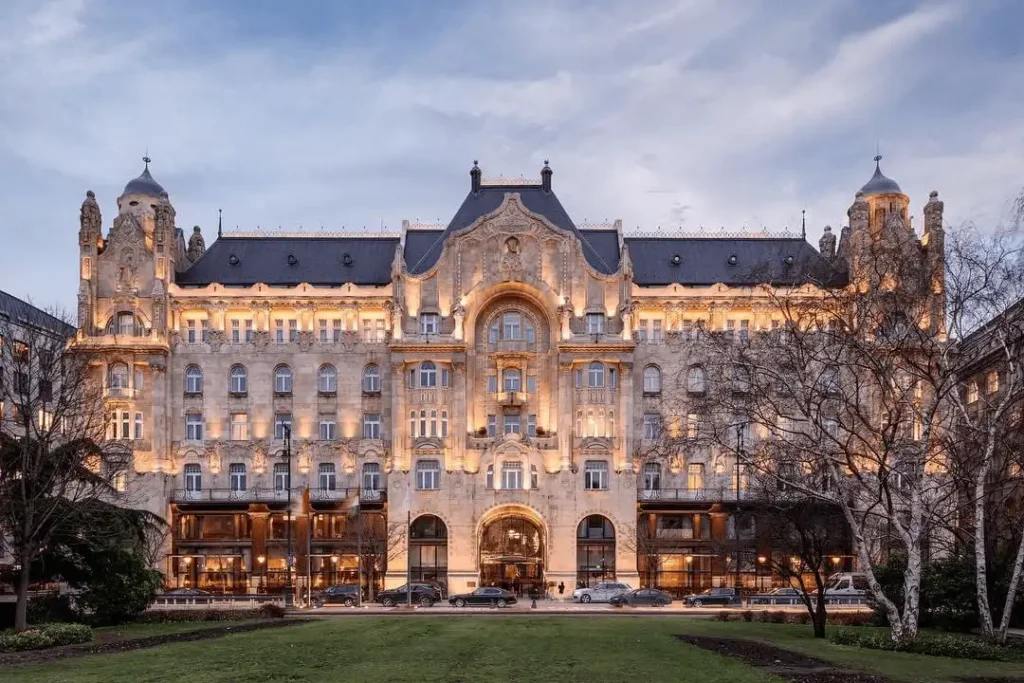
The best hotels in Budapest aren’t defined by star ratings—they’re defined by what the building was before it became a hotel. This city’s architectural soul lives in its 1896-1914 era landmarks: insurance company headquarters rebuilt as Secessionist showpieces, royal spas that retain their original marble vaults, and shopping arcades inspired by Parisian passages. The luxury paradox here is acute—many five-star properties occupy generic glass towers or hollow conversions where historic facades mask gutted interiors.
We audited Budapest’s inventory and filtered out properties with weak provenance, cosmetic restorations, and brand-saturated lobbies. What remains are assets with verified past-life identities: buildings where the original ironwork, Zsolnay ceramics, and mahogany paneling survived Communist-era nationalization and post-1989 privatization. This selection guarantees you’re not just booking a room—you’re occupying a chapter of Budapest’s architectural history, where the building itself is the destination.
For broader context across the country’s heritage landscape, explore our audit of best historic hotels in Hungary.
Imperial Grandeur Along the Danube
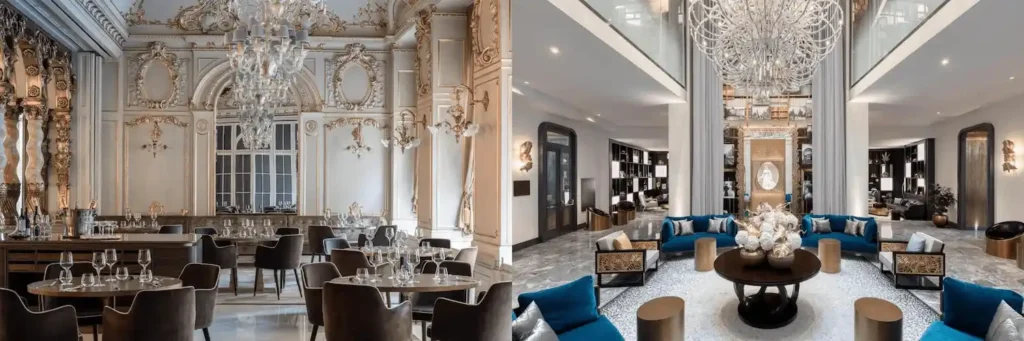
These properties anchor Budapest’s most prestigious riverfront addresses, where turn-of-the-century insurance empires and aristocratic patronage created the city’s most monumental interiors. Expect preserved winter gardens, world-renowned cafés with original frescoes, and the kind of spatial drama that modern construction cannot replicate.
🏰 Four Seasons Hotel Gresham Palace Budapest ★★★★★
The 1906 Secessionist landmark that once housed the Gresham Life Assurance Company’s Central European headquarters now represents Budapest’s most meticulous historical restoration. The building’s original Miksa Róth stained glass peacocks, heritage wrought-iron gates, and grand mosaic floors survived decades of Communist-era neglect before a comprehensive restoration returned every detail to its opening-year condition.
Walking through the lobby’s winter garden atrium, you experience the same spatial choreography London insurance executives encountered in 1906—soaring ceilings framed by ornate ironwork, natural light filtered through Art Nouveau glass, and a palpable sense of entering institutional power translated into architectural form.
No other property in Budapest offers this level of authenticated Secessionist preservation combined with Danube-facing positioning that places you directly opposite the Chain Bridge and Buda Castle.
Best for: Travelers who prioritize architectural preservation at museum-level standards and require prime riverfront positioning with direct castle views.
Signature Experience: Winter garden lobby with original 1906 ironwork and stained glass, Gresham Restaurant occupying the heritage arcade space, rooftop terrace overlooking Chain Bridge, spa integrating thermal spring water with contemporary treatments.
“Breakfast under that peacock glass ceiling—it’s not just a meal, it’s theatre.” — Henrik, StockholmCheck Availability & Rates →
🎭 Anantara New York Palace Budapest ★★★★★
The 1894 eclectic palace built as the New York Life Insurance Company’s European headquarters contains what many consider Central Europe’s most opulent café interior. The ground-floor New York Café preserves its opening-year frescoes, twisted Italian marble columns, and gilded stucco ceiling—a space that functioned as Budapest’s literary salon for over a century and remains structurally untouched since 1894.
The hotel conversion maintained this cultural anchor while transforming upper floors into contemporary luxury suites, creating a rare dual experience where you sleep in modern comfort but descend each morning into an authenticated 19th-century theatrical interior. The café’s preservation extends beyond cosmetic details—original gas lamp fixtures converted to electric, hand-painted ceiling panels restored by the same Venetian artisans who maintain St. Mark’s Basilica, and period-correct furniture reproductions based on 1894 inventory records.
Best for: Literature and art enthusiasts seeking immersion in Budapest’s Belle Époque cultural heritage with access to the city’s most photographed historic interior.
Signature Experience: New York Café with original 1894 frescoes and marble columns, Spa Mosaique featuring Byzantine-inspired thermal treatments, Palatinus Grand Ballroom hosting contemporary events in 19th-century splendor, Grand Boulevard location for direct access to Opera House quarter.
“That café alone justified the entire trip—sitting where writers argued for 120 years.” — Claudia, ViennaCheck Availability & Rates →
👑 Matild Palace, a Luxury Collection Hotel ★★★★★
The 1902 neo-baroque palace commissioned by Archduchess Maria Klotild of Saxe-Coburg and Gotha stands as Budapest’s only UNESCO World Heritage hotel, a designation earned through its preserved architectural elements and functioning historic elevator system. The Otis Elevator Company’s 1902 installation—still operational—represents one of Central Europe’s earliest passenger lift systems, maintained with original brass fixtures and mahogany paneling.
Beyond this engineering heritage, the building preserves Zsolnay ceramic tiles in their original placement patterns, neo-baroque plasterwork executed by craftsmen trained in Vienna’s Imperial workshops, and spatial proportions designed to accommodate Habsburg court protocol. The restoration focused on revealing rather than recreating—stripping away Communist-era modifications to expose authentic 1902 surfaces, then stabilizing them without cosmetic improvement. This approach creates interiors where you experience the palace’s age honestly, with patina and wear patterns that confirm rather than disguise its 122-year existence.
Best for: Heritage collectors drawn to UNESCO-protected assets and travelers who value engineering history alongside architectural preservation.
Signature Experience: Original 1902 Otis elevator system, Zsolnay ceramic tile preservation throughout public spaces, Duchess Restaurant occupying the former ballroom with retained baroque plasterwork, riverside terrace overlooking Elisabeth Bridge construction site.
“Riding that 1902 elevator daily—you feel the city’s industrial past in motion.” — Thomas, BerlinCheck Availability & Rates →
🏛️ Corinthia Budapest ★★★★★
The 1896 neo-renaissance landmark opened as the Grand Hotel Royal during Budapest’s Millennium Exhibition, establishing standards for thermal spa luxury that persist 128 years later.
The Royal Spa occupies the building’s original 1896 basement level, preserving authentic marble floors, vaulted ceilings with period-correct frescoes, and wood-carved doorframes that survived both World Wars and five decades of state ownership. What distinguishes this spa from Budapest’s many thermal bath retrofits is its unbroken operational continuity—the same spring water sources supplying the facility in 1896 still feed the pools today, following identical circulation routes through preserved Art Nouveau piping systems.
Above this subterranean heritage, the hotel maintains its grand ballroom with original 19th-century proportions and crystal chandeliers, creating a vertical experience where you move between eras by simply changing floors.
Best for: Spa-focused travelers seeking authentic thermal heritage rather than contemporary wellness retrofits, and those drawn to Budapest’s Millennium Exhibition legacy.
Signature Experience: Original 1896 Royal Spa with preserved marble and frescoes, thermal spring water from unchanged 19th-century sources, grand ballroom hosting events since opening year, Brasserie & Atrium serving beneath historic glass ceiling.
“Those spa vaults feel older than the hotel itself—like bathing in Budapest’s bedrock.” — Petra, PragueCheck Availability & Rates →
Eclectic Heritage Along Historic Boulevards
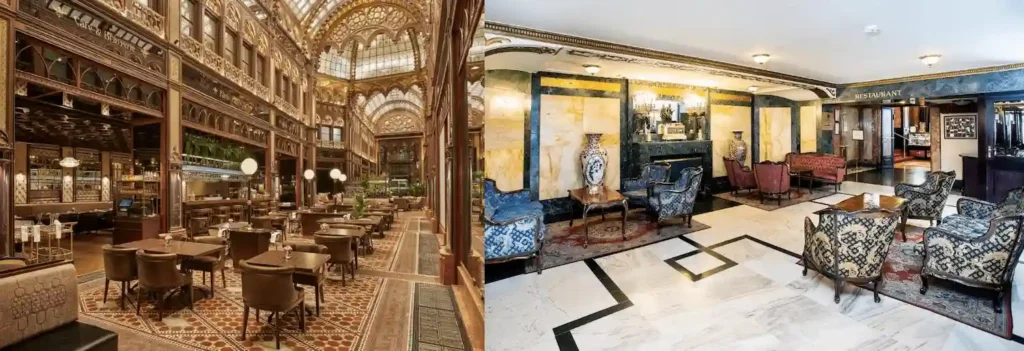
Budapest’s inner boulevards contain a concentration of 1900-1914 commercial palaces where distinctive architectural styles—Moorish Gothic, Empire neoclassicism—create experiences that diverge from the city’s dominant Secessionist narrative. These properties appeal to travelers drawn to architectural variety over stylistic consensus.
🕌 Párisi Udvar Hotel Budapest, part of Hyatt ★★★★★
The 1909 Moorish-Gothic arcade designed as a central bank and luxury shopping passage represents Budapest’s most ornate facade preservation, with over 100,000 individual Zsolnay ceramic elements restored to their original placement. The building’s architect drew direct inspiration from Parisian glass-roofed passages, adapting that typology with Hungarian ceramic craftsmanship and Islamic geometric patterns that were fashionable in Central European luxury design during the Orient-obsessed early 1900s.
The mahogany-framed glass dome crowning the central passage remains structurally original—not reconstructed, not reinforced with modern materials, but the actual 1909 ironwork and timber framework that supported the first installation. Walking through this covered arcade, you experience the same atmospheric transition 1909 shoppers encountered: stepping from street chaos into a controlled microclimate where natural light filters through colored glass, footsteps echo off ceramic walls, and spatial enclosure creates commercial intimacy.
The hotel conversion preserved this public passage function, meaning you share the space with locals crossing through as a pedestrian shortcut, which maintains the building’s original urban role.
Best for: Design-focused travelers drawn to Orientalist architecture and those seeking properties that maintain their original public function within contemporary hotel operations.
Signature Experience: Over 100,000 restored Zsolnay ceramic facade elements, original 1909 mahogany-framed glass dome passage, Párisi Passage Restaurant beneath the arcade’s historic glass ceiling, central location on Ferenciek Square for immediate access to Danube promenade.
“That ceramic facade at dusk—every tile catches light differently, it’s kinetic sculpture.” — Nikolai, MoscowCheck Availability & Rates →
🎪 Danubius Hotel Astoria City Center ★★★★★
The 1914 Empire-style landmark preserves Budapest’s most authentic turn-of-the-century hotel interior, with original mahogany wall paneling, leaded glass windows, and the city’s last functioning 1914 rotating lobby door system. Built on the site of a medieval blacksmith’s shop and 19th-century stagecoach inn, the Astoria represents continuous hospitality use across seven centuries of ownership changes, making it one of Central Europe’s few properties with documented pre-industrial service heritage.
The current building’s 1914 interiors survived Communist nationalization precisely because they were considered too modest to warrant “improvement”—while grander hotels received modern lobbies and dropped ceilings, the Astoria remained essentially unchanged, creating an accidental preservation that now represents the city’s most complete period interior.
Best for: Travelers seeking unrestored authenticity over polished luxury, and those drawn to properties with documented medieval-to-modern continuity.
Signature Experience: Original 1914 mahogany paneling with authentic patina, functioning period rotating door system, leaded glass windows throughout public spaces, Café Astoria occupying the heritage breakfast hall with retained woodwork, central intersection location marking Budapest’s historic Ring Road division.
“Everything creaks, nothing’s perfect—that’s exactly why it feels real.” — Andreas, HamburgCheck Availability & Rates →
🎭 Nemzeti Hotel Budapest – MGallery Collection ★★★★
The 1896 neo-renaissance building served as Budapest’s theatrical elite headquarters during the golden age of Hungarian drama, positioned directly beside the now-demolished National Theatre. This cultural proximity shaped the hotel’s original design—public spaces engineered for pre-performance gatherings and post-show receptions, with spatial acoustics that allowed conversation despite crowd density.
The grand 19th-century staircase ascending from the lobby preserves its opening-year proportions and wrought-iron balustrade, creating the same dramatic ascent actors and playwrights experienced when heading to their rooms after midnight premieres. The breakfast hall’s stained-glass roof represents one of Budapest’s few surviving heritage-protected glass installations from the 1890s, with original lead caming and hand-blown panes that create light patterns unchanged since the hotel’s inaugural season.
Best for: Theatre enthusiasts drawn to Budapest’s dramatic heritage and travelers who appreciate properties with cultural rather than purely architectural significance.
Signature Experience: Grand 19th-century staircase with original ironwork, heritage-protected stained-glass breakfast hall roof, proximity to former National Theatre site for cultural context, recently revealed 1896 facade portals and exterior details.
“Breakfast under that old glass roof—you understand why actors chose this place.” — Katarina, LjubljanaCheck Availability & Rates →
📊 Comparison: Best Hotels in Budapest
| Hotel | Location | Wellness & Spa | Dining | Unique Perks | Best For |
|---|---|---|---|---|---|
|
🏰 Four Seasons Gresham Palace ★★★★★ |
Danube riverfront, Chain Bridge views |
Spa with thermal water, heritage treatments |
Gresham Restaurant, winter garden setting |
1906 Secessionist glass, original ironwork |
Museum-level preservation, castle-facing luxury |
|
🎭 Anantara New York Palace ★★★★★ |
Grand Boulevard, Opera quarter |
Spa Mosaique, Byzantine thermal rituals |
New York Café, 1894 frescoes & marble |
Literary salon heritage, opulent café interiors |
Cultural immersion, Belle Époque drama |
|
👑 Matild Palace Luxury Collection ★★★★★ |
Elisabeth Bridge, riverside terrace |
Contemporary spa, heritage building |
Duchess Restaurant, baroque ballroom |
UNESCO protection, 1902 Otis elevator |
Engineering history, Habsburg provenance |
|
🏛️ Corinthia Budapest ★★★★★ |
Grand Boulevard, central Pest |
Royal Spa 1896, original marble vaults |
Brasserie & Atrium, glass-ceiling dining |
Unbroken spa heritage, thermal spring continuity |
Authentic thermal bathing, Millennium legacy |
❓ FAQ: Best Hotels in Budapest
Which Budapest hotel has the most authentic historic spa?
Corinthia Budapest operates the Royal Spa from 1896, preserving original marble floors, vaulted ceilings, and thermal spring water sources unchanged since opening. The spa’s continuous operation across 128 years, using the same underground water routes and Art Nouveau piping, creates an experience unmatched by contemporary wellness retrofits elsewhere in the city.
What makes Gresham Palace different from other Secessionist buildings?
Four Seasons Hotel Gresham Palace completed a meticulous restoration that returned every original element—Miksa Róth peacock glass, heritage ironwork gates, mosaic floors—to their 1906 condition. Unlike properties that preserved facades while modernizing interiors, Gresham maintained the winter garden atmosphere and spatial drama insurance executives experienced at opening, making it Budapest’s most complete Secessionist preservation.
Is the New York Café accessible to hotel guests only?
The New York Café at Anantara New York Palace operates as a public café welcoming non-guests, maintaining its 120-year tradition as Budapest’s literary salon. Hotel guests access the same 1894 frescoes and marble columns as day visitors, though staying in the palace allows you to experience the café across multiple times of day when tourist crowds fluctuate.
Which hotel offers the best Danube and castle views?
Four Seasons Hotel Gresham Palace holds the prime position directly opposite the Chain Bridge with unobstructed sightlines to Buda Castle. The riverfront terrace and select suites frame the same panorama that made this location Budapest’s most prestigious address when the Gresham Company chose the site in 1906.
Does Matild Palace justify its UNESCO designation?
Matild Palace earned UNESCO World Heritage status through its preserved Zsolnay ceramic tiles, neo-baroque plasterwork, and functioning 1902 Otis elevator system—one of Central Europe’s earliest passenger lifts. The designation reflects both architectural merit and successful restoration that revealed authentic 1902 surfaces rather than recreating period aesthetics, making it Budapest’s only officially protected hotel building.
What’s unique about Párisi Udvar’s arcade passage?
Párisi Udvar Hotel preserves over 100,000 individual Zsolnay ceramic elements on its Moorish-Gothic facade and maintains the original 1909 mahogany-framed glass dome—not a reconstruction but the actual timber and ironwork from opening year. The arcade functions as a public pedestrian passage, continuing its 115-year role as both luxury hotel and commercial shortcut through central Budapest.
Which property appeals to travelers seeking unrestored authenticity?
Danubius Hotel Astoria City Center presents Budapest’s most honest historic interior—original 1914 mahogany paneling showing 110 years of patina, leaded glass with period imperfections, and a functioning rotating door system with brass gearing unchanged since installation. The property avoided Communist-era “improvements” that modernized grander hotels, creating accidental preservation that now represents the city’s most complete turn-of-the-century hotel interior.
Final Verdict: Choosing Your Budapest Palace
The best hotels in Budapest represent architecturally most significant hotel conversions, where the building’s original identity—insurance palace, royal spa, theatrical headquarters—remains the primary experience rather than just marketing context. Star ratings here reflect preservation quality and operational standards, not hierarchy of choice. Availability in these heritage assets shifts quickly during high season, particularly for Danube-facing rooms at Gresham Palace and New York Café-adjacent suites at Anantara.
For more curated itineraries and luxury-focused travel insights, visit Your Luxury Guide. For official travel information and destination updates, visit Hungary tourism-info.
Booking your Budapest hotel now secures access to the city’s most authenticated 1896-1914 architectural landmarks before peak summer demand limits selection and drives premium rates for heritage-view rooms.
Your Luxury Guide — Where Exceptional Travel Begins.