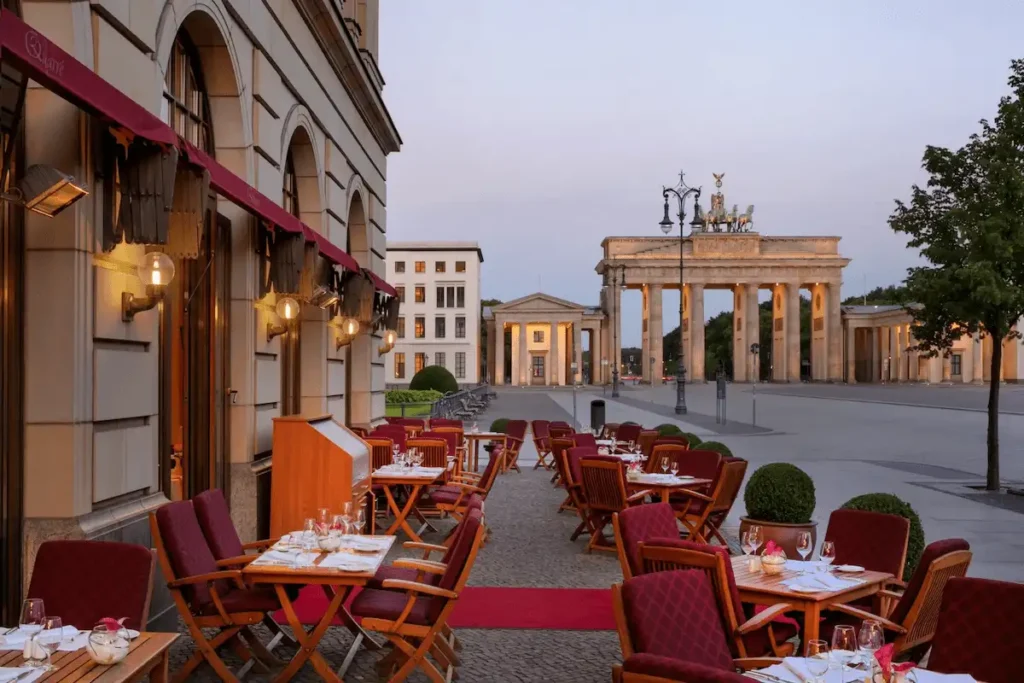
Best hotels in Berlin aren’t defined by thread count or infinity pools—they’re defined by the weight of the buildings themselves. This is a city where former embassies, imperial headquarters, and banking fortresses have been converted into properties that function as both accommodation and living architecture.
After filtering Berlin’s most significant conversions, we’ve identified seven hotels where the structure’s past life justifies the premium and enhances the experience in ways standard luxury cannot replicate.
Below are the stays that make sense if you value historical substance, architectural authority, and locations that anchor you to the city’s actual power centers—not tourist districts.
For broader context across the country, explore the best historic stays in Germany.
State Power & Diplomatic Icons
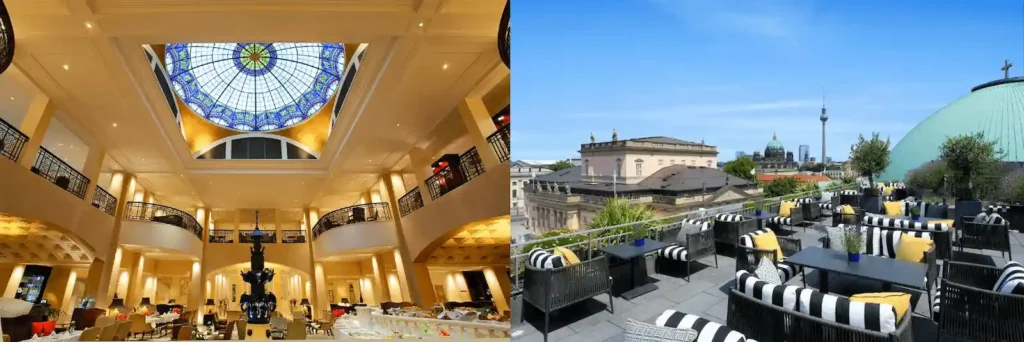
These four properties occupy buildings commissioned by emperors, state ministries, and foreign governments. The heritage isn’t decorative—it’s structural. You’re staying in spaces designed to project national authority, and that monumental scale translates into proportions, materials, and symbolic positioning no modern build can replicate.
Expect grand staircases, preserved vaults, and locations that place you at the literal center of Berlin’s historical and political gravity.
🏛️ Hotel Adlon Kempinski Berlin ★★★★★
This property sits at the Brandenburg Gate—not near it, at it—which means your view frames the single most symbolically loaded monument in modern German history. Originally commissioned by Kaiser Wilhelm II in 1907 as an unofficial state guest house, the 1997 reconstruction is an exact architectural restoration that preserves its role as Berlin’s sovereign receiving ground.
Service operates at diplomatic standard: discreet, multilingual, anticipatory without intrusion. The Lorenz Adlon Esszimmer holds two Michelin stars, but the real pull is the rooftop terrace where you’re drinking Riesling directly above the spot where Cold War ceremonial crossings occurred.
The suites overlooking Pariser Platz feel less like hotel rooms and more like private observation posts over Berlin’s central stage.
Availability tightens significantly during state visits and Berlin Fashion Week, when the property returns to its original function as a receiving house for power.
Best for: Travelers seeking Berlin’s most historically and politically symbolic address with service calibrated to diplomatic expectations.
Signature Experience: Rooftop terrace overlooking Brandenburg Gate, two-Michelin-star dining, limousine service with direct access to Museum Island, suites with floor-to-ceiling Pariser Platz views.
“Watching the sunrise over the Gate from that terrace—you’re standing at the pivot point of European history.” — Marcus, ZürichCheck Availability & Rates →
🏦 Hotel De Rome Berlin ★★★★★
You’re staying inside the former Dresdner Bank headquarters—a 19th-century financial fortress where the original steel jewel vault now functions as a swimming pool and the cashier’s hall hosts receptions under coffered ceilings that once sheltered Germany’s gold reserves.
The conversion preserved the structural authority: marble columns, brass fixtures, the bank director’s former office suite maintains its wood paneling and becomes the hotel’s top-tier historical accommodation.
Location on Bebelplatz positions you 90 seconds on foot from Unter den Linden, the State Opera, and Museum Island, making this the most central base for cultural access without crossing into tourist-district chaos.
The rooftop bar and pool offer unobstructed views over Frederick the Great’s Forum Fridericianum—the original Prussian power complex.
Service mirrors the building: precise, formal, built for clients who expect operational excellence without needing to request it twice.
Best for: Guests prioritizing Museum Island proximity, architectural substance, and a building with financial rather than aristocratic heritage.
Signature Experience: Swimming in the original bank vault, rooftop pool with State Opera views, preserved cashier’s hall for private events, suites in former director’s offices with original 1889 wood details.
“Swimming in a century-old vault while marble columns surround you—it’s absurdly cinematic and completely real.” — Elise, BrusselsCheck Availability & Rates →
📡 Telegraphenamt ★★★★★
This 1910 Neo-Baroque monument served as the Imperial German Telegraph Headquarters—the communication nerve center of the empire.
The architectural impact comes from the soaring glass-roofed courtyards and exposed raw brickwork that once housed technical operations for state telecommunications. The conversion retained industrial honesty: steel beams, original tile mosaics, and a central atrium that rises five stories and floods interiors with natural light while maintaining thermal mass that keeps rooms naturally cool in summer.
Mitte location places you equidistant from Checkpoint Charlie and the Berlin Wall Memorial, ideal for guests building a Cold War historical itinerary. The restaurant occupies the former main sorting hall, where exposed brick and minimalist Scandinavian design create a counterpoint to the building’s imperial proportions. This property appeals to travelers who want historical substance without aristocratic theatrics.
Best for: Design-focused travelers seeking industrial imperial architecture with Mitte access and minimalist Scandinavian interiors inside monumental historic structure.
Signature Experience: Glass-roofed courtyards with original telegraph infrastructure visible, exposed brick and steel beam interiors, five-story central atrium, restaurant in former sorting hall with thermal-cooled natural climate control.
“That atrium at dawn—light pouring through original industrial glass into a space that once coordinated an empire’s communications.” — Johan, StockholmCheck Availability & Rates →
🕊️ Das Stue ★★★★★
This 1938 Neoclassical structure served as the Royal Danish Embassy—a protected monument designed by Johann Emil Schaudt that now operates as Berlin’s most intimate luxury conversion. The heritage is visible in the monumental curved travertine staircase that dominates the entry and the “Embassy Suites” which retain the proportions and wood paneling of the original diplomatic offices.
Tiergarten location is exceptional: you’re inside the park itself, surrounded by 520 acres of forest with Zoo Berlin directly adjacent and the Victory Column a five-minute walk. The property operates at boutique scale—78 rooms—which allows service to function with resort-level personalization rare in urban Berlin. The Cinco by Paco Pérez brings Michelin-level Mediterranean dining into a setting that feels residential rather than hotel formal.
This works best for travelers who want diplomatic-grade heritage with park tranquility and discreet service that never feels corporate.
Best for: Guests seeking protected diplomatic architecture with Tiergarten forest access, boutique-scale personalization, and Michelin dining in residential embassy setting.
Signature Experience: Curved travertine embassy staircase, suites in former diplomatic offices with preserved 1938 wood paneling, Michelin-starred Cinco restaurant, direct Tiergarten forest access with Zoo Berlin adjacent.
“Breakfast on the terrace with nothing but forest canopy and birdsong—you forget you’re in the capital until you choose to remember.” — Astrid, CopenhagenCheck Availability & Rates →
Cultural & Aristocratic Landmarks
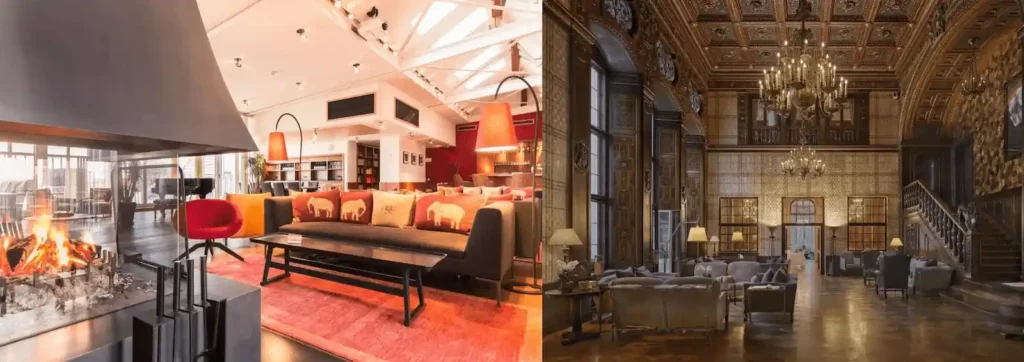
These three properties represent Berlin’s intellectual, artistic, and noble heritage. The buildings served as cultural gathering points, aristocratic residences, and judicial institutions—spaces where social power rather than state authority defined their original purpose. The conversions emphasize preserved interiors: original staircases, libraries, even prison cells.
Expect smaller scale, neighborhood integration, and architecture that tells stories about Berlin’s cultural evolution rather than its political dominance.
🎭 Orania.Berlin ★★★★★
This 1913 structure survived both World Wars as the Café Oranienpalast—a landmark cabaret and concert hall that anchored Kreuzberg’s intellectual and artistic scene through every regime change Berlin endured. The 1913 facade remains protected, and the conversion retained the “Salon” with its grand piano and original stucco work where pre-war performances occurred.
Kreuzberg location puts you in Berlin’s most culturally layered neighborhood: Turkish markets, Cold War squats turned galleries, and street-level vitality that feels worlds away from Mitte’s tourist infrastructure.
The property operates as both hotel and cultural venue—regular concerts, art exhibitions, and a bar that functions as neighborhood anchor rather than hotel amenity.
This suits travelers who want verified heritage without imperial scale, and who value being embedded in Berlin’s actual contemporary creative district.
Best for: Culturally engaged travelers seeking authentic Kreuzberg immersion with cabaret-era architecture and ongoing arts programming in a living neighborhood venue.
Signature Experience: Preserved 1913 cabaret salon with grand piano and original stucco, regular concert series and art exhibitions, rooftop terrace overlooking Kreuzberg, hotel-as-cultural-venue with neighborhood bar integration.
“Hearing live jazz in the same salon where Weimar-era performers played—the architecture holds that memory in the walls.” — Claudia, ViennaCheck Availability & Rates →
🏰 Schlosshotel Berlin ★★★★★
This Renaissance-style palace was built in 1911 for Walter von Pannwitz, the Kaiser’s personal legal advisor—an authentic aristocratic residence that preserves the original wood-carved staircase, library with floor-to-ceiling oak shelving, and proportions designed for noble entertaining.
Grunewald location offers something rare in Berlin: forest seclusion with 30-minute access to central districts. The 10-acre private park includes century-old trees, a private lake, and walking trails that connect directly to Grunewald forest preserve.
The conversion retained imperial-era details—chandeliers, parquet floors, fireplaces—while introducing Karl Lagerfeld interiors in select suites that layer contemporary design over historical bones.
Service operates at estate standard: personal butler service, in-room fireplaces lit on request, and a Michelin-starred restaurant that feels like dining in a private palace rather than a hotel.
This appeals to travelers who want titled-estate heritage with forest privacy and service calibrated to residential rather than commercial hospitality.
Best for: Guests prioritizing imperial noble architecture with forest estate privacy, butler service, and Michelin dining in a setting that replicates aristocratic residential life.
Signature Experience: Original 1911 wood-carved staircase and oak library, 10-acre private park with lake and Grunewald forest trails, Karl Lagerfeld-designed suites, Michelin-starred dining with personal butler service and in-room fireplaces.
“Morning walks through private forest trails before returning to a lit fireplace and butler-prepared breakfast—pure estate living.” — Heinrich, MunichCheck Availability & Rates →
⚖️ Wilmina Hotel ★★★★
This 1896 structure served as a women’s judicial prison and courthouse—an exceptionally rare heritage type that preserves original cell doors, barred windows, and the walled prison courtyard now transformed into the “Lovis” restaurant and bar. The architecture functions as narrative: long corridors with high ceilings and original brass fixtures create a sense of institutional scale softened by contemporary Scandinavian design that respects rather than erases the building’s judicial past.
Charlottenburg location offers residential neighborhood access with direct proximity to Kurfürstendamm shopping and Zoo Berlin. The conversion retained structural honesty—exposed brick, original steel doors, and a spa built within the former solitary confinement wing where small windows and thick walls create an atmosphere of profound quiet.
This property appeals to travelers who want significant historical architecture that tells an unusual story and value design that acknowledges rather than conceals a building’s difficult past.
Best for: Design-conscious travelers seeking rare judicial architecture with original prison features preserved, Scandinavian interiors, and Charlottenburg residential neighborhood access.
Signature Experience: Original 1896 prison cells with preserved doors and barred windows, restaurant in walled prison courtyard, spa in former solitary wing with thick-wall acoustic isolation, exposed brick and brass fixtures throughout.
“Dining in the courtyard where prisoners once walked—the walls hold that weight, and the design honors rather than hides it.” — Petra, HamburgCheck Availability & Rates →
📊 Comparison: Best Hotels in Berlin
| Hotel | Location | Wellness & Spa | Dining | Unique Perks | Best For |
|---|---|---|---|---|---|
|
Hotel Adlon ★★★★★ |
Brandenburg Gate, Pariser Platz |
Spa by Resense, indoor pool |
Two Michelin stars, rooftop terrace dining |
Kaiser’s guest house, Gate views |
Diplomatic heritage, state-level service |
|
Hotel De Rome ★★★★★ |
Bebelplatz, Museum Island access |
Pool in original bank vault |
Rooftop bar, Opera House views |
Dresdner Bank HQ, preserved vault |
Financial heritage, cultural proximity |
|
Telegraph. ★★★★★ |
Mitte, Checkpoint Charlie area |
Thermal courtyard cooling system |
Former sorting hall restaurant |
Imperial Telegraph HQ, glass-roofed atriums |
Industrial heritage, minimalist design |
|
Das Stue ★★★★★ |
Tiergarten, inside park |
Intimate spa, forest-view treatments |
Michelin-starred Cinco, Mediterranean |
Danish Embassy, travertine staircase |
Diplomatic intimacy, park tranquility |
- Continue exploring historic stays with the best luxury castles near Berlin.
❓ FAQ: Best Hotels in Berlin
What makes Berlin’s best hotels different from standard luxury properties?
Berlin’s top hotels occupy buildings commissioned by emperors, state ministries, and foreign governments—former embassies, bank headquarters, and telegraph centers where the architecture itself conveys historical authority. You’re staying in structures designed to project national power, which translates into monumental proportions, preserved materials like marble and brass, and locations at the literal center of the city’s political and cultural gravity. Properties like Hotel Adlon Kempinski and Hotel De Rome deliver heritage substance no modern build can replicate.
Which Berlin hotel offers the most significant historical architecture?
Hotel Adlon Kempinski Berlin occupies the most symbolically loaded location—directly at Brandenburg Gate—as the former Kaiser’s unofficial guest house. Hotel De Rome offers the most structurally dramatic conversion, preserving the original Dresdner Bank vault as a swimming pool and the cashier’s hall for events. Telegraphenamt provides the most intact industrial imperial architecture with its glass-roofed telegraph sorting halls.
Where should I stay in Berlin for Museum Island access?
Hotel De Rome on Bebelplatz places you 90 seconds on foot from Museum Island, the State Opera, and Unter den Linden. This former bank headquarters offers the most central base for cultural access without crossing into tourist-district chaos, with rooftop views over Frederick the Great’s Forum Fridericianum.
Which Berlin historic hotel offers the most privacy?
Schlosshotel Berlin in Grunewald provides 10-acre private park grounds with forest trails connecting to the larger Grunewald preserve—you’re staying in a 1911 imperial palace with butler service and estate-level seclusion, 30 minutes from central districts. Das Stue offers similar tranquility inside Tiergarten park itself, with 520 acres of forest surrounding the former Danish Embassy.
Do Berlin’s best hotels require advance booking?
Properties like Hotel Adlon Kempinski and Das Stue fill quickly during state visits, Berlin Fashion Week, and major cultural events when rooms return to their original diplomatic and receiving functions. Embassy Suites at Das Stue and vault-view rooms at Hotel De Rome are particularly limited. Booking 90+ days ahead secures better suite selection and avoids premium surge periods.
Which Berlin hotel best combines historical with contemporary design?
Telegraphenamt layers minimalist Scandinavian interiors inside the 1910 Neo-Baroque telegraph headquarters, preserving industrial elements like exposed brick and steel beams while introducing clean-lined furniture and natural materials. Wilmina Hotel follows similar logic, respecting its 1896 judicial prison architecture with Scandinavian design that acknowledges rather than erases the building’s institutional past.
What’s the best historic hotel for Michelin dining in Berlin?
Hotel Adlon Kempinski houses the two-Michelin-star Lorenz Adlon Esszimmer with Brandenburg Gate views. Das Stue offers Cinco by Paco Pérez, bringing Mediterranean Michelin-level cuisine into the intimate setting of the former Danish Embassy. Schlosshotel Berlin’s Michelin-starred restaurant operates inside the 1911 palace with butler service and private estate atmosphere.
Final Verdict: Where Berlin’s Architectural Power Justifies the Premium
Selecting the right hotel in Berlin isn’t about amenities—it’s about choosing a building whose past life enhances your understanding of the city’s layered power structures. The properties above represent conversions where imperial, diplomatic, or cultural authority remains structurally visible and experientially meaningful. Availability at embassy-grade properties shifts rapidly during state visits and cultural peak seasons.
For refined iconic stays beyond the capital, compare best hotels in Munich and discover architectural depth in best hotels Dresden.
For more curated itineraries and luxury-focused travel insights, visit Your Luxury Guide. For official travel information and destination updates, visit Germany tourism-info.
Booking your Berlin historic hotel now secures access to the city’s most historically commanding addresses before seasonal demand drives inventory to diplomatic-block reservations and VIP holds.
Your Luxury Guide — Where Exceptional Travel Begins.