The best hotels in Basel aren’t five-star newcomers—they’re 17th-century Rhine anchors, converted monasteries, and former prison cells that now function as Switzerland’s most architecturally honest accommodations. Choosing where to stay here means deciding between Napoleonic ballrooms or medieval fortifications, between neo-Renaissance grandeur or Romanesque stone corridors.
After filtering Basel’s most historically significant properties, we selected six hotels that deliver on history depth, service precision, and architectural soul—not just proximity to the Kunstmuseum.
Below are the stays that make sense if you value buildings with verified past lives over generic luxury branding.
For a broader perspective on Switzerland’s most refined heritage properties, explore guide to the best historical hotels Switzerland.
Rhine Anchor Hotels: Grand Hotel Power on the Water
These are Basel’s original social institutions—properties built when the Rhine was both trade route and status symbol. They defined the city’s 19th-century hotel culture and continue to anchor Basel’s luxury hospitality today. Expect high-ceilinged salons, formal riverside dining, and service protocols shaped by centuries of diplomatic arrivals.
🏛️ Grand Hotel LES TROIS ROIS ★★★★★
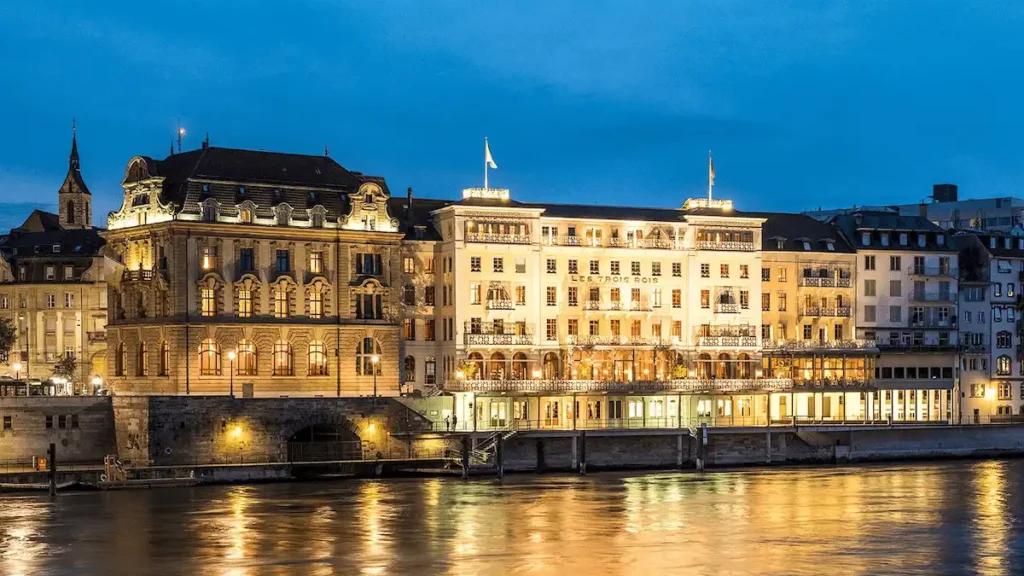
This is Basel’s oldest documented hotel site, operational since 1681, and the city’s most powerful social institution. Napoleon stayed here, as did Theodor Herzl and Picasso—not for marketing value, but because this was where European power convened in Basel. The property sits directly on the Rhine with triple-arched windows facing the water, preserving the formal grandeur of 19th-century “Grand Hotel” culture.
Service here operates with Swiss precision layered over centuries of diplomatic protocol. Rooms blend Empire-style furnishings with contemporary comfort, but the real draw is the public presence—this is where Basel’s political and cultural elite still gather. The Cheval Blanc restaurant holds three Michelin stars, and the terrace remains the city’s most visible luxury dining stage.
Booking here positions you at the historical and social center of Basel, not just near it.
Best for: Travelers seeking verified 17th-century Rhine-side heritage with three-Michelin-star dining and Basel’s most historically anchored social presence.
Signature Experience: Triple-arched Rhine views from Empire-style suites, Cheval Blanc three-Michelin-star dining, La Brasserie terrace overlooking Mittlere Brücke, Cinq Mondes spa with river-facing treatment rooms.
“Breakfast on that Rhine terrace—you’re sitting where Napoleon sat. That alone.” — Thomas, GenevaCheck Availability & Rates →
🌊 Krafft Basel ★★★★
Built in 1873 by architect Ferdinand Iselin, this is Kleinbasel’s defining architectural anchor on the Rhine’s right bank. Hermann Hesse wrote Steppenwolf here, and the property preserves the 19th-century intellectual and bourgeois soul of Basel’s literary golden age.
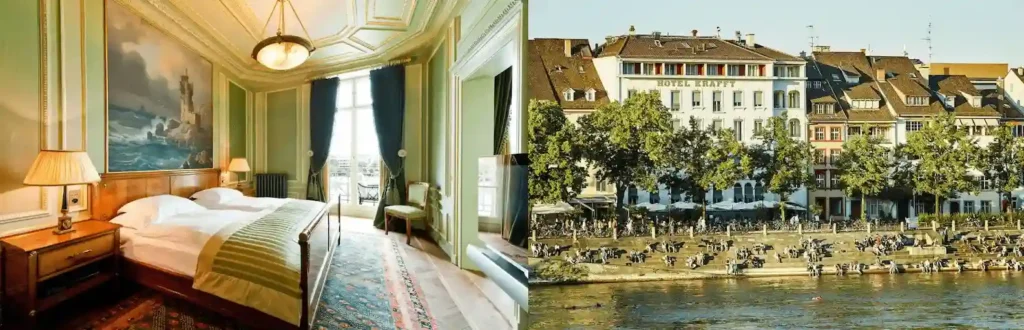
Unlike the grand formality across the river, Krafft maintains an intimate, almost residential scale—rooms face the water with floor-to-ceiling windows, and the atmosphere leans cultural rather than diplomatic. The interior retains original wood paneling and high stucco ceilings, balanced with contemporary art installations that respect the building’s proportions.
The riverside terrace functions as Kleinbasel’s most discreet luxury dining space, frequented by locals who value heritage without ceremony.
Service here is Swiss-efficient but unpretentious, appealing to travelers drawn to literary history and quieter Rhine-side positioning.
Booking Krafft makes sense if you want verified 1873 architecture without grand hotel formality.
Best for: Literary-minded travelers seeking 1873 Rhine-side heritage with intimate scale, Hesse’s creative legacy, and Kleinbasel’s quieter cultural character.
Signature Experience: Hermann Hesse’s writing rooms preserved with original decor, Rhine-facing terrace dining with local wine pairings, 19th-century wood-paneled salons, contemporary art exhibitions in historic halls.
“You wake up in the same room where Hesse wrote. Not a replica—the actual space.” — Elena, ZurichCheck Availability & Rates →
🏨 Hotel Euler Basel ★★★★
Founded in 1867 near Basel SBB, this is Switzerland’s grand hotel expression of industrial-era luxury positioned for railway aristocracy. The property survived two world wars and hosted global celebrities drawn to Basel’s pharmaceutical and banking power. It retains the high-ceilinged proportions and formal entry protocols of 19th-century station hotels, but the interiors have been updated with contemporary finishes that respect the original architecture.
Rooms feature tall windows and marble bathrooms, and the brasserie preserves the Belle Époque atmosphere of European train-station dining culture.
Service here operates with Swiss precision but without the Rhine-side formality of Les Trois Rois.
The location near the station appeals to travelers prioritizing direct access to Zurich, Lucerne, and international rail connections over waterfront positioning.
Booking Euler makes sense if you value verified 1867 grand hotel heritage with railway convenience.
Best for: Travelers seeking 1867 railway-era grand hotel architecture with Belle Époque dining culture and direct Basel SBB station proximity.
Signature Experience: Belle Époque brasserie with original stucco detailing, high-ceilinged suites with marble bathrooms, grand staircase preserved from 1867 construction, Swiss business-class service protocols.
“That staircase alone—you feel the weight of 150 years every time you descend.” — Marcus, BerlinCheck Availability & Rates →
Medieval Conversion Hotels: Living Archaeological Sites
These properties aren’t renovations—they’re structural integrations of Basel’s 11th and 13th-century defensive history.
Expect exposed medieval masonry, preserved prison cells, and monastery walls functioning as load-bearing architecture. The heritage here is tactile, not decorative.
🕯️ Gast- und Kulturhaus Der Teufelhof Basel ★★★★
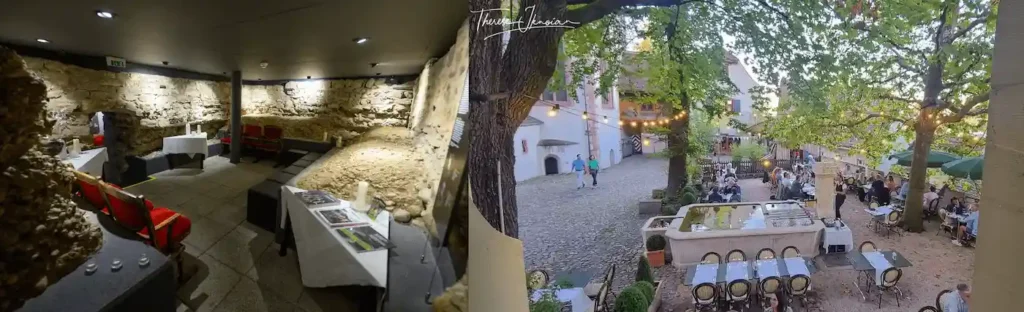
This property sits directly atop Basel’s 11th and 13th-century defensive walls, functioning as a living archaeological site where medieval fortifications remain structurally visible. Original masonry has been exposed in rooms and hallways, and the hotel preserves the heavy stone proportions of Basel’s ancient military protection.
The complex also houses an art gallery and two restaurants, creating a cultural atmosphere layered over medieval foundations. Rooms vary in scale—some retain the cell-like dimensions of the original fortress structure, others open into vaulted spaces where defensive walls once stood. Service here leans informal and art-focused, appealing to travelers drawn to Basel’s contemporary art scene as much as its medieval past.
The location in Altstadt places you within walking distance of Münster and Marktplatz. Booking Der Teufelhof makes sense if you prioritize direct contact with 11th-century fortifications over polished luxury finishes.
Best for: Art-conscious travelers seeking 11th-century defensive wall integration with contemporary gallery culture and tactile medieval architecture.
Signature Experience: Exposed 11th-century fortress walls in suites, on-site art gallery with rotating exhibitions, dual-restaurant concept within medieval structure, Altstadt positioning near Münster.
“Your bedroom wall is literally part of Basel’s original fortifications. Surreal.” — Sophia, ViennaCheck Availability & Rates →
⚖️ hotel brasserie au violon
Originally an 11th-century Augustinian monastery, this property served as Basel’s Lohnhof Prison until 1995—making it one of Europe’s most extreme “Past Life” hotel conversions.
The structure preserves the cell-like architecture and heavy stone corridors of the medieval judicial system, with original iron doors and fortress-weight walls still intact. Rooms retain the monastery’s Romanesque proportions, and the brasserie operates in the former prison refectory with vaulted ceilings and minimal contemporary intervention.
The atmosphere here is intentionally austere—this is not polished luxury, but direct architectural contact with Basel’s monastic and penal history. Service is straightforward and unpretentious, appealing to travelers who value structural honesty over decorative comfort.
The Altstadt location places you near Barfüsserplatz and Marktplatz. Booking au violon makes sense if you want to sleep in a verified 11th-century monastery turned 20th-century prison.
Best for: Travelers seeking 11th-century monastery and former prison architecture with Romanesque stonework, austere heritage atmosphere, and extreme “Past Life” conversion.
Signature Experience: Former prison cells converted to guest rooms, Romanesque refectory now functioning as brasserie, original iron doors preserved in corridors, unpolished medieval stone interiors.
“Sleeping in an actual prison cell with 900-year-old walls—nothing else compares.” — Lukas, MunichCheck Availability & Rates →
🏛️ Hotel Märthof Basel ★★★★
Housed in a landmark neo-Renaissance building on Marktplatz, this property served as the primary commercial anchor of Basel’s central square during the city’s banking and trade golden age.
The facade retains the grand stone proportions and high-vaulted entry hall of 19th-century civic architecture, and interiors preserve the original stucco detailing and formal ceiling heights. Rooms overlook Marktplatz or the adjacent medieval streets, offering views of Basel’s Rathaus and daily market activity.
The atmosphere here balances civic grandeur with boutique-scale service, appealing to travelers drawn to central positioning without grand hotel formality.
The location places you at the literal heart of Basel’s Altstadt, within walking distance of Münster, Rathaus, and Rhine bridges.
Booking Märthof makes sense if you value neo-Renaissance architecture and direct Marktplatz access over Rhine-side positioning.
Best for: Travelers seeking neo-Renaissance civic architecture with Marktplatz views, central Altstadt positioning, and boutique service within a 19th-century trade hub.
Signature Experience: Neo-Renaissance facade overlooking Marktplatz, high-vaulted entry hall with original stucco, Rathaus views from upper suites, daily market activity visible from breakfast rooms.
“Waking up to the Marktplatz market below—you’re staying inside Basel’s living center.” — Anna, BernCheck Availability & Rates →
📊 Comparison: Best Hotels in Basel
| Hotel | Location | Wellness & Spa | Dining | Unique Perks | Best For |
|---|---|---|---|---|---|
|
🏛️ Grand Hotel LES TROIS ★★★★★ |
Rhine riverside, Altstadt |
Cinq Mondes spa, river-view treatments |
Cheval Blanc 3-star, La Brasserie terrace |
1681 heritage, Napoleon’s rooms |
Grand Hotel prestige, diplomatic history |
|
🌊 Krafft Basel ★★★★ |
Rhine Kleinbasel, right bank |
Intimate wellness, sauna facilities |
Riverside terrace, local wine focus |
Hermann Hesse’s writing room |
Literary heritage, quieter Rhine-side |
|
🏨 Hotel Euler ★★★★ |
Near Basel SBB, station district |
Fitness facilities, wellness packages |
Belle Époque brasserie |
1867 railway-era grand hotel |
Railway convenience, industrial-era luxury |
- If you’re comparing Basel’s historical scene with other Swiss cities, continue with the best hotels in Zurich to explore Switzerland’s financial capital’s converted guild halls and Belle Époque lakeside institutions.
❓ FAQ: Best Hotels in Basel
What makes a hotel in Basel “historic” or “heritage”?
A Basel historic hotel occupies a building with verified historical function—monasteries converted to accommodations, 17th-century Rhine-side grand hotels, or former prisons retaining medieval architecture. These are not themed properties; they’re structural conversions where the original purpose remains architecturally legible. Grand Hotel Les Trois Rois has operated since 1681, and hotel brasserie au violon functioned as Basel’s Lohnhof Prison until 1995. The building’s past life must be documented, not decorative.
Which Basel hotel has the strongest historical credentials?
Grand Hotel Les Trois Rois holds Basel’s deepest documented heritage, with a hotel presence on this Rhine site since 1681. Napoleon, Picasso, and Theodor Herzl stayed here—not for marketing, but because this was Switzerland’s most powerful social institution on the Rhine. The property retains Empire-style interiors and Cheval Blanc’s three Michelin stars. If you prioritize verified centuries-old pedigree, Les Trois Rois is Basel’s architectural and social anchor.
Are Basel’s heritage hotels located in Altstadt or near the Rhine?
Most occupy both—Altstadt medieval streets meet the Rhine waterfront in Basel’s historic core. Les Trois Rois and Krafft Basel sit directly on the Rhine with rooms facing the water. Der Teufelhof and au violon embed into Altstadt’s medieval fortifications. Märthof overlooks Marktplatz at the city’s civic center. If you want Rhine views, book Les Trois Rois or Krafft; for medieval walls, choose Der Teufelhof or au violon.
Which best hotels in Basel offer medieval architecture?
Gast- und Kulturhaus Der Teufelhof and hotel brasserie au violon preserve Basel’s 11th and 13th-century defensive and monastic structures. Der Teufelhof sits atop the city’s medieval walls with exposed fortifications in guest rooms. Au violon converts an 11th-century Augustinian monastery that later served as a prison—original cells and Romanesque stonework remain intact. Both offer tactile contact with Basel’s medieval past, not decorative recreations.
Do Basel historic hotels cater to luxury travelers or history enthusiasts?
They serve both, but in different expressions. Grand Hotel Les Trois Rois delivers three-Michelin-star dining and five-star Rhine-side service within 1681 architecture—luxury wrapped in verified heritage. Au violon offers austere, cell-like rooms with 900-year-old walls and minimal polish—heritage prioritized over luxury finishes. Krafft Basel balances both: 1873 literary history with contemporary comfort. Choose based on whether you prioritize polish or structural honesty.
Should I book a Rhine-view room in Basel’s historic hotels?
If you’re staying at Les Trois Rois or Krafft Basel, yes—Rhine views are central to the experience. Both properties were built to face the water, and rooms overlooking the river capture the 19th-century grand hotel positioning that made these hotels Basel’s social anchors. At medieval conversions like Der Teufelhof or au violon, interior courtyard or fortification-facing rooms offer more architectural immersion than water views.
What’s the best historic hotel in Basel for first-time visitors?
Grand Hotel Les Trois Rois combines the deepest historical pedigree with contemporary luxury infrastructure—Michelin dining, Rhine-side terrace, and rooms where European power brokers convened for over three centuries. It positions you at Basel’s social and architectural center, within walking distance of Münster, Altstadt, and both Rhine bridges. If you want one property that captures Basel’s heritage essence with polished service, book Les Trois Rois.
Which Basel Historic Hotel Suits Your Stay?
Booking the right hotel in Basel means choosing between Rhine-side grand hotel power and medieval fortification immersion—not star ratings. The properties above represent Basel’s most architecturally honest stays, from 1681 social institutions to converted 11th-century monasteries. Availability at this heritage level shifts quickly during Art Basel and Baselworld seasons.
For Switzerland’s broader historical collection, explore best hotels in Lucerne to compare lakeside Belle Époque estates and Alpine grand hotels.
For more curated itineraries and luxury-focused travel insights, visit Your Luxury Guide. For official travel information and destination updates, visit Switzerland tourism-info.
Booking your Basel historic hotel secures access to properties where the city’s medieval defensive soul, Rhine-side mercantile power, and 19th-century Neo-Renaissance ambitions converge within buildings that functioned as civic anchors long before they became global hospitality icons.
Your Luxury Guide — Where Exceptional Travel Begins.