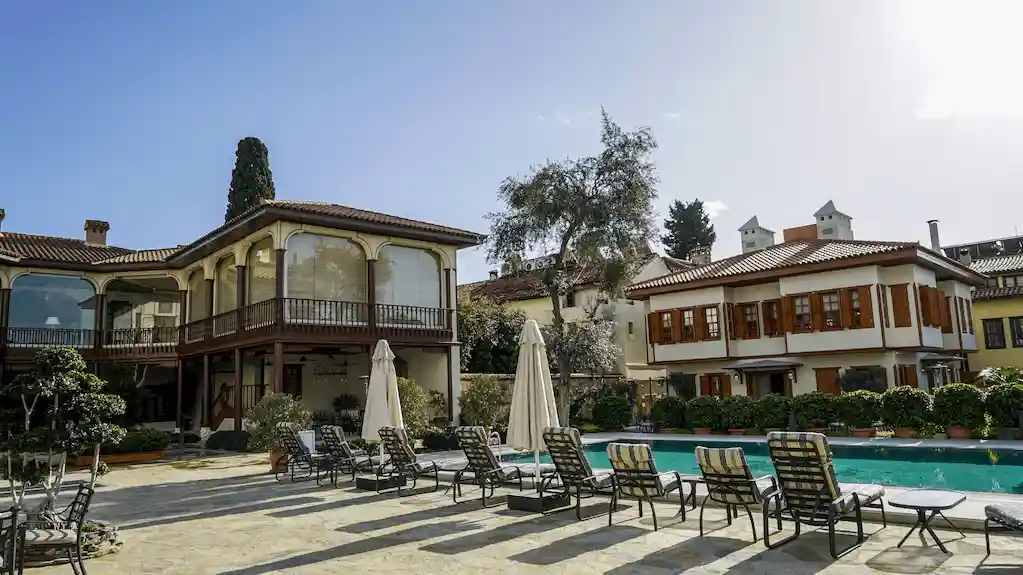
The best hotels in Antalya Turkey aren’t found in Lara Beach’s glass towers—they’re hidden inside Kaleiçi’s Ottoman quarter, where 18th-century Pasha residences and marble-floored Roman villas still stand. Most travelers miss this entirely, booking branded resorts that could exist anywhere from Dubai to Cancun. The real luxury in Antalya is architectural: staying inside a building that predates the Turkish Republic by two centuries.
We audited the old quarter’s inventory and rejected every property lacking verified provenance or original structural elements. What remains are seven conversions where Ottoman nobility, port merchants, and archaeological layers form the foundation of the experience. This is the only curated selection in Antalya that prioritizes building significance over star ratings. Every property below has documented historical identity and maintains original architectural features—no replicas, no theme park Ottoman. If you’re booking Antalya for the first time, start here.
Kaleiçi’s Premier Ottoman Conversions
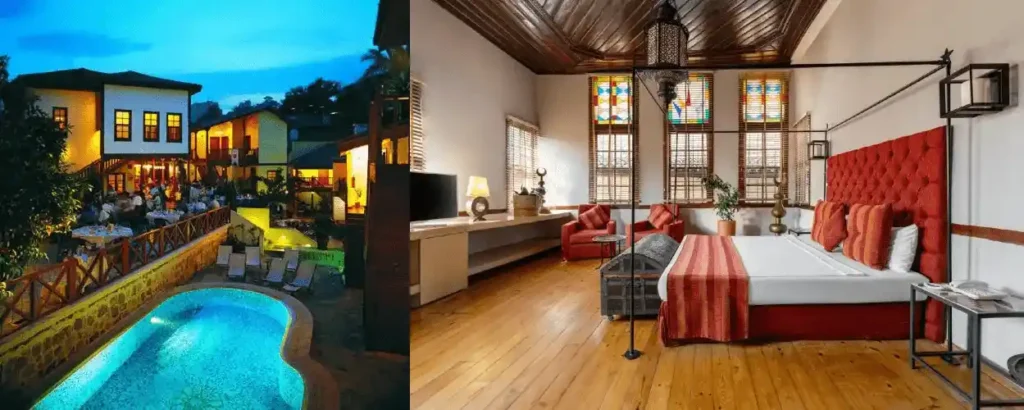
These aren’t boutique hotels that borrowed Ottoman motifs—they’re the actual residences where the ruling class lived, governed, and entertained. Each property maintains the original “konak” layout: private courtyards, hand-carved ceilings, and stone cooling systems that predate air conditioning by 200 years.
What separates these from standard restorations is material authenticity. You’re walking on the same marble flooring Ottoman administrators used. The wooden lattice windows still function. The cisterns still hold water. Kaleiçi’s premium tier represents the highest concentration of verified 18th-century domestic architecture still operating as accommodation in the entire Mediterranean.
⚔️ RuinAdalia Hotel – Adult Only
RuinAdalia isn’t a hotel built near ruins—it’s a hotel built over them. This 19th-century Ottoman complex of five interconnected mansions sits directly atop a major archaeological site spanning three civilizations. The lobby floor is transparent glass revealing Roman mosaics in situ. The restaurant’s foundation exposes Byzantine cisterns. Seljuk defensive walls run through the bar.
Every suite maintains the original Ottoman mansion layout—high ceilings, carved wooden cupboards, stone archways—while the subterranean levels function as a live excavation museum. The rooftop terrace overlooks both the Mediterranean and Kaleiçi’s maze of terracotta roofs, positioning you above the only neighborhood in Turkey where continuous habitation stretches back 2,300 years.
No other property in Antalya offers this archaeological depth beneath contemporary luxury. The adult-only policy ensures the site’s scholarly atmosphere remains undisturbed.
Best for: Couples seeking verified Roman-era provenance with in-room archaeological viewing and uninterrupted access to Antalya’s densest historical layer.
Signature Experience: Glass-floored lobby revealing Roman mosaics, Byzantine cistern bar, Seljuk wall integration, rooftop Mediterranean views, in-house archaeological exhibitions.
“Standing over a 1,800-year-old mosaic while drinking Turkish coffee—that’s worth the entire trip.” — Marcus, ViennaCheck Availability & Rates →
🏛️ Tekeli Konaklari
Tekeli Konaklari is the private compound an Ottoman Pasha built for his family in the 1700s—six traditional houses arranged around a central courtyard, now operating as Antalya’s most architecturally complete Ottoman estate. The preservation is institutional-grade: the original “Haremlik” (women’s quarters) and “Selamlik” (men’s reception hall) divisions remain intact with period-appropriate furnishings.
Stone elements date to the 1300s Seljuk period, salvaged from the local Seigniory and embedded into walls and arches. Each suite occupies a separate house, meaning total privacy within a historically unified compound. The estate’s garden uses the original Ottoman irrigation system—stone channels carved seven centuries ago still distribute water to fig and pomegranate trees.
What you’re booking isn’t a hotel room; it’s tenancy in a preserved aristocratic household that predates modern Turkey by 200 years.
Best for: Travelers prioritizing architectural completeness and multi-century material authenticity within a historically unified Ottoman estate.
Signature Experience: Intact Haremlik-Selamlik quarters, 700-year-old Seljuk stonework, private house suites, original Ottoman irrigation channels, courtyard fig garden.
“Every corner had a story—stones older than most European cathedrals, just part of the walls.” — Elena, MilanCheck Availability & Rates →
👑 Alp Pasa Hotel – Special Class
Alp Pasa represents the administrative elite’s domestic architecture—mansions built in the 18th and 19th centuries for Antalya’s highest-ranking Ottoman governors. The Pasha-grade distinction is visible immediately: hand-carved wooden ceilings with geometric Islamic patterns that required master artisans months to complete.
The courtyard’s centerpiece is a 2,000-year-old Roman column, not decorative but structural—it still supports part of the building’s weight. Suites maintain the original spatial hierarchy of Ottoman nobility: separate sitting areas, elevated sleeping platforms, and carved wooden storage that functions as room dividers. The stone courtyard remains the social center, just as it was 250 years ago when Pashas received officials and foreign dignitaries.
Alp Pasa earned “Special Class” designation from Turkey’s Ministry of Culture, a rating reserved for properties of national architectural significance.
Best for: Guests valuing Pasha-grade craftsmanship and Roman-Ottoman material continuity within a Ministry-designated landmark property.
Signature Experience: Hand-carved Pasha ceilings, 2,000-year-old structural Roman column, elevated Ottoman sleeping platforms, Ministry of Culture Special Class status.
“That ceiling alone deserves museum status—it’s absurd that you can sleep beneath it.” — James, LondonCheck Availability & Rates →
🌳 Tuvana Hotel
Tuvana began as the private residence of Abdi Efendi, a high-ranking Ottoman officer who built his family compound in the 1700s. Today it operates as four listed buildings connected by stone passageways and courtyard gardens thick with citrus trees. The defining architectural feature is the traditional “Cumbalı” design—cantilevered bay windows that project over the street, originally built to expand interior space without increasing the building’s footprint.
These hand-carved wooden bays still function, flooding rooms with filtered light while maintaining the privacy Ottoman domestic architecture prioritized. The exposed timber beams are original 18th-century construction, never replaced, only reinforced where necessary. Tuvana’s garden courtyard doubles as an open-air lounge where the temperature drops 10 degrees beneath ancient stone arches—a passive cooling system that predates electricity by two centuries.
Best for: Solo travelers and small groups seeking authentic Ottoman residential layout with functioning 18th-century architectural features and garden tranquility.
Signature Experience: Traditional Cumbalı bay windows, original timber beam construction, four-building listed complex, stone courtyard passive cooling, citrus tree garden.
“The courtyard at dusk, with those lanterns and old stone—felt like stepping into another century.” — Ayşe, IstanbulCheck Availability & Rates →
Harbor-Facing Ottoman & Archaeological Layers
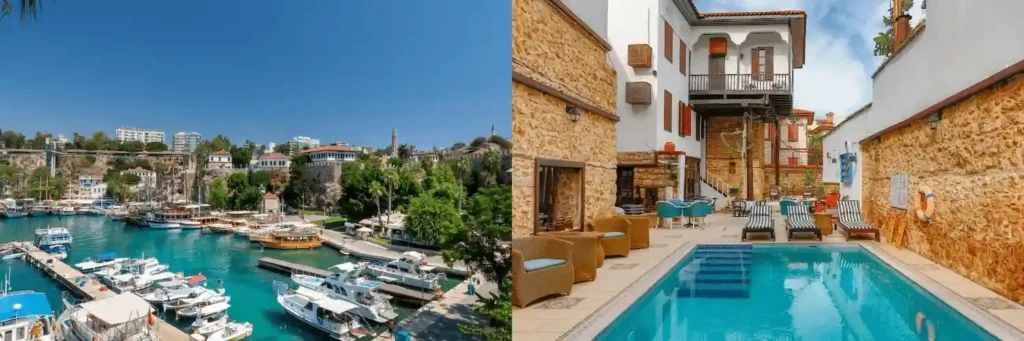
Kaleiçi’s eastern edge drops directly into Antalya’s Roman-era harbor, where the city’s commercial identity was forged over two millennia. The hotels here aren’t just Ottoman—they’re maritime architecture, built when the port was the primary economic engine of the Pamphylian coast.
Stone warehouses, merchant houses, and administrative buildings converted into contemporary accommodation while maintaining their original function: providing direct harbor access. These aren’t residential konaks; they’re working buildings that transitioned from trade to hospitality without losing their utilitarian soul.
⚓ Adalya Port Hotel
Adalya Port occupies a 19th-century merchant building that served as both residence and warehouse when Antalya’s harbor was the region’s primary import-export gateway. The stone facade—three feet thick in places—was designed to withstand both Mediterranean storms and the constant vibration of cargo movement. The layout reflects commercial architecture: wide ground-floor spaces for goods storage, narrow upper floors for merchant families, and harbor-facing windows that allowed owners to monitor ship arrivals.
Adalya’s terrace provides the most direct harbor view of any property in Kaleiçi—you’re positioned exactly where Ottoman merchants stood to assess incoming trade vessels. The district’s original cobblestone streets, unchanged since the 1800s, run directly past the entrance.
Best for: Guests prioritizing authentic maritime architecture and direct Roman harbor access within the old port’s commercial quarter.
Signature Experience: Three-foot-thick merchant building walls, original commercial layout, harbor-facing terrace, Roman port proximity, 19th-century cobblestone access.
“Watching boats come in from that terrace, knowing merchants did the same 200 years ago—perfect.” — Dmitri, MoscowCheck Availability & Rates →
🏘️ Dogan Hotel
Dogan Hotel is four 19th-century Ottoman houses joined into a single boutique complex without erasing individual identities. Each house maintains its original stone walls, timber-framed interiors, and separate entrance courtyards—meaning the property functions as a micro-neighborhood rather than a unified hotel.
This preservation method is rare: most conversions homogenize multiple buildings into one design language. Dogan kept the architectural distinctions intact. One house features vaulted stone ceilings typical of merchant quarters. Another retains the elevated wooden floors of residential Ottoman design. The third has exposed masonry from an earlier Byzantine structure. The fourth connects directly to Kaleiçi’s defensive walls.
The result is a stay where every room occupies a distinct historical layer, and moving between buildings means transitioning through different construction periods and social classes.
Best for: Architecture enthusiasts seeking multi-building Ottoman diversity and Byzantine-Ottoman material layering within a single property.
Signature Experience: Four individual historic houses, retained separate identities, vaulted merchant ceilings, elevated wooden floors, Byzantine masonry integration.
“Switching rooms halfway through felt like moving houses—completely different eras, same property.” — Natalia, BucharestCheck Availability & Rates →
🎨 Atelya Art Hotel
Atelya Art Hotel combines two Ottoman mansions with four additional historic houses, functioning as both accommodation and open-air museum. The courtyard is the primary attraction: ancient marble fragments salvaged from Roman and Byzantine sites line the pathways, and an original Ottoman-era stone water well—still functional—serves as the garden’s centerpiece. Each mansion section retains its original interior configuration: wooden ceilings, stone archways, elevated sitting areas.
The art designation comes from the property’s curatorial approach: antique Ottoman furniture, period textiles, and archaeological finds are integrated into guest spaces rather than locked behind glass. The effect is immersive rather than decorative—you’re living inside a curated collection, not visiting it.
Atelya’s location on the eastern edge of Kaleiçi provides direct views of the Taurus Mountains and the Mediterranean, the same vista Ottoman nobility enjoyed from these exact windows.
Best for: Guests seeking museum-grade antiquities integration and curatorial presentation within functioning Ottoman residential architecture.
Signature Experience: Open-air courtyard museum, functional Ottoman stone well, ancient marble fragment pathways, period furniture integration, Taurus Mountain views.
“Every hallway had something two thousand years old just sitting there—felt like a private collection.” — Sophie, BrusselsCheck Availability & Rates →
📊 Comparison: Best Hotels in Antalya Turkey
| Hotel | Location | Wellness & Spa | Dining | Unique Perks | Best For |
|---|---|---|---|---|---|
|
⚔️ RuinAdalia Hotel |
Kaleiçi, central quarter |
Rooftop terrace, archaeological spa |
Roman mosaic floor restaurant |
Glass floors over live excavations |
Archaeological immersion |
|
🏛️ Tekeli Konaklari |
Kaleiçi, estate compound |
Traditional hammam, courtyard garden |
Ottoman courtyard dining |
Intact Haremlik- Selamlik quarters |
Pasha estate authenticity |
|
👑 Alp Pasa Hotel |
Kaleiçi, mansion quarter |
Garden courtyard, stone hammam |
Pasha-grade traditional menu |
Hand-carved ceilings, Roman column |
Ministry-designated craftsmanship |
|
🌳 Tuvana Hotel |
Kaleiçi, four-building estate |
Citrus garden, courtyard lounge |
Stone terrace dining |
Cumbalı bay windows, 18th-century beams |
Residential Ottoman tranquility |
- For travelers expanding their Turkey itinerary beyond Antalya, explore best hotels in Istanbul to compare the imperial and institutional history of the former capital.
❓ FAQ: Best Hotels in Antalya Turkey
What makes Kaleiçi hotels better than Lara Beach resorts?
Kaleiçi hotels occupy 18th and 19th-century Ottoman buildings with verified architectural provenance—original stone walls, hand-carved ceilings, and Roman-era foundations. Lara Beach resorts are modern constructions designed for volume tourism. The experience differs fundamentally: one offers material authenticity and historical continuity, the other offers standardized luxury that exists in every beach destination globally.
Are these hotels actually historic or just themed?
Every property listed maintains original structural elements: load-bearing stone walls, timber beams, courtyard layouts, and foundation layers that predate the Turkish Republic. Several buildings are Ministry of Culture-designated landmarks, meaning structural changes require government approval. These aren’t replicas or themed spaces—they’re preserved conversions of buildings that served Ottoman nobility, merchants, and administrators for 200+ years.
How close are Kaleiçi hotels to Antalya’s attractions?
Kaleiçi is the attraction. The neighborhood contains Antalya’s Roman harbor, Hadrian’s Gate, the Kesik Minare Mosque, and the old bazaar—all within 5–10 minutes walking. Most listed hotels sit directly on or adjacent to these landmarks. Modern Antalya (shopping malls, chain restaurants) requires a short taxi ride, but the historical core is immediate and walkable.
Do Ottoman hotels have modern amenities?
All listed properties include air conditioning, Wi-Fi, modern bathrooms, and contemporary bedding. The distinction is that these amenities are integrated into historic architecture rather than replacing it. You’re sleeping in rooms with 18th-century ceilings and using bathrooms carved into Ottoman-era stone walls. The experience balances material authenticity with functional comfort.
Which hotel has the most significant archaeological features?
RuinAdalia Hotel operates directly over active excavation layers spanning Roman, Byzantine, and Seljuk periods. Glass floors throughout the property reveal mosaics, cisterns, and defensive walls in situ. It’s the only hotel in Antalya where archaeological viewing is part of the standard guest experience rather than a nearby attraction.
Can I visit the old town without staying in Kaleiçi?
Yes, but you’ll miss the primary value: living inside the architecture you’re visiting. Kaleiçi hotels don’t provide proximity to the old town—they are the old town. Staying outside means treating historic buildings as museums you tour during the day. Staying inside means inhabiting them as they were originally intended: as private residences for the city’s elite.
Is Kaleiçi safe and well-maintained?
Kaleiçi is Antalya’s most protected district, with strict preservation regulations and 24-hour municipal oversight. Streets are cobblestone and pedestrian-only, creating a low-traffic environment. The neighborhood functions as a living heritage zone, meaning infrastructure (lighting, paving, building maintenance) is actively managed by both property owners and the city’s cultural department. It’s significantly quieter and more controlled than modern Antalya.
Your Best Historic Hotel Awaits
Choosing best hotels in Antalya Turkey means deciding whether you value architectural provenance or resort amenities. The properties above represent the city’s most verified 18th and 19th-century Ottoman conversions—buildings where historical identity is structural, not decorative. If your priority is material authenticity and direct access to Antalya’s Roman-Byzantine-Ottoman layers, Kaleiçi’s Ottoman quarter is the only district that delivers. Availability in these properties shifts quickly during shoulder season when European travelers prioritize cultural immersion over beach access.
If you’re continuing to Southeast Anatolia, continue with best hotels in Mardin to see how Mesopotamian stone cities converted administrative palaces into boutique stays.
For more curated itineraries and luxury-focused travel insights, visit Your Luxury Guide. For official travel information and destination updates, visit Turkey tourism-info.
Booking your Antalya hotel secures access to the Mediterranean’s densest concentration of Ottoman residential architecture still functioning as accommodation—a conversion model increasingly rare as coastal development replaces historic cores with generic towers.
Your Luxury Guide — Where Exceptional Travel Begins.