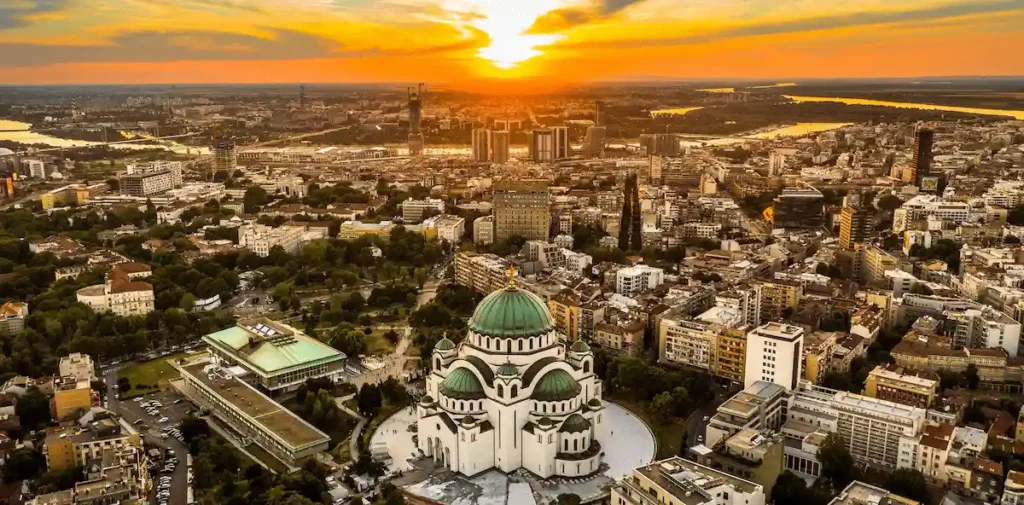
Best historic hotels in Serbia occupy buildings that predate modern hospitality—17th-century military bastions, 1908 insurance palaces clad in Zsolnay ceramics, and 1950s Socialist diplomatic residences that hosted royalty. Yet the majority of travelers default to generic chain properties with fabricated “historic touches” and lobby art that mimics, rather than preserves, the past. The result: rooms that cost premium rates but deliver zero architectural soul.
We audited Serbia’s inventory and rejected every property where “history” was cosmetic. The selection below includes only buildings with verified Past-Life identities—structures where the original facade, vaulted ceilings, or marble staircases remain intact. These aren’t hotels that reference history; they are history. If you want to stay inside a 1692 fortress bastion or sleep beneath original Murano chandeliers installed for Communist leaders, this is your filter.
Fortress Conversions & Danube Bastions
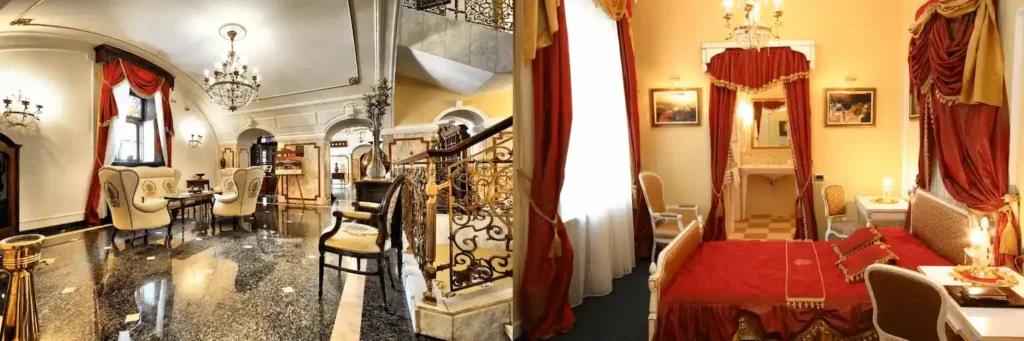
This propertiy occupy military structures built to defend empire borders—now transformed into riverside luxury with original stone walls and vaulted chambers intact.
⚔️ Hotel Leopold I ★★★★
Housed inside the 1692 military headquarters of Petrovaradin Fortress, Hotel Leopold I is the only property in Serbia where guests sleep within a Baroque bastion overlooking the Danube. The original stone walls—two meters thick—anchor every room, and the 18th-century vaulted ceilings remain structurally unaltered. You walk through archways designed for Habsburg officers and wake to the same river view that fortified commanders monitored three centuries ago.
The spa descends into the fortress undercroft, where stone corridors echo with the silence of Novi Sad’s wartime past. No other hotel in the region offers this level of integrated military architecture with modern thermal facilities. This is not a fortress-themed property—it’s an actual Habsburg defense structure converted with surgical precision.
Best for: History-focused travelers seeking authentic 17th-century military architecture with thermal wellness and direct Danube riverfront access.
Signature Experience: Vaulted stone spa in fortress undercroft, Danube-view terrace dining within bastion walls, Habsburg officer quarters reimagined as suites, sunrise access to fortress ramparts before public opening.
“Sleeping inside those fortress walls—you feel the weight of history in every stone.” — Milos, ViennaCheck Availability & Rates →
Art Nouveau & Secession Landmarks: Belgrade’s Elite Interwar Identity
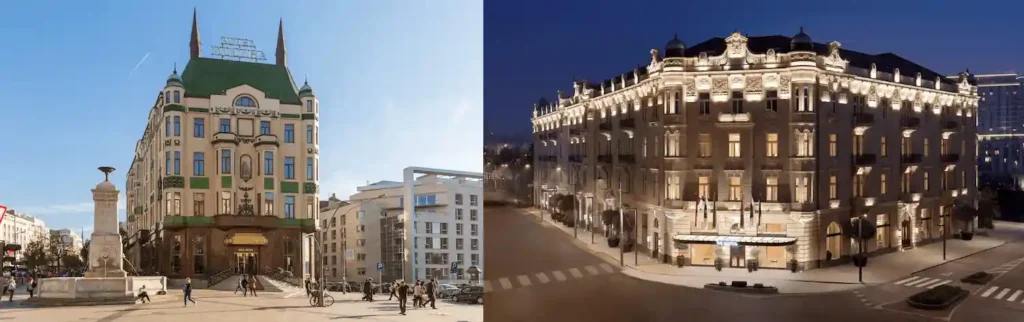
These properties represent Serbia’s pre-WWI and Kingdom-era elite culture—where insurance magnates, diplomats, and Balkan royalty built Secession palaces that defined Belgrade’s architectural golden age.
🏛️ Hotel Moskva ★★★★
Hotel Moskva is the oldest continuously operating hotel in Serbia, built in 1908 as an elite insurance palace and clad entirely in original emerald-green Zsolnay ceramic tiles—the same Hungarian workshop that supplied Budapest’s Parliament. The 1900s grand café layout remains structurally unchanged, with the “Hall of Fame” corridor displaying photographs of world leaders who stayed here—from Einstein to Hitchcock.
You enter through the same Art Nouveau lobby that greeted Balkan aristocracy over a century ago, and the café serves beneath original stained glass that filters light exactly as it did in 1908. The rooms retain high-proportioned windows and period moldings, ensuring that modern comfort doesn’t erase the building’s Secession soul.
No other property in Serbia offers this combination of verified ceramic heritage, continuous operation, and documented diplomatic legacy.
Best for: Architecture enthusiasts seeking Serbia’s most iconic Art Nouveau landmark with documented cultural legacy and central Belgrade positioning.
Signature Experience: Grand café with original 1908 stained glass, Hall of Fame corridor showcasing historic guest photographs, Zsolnay-tiled exterior facade tours, rooms with preserved Secession moldings and high ceilings.
“That emerald ceramic facade at dawn—it glows like something out of Vienna’s golden age.” — Elena, BucharestCheck Availability & Rates →
🏛️ The Bristol Belgrade ★★★★★
The Bristol underwent a massive 2024 restoration that returned the 1912 Secession structure to its original status as Belgrade’s premier social hub. The exterior sculptures and grand marble staircases remain untouched, while the David Rockefeller suite—where the financier stayed during Yugoslavia-era summits—has been preserved as a period-correct homage to 1910s elite proportions.
You ascend through a lobby that retains original stone columns and brass fixtures, entering rooms designed to maintain the building’s interwar spatial volumes rather than fragment them into modern micro-units. The rooftop lounge overlooks Belgrade Fortress with the same panoramic access that made this building a diplomatic landmark. This is the only property in the capital where modern luxury doesn’t compromise the 1910s architectural scale—a rare preservation victory in a city dominated by careless renovations.
Best for: Discerning travelers seeking Serbia’s most meticulously restored Secession palace with modern luxury that respects 1910s architectural proportions.
Signature Experience: David Rockefeller suite with preserved diplomatic interiors, rooftop lounge overlooking Belgrade Fortress, grand marble staircases from 1912, period-style rooms maintaining original spatial volumes.
“The restoration is flawless—it feels like 1912 luxury without sacrificing a single modern comfort.” — Luka, ZagrebCheck Availability & Rates →
🏛️ Palace Hotel ★★★★
Built in 1923 near Belgrade Fortress, Palace Hotel was the Kingdom of Yugoslavia’s elite social anchor—a Neoclassical landmark where the interwar aristocracy gathered beneath original marble pillars and authentic stuccowork. The “Crystal Hall” remains the architectural centerpiece, preserving 1920s interior volumes that most renovations would have fragmented into smaller banquet rooms. You stay in high-ceilinged rooms with original window proportions and period moldings, ensuring the building’s interwar spatial logic remains legible.
The location places you within walking distance of Kalemegdan Park, yet the thick stone walls insulate you from the city’s density. This is the only property in Belgrade where 1920s elite proportions haven’t been sacrificed for modern capacity—a critical distinction for travelers who value architectural integrity over room count.
Best for: Travelers valuing authentic 1920s Neoclassical interiors with proximity to Belgrade Fortress and preserved Kingdom-era spatial elegance.
Signature Experience: Crystal Hall with original 1920s stuccowork, rooms with preserved interwar proportions, marble pillar lobby unchanged since Kingdom era, fortress-adjacent positioning with historic park access.
“Walking into that Crystal Hall—it’s like stepping into Yugoslavia’s aristocratic past, untouched.” — Nikola, LjubljanaCheck Availability & Rates →
🏛️ Envoy Hotel ★★★★
Envoy Hotel occupies a 1929 Art Deco diplomatic residence in Belgrade’s Old City, preserving the original stone facade and high-proportioned window frames that defined interwar elite architecture. The building’s structural footprint remains unaltered, with rooms maintaining the authentic 1920s architectural scale—tall ceilings, wide corridors, and spatial generosity that modern developments can’t replicate.
You stay in the heart of the Old City yet inside a building designed for diplomats who required both central access and residential privacy. The lobby retains original Art Deco proportions, and the exterior stonework shows patina that signals continuous operation since the Kingdom era. This is one of the few properties in Belgrade where Art Deco isn’t a style reference—it’s the building’s verified 1929 DNA.
Best for: Central Old City access within a verified 1929 Art Deco diplomatic residence that preserves interwar architectural proportions and spatial logic.
Signature Experience: Original 1920s stone facade with diplomatic-era patina, high-proportioned rooms maintaining Art Deco spatial scale, lobby with period-correct architectural volumes, Old City positioning without modern density compromise.
“The room proportions feel generous—like staying in a 1920s diplomat’s private residence.” — Ana, SarajevoCheck Availability & Rates →
Neoclassical Landmarks & Modernist Socialist Palaces
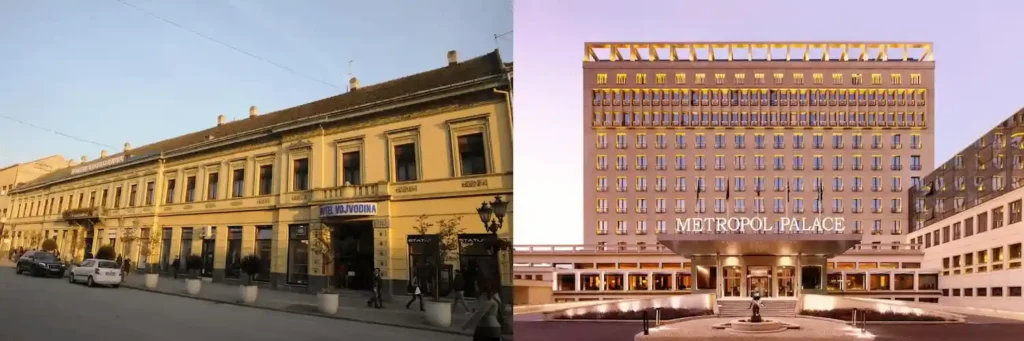
From Novi Sad’s oldest 1854 hotel to Belgrade’s 1957 diplomatic monument—these properties represent the extremes of Serbia’s architectural timeline, unified by their status as verified landmarks with continuous operation.
🏛️ Hotel Vojvodina ★★★★
Hotel Vojvodina is the oldest hotel in Novi Sad, built in 1854 as “The Empress Elizabeth” and operating continuously on the main square ever since. The late-classicist facade remains unchanged, and the authentic 19th-century inner courtyard preserves the original ground-floor spatial configuration that defined Austro-Hungarian urban hospitality.
You stay in a building that hosted travelers when Novi Sad was still an imperial garrison town, with rooms overlooking the same square that Empress Elizabeth’s entourage once crossed. The hotel maintains period-correct window proportions and original courtyard access, ensuring the 1854 footprint remains architecturally legible. This is the only property in Novi Sad where the building’s 19th-century identity hasn’t been fragmented by modern lobby expansions or facade alterations—a rare preservation achievement in a city that has aggressively modernized its historic core.
Best for: Travelers seeking Novi Sad’s oldest continuously operating hotel with verified 1854 Neoclassical architecture and main square positioning.
Signature Experience: Original 19th-century inner courtyard preserved from Empress Elizabeth era, late-classicist facade unchanged since 1854, rooms overlooking Novi Sad’s main square with period window proportions, continuous operation spanning Austro-Hungarian to modern Serbia.
“Staying in the same building that hosted imperial travelers in 1854—it grounds you in the city’s real history.” — Marko, BelgradeCheck Availability & Rates →
🏛️ Metropol Palace, Belgrade ★★★★★
Built in 1957 as a “Socialist Palace” to host Communist heads of state and visiting royalty, Metropol Palace preserves a monumental mid-century wood-inlay panel in the lobby and original Murano glass chandeliers that once illuminated diplomatic summits. The building maintains the 1950s structural symmetry and spatial grandeur that defined Yugoslavia’s effort to project power through architecture.
You stay inside a property where Tito hosted world leaders, with rooms that retain mid-century proportions—high ceilings, wide corridors, and the deliberate lack of clutter that Socialist modernism demanded. The lobby‘s original chandeliers and wood paneling create an atmosphere of diplomatic restraint, a stark contrast to the maximalist luxury that dominates modern five-star renovations.
This is the only property in Belgrade where Socialist-era glamour remains architecturally intact, making it essential for travelers who value mid-century modernist preservation over contemporary design trends.
Best for: Modernist architecture enthusiasts seeking a verified 1950s Socialist diplomatic palace with original Murano chandeliers and mid-century spatial integrity.
Signature Experience: Monumental wood-inlay panel preserved from 1957 state summit era, original Murano glass chandeliers lighting diplomatic lobby, mid-century rooms maintaining Socialist modernist proportions, documented history as Tito’s preferred hosting venue.
“The lobby chandeliers alone are worth the stay—pure mid-century diplomatic elegance.” — Ivana, PragueCheck Availability & Rates →
📊 Comparison: Best Historic Hotels in Serbia
| Hotel | Location | Wellness & Spa | Dining | Unique Perks | Best For |
|---|---|---|---|---|---|
|
⚔️ Hotel Leopold I ★★★★ |
Novi Sad, Petrovaradin Fortress |
Vaulted spa in fortress undercroft |
Danube terrace within bastion walls |
1692 Habsburg bastion Original vaulted ceilings |
Fortress immersion, Danube views |
|
🏛️ Hotel Moskva ★★★★ |
Belgrade, city center |
Wellness lounge with period details |
Grand café with 1908 stained glass |
Original Zsolnay tiles Hall of Fame corridor |
Art Nouveau heritage, cultural legacy |
|
🏛️ The Bristol Belgrade ★★★★★ |
Belgrade, near fortress |
Modern wellness with historic setting |
Rooftop lounge fortress panorama |
David Rockefeller suite 1912 marble staircases |
Meticulously restored Secession luxury |
|
🏛️ Palace Hotel ★★★★ |
Belgrade, fortress proximity |
Spa with original stonework |
Dining beneath 1920s stuccowork |
Crystal Hall preserved Kingdom-era proportions |
1920s Neoclassical authenticity |
❓ FAQ: Best Historic Hotels in Serbia
What defines a historic hotel in Serbia?
A verified historic hotel in Serbia occupies a building with documented architectural significance—17th-century military bastions, 1908 Art Nouveau insurance palaces, or 1957 Socialist diplomatic structures. The original facade, structural elements, or interior volumes must remain intact, not merely referenced through cosmetic restoration. Properties where “history” is decorative rather than structural are excluded.
Which Serbian hotel offers the most authentic fortress experience?
Hotel Leopold I inside Petrovaradin Fortress is the only property where guests sleep within a 1692 Habsburg military bastion. The original two-meter-thick stone walls, 18th-century vaulted ceilings, and fortress spa descending into the undercroft provide an unmatched level of architectural immersion. No other hotel in Serbia integrates military heritage with this precision.
Are Serbia’s historic hotels centrally located?
Hotel Moskva, The Bristol Belgrade, Palace Hotel, and Envoy Hotel all occupy central Belgrade positions near the fortress and Old City. Hotel Leopold I is embedded within Novi Sad’s Petrovaradin Fortress with direct Danube access. Central positioning without architectural compromise is a defining characteristic of these properties—they were built as elite landmarks in their respective city cores.
Which hotel best represents Art Nouveau preservation in Serbia?
Hotel Moskva is Serbia’s most iconic Art Nouveau landmark, clad entirely in original emerald-green Zsolnay ceramic tiles from 1908. The grand café, Hall of Fame corridor, and continuous operation since opening make it the definitive example of preserved Secession architecture in the Balkans. The exterior facade alone justifies its status as a national architectural monument.
Do Serbia’s historic hotels maintain original interiors?
The Bristol Belgrade preserves the David Rockefeller suite with period-correct 1910s proportions. Palace Hotel retains its 1920s Crystal Hall with original stuccowork and marble pillars. Metropol Palace maintains 1957 Murano chandeliers and wood-inlay panels from the Socialist era. Each property balances modern comfort with verified preservation of defining architectural elements from its original construction period.
Which historic hotel in Serbia offers the best wellness facilities?
Hotel Leopold I’s vaulted spa descending into the 17th-century fortress undercroft provides the most architecturally integrated wellness experience. The combination of Habsburg stone chambers, thermal facilities, and Danube terrace access creates a unique fusion of military heritage and modern relaxation. No other property in Serbia offers spa architecture embedded within fortification walls.
What is the oldest continuously operating hotel in Serbia?
Hotel Vojvodina in Novi Sad, built in 1854 as “The Empress Elizabeth,” holds the distinction as the oldest continuously operating hotel in the city. The late-classicist facade and 19th-century inner courtyard remain structurally unchanged, offering a verified link to Austro-Hungarian hospitality traditions that predate modern Serbia by over a century.
Booking Serbia’s Historic Hotels Requires Architectural Clarity
The properties listed above represent the most architecturally significant historic hotels in Serbia—verified conversions where the building’s past life remains structurally and visually intact. These aren’t hotels with historic “themes”; they are historic buildings adapted for contemporary use without erasing their original identity. From 1692 fortress bastions to 1957 Socialist palaces, each property offers a distinct entry point into Serbia’s layered architectural timeline.
Explore additional verified heritage conversions across the Balkans with our curated guide to best historic hotels in Croatia, or discover coastal fortifications and Venetian palaces through our best historic hotels in Montenegro audit.
For more curated itineraries and luxury-focused travel insights, visit Your Luxury Guide. For official travel information and destination updates, visit Serbia tourism-info.
Booking your Serbia hotel unlocks access to the Balkans’ most undervalued architectural conversions—fortress bastions, Art Nouveau insurance palaces, and Socialist diplomatic monuments that define the region’s pre-1990s elite identity.
Your Luxury Guide — Where Exceptional Travel Begins.