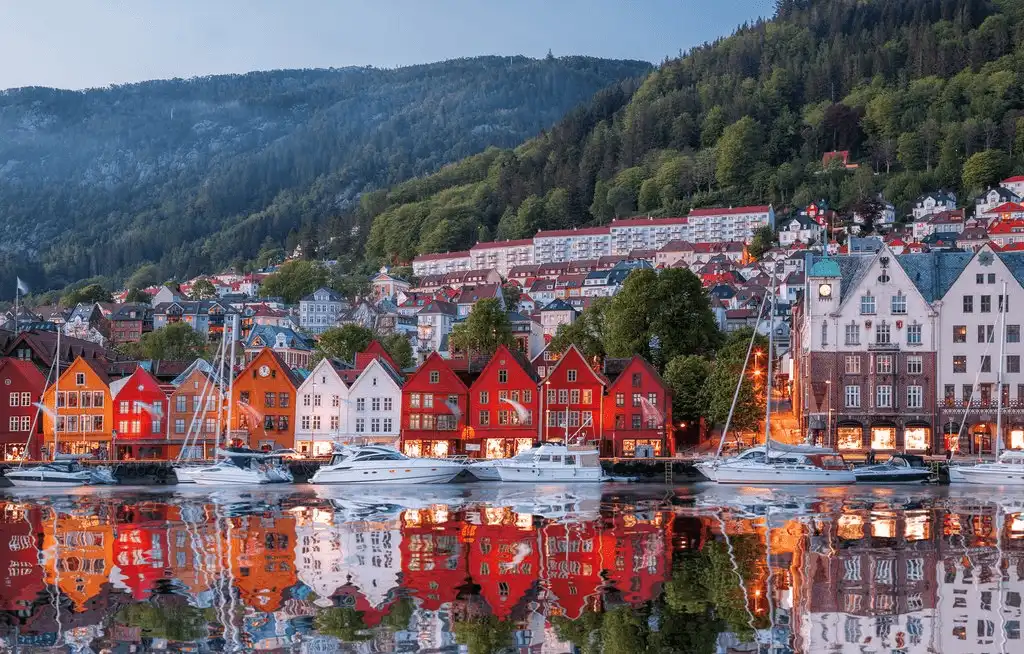
Choosing the best historic hotels in Norway requires understanding that Norway’s architectural heritage differs fundamentally from Continental Europe’s palace-dense capitals. This isn’t a country where former royal residences dominate—it’s a nation where merchant houses, alpine railway hotels, and Art Deco power stations carry the narrative weight.
After auditing Norway’s most significant heritage conversions across Oslo, Bergen, and Trondheim, we identified 15 properties where the building’s original function and architectural integrity remain the primary attraction.
These selections represent Norway’s most authentic historic stays—properties where past-life identity shapes every design decision.
What Qualifies as an Absolute Historical Asset in Norway?
Norway’s historic hotel landscape operates under different architectural rules than Central or Southern Europe. This is not a country built on palace conversions or Renaissance grandeur—Norway’s heritage assets emerge from mercantile power (Hanseatic League warehouses), alpine infrastructure (early-1900s railway hotels), and industrial modernism (Art Deco power stations).
To qualify for inclusion here, a property must demonstrate one or more of these criteria: original function preservation (the building’s past life remains architecturally legible), documented heritage status (protected façades, designated landmark classification, or verified construction dates), and architectural continuity (period details, materials, and spatial logic remain intact rather than cosmetically referenced).
Properties that simply occupy “old buildings” without preserved historical narrative or verifiable architectural significance were excluded. This audit prioritizes buildings where the asset itself—not the interior design overlay—carries the heritage value.
Norway Historic Hotels by Region
🏛️ Oslo: The Capital’s Institutional Heritage Core
Oslo’s historic hotel landscape reflects the city’s dual identity as both a royal capital and a 19th-century merchant power center. Unlike Copenhagen or Stockholm, Oslo’s heritage conversions don’t rely heavily on palace architecture—instead, the city’s most significant properties emerge from grand hotels built to serve Norway’s independence-era elite and continental cultural institutions.
The architectural focus here is neoclassical and early-modern, with properties preserving original public salons, ceremonial staircases, and façade details tied to Norway’s national identity formation.
Grand Hotels & Royal-Era Landmarks
Grand Hotel Oslo (1874 neoclassical grand hotel, ceremonial meeting point for Norwegian independence figures with preserved façades and Nobel Peace Prize banquet history), Hotel Continental (1900 Vienna-style café-hotel with original Jugendstil interiors and documented royal patronage), and Sommerro (1932 Art Deco power station conversion featuring preserved turbine halls and industrial modernist façades).
Grand Hotel Oslo stands as Norway’s most institutionally significant heritage hotel—built in 1874 as Oslo’s first true grand hotel and serving as the ceremonial headquarters for figures central to Norwegian independence. The property’s neoclassical façade and preserved public salons carry a historical narrative no modern hotel can replicate, making it Norway’s equivalent to Vienna’s Imperial or Paris’s Ritz in terms of national symbolic weight.
For travelers seeking Oslo’s most architecturally important heritage stays, explore the full selection in best hotels Oslo.
⚓ Bergen: Hanseatic Merchant Houses & Wharf Heritage
Bergen’s historic hotel identity is inseparable from its Hanseatic League past—the city’s most significant heritage conversions occupy former merchant houses, warehouses, and trading-post structures that defined Bergen’s economic power from the 14th through 19th centuries. These are not palace conversions or aristocratic estates; they are working-class mercantile buildings now preserved as some of Norway’s most atmospherically distinct heritage stays.
The architectural language here is wooden wharf construction, compact room layouts reflecting original merchant quarters, and exposed-beam ceilings that reveal structural honesty rather than decorative flourish.
Hanseatic Wharf Conversions & Trading-Post Hotels
Det Hanseatiske Hotel (1721 Hanseatic merchant house with preserved wharf-side timber construction and original trading-post room configurations), Bergen Børs Hotel (1862 stock exchange building featuring neoclassical façades and preserved ceremonial trading hall), and Hotel Norge by Scandic (1885 grand hotel with documented royal patronage and original belle-époque interiors).
Det Hanseatiske Hotel represents Bergen’s most architecturally authentic Hanseatic conversion—originally built in 1721 as a merchant residence and warehouse, the property retains exposed timber beams, compact room proportions, and wharf-side positioning that make its past life immediately legible. This is heritage preservation as historical narrative, not luxury branding.
For travelers prioritizing Bergen’s most authentic wharf-district heritage, explore the full selection in best hotels Bergen.
🏔️ Trondheim: Royal Ceremonial Heritage & Alpine Railway Landmarks
Trondheim’s historic hotel landscape reflects its dual role as Norway’s medieval coronation city and a key stop on early-1900s alpine railway routes. The city’s most significant heritage conversions include grand hotels built to serve royal ceremonies and continental travelers, alongside adaptive reuse projects that transform historic grain warehouses and bakery buildings into boutique heritage stays.
The architectural focus here is belle-époque ceremonial grandeur mixed with industrial adaptive reuse—properties that preserve original function through spatial planning rather than decorative overlay.
Royal-Era Grand Hotels & Industrial Conversions
Britannia Hotel (1897 belle-époque grand hotel with preserved royal reception halls and original Art Nouveau façades), Best Western Plus Hotel Bakeriet (1863 grain bakery conversion featuring exposed brick and preserved industrial mill infrastructure), and Home Hotel Grand Olav (early-1900s commercial building conversion with period façade restoration and historic city-center positioning).
Britannia Hotel stands as Trondheim’s most ceremonially significant heritage property—built in 1897 to serve Norway’s royal coronations and continental elite, the hotel’s preserved Art Nouveau interiors and documented royal patronage make it the city’s architectural equivalent to Oslo’s Grand Hotel in terms of institutional heritage weight.
For travelers seeking Trondheim’s most historically grounded heritage stays, explore the full selection in best hotels Trondheim.
Fortress Retreats & Royal Manors in Norway
📊 Regional Comparison: Historic Cities in Norway
| Region | Architectural Archetype | Period | Original Function | Signature Detail | Best For |
|---|---|---|---|---|---|
| Oslo | Neoclassical grand hotels, Art Deco conversions |
1870s–1930s | Royal reception hotels, industrial power stations |
Nobel Peace Prize banquet halls, preserved turbine rooms |
Ceremonial heritage, industrial modernism |
| Bergen | Hanseatic merchant houses, wharf-side timber structures |
1720s–1880s | Trading-post warehouses, stock exchange buildings |
Exposed-beam merchant quarters, original wharf positioning |
Mercantile authenticity, UNESCO district stays |
| Trondheim | Belle-époque ceremonial hotels, industrial bakery conversions |
1860s–1900s | Royal coronation hotels, grain mill bakeries |
Art Nouveau royal reception halls, preserved mill infrastructure |
Royal ceremonial heritage, adaptive reuse character |
❓ FAQ: Best Historic Hotels in Norway
What defines a historic hotel in Norway versus other European countries?
Norwegian historic hotels prioritize mercantile and industrial heritage over palace conversions. While Central Europe emphasizes royal residences and Renaissance architecture, Norway’s most significant properties emerge from Hanseatic merchant houses, alpine railway hotels, and Art Deco power stations. Properties like Det Hanseatiske Hotel in Bergen and Sommerro in Oslo demonstrate how Norway’s heritage narrative centers on functional architecture rather than aristocratic grandeur—buildings whose original working-class purpose remains architecturally legible.
Which Norwegian city offers the most architecturally significant historic hotels?
Bergen holds Norway’s densest concentration of verified Hanseatic-era conversions, with properties like Det Hanseatiske Hotel occupying UNESCO-protected wharf districts. Oslo offers the highest institutional heritage weight through grand hotels tied to Norwegian independence and royal ceremonies, including Grand Hotel Oslo’s preserved neoclassical salons. Trondheim provides the strongest alpine railway heritage through belle-époque properties built to serve continental travelers and royal coronation events.
Are Norway’s historic hotels more expensive than modern luxury properties?
Pricing varies by property type and seasonal demand rather than heritage classification. Hanseatic conversions in Bergen often price competitively with modern boutique hotels due to compact room sizes and shared-bathroom configurations in some merchant-house properties. Grand hotels in Oslo command premium rates during Nobel Prize season and royal events, while industrial conversions like Sommerro price comparably to design-forward contemporary hotels. Heritage value doesn’t automatically correlate with higher nightly rates.
What period of Norwegian architecture is most represented in historic hotel conversions?
The 1870s–1930s period dominates Norway’s heritage hotel landscape, reflecting the country’s independence era, Hanseatic trade decline, and early industrial modernism. Grand hotels built for Norway’s 1905 independence celebrations and belle-époque railway expansion remain the most institutionally significant, while Art Deco industrial conversions from the 1920s–1930s represent Norway’s shift toward modernist power infrastructure. Earlier Hanseatic merchant houses (1700s–1800s) survive primarily in Bergen’s protected wharf districts.
How do I verify if a Norwegian hotel’s heritage claims are authentic?
Check for specific past-life documentation: original construction dates, verified building functions (merchant house, stock exchange, power station), and heritage protection status (Riksantikvaren listings, UNESCO district inclusion). Authentic conversions preserve original spatial planning—exposed beams in merchant quarters, turbine halls in power stations, ceremonial staircases in grand hotels. Properties that only reference “historic inspiration” without documented original-use preservation should be treated as modern hotels with heritage-themed interiors.
Which Norwegian historic hotel best represents Hanseatic League architecture?
Det Hanseatiske Hotel in Bergen offers the most architecturally authentic Hanseatic experience—built in 1721 as a merchant residence and warehouse, the property retains exposed timber beams, compact trading-post room configurations, and wharf-side positioning that make its past life immediately legible. The hotel occupies Bergen’s UNESCO-protected Bryggen district, where original Hanseatic building codes and fire-safety regulations still govern structural preservation.
Can I stay in a historic hotel in Norway year-round, or are some seasonal?
Most heritage properties in Oslo, Bergen, and Trondheim operate year-round due to urban positioning and modern infrastructure integration. Alpine railway hotels and rural manor conversions may close during off-peak winter months, though this is less common in Norway than in Southern Europe. Hanseatic wharf-district hotels in Bergen remain open through winter but may reduce service offerings during low-occupancy periods. Always verify seasonal schedules directly with properties before booking shoulder-season dates.
Where Norway’s Architectural Past Remains Present
Booking a historic hotel in Norway means choosing a property where the building’s original function—whether Hanseatic warehouse, royal grand hotel, or Art Deco power station—remains architecturally legible rather than cosmetically referenced.
The selections above represent Norway’s most institutionally significant heritage conversions, properties where past-life identity shapes spatial experience, not just interior design. Availability at UNESCO-protected properties and ceremonial grand hotels shifts quickly during peak royal and Nobel Prize event seasons.
For travelers expanding their Nordic heritage audit beyond Norway, continue with best historic hotels in Sweden for palace conversions and Hanseatic trading posts, or explore best historic hotels in Finland for Art Nouveau merchant houses and archipelago manor estates.
For more curated itineraries and luxury-focused travel insights, visit Your Luxury Guide. For official travel information and destination updates, visit Norway tourism-info.
Booking your stay at Norway’s most significant heritage properties secures access to buildings whose architectural narratives predate modern luxury branding—these are the conversions where history isn’t a theme, it’s the structure itself.
Your Luxury Guide — Where Exceptional Travel Begins.