The best historic hotels in Greece are not found in resort brochures—they exist where Ottoman-era merchant mansions meet Cycladic monastery walls, where Venetian palazzos hide behind neoclassical facades, and where Byzantine fortifications now frame infinity pools overlooking the Aegean. Greece’s architectural legacy is dense, layered, and fiercely protected, but most travelers never access it—they land in generic five-star compounds that could exist anywhere from Dubai to Miami. The problem is overchoice disguised as luxury: sanitized marble lobbies, predictable infinity pools, and interior design that erases centuries of conquest, trade, and craftsmanship.
This audit eliminates that noise. We have filtered Greece’s hotel inventory through a single mandate: verified provenance and physical soul. Every property included here carries a “Past-Life Identity”—a documented architectural conversion from palace, fortress, mansion, or monastery into a functioning luxury asset. This is not a helpful guide. This is a heritage map for travelers who understand that in Greece, the building is the destination.
What Qualifies as a Landmark Asset in Greece?
Not every old building in Greece qualifies as a landmark conversion. A fresh coat of whitewash and a rooftop bar do not constitute heritage. Our audit applies institutional-grade filters: verified age (pre-1950 construction), documented original function (palace, fortress, merchant residence, monastery), protected architectural status (listed building or conservation area designation), and physical integrity (load-bearing walls, original staircases, ceiling frescoes, or masonry details still intact and integrated into guest experience).
The assets that survived are not accidental—they were strategic: defensible positions (Rhodes fortifications), trade hubs (Chania harbor palazzos), aristocratic compounds (Corfu mansions), or religious sanctuaries (Santorini monasteries). Each typology carries specific emotional and spatial signatures that cannot be replicated in new construction.
We rejected properties where “historic” was a marketing claim rather than a structural fact—hotels housed in reconstructed replicas, modern builds with “traditional styling,” or where original elements were confined to lobby display cases while guest rooms defaulted to contemporary minimalism. The properties below passed a single test: the architecture is the amenity. If you remove the frescoed ceiling, the carved marble threshold, or the vaulted stone chamber, the experience collapses. That is the difference between a landmark hotel and a boutique property with antique furniture.
Historic Hotels in Greece by Region
Athens & Thessaloniki: The Imperial & Neoclassical Capitals
Athens and Thessaloniki anchor Greece’s neoclassical and late Ottoman architectural hierarchy—two cities where imperial ambition met Mediterranean light, where 19th-century European salon culture collided with Byzantine trade routes. Athens rebuilt itself as a modern capital after independence, commissioning neoclassical monuments that framed Syntagma Square as a royal theater. Thessaloniki, meanwhile, retained its Ottoman commercial palazzos and converted them into Belle Époque hotels as the city transitioned from empire to republic.
Both cities offer a specific luxury profile: high ceilings, marble staircases, and positioning within walking distance of archaeological and political landmarks. The assets here are not countryside retreats—they are urban landmarks designed to project power, wealth, and access.
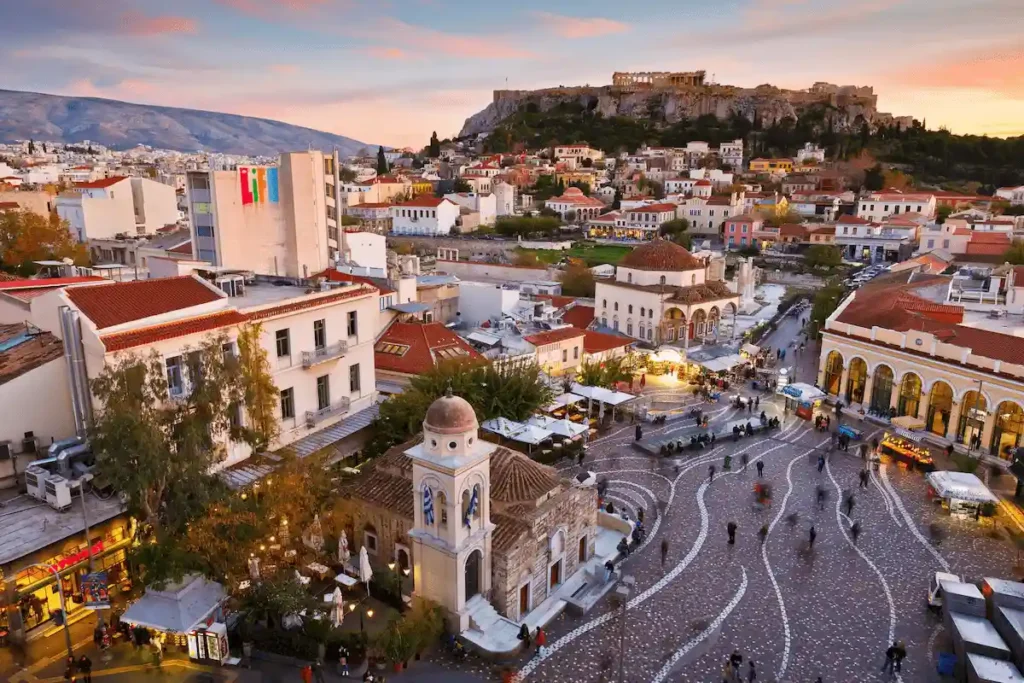
Athens: Grand Hotels & Neoclassical Palaces Facing the Acropolis:
- Hotel Grande Bretagne — The 1874 neoclassical palace where heads of state stay, marble lobby, Acropolis views from rooftop.
- King George — Belle Époque interiors, chandeliers, velvet upholstery, steps from Syntagma, institutional-grade service.
- The Dolli at Acropolis — Restored neoclassical mansion, original frescoes, private terraces, boutique scale with landmark positioning.
Spotlight: Hotel Grande Bretagne remains Athens’ institutional anchor—a neoclassical palace where Winston Churchill survived an assassination attempt, where balconies overlook Syntagma’s political theater, and where original marble floors guide you from lobby to rooftop without a single modern shortcut.
Thessaloniki: Belle Époque Commercial Palaces & Ottoman Merchant Houses:
- IL CONFORMISTA Casa Storica — 1920s Italianate merchant residence, original frescoed ceilings, curated interiors, city center.
- ON Residence — Restored neoclassical mansion, parquet floors, Chesterfield sofas, quiet positioning near Byzantine walls.
- Capsis Bristol Boutique Hotel — Belle Époque façade, Art Deco interiors, historic foyer, walking distance to waterfront.
Spotlight: IL CONFORMISTA Casa Storica occupies a 1920s Italianate merchant house where ceiling frescoes and carved wood details were preserved, not replicated—each room retains original proportions, offering the spatial luxury of pre-war European city living without boutique hotel theatrics.
For the full audit of Thessaloniki‘s Belle Époque and neoclassical merchant houses, discover the best hotels in Thessaloniki.
Rhodes: The Medieval Military Stronghold
Rhodes Old Town is not a historic district—it is a fortified medieval city still enclosed by 4km of stone walls built by the Knights Hospitaller in the 14th century. When these fortifications became obsolete, the interiors were converted into merchant residences, then boutique hotels, retaining the structural bones of medieval Europe’s most complete fortress city. The hotels within these walls offer something no Greek island resort can: enclosed stone courtyards, original vaulted ceilings, and positioning inside a UNESCO-protected military monument. This is not picturesque charm—it is fortress living.
Medieval Townhouses & Knights’ Residences Converted into Boutique Hotels:
- Kókkini Porta Rossa — 15th-century stone townhouse, barrel-vaulted ceilings, original masonry, inner courtyard with Ottoman tiles.
- Spirit Of The Knights Boutique Hotel — Medieval residence, Gothic arches, stone walls, steps from Knights’ Street.
- S.Nikolis’ Historic Boutique Hotel — Restored merchant house, original beams, quiet courtyard, UNESCO zone positioning.
Spotlight: Kókkini Porta Rossa occupies a 15th-century stone townhouse within Rhodes’ fortified walls—guests sleep under barrel-vaulted ceilings built to withstand Ottoman siege cannons, surrounded by walls so thick they regulate temperature without air conditioning, inside Europe’s last complete medieval fortress city.
For the full audit of Rhodes‘ medieval fortifications and Gothic merchant conversions, explore the best hotels in Rhodes.
Chania & Rethymno: The Venetian & Ottoman Palazzos
Chania and Rethymno represent Crete’s dual colonial legacy: Venetian stone palazzos lining harbors built for Mediterranean trade, later absorbed into Ottoman administrative quarters and reconverted into boutique hotels after Greek independence.
These are not countryside villas—they are urban palazzos designed for harbor surveillance and commercial control, now offering waterfront positioning and architectural depth no modern construction can replicate.
Chania: Venetian Harbor Palazzos & Merchant Residences:
- Domus Renier Boutique Hotel — 13th-century Venetian palazzo, Gothic arches, original stone walls, harbor views.
- Casa Delfino Hotel & Spa — 17th-century mansion, Venetian masonry, spa in vaulted cellar, steps from old port.
- Serenissima Boutique Hotel — Renaissance facade, Ottoman interiors, marble courtyard, waterfront positioning.
Spotlight: Domus Renier Boutique Hotel occupies a 13th-century Venetian palazzo where Gothic arches frame Chania’s harbor, where original stone walls and vaulted ceilings survived seven centuries of conquest, and where every window offers surveillance-grade views over the Aegean—architecture built for Venetian admirals, now hosting travelers who understand that in Crete, the palazzo is the amenity.
For the full audit of Chania‘s Venetian palazzos and Ottoman merchant houses, discover the best hotels in Chania.
Rethymno: Ottoman Mansions & Venetian Stone Townhouses:
- Veneto Boutique Hotel — 14th-century Venetian monastery, original stone vaults, marble details, old town center.
- Hamam Oriental Suites — Converted Ottoman bathhouse, original hammam chambers, atmospheric lighting, steps from fortress.
- Avli Lounge Apartments — 16th-century Venetian residence, courtyard dining, Renaissance architecture, UNESCO zone.
Spotlight: Veneto Boutique Hotel was built as a 14th-century Venetian monastery—today, guests sleep in rooms with original stone-vaulted ceilings, dine in a courtyard where monks once walked, and occupy a rare intersection of monastic simplicity and Venetian military precision in Rethymno’s fortified heart.
For the full audit of Rethymno‘s Ottoman bathhouses and Venetian stone conversions, explore the best hotels in Rethymno, Crete.
Corfu Town: The Ionian Aristocratic Hierarchy
Corfu Town was never Turkish—it remained Venetian through the Ottoman era, then passed to French and British control before rejoining Greece. The result is architectural anomaly: Italian arcades, French neoclassical mansions, British cricket grounds, and Venetian fortifications layered into a compact Old Town that feels more Adriatic than Aegean.
The hotels here occupy aristocratic townhouses built for Venetian nobility and British colonial officers—high-ceilinged salons, marble staircases, ironwork balconies overlooking narrow streets. This is not island minimalism; it is European salon luxury in Mediterranean light.
Venetian Aristocratic Mansions & Colonial Officers’ Residences:
- Bella Venezia — Venetian mansion, neoclassical salon, original ironwork balconies, steps from Liston arcades.
- Cavalieri Hotel — 17th-century townhouse, baroque ceilings, rooftop overlooking Old Fortress, institutional scale.
- Siora Vittoria Boutique Hotel — Restored aristocratic residence, marble lobby, Belle Époque details, UNESCO positioning.
Spotlight: Bella Venezia occupies a Venetian mansion where original ironwork balconies overlook Corfu’s arcaded Liston—guests stay in neoclassical salons built for Venetian aristocrats, dine under baroque ceilings, and access the Old Town’s most intact colonial hierarchy without leaving the property’s marble threshold.
For the full audit of Corfu Town‘s Venetian mansions and colonial-era aristocratic conversions, discover the best hotels in Corfu Town.
Santorini & Mykonos Town: Monastic Sites & Cycladic Vernacular
Santorini and Mykonos anchor the Cycladic aesthetic—whitewashed cube houses, volcanic stone terraces, monastery ruins carved into caldera cliffs. But the architecture here is not decorative: it is survival-based. Cycladic vernacular evolved for wind resistance, water scarcity, and pirate defense—thick walls for thermal mass, domed roofs for structural simplicity, cave houses for protection.
The best conversions preserve this logic: hotels built into cliffside caves, former monastery complexes repurposed with infinity pools, traditional captains’ houses where original stone and wood details frame Aegean views. These are not resort compounds—they are architectural responses to extreme landscape conditions now functioning as luxury assets.
Santorini: Monastic Cave Houses & Volcanic Caldera Conversions:
- Aghios Artemios Traditional Houses — 19th-century cave dwellings, original volcanic stone, caldera views, village-center positioning.
- Katikies Garden Santorini — Converted monastery, terraced gardens, Cycladic minimalism, Megalochori village heart.
- The Tsitouras Collection — Captain’s mansion, traditional architecture, infinity pool, museum-grade interiors.
Spotlight: Aghios Artemios Traditional Houses occupy 19th-century cave dwellings carved into Santorini’s volcanic caldera—guests sleep in rooms with original stone walls three feet thick, under barrel-vaulted ceilings that predate tourism, inside the architectural logic that made Cycladic island life survivable before electricity and plumbing arrived.
Mykonos Town: Captains’ Houses & Windmill-Era Vernacular Architecture:
- Mykonos Theoxenia — 1960s modernist landmark, Arne Jacobsen design, waterfront positioning, architectural conservation status.
- Tharroe of Mykonos Boutique Hotel — Traditional captain’s house, original wood beams, stone walls, Chora center.
- Despotiko Hotel — Neoclassical mansion, restored interiors, marble details, quiet Old Town positioning.
Spotlight: Mykonos Theoxenia is not ancient—it is a 1960s modernist landmark designed by Arne Jacobsen, where Danish minimalism met Cycladic light, creating Greece’s only protected mid-century hotel architecture and proving that “historic” is not always medieval when the building carries institutional design authority.
For the full audit of Mykonos Town‘s captains’ houses and mid-century modernist landmarks, explore the best hotels in Mykonos Town.
Peloponnese: The Byzantine, Revolutionary & Industrial Assets
The Peloponnese condenses Greek history into architecture: Byzantine monasteries, Venetian fortresses, Ottoman barracks, and 19th-century neoclassical mansions built after Greek independence. Nafplio served as Greece’s first capital—its hotels occupy revolutionary-era buildings where the modern Greek state was invented. Monemvasia hides Byzantine stone houses inside a medieval fortress carved into a sea cliff.
The region’s conversions are not coastal resorts—they are historical anchors: monastery complexes with frescoed chapels, stone tower houses built for clan defense, and neoclassical mansions where Europe’s philhellenes financed rebellion. This is Greece’s political and military backstory, now inhabitable.
Revolutionary-Era Neoclassical Mansions & Byzantine Fortress Towns:
- Grand Sarai Nafplio — Ottoman-era mansion, neoclassical interiors, frescoed ceilings, former first capital positioning.
- Aetoma Hotel — Byzantine fortress tower, stone walls, Monemvasia cliffside, cave-house extensions.
- Ardamis — 1864 neoclassical residence, original parquet floors, Nafplio Old Town, institutional-grade restoration.
Spotlight: Grand Sarai Nafplio occupies an Ottoman-era mansion later converted into a neoclassical residence during Greece’s revolutionary era—guests stay in rooms with frescoed ceilings and original masonry, inside the city that served as Greece’s first capital, where the architecture itself documents the transition from empire to republic.
For the full audit of the Peloponnese‘s Byzantine fortresses and revolutionary-era neoclassical mansions, discover the best hotels in Peloponnese.
📊 Regional Comparison: Historic Cities in Greece
| Region / City | Architectural Archetype | Period | Original Function | Signature Detail | Best For |
|---|---|---|---|---|---|
| Athens | Neoclassical palaces, Belle Époque hotels |
1870s–1920s | Royal residences, aristocratic salons |
Marble staircases, Acropolis sightlines |
Political landmarks, urban luxury |
| Thessaloniki | Ottoman merchant houses, Belle Époque palazzos |
1890s–1930s | Commercial residences, trading quarters |
Frescoed ceilings, Art Deco foyers |
Byzantine walls, waterfront access |
| Rhodes | Medieval fortifications, Knights’ townhouses |
14th–15th century | Military stronghold, Gothic residences |
Barrel-vaulted ceilings, inner courtyards |
Fortress living, UNESCO walls |
| Chania | Venetian harbor palazzos, Ottoman mansions |
13th–17th century | Trade headquarters, merchant residences |
Gothic arches, harbor surveillance |
Waterfront architecture, colonial layers |
| Rethymno | Venetian monasteries, Ottoman bathhouses |
14th–16th century | Monastic complexes, hammam chambers |
Stone vaults, Renaissance courtyards |
Fortress-town, spa conversions |
| Corfu Town | Venetian aristocratic mansions, colonial residences |
17th–19th century | Noble townhouses, officers’ quarters |
Ironwork balconies, Liston arcades |
European salon culture, Adriatic refinement |
| Santorini | Volcanic cave houses, monastic conversions |
18th–19th century | Monastery complexes, captain dwellings |
Caldera cliffs, domed roofs |
Cycladic minimalism, extreme landscape |
| Mykonos Town | Captains’ houses, modernist landmarks |
18th century / 1960s | Maritime residences, design hotels |
Windmill-era vernacular, mid-century conservation |
Chora center, architectural design |
| Peloponnese | Byzantine fortress towns, revolutionary mansions |
12th century / 1820s–1860s | Clan tower houses, independence-era residences |
Stone fortifications, frescoed political salons |
Greece’s first capital, historical anchors |
❓ FAQ: Best Historic Hotels in Greece
What defines a historic hotel in Greece versus a boutique property with antiques?
A historic hotel in Greece occupies a building with documented pre-1950 construction, protected architectural status, and original structural elements integrated into the guest experience—load-bearing stone walls, vaulted ceilings, frescoed chambers, or Gothic arches. Boutique properties with antique furniture in modern buildings do not qualify. The test is simple: if you remove the historic architecture, does the experience collapse? If yes, it is a landmark conversion. If no, it is interior design.
Are Greece’s historic hotels concentrated in specific regions, or spread across the mainland and islands?
Greece’s historic hotel inventory follows colonial and trade routes: Venetian fortifications and merchant palazzos dominate Crete (Chania, Rethymno) and Rhodes; neoclassical palaces cluster in Athens and the first capital, Nafplio; Ottoman-era merchant houses define Thessaloniki; Cycladic cave conversions concentrate in Santorini; and Venetian-British aristocratic mansions are exclusive to Corfu Town. Each region offers a distinct architectural typology tied to military, commercial, or colonial control.
Can I stay inside UNESCO World Heritage Sites in Greece?
Yes. Rhodes Old Town (medieval fortress), Corfu Town (Venetian-British layering), and parts of Chania’s harbor quarter are UNESCO-protected zones where hotels occupy original fortifications, palazzos, and aristocratic residences. Staying inside these zones provides immersive access to architectural assets that cannot be replicated—fortress walls, Gothic merchant houses, and Venetian harbor surveillance positions now functioning as boutique hotels.
Do historic hotels in Greece retain original features, or are they reconstructed replicas?
The properties included in this audit passed structural integrity tests: original stone walls, vaulted ceilings, frescoed chambers, Gothic arches, or monastery courtyards must be integrated into guest rooms and common areas, not confined to lobbies. We excluded hotels where “historic” is a facade treatment or where interiors default to contemporary minimalism. The architecture is the amenity—if it was rebuilt from scratch, it is not included here.
Are Santorini’s cave hotels authentic historical conversions, or modern constructions styled to look traditional?
Authentic Cycladic cave houses were carved into volcanic caldera cliffs in the 18th and 19th centuries for thermal mass, wind resistance, and pirate defense. Many of Santorini’s “cave hotels” are modern constructions mimicking this style. The properties listed here occupy verified pre-1950 cave dwellings or converted monastery complexes with original stone walls, barrel-vaulted ceilings, and documented architectural provenance—not themed replicas.
What is the difference between a Venetian palazzo in Crete and a neoclassical mansion in Athens?
Venetian palazzos (13th–17th century) were built as harbor-facing trade headquarters with Gothic arches, stone courtyards, and defensive positioning—military-commercial architecture later absorbed into Ottoman quarters. Neoclassical mansions in Athens (1870s–1920s) were post-independence constructions designed for royal and aristocratic display: marble staircases, high ceilings, and Acropolis sightlines. Both are luxury conversions, but the first is fortress-derived, the second is salon-derived. Choose based on whether you want colonial defense or European grandeur.
How do I choose between Athens’ grand hotels and a boutique conversion in Corfu or Rhodes?
Athens’ grand hotels (Hotel Grande Bretagne, King George) offer institutional-scale neoclassical architecture with Acropolis proximity and political gravitas—designed for heads of state and high-profile positioning. Boutique conversions in Corfu or Rhodes occupy smaller-scale aristocratic mansions or medieval townhouses with intimate courtyards, UNESCO fortress walls, and quieter Old Town positioning. Choose Athens for urban monumentality and landmark density; choose Corfu or Rhodes for colonial intimacy and fortress living.
Why These Properties Define Greece’s Historic Hotel Hierarchy
The hotels and cities audited above were not chosen for comfort or amenities—they were selected because they occupy Greece’s most significant architectural conversions. Every property passed the same filter: documented provenance, structural integrity, and the institutional authority of a building that shaped the political, military, or commercial landscape before it became a hotel.
The experience is not about thread count or breakfast spreads—it is about sleeping inside a 14th-century Venetian palazzo where harbor surveillance once dictated Mediterranean trade routes, or waking under barrel-vaulted ceilings built to withstand Ottoman siege cannons.
Greece’s overcrowded hotel market rewards generic luxury: infinity pools, minimalist interiors, and “five-star” labels that erase centuries of conquest and craftsmanship. The properties in this audit reject that model. They preserve spatial logic—fortress courtyards, neoclassical salons, monastic chambers—that modern construction cannot replicate. This is not nostalgia. It is architectural access: the ability to inhabit buildings that documented empires, revolutions, and trade networks before tourism existed.
If you are mapping Greece’s historic hotel landscape beyond a single city, begin with our broader regional audit of the best historic hotels in Turkey, which shares Venetian-Ottoman architectural parallels, or compare Greece’s Adriatic coastal palazzos to the Venetian conversions detailed in the best historic hotels in Croatia.
For more curated itineraries and luxury-focused travel insights, visit Your Luxury Guide. For official travel information and destination updates, visit Greece tourism-info.
Booking a stay at one of Greece’s landmark conversions places you inside the architecture that defined Mediterranean power—fortress walls, harbor palazzos, and neoclassical salons where the physical structure carries more authority than any amenity list ever could.
Your Luxury Guide — Where Exceptional Travel Begins.