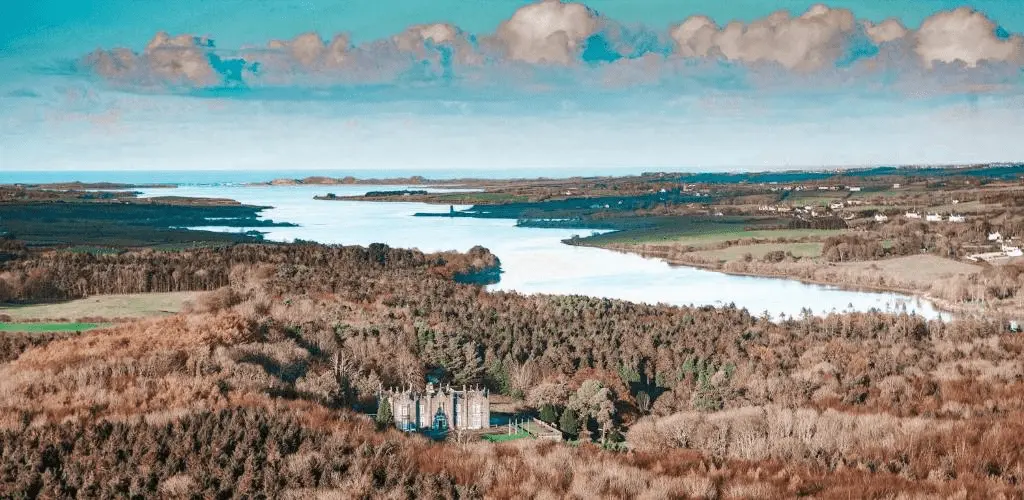
Built in 1831 as the private seat of Sir Arthur Edward Knox, Belleek Castle represents the territorial command of Victorian Ireland’s landed gentry. The Gothic Revival fortress, positioned on the River Moy’s strategic banks, functioned as the administrative center for one of County Mayo’s most influential estates.
Today, the four-star property preserves the baronial architecture that defined 19th-century Irish power structures—from the oak-paneled Great Hall to the fortified corner towers that announce dominance over 1,000 acres of heritage woodland. This is not accommodation; this is occupation of a seat of historic territorial authority.
Belleek Castle, Ballina ★★★★
Sir Arthur Edward Knox commissioned Belleek Castle as the architectural manifestation of his family’s control over Mayo’s western territories. The 1831 Gothic Revival structure—designed with defensive turrets, crenellated battlements, and 3-foot limestone walls—was engineered to project permanence. The Knox family’s residence functioned as the region’s judicial and social nucleus for over a century, hosting visiting magistrates, military officers, and Anglo-Irish aristocracy within its baronial interiors.
Belleek Castle weaponizes 19th-century Neo-Gothic architecture into a high-density stronghold of baronial prestige.
The castle’s spatial authority remains intact. The entrance hall, supported by hammerbeam trusses and medieval-style archways, leads to the Great Hall—a 40-foot ceremonial space where the Knox family exercised social command. Original Victorian fireplaces, carved oak paneling, and heraldic shields establish the room’s function as a seat of territorial influence. The drawing rooms retain their period cornicing and window configurations, designed to survey the estate’s approach roads and river boundaries.
Guest accommodations occupy the castle’s original residential quarters and tower extensions. The Tower Suites—positioned in the fortress’s corner bastions—feature exposed stonework, arched windows, and elevated vantage points over the Moy Valley. Standard rooms maintain Victorian proportions with 12-foot ceilings, period moldings, and en-suite bathrooms integrated into historic footprints. The castle’s 1,000-acre grounds preserve the Knox family’s designed landscape: woodland trails, walled gardens, and river frontage that once defined estate boundaries.
The property’s dining operation utilizes the original baronial kitchens and service quarters. The restaurant occupies interconnected Victorian rooms where family dinners and estate gatherings established social hierarchies. Modern culinary service operates within infrastructure built to support 19th-century household scale—vaulted ceilings, stone archways, and service corridors that maintain the separation between public and private castle zones.
Belleek Castle’s conversion to hospitality does not diminish its architectural authority. The Knox family’s Gothic Revival fortress remains a documented example of Victorian territorial design—a structure engineered to announce, defend, and perpetuate landed power across County Mayo’s western estates.
Check Availability & Rates →Belleek Castle preserves the Gothic Revival fortress architecture that established Victorian Ireland’s territorial command—1831 limestone battlements, baronial halls, and tower vantage points where guests occupy the Knox family’s seat of Mayo estate authority.
FAQ: Belleek Castle, Ballina
What is the historical significance of Belleek Castle?
Belleek Castle was constructed in 1831 as the private Gothic Revival fortress of Sir Arthur Edward Knox, serving as the administrative and social headquarters for one of County Mayo’s most influential landed estates. The baronial structure functioned as the Knox family’s territorial seat for over a century, hosting magistrates, military officers, and Anglo-Irish society within its fortified limestone architecture.
What room types are available at Belleek Castle?
The castle offers Tower Suites positioned in original corner bastions with exposed stonework and elevated Moy Valley views, alongside standard rooms occupying Victorian residential quarters. All accommodations maintain period architectural features including 12-foot ceilings, Gothic Revival windows, and en-suite facilities integrated into historic footprints.
What grounds and facilities does Belleek Castle offer?
The property preserves the Knox family’s original 1,000-acre estate landscape, including heritage woodland trails, walled gardens, and River Moy frontage. The castle’s baronial interiors house dining operations in Victorian service quarters and gathering spaces within the 40-foot Great Hall and oak-paneled drawing rooms.
Where is Belleek Castle located in County Mayo?
Belleek Castle stands 3 miles from Ballina town center on the River Moy’s strategic banks, positioned to command views across the estate’s western approaches. The fortress occupies the historic Knox family territorial seat within Mayo’s coastal lowlands, maintaining original boundary woodland and river access points.
From Victorian Stronghold to Heritage Residence
Belleek Castle delivers the Gothic Revival fortress experience without compromise—1831 limestone battlements, baronial halls, and tower accommodations that preserve the Knox family’s territorial architecture. The four-star property maintains the defensive scale and ceremonial spaces that defined Victorian Ireland’s landed elite, offering guests occupation of documented historic authority.
Those seeking Irish castle heritage beyond County Mayo, Lough Eske Castle in Donegal and Cabra Castle Hotel in Cavan present alternative baronial estates with equally preserved lineages of territorial command.
For more curated itineraries and luxury-focused travel insights, visit Your Luxury Guide. For official travel information and destination updates, visit Ireland tourism-info.
Your Luxury Guide — Where Exceptional Travel Begins.