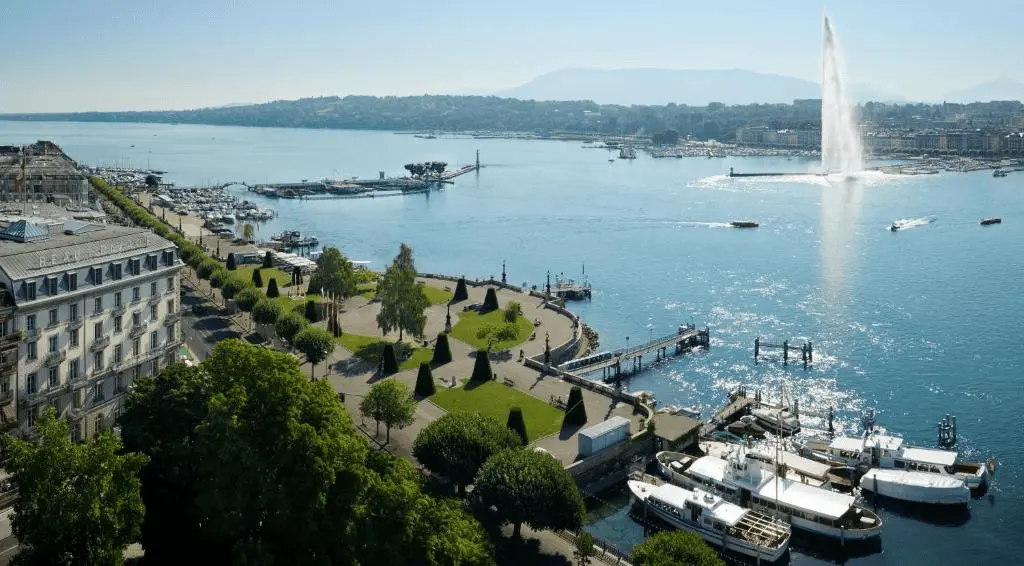
Beau-Rivage Genève is not a hotel—it is a theater of consequence. Founded in 1865 by Jean-Jacques Mayer, this lakefront fortress witnessed the signing of Czechoslovakia’s founding treaty in 1918, the assassination of Empress Elisabeth of Austria in 1898, and Eleanor Roosevelt drafting the Universal Declaration of Human Rights within its salons. Still family-owned, it installed Switzerland’s first elevator in 1873 and pioneered gas lighting across Geneva. This is where influence was exercised, treaties were sealed, and global power resided.
For those seeking proximity to history’s command centers, explore the best historic hotels in Geneva.
Beau-Rivage Genève ★★★★★
The Beau-Rivage Genève commands Lake Geneva’s shore with the authority of an institution that shaped modern Europe. Built in 1865, this is not a renovated palace pretending at grandeur—it is the original seat where empires negotiated, monarchs died, and nations were forged. The hotel introduced Switzerland’s first elevator in 1873, a technological statement that signaled Geneva’s emergence as a center of continental power.
While other properties claim “historic charm,” Beau-Rivage offers documented proof: the 1918 treaty that created Czechoslovakia was signed in its salons, not in a government building, but here—because this was where decisions of consequence occurred.
Beau-Rivage Genève is a legendary lakefront palace famously known as the site of Empress Sissi’s final moments and the birthplace of the Czechoslovakian state.
The Sissi Suite is not a marketing fabrication. Empress Elisabeth of Austria—”Sissi”—was stabbed by an anarchist outside the hotel in 1898 and died within her suite. The rooms are preserved as a memorial, a reminder that proximity to power has always carried risk. This is the caliber of legacy you inhabit.
Eleanor Roosevelt resided here while drafting the Universal Declaration of Human Rights, treating the Beau-Rivage as her operational headquarters, not a temporary lodging. The Duke of Brunswick died within these walls in 1873, leaving Geneva 20 million gold francs—a bequest that built the Grand Théâtre. The hotel didn’t just host wealth; it redistributed it, shaping the city’s cultural infrastructure.
The architecture reflects Neo-Classical command: grand marble columns, restored frescoes, and crystal chandeliers that survived a 2010 renovation designed to preserve, not erase, the building’s 19th-century dominance.
The six Penthouse Suites, each up to 190 square meters, feature glass ceilings for night-sky observation—an architectural decision that mirrors the astronomical ambitions of Geneva’s scientific elite. These are not “luxury accommodations”; they are private observatories with integrated spas, hammams, saunas, and whirlpools that eliminate the need to share facilities with transient guests.
Le Chat Botté, the hotel’s Michelin-starred restaurant, occupies the ground floor—not as an amenity, but as a continuation of the salon tradition where Wagner, Jean Cocteau, and Albert Schweitzer dined. The menu is contemporary French, executed with the precision expected of an establishment that once fed the architects of modern Europe.
The Maharadja Suite, spanning 105 square meters, offers 180-degree lake views and is designed as an homage to India’s Golden Age—a deliberate acknowledgment of the hotel’s role as a meeting point for global aristocracy. The Saint-Exupéry Suite, named after the Little Prince author, reinforces the property’s literary lineage, a space where words carried the weight of philosophy, not entertainment.
The GeniLac cooling system—drawing water from 45 meters beneath Lake Geneva—is not an eco-friendly gesture but a strategic infrastructure decision that ensures the building operates with the same technological foresight that installed Switzerland’s first elevator 150 years ago.
The wellness floor functions as a private clinic, offering bespoke therapies in a dedicated environment designed for those who view health as a competitive advantage, not a spa day. The 1987 auction of the Duchess of Windsor’s jewelry collection occurred here, not at Sotheby’s headquarters, because the Beau-Rivage was the appropriate venue for assets of that magnitude.
This is the hotel where power convened, where royalty expired, and where treaties that redrew maps were executed. You are not staying in a historic building—you are occupying a command post.
Check Availability & Rates →The Beau-Rivage does not offer history as decoration—it offers residency in the very salons where empires negotiated their survival. This is not heritage; this is inherited dominance.
FAQ: Beau-Rivage Genève
What historical significance does Beau-Rivage Genève hold?
Beau-Rivage Genève was the site where the 1918 treaty creating Czechoslovakia was signed, where Empress Elisabeth of Austria died in 1898 after being assassinated, and where Eleanor Roosevelt drafted portions of the Universal Declaration of Human Rights. The Duke of Brunswick died at the hotel in 1873, bequeathing 20 million gold francs to Geneva, funding the Grand Théâtre. It is a documented seat of political and cultural authority.
What makes Beau-Rivage Genève architecturally unique?
Founded in 1865, the hotel installed Switzerland’s first elevator in 1873 and was the first in Geneva to feature gas lighting. Its Neo-Classical facade, restored in 2010, preserves original marble columns, frescoes, and crystal chandeliers. The six Penthouse Suites include glass ceilings and private spas with hammams, saunas, and whirlpools, eliminating shared facilities.
Who are some notable guests who have stayed at Beau-Rivage Genève?
The hotel has hosted Empress Elisabeth of Austria, Eleanor Roosevelt, Albert Schweitzer, Richard Wagner, Jean Cocteau, Angelina Jolie, and Elizabeth Taylor. It also served as the venue for the 1987 Sotheby’s auction of the Duchess of Windsor’s jewelry collection, marking its role as a site for high-value transactions.
What are the key amenities at Beau-Rivage Genève?
Le Chat Botté, the hotel’s Michelin-starred restaurant, offers contemporary French cuisine. The wellness floor provides bespoke therapies in a private clinic-style setting. The GeniLac system uses water from 45 meters beneath Lake Geneva for sustainable cooling. Penthouse Suites feature private spas, and the property operates with the technological foresight established in 1873.
Where Command Still Resides
The Beau-Rivage Genève does not compete with other luxury hotels—it predates the category. This is the original lakefront fortress where treaties were signed, monarchs died, and global elites convened.
For those seeking similar institutional authority, the Four Seasons Hotel des Bergues Geneva occupies a former private bank, and the Ritz-Carlton Hotel de la Paix Geneva anchors the city’s financial district. But none replicate the Beau-Rivage’s unbroken lineage as the salon where history unfolded, not where it is remembered.
For more curated itineraries and luxury-focused travel insights, visit Your Luxury Guide. For official travel information and destination updates, visit Switzerland tourism-info.
Your Luxury Guide — Where Exceptional Travel Begins.