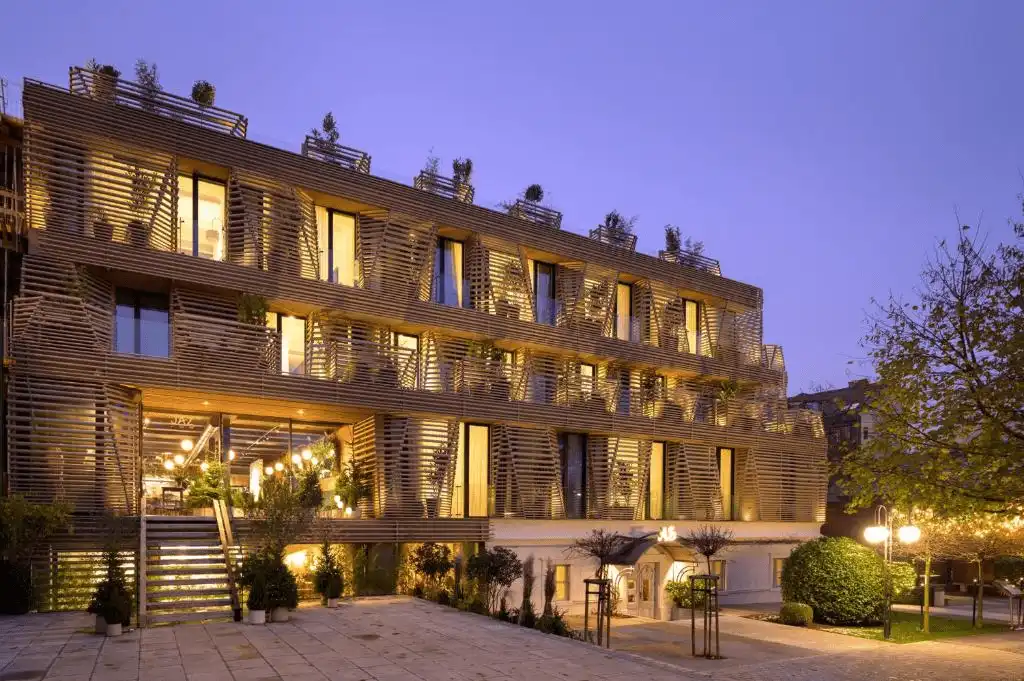
AS Boutique Hotel stands at the convergence of Ljubljana’s shopping arcade and hidden courtyard gardens, wrapped in a signature facade by OFIS Architects. The vertical larch slats filter Mediterranean light into a building constructed atop a 19th-century merchant house—the original home of the city’s pioneering fine-dining establishment.
The rooftop terrace overlooks Ljubljana Castle and the Franciscan Church‘s rose-colored walls, offering open-air Jacuzzi access from spring through autumn. Breakfast is served at Jaz by Ana Roš, where the focus shifts from buffet conventions to à la carte experimentation with Slovenian ingredients. For those seeking the capital’s most compelling hotels in Ljubljana, this property demonstrates how 19th-century foundations support 21st-century innovation.
AS Boutique Hotel ★★★★
The hotel occupies two entrances: one through Knafelj Passage’s commercial arcade, the other through a courtyard garden that functions as a buffer between medieval Ljubljana and the property’s modernist interior. OFIS Architects designed the timber screen facade using Slovenian larch—134 vertical slats that shift shadow patterns throughout the day and provide privacy without closing off natural light. The structure rises from the basement and ground floor of the original 19th-century townhouse that housed the AS Restaurant, established by the Raspopović family when Mediterranean cuisine was still unfamiliar in post-Yugoslav Slovenia.
AS Boutique Hotel is a daring contemporary landmark that offers guests the rare privilege of residing within a high-design architectural masterpiece, blending the 30-year culinary sovereignty of Gostilna AS with a youthful, ‘no-rules’ dining experience curated by the world-renowned Ana Roš.
Each of the hotel’s rooms features electrochromic smart glass in the bathrooms—technology that switches from transparent to opaque with a wall switch, maintaining open-plan light flow while offering instant privacy. Interior designer Janja Bulc sourced vintage furniture individually for each space: mirrored rose-gold panels, custom geometric carpets, and striped chaises-longues that contrast with the building’s minimalist architecture. The walls function as rotating gallery space for Slovenian contemporary artists, meaning the visual environment changes seasonally.
The rooftop sun deck provides direct views of Ljubljana Castle’s medieval ramparts and the Franciscan Church’s salmon-pink facade. A Jacuzzi operates from March through October, surrounded by black-and-white striped parasols and lounge furniture positioned for afternoon sun. During evening hours, the space transitions into an aperitivo setting with controlled lighting and background music that shifts the atmosphere from daytime relaxation to social gathering.
Breakfast is served at Jaz, Ana Roš’s bistro located on the ground floor. Roš—whose primary restaurant Hiša Franko holds three Michelin stars—designed Jaz as an experimental space where leftover sourdough becomes components of savory dishes and seasonal ingredients are presented without formal plating conventions. The staff uniforms, designed by Matea Benedetti, feature botanical prints that reference the bistro’s jasmine theme, creating visual continuity between service and setting.
The property demonstrates how historic building foundations—in this case, a 19th-century merchant house basement—can support contemporary architectural ambition without erasing the original structure’s material evidence. The larch facade filters light into stone-walled lower floors, while smart glass and vintage furniture create private environments within an open-plan layout. The result is a building where historic preservation and modern utility function as complementary strategies rather than competing priorities.
Check Availability & Rates →AS Boutique Hotel operates where architectural innovation meets historic continuity—vertical larch screening filters Mediterranean light into 19th-century foundations, while smart glass technology and rotating art installations create spaces that function as both private residence and public gallery.
FAQ: AS Boutique Hotel
What makes AS Boutique Hotel architecturally significant?
The hotel features a facade designed by internationally recognized OFIS Architects, consisting of 134 vertical Slovenian larch slats that create dynamic shadow patterns while filtering natural light. The structure is built atop a 19th-century merchant house, preserving the original basement and ground floor while adding contemporary architectural elements above.
Who operates the breakfast restaurant at AS Boutique Hotel?
Jaz, the ground-floor bistro, is operated under the creative direction of Ana Roš, whose primary restaurant Hiša Franko holds three Michelin stars. The breakfast menu focuses on seasonal Slovenian ingredients presented through experimental plating and preparation methods rather than traditional buffet formats.
What amenities are available on the rooftop?
The rooftop sun deck includes a Jacuzzi (operational March through October), lounge furniture positioned for castle views, and black-and-white striped parasols. The space provides direct sightlines to Ljubljana Castle’s medieval walls and the Franciscan Church’s rose-colored facade.
How does the smart glass technology work in the rooms?
The bathrooms feature electrochromic glass walls that switch from transparent to opaque via a wall-mounted control. This allows the rooms to maintain open-plan light flow and spatial continuity while providing instant privacy when needed—combining visual openness with functional discretion.
Where Historic Foundations Meet Contemporary Innovation
AS Boutique Hotel demonstrates how 19th-century architectural footprints can support 21st-century design ambition without compromising either historic integrity or modern functionality. The building’s dual-entrance strategy, timber-screened facade, and rooftop views establish it as a property where spatial innovation and material preservation operate as complementary forces rather than opposing design philosophies.
Guests drawn to Ljubljana’s architectural evolution will find further context in properties like Zlata Ladjica Boutique Hotel, where Baroque streetscapes frame contemporary interior design, and Grand Hotel Union Eurostars, where Art Nouveau heritage defines the city’s early 20th-century luxury hospitality legacy.
For more curated itineraries and luxury-focused travel insights, visit Your Luxury Guide. For official travel information and destination updates, visit Slovenia tourism.
Your Luxury Guide — Where Exceptional Travel Begins.